
#On the City That Keeps Too Many Bones
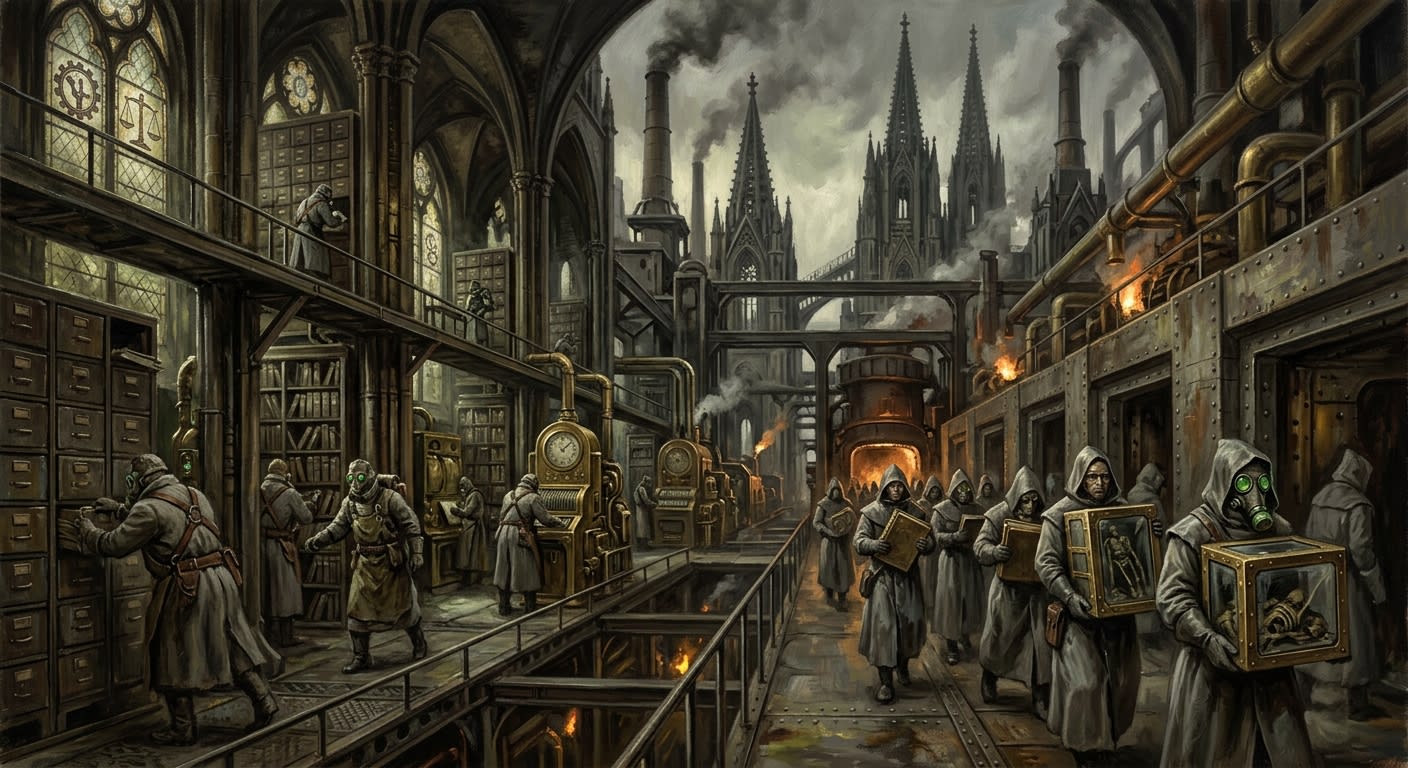
Cologne sits on the Rhine as a cathedral-city, archive-bank, vault-finance hub, minting throat, relic cupboard, and ecclesiastical trap. Other cities possess histories. Cologne possesses receipts. Every stone in its cathedral precinct has been sworn over, mortgaged, kissed, disputed, redacted, and entered into a ledger whose clerk died before finishing the column and was replaced before he cooled.
The city is Zone 2 Heartlands: safe, prosperous, guarded, watched, and so saturated with administrative consequence that a citizen may cross three jurisdictions buying a loaf. It is the Rhine basin's counterweight to Strasbourg, a second sacred centre whose obedience has always required louder seals because it remembers, with irritating accuracy, that it was holy before the Synod learned to spell itself.
Its great cathedral, the Cathedral of the Holy Column, rises above the river like an argument won by height. The faithful call it Strasbourg's counterpart. The Bureau calls it a subordinate radiance. The local chapter smiles at that phrase and continues counting pilgrims. Beneath its vaults lie sealed minutes, relic inventories, diocesan bonds, and enough contested bone to bankrupt a lesser theology.
#On the Two Councils and the Habit of Obedience
Cologne's first great contribution to Synodic history was failure. The First Council of Cologne met in A.S. 27, in the western chapter chamber of the cathedral precinct, with bishops frightened by Rationalist ascent and still vain enough to confuse fright with independence. Thirty-seven delegates attended by official count. Forty-one chairs appear in the seating diagram. Thirty-nine names survive in the hospitality ledger. The city has fed on that discrepancy for almost two centuries.
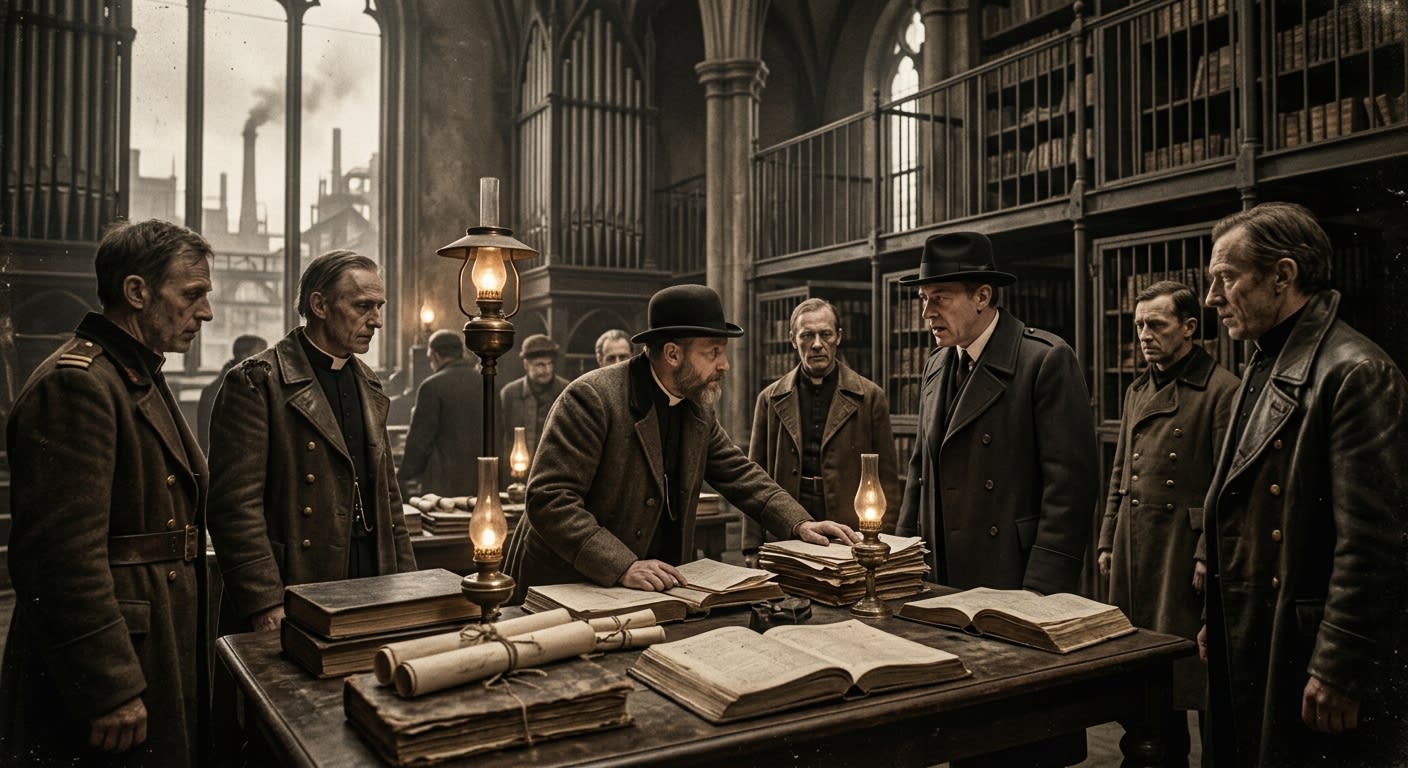
No Concordat resulted. None of the seven articles passed. Augustinus attended as an ordinary nineteen-year-old auxiliary; Kratz, also nineteen, copied under secretary Breitner. Discrepancies in the minutes were corrected before reliance. Cologne authorized limited voluntary contacts and separate custodial consent; later writers made this narrower result into the prologue of a constitution.
The later Council of Cologne in A.S. 100 extended the formal settlement. Ten years after the Concordat of Strasbourg, successor officials convened beneath the Cathedral of the Holy Column. Kratz had died in A.S. 88; his earlier papers could be invoked, but he could not convene the gathering. Half the minutes were blacked out before they dried. The Edict of Cologne claimed to bind parishes from the Baltic to the Tagus beneath Strasbourg's hand. Pilgrimage became annexation. Procession became title deed. A relic carried three times through a gate could do what an army did more messily.
Provincial school primers once described Cologne as “the birthplace of Synodic consensus.”
Corrected. Consensus implies gathered willingness. Cologne produced recorded willingness. The difference is the difference between a congregation singing and a choir-master entering “sung” beside the names of men still clearing their throats.
The cathedral chapter has never forgotten its role. Strasbourg has never permitted it to remember too loudly. This tension gives Cologne its civic temperature: warm incense above, cold ink below.
#On the Cathedral of the Holy Column
The Cathedral of the Holy Column is less a church than a vertical archive with altars attached. Its nave has hosted councils, relic trials, annulments, deposition hearings, bone processions, currency blessings, tribunal masses, and at least four events now officially classified as architectural misunderstanding. The central column, from which the cathedral takes its sanctified title, is said to contain stone from seven older churches and one Rationalist lecture hall. The lecture hall stone was inserted facing inward so that its heresy might spend eternity staring at masonry.
The western chapter rooms preserve the memory of the A.S. 27 convocation. The Great Chamber preserves the A.S. 100 yoking. The Reliquary Galleries preserve Saint Aldebrand's femurs, which is where anatomy stops being helpful and doctrine begins earning its dinner.
Seventeen femurs of Saint Aldebrand are held in Cologne's cathedral custody, each notarized, each authenticated, each sole and genuine, each resting in a reliquary whose label declines to acknowledge the others. Pilgrims approach them in sequence. The official liturgy refers to the “Seventeenfold Testimony of the One Bone.” The Bureau of Medicine lodged an objection in A.S. 147. The objection was classified under Presumption of Competence and sent to the wrong office forever.
The femurs are not Cologne's only relics, merely its most notorious. The cathedral vaults hold tibiae of martyrs from Saint-Malo, chain links from Avignon, candle stubs from the Year Without Dawn, and one sealed coffer marked ONLY OPEN IF COLOGNE CEASES TO EXIST. The local custodians claim not to know what lies inside. This is probably true. Custodians live longer when ignorance is properly maintained.
#On Money, Faces, and Sable Court
South of the cathedral precinct lies the restricted mint quarter known as the Crownwright Diehouses of Sable Court, where the Synod strikes identity into metal and calls the bruise currency. Cologne did not become a vault-finance hub because it loved money. It became one because the Synod discovered that a city with relics, councils, and engravers could make law portable.
The Bureau of Records keeps archive-banks here: institutions that lend against provenance, pledge against future tithe receipts, and store sealed copies of identity concordances behind vault doors thick enough to reassure cowards. The Mint-Chapter uses Crownwright hands to cut faces into dies. The dies become coins. The coins carry names. The names carry accounts. Bread sellers in Sable Court require assay slips for change; marriage contracts sometimes specify coin-face validity; widows have been known to keep their dead husbands' faces in locked drawers and argue with priests over whether circulation constitutes mourning.
This is Cologne's genius: it makes metaphysics liquid without admitting liquidity. Sanctity passes through reliquaries. Authority passes through minutes. Identity passes through coin. All three pass through counters, grilles, clerks, and men with keys who deny enjoying the sound.
The Face Theft crisis of A.S. 199 began in Sable Court and spread unease through the outer districts. Coins changed faces. Merchants forgot customers mid-sale. The Mint-Chapter ordered recalls across seventeen denominations, an unfortunate number in a city already burdened with seventeen femurs. The people noticed. People always notice arithmetic when fear is doing the counting.
BUREAU OF PURITY — COLOGNE SUB-REGISTRY Subject: Relationship between Aldebrand femur-count and Sable Court seventeen-denomination recall. Finding: █████████████████████████████████████████████████ Action: all numerological speculation forbidden unless performed by licensed Doctrine staff in windowless rooms.
#On Confession, Kiosks, and the Rhine Manner
Cologne invented the confessor-kiosk precedent, though three Bureaus dispute the word invented and two dispute Cologne. The practice began as crowd management during high relic seasons. Pilgrims arrived in quantities that clogged the cathedral close and fouled the alleys. The chapter installed small screened booths along processional routes so penitents could confess without entering the main nave. Efficient, discreet, profitable. Three qualities that guarantee eventual Synod adoption.
By A.S. 112, the kiosks had become civic furniture. By A.S. 134, they carried oath-slots, tithe apertures, and small side drawers for denunciations. By A.S. 160, the Bureau of Purity had stationed listeners behind every third screen, which produced an immediate improvement in public morality and a corresponding decline in interesting conversation.
Older Cologne tourist sheets call the confessor-kiosks “devotional conveniences.”
Corrected. A convenience serves the penitent. A Cologne kiosk serves the priest, the clerk, the auditor, the informer, the queue marshal, and occasionally God, when scheduling allows.
The Rhine manner of confession is brisk. Cologne citizens confess like merchants settling invoices: item, date, witness, aggravating circumstance, requested penance, proposed discount. Rural pilgrims find this shocking. The Bureau finds it admirable. The soul, once itemized, becomes far easier to misplace.
#On the City's Quarters
Cologne divides itself by function more than by parish, though the parishes pretend otherwise.
The Cathedral Precinct holds the Holy Column, council chambers, relic galleries, chapter houses, and the Processional Square where pilgrim lines are sorted by origin, purity status, and likelihood of fainting. The square's paving stones bear embedded brass numerals. Kneel on the wrong numeral and a clerk will correct you before the Creator has time to mind.
The Archive-Bank Rows run north toward the river: tall houses with barred windows, slate roofs, and sub-basements full of wax-sealed folios. Families deposit wills, dowries, confession abstracts, face plates, relic claims, and letters they wish their descendants never to read. Descendants pay handsomely to read them anyway.
The Sable Court Quarter smokes to the south: mint walls, annealing stacks, mirrored windows, wardens above, workers below, coins between. It is restricted on paper and porous in practice, like every forbidden thing that must employ twenty-eight thousand people to keep functioning.
The Rhine Quays are Cologne's throat. Barges bring pilgrims, bullion, bones, salt, paper, and rumours upriver. The harbour clerks classify cargo with admirable speed unless the cargo smells holy, in which case they slow down, summon Relics, summon Records, summon Doctrine, and invoice the barge for spiritual obstruction.
The Kiosk Lanes coil around the cathedral approach. Screens, grilles, narrow benches, priest-doors, clerk-doors, denunciation slots, candle niches, and little iron bells no one admits ringing. At night the lanes sound like whispered arithmetic.
#On the Present Condition
As of A.S. 201, Cologne is loyal, watched, wealthy, holy, vain, and correct in enough of its vanity to be intolerable. The Face Theft investigation continues in Sable Court. The cathedral custodians continue filing annual glow reports for all seventeen Aldebrand femurs. The archive-banks continue lending against sealed memory. The confessor-kiosks continue receiving sins at a rate that impresses even Strasbourg. The Rhine continues carrying barges past the quays as if water has not read a single decree.
Cologne's danger to the Synod is not disobedience. Disobedience would simplify matters. Cologne's danger is precedent. The city remembers that Kratz learned there; that councils could fail usefully there; that the Edict which bound Europe required Cologne's chamber, Cologne's bones, Cologne's signatures, Cologne's black ink. Strasbourg commands. Cologne remembers the day command borrowed a room.
The bells of the Holy Column sound six times at Vespers. The Sable Court presses answer in iron. The kiosks fill. The femurs glow or do not glow according to a schedule no Bureau has successfully imposed.