
#On the Hour That Was Stolen
The Night of Borrowed Curfew occurred in Cologne, in A.S. 134 according to the Bureau of Bells, in A.S. 136 according to the Bureau of Records, and in no year at all according to the Bureau of War, which classified the matter as “Pending Classification” and retreated behind its own filing cabinet like a captain behind a mule.
The Bureau of Bells is correct. Records is orderly. War is embarrassed.
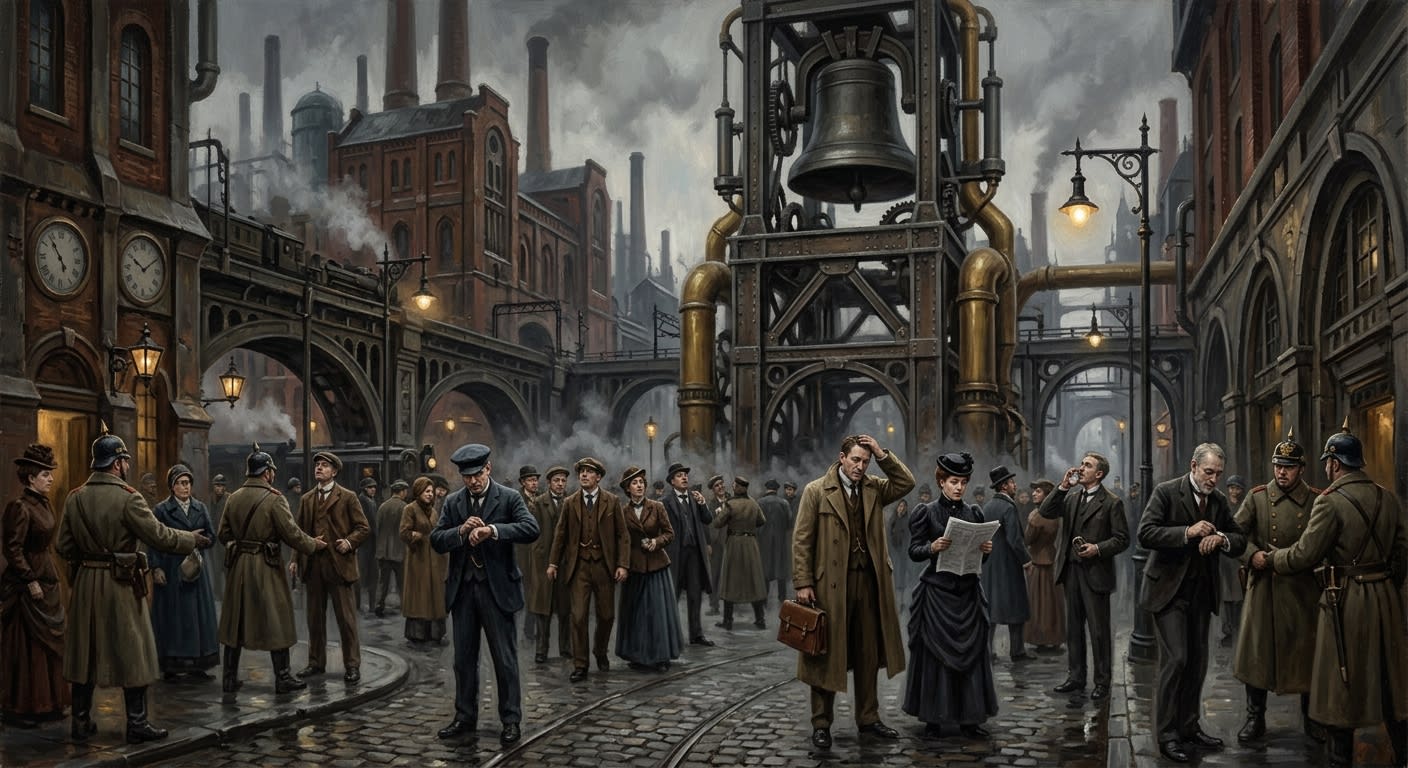
A foreign peal entered Cologne's bell-grid and rang curfew three hours early. The city obeyed. Doors locked. Streets emptied. Market stalls shuttered with the prompt little panic of merchants who know that curfew violations cost more than bread. The garrison stood down. Patrol routes collapsed into barracks discipline. Chapel doors barred. Tavern lamps died. The city became, with perfect civic efficiency, a prepared corridor.
Into that corridor something moved.
#On Cologne's Obedience
Cologne was an excellent victim because Cologne was well governed. This fact irritates reformers, sentimentalists, and other loose-bottomed readers who prefer disasters to require visible negligence. The city heard curfew. The city obeyed. That obedience, drilled through years of Ninth Bell enforcement, bellway correction, parish timing, gatehouse rhythm, and household fear, performed exactly as purchased.
A bad city would have hesitated. A rebellious city would have argued. Cologne locked itself.
The streets were swept clean by law. Bakers banked ovens. Archive clerks sealed drawers. Bank-vault porters lowered grille chains. Lantern wardens crossed routes off their slates and went indoors because the bell had spoken, and the bell is older than appetite, commerce, grief, and the private suspicion that one has just heard the wrong hour.
The first reports mention no scream. That absence has been quoted by fools as proof of exaggeration. I have read enough sealed casualty abstracts to know silence is often the first accurate witness. The foreign peal did not attack Cologne's walls, towers, gates, arsenals, bridges, vaults, or granaries. It attacked sequence. It made the city perform tomorrow's fear at today's hour.
Sound is a schedule with teeth.
#On the Peal
The peal's source remains unknown. Bureau of Bells notation boards record an origin outside the licensed grid, entering through no recognised bellway corridor, bearing no sanctioned church signature, no Bell Codex cadence, no registered foundry voice, no known rebel chime-mark, no Pale Chanter overtone, and no foreign polity's declared acoustic hand.
That last point has been made much of in diplomatic circles, where men are paid to treat ignorance as etiquette.
Early pamphlets attributed the peal to Rationalist remnant agents operating from an abandoned tower east of the Rhine.
Withdrawn. No such tower was found. The pamphlets were pulped, their authors fined for premature certainty, and the theory retained in a sealed appendix because even false explanations can be useful if properly indexed.
Some Bell auditors believed the peal was rung from inside Cologne's own grid. This possibility was denounced, then investigated, then denounced again with better punctuation. Three minor towers were dismantled stone by stone. Their bells were recast under supervision. One recast bell reportedly rang curfew at noon during cooling. The foundry master denied hearing it. His apprentices denied hearing him deny it.
BUREAU OF BELLS FIELD NOTE — COLOGNE, CURFEW AFTERMATH Tower inspection team entered Saint Aldegund Sub-Belfry (Unregistered). Clock hands fixed at Ninth Bell. Rope moving without wind. Bell unstruck; sound present in teeth. Inspector K—— wrote: “It is still ringing, but backwards.” Entry sealed under acoustic contamination.
#On What Moved
The casualty report is sealed. The number is in the hundreds. Anyone claiming a precise figure is either a liar, a clerk of unusual clearance, or a liar who has slept with such a clerk.
The bodies, where bodies were available, presented no single grammar. Some were found indoors behind locked doors. Some were discovered in alleys swept clean of footprints except their own. Several households were recorded as “absent with furniture undisturbed,” which is Records' way of confessing that a family has vanished without giving the filing system the courtesy of remains. One garrison squad was found seated in order by rank, hands folded, throats bruised from the inside. The squad ledger had been signed for the next morning's watch.
Bureau of Engineering assessed structural damage. Bureau of Rites assessed spiritual contamination. Their reports agreed on one point: the breach did not require broken stone. The foreign bell borrowed obedience, and obedience opened every civic lock worth opening.
This is why the event frightened Strasbourg more than a riot. Riots flatter authority. A riot says command has failed and must be restored. Cologne said command could be spoken in the enemy's voice and still be obeyed.
#On the Three Dates
Bells filed the Night in A.S. 134 because its inspectors reached Cologne first and because a Bureau that governs time cannot afford to be late inside its own archive. Records filed it in A.S. 136 after a two-year reconciliation of casualty sheets, repair invoices, witness withdrawals, bell-metal requisitions, and burial allowances. War refused a date because War's units had stood down when told, and the report would have required someone to write that sentence without choking.
The contradiction is not a flaw. It is a cabinet. Each Bureau opens the drawer that preserves its authority. Bells owns the wound. Records owns the paperwork. War owns the locked drawer nobody dusts.
A previous instructional abstract harmonised the dates as “A.S. 135, approximate.”
Rejected. Approximation is a coward's peace. The dispute is doctrinally valuable and will be preserved.
#On the Answer
Master-Carillonist Aldo Venn later reduced the incident to its proper cruelty. Asked whether Cologne could have been prevented, he tapped his tuning fork against the desk — long, short, long — and answered: “Prevented, no. Answered, yes.”
That sentence became the conscience of a new profession.
Within the year, the Counter-Toll Corps was chartered under Canon Veyl “Iron Throat”. Veyl's doctrine had the moral delicacy of a furnace shovel: when a foreign bell rings, ring louder. When a hostile tone enters a corridor, flood the corridor with sanctioned bronze. When citizens panic, thank the Creator they are panicking under the right authority.
Soft Drown, Hard Dominance, Full Wash — those are Cologne's children. Every Counter-Toll vault is a monument to that emptied street.
The first training maxim following the charter reads: “Do not negotiate with noise.” The second reads: “If it rings wrong, ring it dead.” A marginal hand, sometimes attributed to Veyl, added: “Count later.” The marginal hand has never been authenticated. It has also never been removed.
#On the Present Scar
Cologne remembers badly, which is to say usefully. Later troubles — the Cologne Schism, Lantern disputes, Mercy Preacher arrangements, archive-bank panics — all pass through the old curfew scar. The city has learned to mistrust obedience for roughly half a heartbeat before obeying anyway. That half-heartbeat is treasured by civic romanticists as resilience. The Bureau classifies it as timing drift.
The affected districts still over-lock at Ninth Bell. Households set two bolts where one would do. Tavern keepers count shutters aloud. Children in certain wards play a game called False Curfew, in which one child rings a spoon against a pipe and the others run indoors. The Bureau of Festivals has declined to license the game. The children continue, showing the usual childish preference for accuracy over permission.