
#On the Mouths
"Don't breathe where the stone is sweet." — Candle-Sump saying, distributed free of charge, which makes it the only free thing in the district
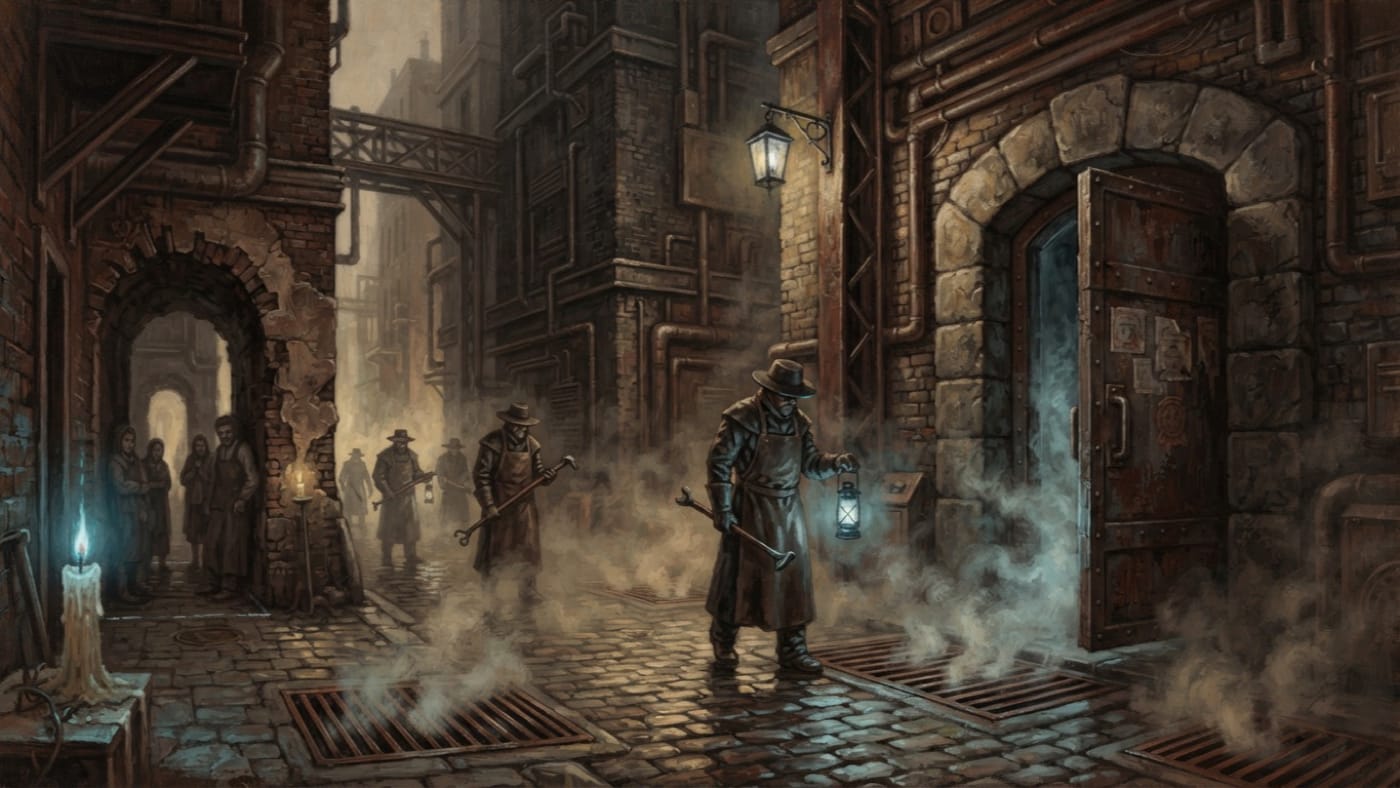
The Crypt Mouths are one of the eight named wards of Candle-Sump. They lie in the lowest and wettest quarter of Lower Vire, where the river turns on its inner bend, in the western River-belt and deep inside the safe heartland of Zone 1. The ward consists of vent alleys and sealed doors, and the doors are the only reason it has a name. Elsewhere in the Sump the cellars hold water. Here they hold the dead.
The ground beneath belongs to an older parish than ours. Before the Sundering of A.S. 45, this bend of the Vire housed a riverside shrine district with burial lanes and crypt routes cut below it. No surviving record gives the year of their digging or the year the first door was closed on them. The Bureau of Records files the congregants as "pre-doctrinal population, unrecoverable." In this ward that heading is a forecast at best.
Above ground, the materials are those of the whole district: soot brick, bone-lime cement, rust-iron grates, and tallow-wax dripped into every joint a candle has ever stood near. The stone stays cold to the hand. The air does not. Warm updrafts rise through the grates from the underworks, and fog gathers around the heat as fog gathers around a censer, thickest where the draw is strongest. The ward smells of cold stone and sweet rot. The residents distinguish the two the way a sacristan distinguishes old incense from a fire in the vestry.
Underneath lie underworks ladders, forgotten tag vaults, and catacomb pockets recorded as collapsed. No surveyed plan of the routes has reached my desk. I decline to draw one.
Crypt Mouth 3 is the ward's best-known address: a vent alley of cold stone and sweet rot, a known site of rot-lung exposure, and a door the district record describes as sealed that is not sealed. The record does not explain the contradiction. It simply files the door under both conditions at once.
#On the Wardens and the Seals
The vents are kept by the Crypt-Mouth Wardens. Publicly they are a maintenance crew: they clear the grates, keep the shafts drawing, and keep the alleys free of the obstructions that a district of forty-two thousand registered souls deposits wherever it can. They carry keys, masks, and maps. They work at night, and they work in silence. The district record calls them "erased-but-used." That is no Bureau formula, and no Bureau would set it in its own hand. I have no roster to give the reader, no captain's name, and no founding warrant. The phrase is all the roster there is.
Three bodies in the Sump wear the language of guarding, and the reader must not mistake them for one another. The Sluice Wardens carry rust keys and waterproof capes and check permits at the gates on Prefect Sera Mott's authority. The Quarantine Provosts carry ribbon shears and answer jointly to the Sluice Prefecture and the Bureau of Purity. The Crypt-Mouth Wardens share a noun with the first and a ward with the second. No document I have handled puts either body over them.
Their stated duty is to keep the underworks sealed. The district record adds the clause the duty omits: sealed, or selectively open. Who does the selecting is unwritten. When the draft turns sweet, which the alleys call vent-sweet, the Wardens take it as their omen and move. Residents take it as a reason to stop breathing through the nose.
At curfew the floodwall gates narrow, the Crypt Mouth zones go silent, and the mouths breathe louder. Opening a sealed crypt mouth after curfew is one of the Sump's red lines, ranked with moving an untagged body and falsifying a quarantine ribbon. The penalty is total. The district does not believe in partial punishment for any of the three.
The Candle-Sump assessment describes "the Crypt Mouths, where sealed doors lead to underworks the Bureau insists do not function as corridors," and elsewhere states that "the Synod sealed the crypt mouths."
The same assessment records that tunnels marked "collapsed" on Prefecture maps are maintained, that a registry operates in them, and that the Wardens keep passages sealed or open on instruction. Crypt Mouth 3 has a door that is sealed and not sealed. The door seals survive in places; the routes behind them are open to traffic. Nor can the original sealing be credited to the Synod. No record dates it, and the Synod did not exist in its constitutional form until A.S. 90. The attribution is retrospective, and it is withdrawn.
#On the Drafts
Air rises from the underworks through the vent alleys and the maintenance shafts. It carries rot-spores. It also carries what the residents call name-whispers: faint sounds in the draft that resemble syllables, then names, then the opening of a confession nobody solicited. Near the vents, paper fuzzes at the edges and ink bleeds. Coughing worsens at particular corners, always the same corners, and generations of Sump dwellers have learned them as a choirboy learns which stalls creak.
Candles gutter near the mouths, and they gutter in patterns that resemble letters. Some are reported to burn blue. The blue-burn flame is called a cold blue, and I enter that as a colour and nothing more, because no survey has measured its heat and the warm updrafts continue to rise past the cold stone regardless. The local rule is attributed to no one and observed by everyone: "If your candle burns blue, don't say your name that night." No record establishes what happens to those who say it. The Sump has declined to run the experiment.
The reader should weigh the reports with care. The Wickmarket sells counterfeit blue-burn candles. The Quarantine Provosts act on blue-burn reports, and residents have learned to file such reports when they want a neighbour gone. A reported flame is a filed document. Nobody has shown how many of the filings describe real flames.
Rot-lung is endemic to the district and concentrated wherever the drafts meet paper. The Sluice Prefecture numbers its stages: productive cough, blood-flecked sputum, paper sensitivity, and what its handbook calls "terminal administrative transfer." Clerks and paper workers suffer first and worst. The Bone-Tag Arcade knows which side of its counter faces the vents.
In A.S. 194 the Bureau of Purity classified the draft complex as a Category Two Localized Atmospheric-Scribal Disturbance. As of A.S. 201 the classification remains pending review. A field notation of the Bureau of Alchemical Standards carries the same designation. Three survey teams were sent, and their reports agreed only that the phenomenon continued. The notation recommends a further survey. Its additional notes are marked as removed by the Sluice Prefecture.
Additional Notes: [PAGE REMOVED BY SLUICE PREFECTURE]
Category Two attaches to the disturbance. AMBER attaches to the district. Neither confers a separate rating on Crypt Mouth 3, on the Wardens, or on blue-burn, and I will not invent one to tidy the file.
Paper is protected by vinegar baths and wax-sealed folders, which keep documents legible longer. Bodies are protected, in the residents' account, by salt lines laid around the vents and by bone beads worn at the throat. The district record's own verdict on these measures is that they help "sometimes." I have no better figure. The Bureau of Doctrine has certified no cure, and no rite of proven effect.
#On the Names Below
The parent assessment has already disclosed the matter, so I repeat it without ceremony. The underworks are maintained, and the sealing is a description of certain doors.
Under the mouths, in tunnels the Prefecture's maps call "collapsed," a shadow registry operates. Names harvested from the drafts are transcribed onto fresh paper and passed upward through the Washhouse into the legitimate bone-tag channels of the Bone-Tag Registry, and from there toward the Great Ledger. The clean slips that result are better than street forgery. Their seals are accurate, their ink is regulation, and their paper matches the Registry's own stock. A forger who had to beg for these materials would be caught at the first counter. These were never begged for.
Each party draws a different benefit. Chief Clerk Dalen Voss's Registry gains control: a supply of names it can issue, withhold, or recall. The Washhouse gains profit. Prefect Sera Mott's Sluice Prefecture commands the sluice timings and flood releases, and through them the airflow at the crypt mouths, and through that, at a gloved remove, the flow of names. An unknown hand works in the underworks below all three. Its identity, allegiance, and purpose are unrecorded. So is the means by which names enter the drafts at all.
Doctrine has made no ruling on what the whispers are. Surviving souls, the Great Deceiver's handiwork, an echo the shrine district's stone keeps the way old vellum keeps a scraped text: each has its advocates in the alleys, and none has a seal. I can certify only that the names come up, that someone writes them down, and that the ink is good.
Nor should the reader assume that every Warden who turns a key knows what passes behind it. A crew paid to keep a vent drawing need know nothing of what the draught carries. Nothing in the record says how many of them know.
#On the Present Condition
As of the A.S. 201 assessment, blue-burn reports are rising and so is rot-lung. The Registry and the Prefecture are disputing ownership of seized clean slips, each claiming the stockpile as evidence and neither disclosing what it is evidence of. The Care crews have threatened to strike if rations are cut again. Matron Ilka controls the broth, and so the labour of the whole district, the vent crews included, continues at her pleasure. The Washhouse is planning a mass identity swap with slip stock it claims to have sourced from below. The plan has not been carried out. The Washhouse has also not abandoned it.
A transfer order for Inquisitor Halvyr, called White-Lung, is moving through the Bureau of Purity's approval chain. Halvyr carries a portable audit press and burn authority. When the order clears, the Crypt Mouths will receive the attention the survey teams recommended and the Prefecture removed. Which door Halvyr opens first, and in which hour, is a matter for a later entry. I note only that a man with burn authority is coming to a ward where opening a door after curfew is a red line, and I do not yet know which of the two will have to give way.
The review of A.S. 194 remains pending. The Wardens are still at work. The draft still rises.