
#On Their Nature
"Crooked chanters whose curses lay invisible chains upon foes, forcing them to stumble and bow." — Bureau troop classification of Velmora's field host
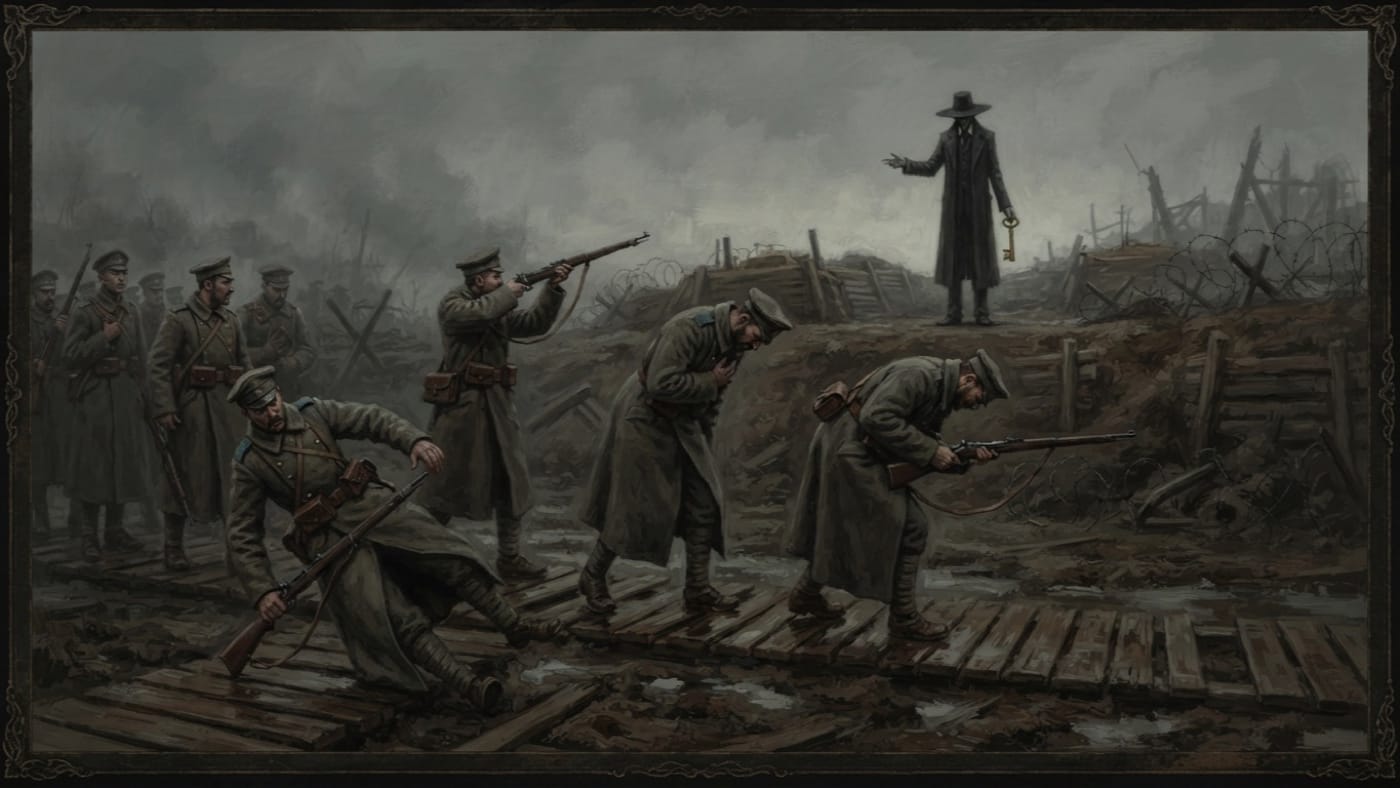
A soldier usually first learns of a Debt-Binder through his own knee. He is advancing at the trot with his rifle at the port when the knee folds, and he goes down on the duckboards in a posture the chaplains find uncomfortably close to obeisance. Somewhere behind the enemy line, beyond easy range, a crooked figure is muttering.
The Debt-Binders are the support chanters of Velmora's field host. They stand behind the Gilded Sentinels and the Gem-Eyed Archers much as a notary stands behind a bailiff. The troop classification calls them crooked. Witnesses agree on that much. Their accounts of height, gait and face vary with the witness, the distance and the fog.
The Bureau's knowledge of the class rests on three supports: symptoms observed on the battlefield, a single reconstruction from the Transylvanian highlands, and a captive taken at Bastion-Sibiu in A.S. 194. The captive matters most because it could be held. Whatever a Debt-Binder is, it has a body that rope restrains and fire reduces. No file I have examined records its origin, any former humanity, or its numbers, and I will not fill those gaps with invention.
#On the Inverse Litany
"Their curses lay chains upon the body that the body cannot feel." — Codex entry on Velmora
The Bureau of Doctrine calls the Debt-Binders' cadence the Inverse Litany. The name identifies a sound and nothing more. Doctrine holds no transcription, no notation and no agreed language for it. The clerks sent to the forward wire to listen came back with a count of stresses and a complaint about their ears. I print no specimen. Anyone who offers you one is selling it.
Field reports describe the effect in stages. The first is the stumble: a boot lands short, a step meets ground that is not there, and a man in good order goes down on flat earth. The second is the bow. Spines incline and heads lower, and a firing line bends at the waist as if a magistrate had entered the trench. The gravest reports concern the third stage. A soldier tries to raise his sword or rifle against Velmora's host and his arm will not obey. Until that moment he felt nothing. He finds the restraint only when he tries to use the limb.
Doctrine's word for this is repossession: the arm has been repossessed. I report the word as Doctrine's. The soldier reports an arm that will not rise. Doctrine adds a creditor. The Bureau's own teaching requires the reader to keep those two statements apart. No demon compels a human choice in Synod territory, and no pact, however venomous, removes a man's power to choose differently. The soldier keeps his will. The record cannot yet say whether he keeps his arm.
The range of the curse, its duration, how its targets are chosen, and whether a man must have signed anything first are all open matters in the file. They will stay open until someone measures them under fire and comes back.
Earlier editions of this Codex identified Velmora's primary sorcery as "cursed coinage."
The Velmora entry carries the correction: the classification is Contract Theurgy. I repeat it here for a practical reason. A soldier who thinks the danger lives in coins will empty his pockets before facing a Debt-Binder and believe himself protected. No record shows that the Inverse Litany needs anything from his purse.
#On Generous Terms
"The loans are generous. The terms are clear. The collateral is always the same." — Bureau of Purity, Internal Report
The Sibiu garrison keeps a woodcut reconstructed from witness accounts of A.S. 194. A figure, too tall for the room, sits across a rough table from a highland farmer. It wears a frock coat and a top hat. It offers a large brass key beside an open contract, with an inkwell and quill between them. This is one reconstruction of one appearance. The Bureau has not concluded that Debt-Binders share a uniform, nor that a lending variety of the class exists. It has concluded, correctly, that one of them was seen at that table.
The table belongs to the Ten Thousand Keys. The cult lends in the villages between the passes and the bastion, where harvests fail with alpine regularity. The loans are useful. The grain arrives, the seed corn is replaced and the roof is mended before snow. The repayment schedule is manageable. The farmer receives a brass key cut for no lock he owns, and he signs in an ink that dries the colour of old blood. The Sibiu file calls the key collateral even though the woodcut shows it passing to the borrower. The record does not explain how both can be true, and I will not invent a conveyancing procedure for Hell. Purity has burned six hundred of these contracts. Tithes has confiscated fourteen hundred keys.
The farmer could instead apply for Synod relief. That takes six weeks, three Bureaus and a theological examination. His grain ran out this week.
The farmer is a debtor, which the Bureau does not classify as demonic. Lending is not a sin either; the Bureau of Tithes lends, at rates I am not authorised to describe. The cult's human ranks are fixed at five: Debtors, Creditors, Assessors, Ledger-Keepers and Inheritors. The Debt-Binder is not a sixth rank. Assessors appraise and Ledger-Keepers record. The Debt-Binder chants, and at least once it sat at the table. The file does not show whether every highland loan has one in attendance, or whether its chant needs a signature to act on.
#On the Sibiu Record
"It offered to settle out of court." — Bastion-Sibiu garrison account, A.S. 194
All the published accounts agree on the following. In A.S. 194 a Debt-Binder was captured at the Sibiu perimeter. It spoke fluent Synodal Latin. It offered to settle out of court. The Bureau of Purity burned it on the spot. The ashes arranged themselves into a receipt. The Sibiu entry adds that the receipt was itemised and that the total was correct.
Purity answered a settlement offer with a brazier. I concede that this is a form of counter-proposal. No tribunal has recognised the receipt, nobody is recorded as bound by it, and no report has the creature reassembling. The bookkeeping survived the bookkeeper. It is the most competent document Purity has ever produced, and Purity had no hand in writing it.
That same season, the Avarice Engine stood for eleven minutes on the Predeal ridge and every unpaid chit in the Market Ring fluttered eastward. The two events share a season. The file establishes no other connection between them.
A second account must be set beside the first. The Vault of Ten Thousand Keys entry records a Debt-Binder captured near Sibiu in A.S. 194 that gave testimony under sustained interrogation until its mouth filled with coins. The Sibiu account burns its captive on the spot. The record does not say whether these describe one captive or two, and I have not combined them to make the file tidier.
#On the Vault Testimony
The five levels of the Vault come from Debt-Binder testimony: the Hall of Surplus, the Gallery of Rarities, the Counting Halls, the Appraisal Chambers and the Confessional. Expeditions have reached some of them. The Third Expedition got as far as the Counting Halls and lost its leader at a desk there. No expedition has seen the Confessional. The testimony is the only account of it. Velmora's presence in that room is suspected and remains unconfirmed.
The testimony shows that one Debt-Binder could describe the Vault in detail. It does not show that every Debt-Binder has been inside, and it reveals nothing of what the Vault is for.
#On Countermeasures and Present Application
No tested remedy exists for the stumble, the bow or the arm that will not rise. The precautions the Bureau prescribes against Velmora's influence protect the lending table. None has been shown to protect the trench.
The Bureau of Records keeps contract readers who examine agreements for buried clauses and terms that do not mean what they seem to mean. The Debt Tribunals can annul a contract once its demonic origin is proven, which happens about once a decade. Tithes promotes the doctrine of tithe as inoculation with an enthusiasm that its annual projections explain well enough. Some of the faithful take the Mark of Poverty, which leaves Velmora's agents nothing to purchase and leaves the Bureau of War without a usable clerk. The Value Fast, instituted in A.S. 199, empties every pocket for fourteen days. Velmora's agents have the dates.
None of these has been shown to cure a Debt-Binder's curse. Each may keep a highland farmer from signing at the table. Whether a man who has never signed is spared the Inverse Litany is not recorded.