
#On the Wall That Pretends to Be Weather
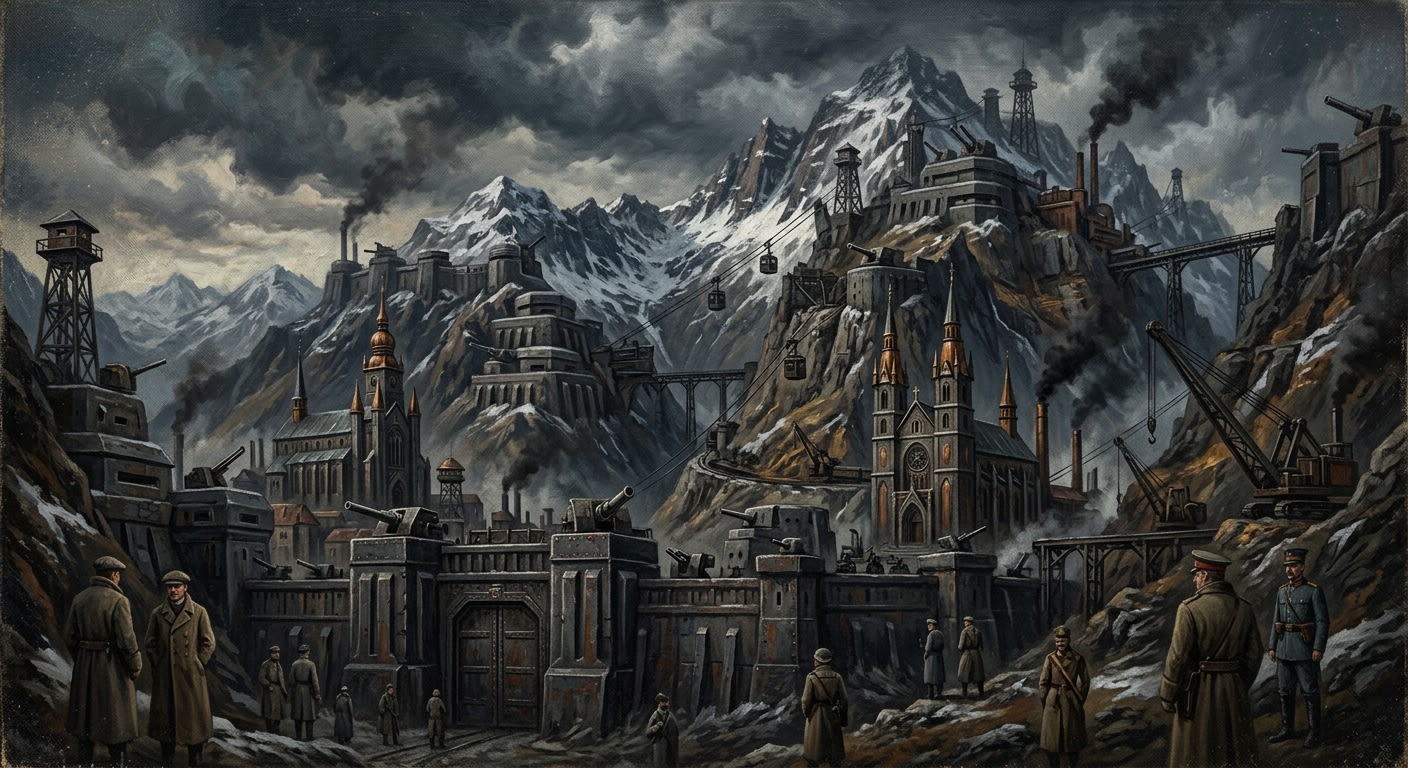
The Transylvanian Alps are the southern stone wall of the Carpathian argument: granite, pine, snow, fog, old Saxon stubbornness, and ore-bearing darkness arranged by Providence into a barrier so useful that the Bureau of Engineering has attempted, with characteristic vanity, to take credit for geology. They run across the belly of the Carpathian arc between Przemyśl and Irongate, filling what would otherwise be a seven-hundred-kilometre wound in the Sagittal Line. Without them, the Line would sag. With them, it clenches.
The mountains guard Bastion-Sibiu, the fortified Saxon citadel that became a bastion because the Synod discovered that its maps contained a hole large enough for Hell to drive a kingdom through. The peaks do not look obedient. No mountain does. Yet in the A.S. 65 hardening of the Line, when retreat finally ran out of west and frightened men began calling refusal strategy, these ridges supplied what no ministry could manufacture: height, cold, narrow passes, and the brute fact that armies dislike climbing into artillery.
Their public description is simple. The Transylvanian Alps form the natural outer works of Sibiu. Their private description is worse. They are the place where military defence, mineral appetite, refugee memory, Velmoran accountancy, Saxon piety, and Synodal requisition lie on top of one another like corpses in a properly budgeted ditch. The Bureau calls this depth. Soldiers call it trouble with snow on it.
#On the Old Heights Before the Synod Arrived
Before the Sundering, before the Line, before Strasbourg learned to pronounce every province as if annexation were a sacrament, the Transylvanian heights already knew siege. Saxon villages built churches like clenched fists: walls three metres thick, granaries inside the precinct, towers with murder-slits, bells that served prayer on Sunday and alarm on every other day the Creator permitted the neighbours. A weaker people would have called this paranoia. The Saxons called it architecture.
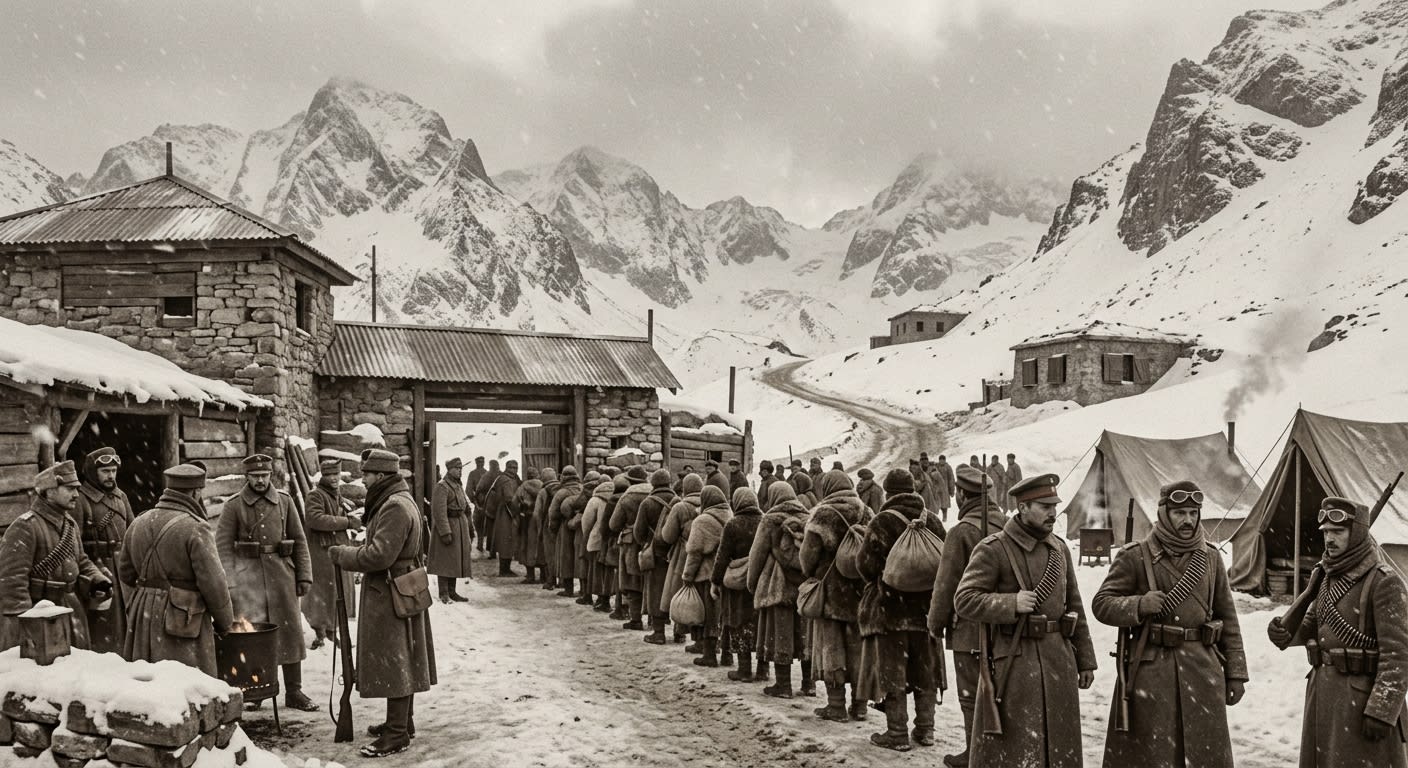
The range itself made the habit sensible. Passes narrowed without courtesy. Valleys ended in walls. Roads climbed through pine-dark mouths where a dozen men with stones could embarrass a cavalry column and a grandmother with local knowledge could ruin a brigade. Snow closed accounts without appeal. Spring thaw wrote its own casualty list. The old mountain communities learned that salvation required storage, signal, thick doors, and neighbours who could be disliked in peacetime and trusted when smoke appeared on the ridge.
Then the eastern world began failing in stages. A.S. 32 brought forty days without dawn. A.S. 34 gave the Danube its crimson boiling, which Rationalist hydrologists, those powdered monks of error, attributed to runoff from these same Transylvanian heights. They were wrong in the exact manner that made them famous: precise in vocabulary, dead in understanding. A.S. 38 silenced the eastern roads. A.S. 45 opened the Balkans. By A.S. 48 the Great Retreat had filled the approaches with wagons, reliquaries, children, plague bundles, officer maps, cattle, broken cannon, forbidden books, saints’ fingers in bread sacks, and men who had learned, too late, that philosophy performs poorly against teeth.
Old Rationalist border papers described the Transylvanian disturbances as “geological instability with sociological consequences.”
Corrected. The phrase is what happens when a clerk hears the earth scream and reaches for a drawer label. The Bureau reclassifies the disturbances as pre-Sundering adversarial pressure, observed through cowardly instruments.
The Saxon churches received refugees before they received Synodal officers. This matters, because bureaucracy came later and claimed first place in memory, as bureaucracy does when no one pins its sleeves to the table. Parish granaries became intake rooms. Bell towers became signal stations. Churchyards became sorting pens for the living and temporary shelves for the dead. The old dialect prayers persisted under the new alarms. Nobody had time to translate survival.
By A.S. 65, when the first Line was no longer panic but refusal, the Transylvanian Alps had already been tested by movement, hunger, and pursuit. A.S. 66 brought designation of Bastion-Sibiu. A.S. 72 ratified the position. These dates are tidy because later men tidied them. The mountains had begun their office earlier, without seal, salary, or permission.
#On Passes, Teeth, and the Art of Making Armies Pay Uphill
The mountains do not form one continuous cliff. That is a child’s drawing of defence and a staff officer’s preferred dream after too much fortified wine. They form a system: ridges, saddles, gullies, narrow roads, river cuts, avalanche throats, hidden shelves, timber tracks, and those little side paths by which smugglers, saints, deserters, and demon-accountants prove the insufficiency of official cartography.
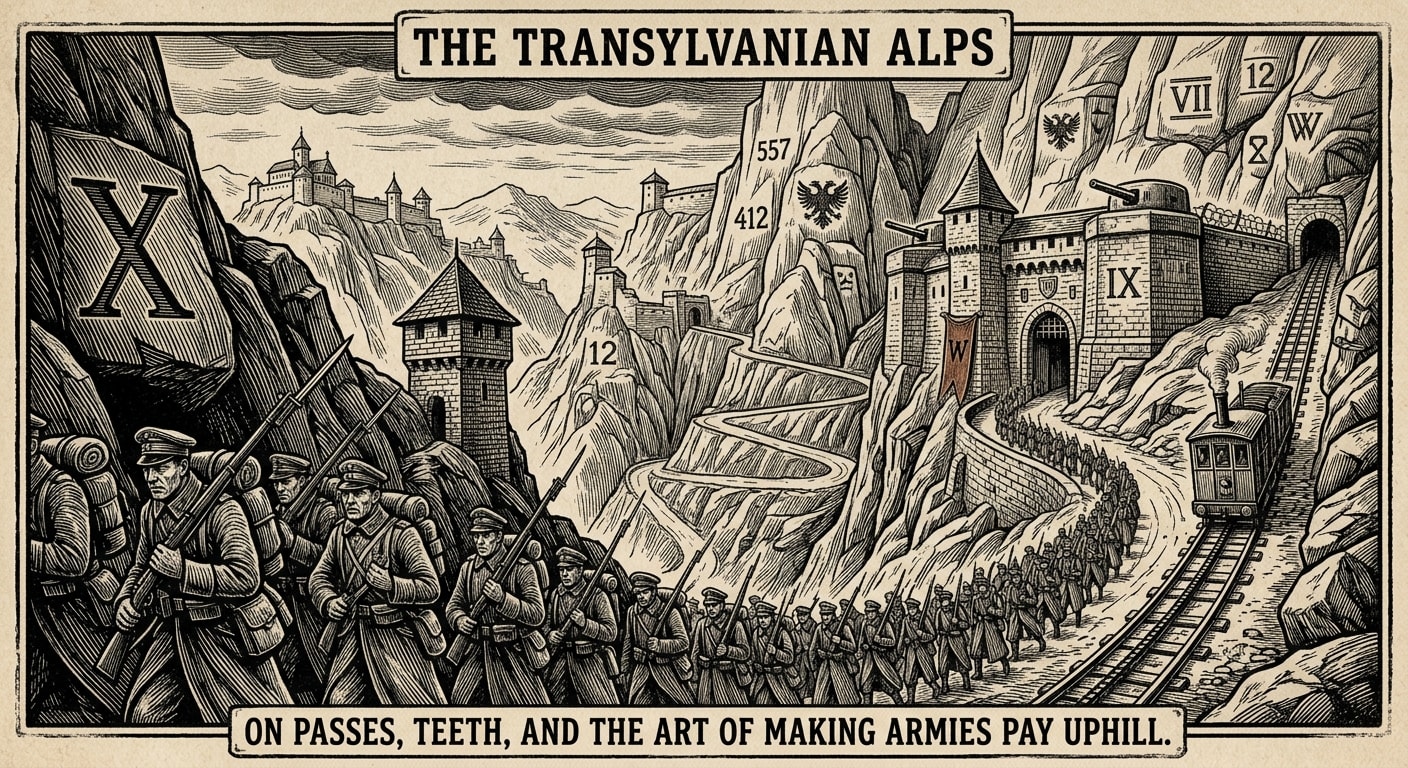
Turnu Roșu, the Red Tower pass, is the southern throat. It takes traffic that should have stayed in bed and funnels it between slopes where guns on the high works can turn a road into a theological correction. Bran is the northeastern corridor, famous among soldiers for fog, bad stones, and rumours that payments made there return to the purse minus the memory of having paid. Predeal is the eastern gap, the road most beloved by surveyors and most hated by men who must defend what surveyors have made visible. Around these three lie lesser routes whose names change by parish, season, and bribe.
Each pass is fortified with gun-redoubts, wire, chapel batteries, signal posts, catechism towers, avalanche charges, and listening huts where men record noises that may be falling ice, enemy tools, mule bells, coin, teeth, or thoughts not their own. The Doctrine of Layered Death is drilled there with the mountain as instructor. First the wall. Then the charge. Then ash. Then rhythm. Then the dividend. In Sibiu sector, the first wall is often not a shield line but a slope, a blasted road, a snow-cut, a barricade of felled pine and hymnsteel spikes driven through frozen mud.
This is why frontal assault remains rare. Velmora is not Maldrake. She does not waste beautiful difficulty on ugly courage. A Wrath general sees a pass and imagines flame. Velmora sees the same pass and asks who owns the mules, who pays the road keeper, whose brother needs surgery, which bridge tax is in arrears, which chaplain has chapel-roof debts, and how many hours a convoy can be delayed before hunger becomes negotiable.
The mountains make an army pay uphill. Velmora makes the army borrow the payment.
Even the weather has entered the accounts. Snow is defence when it falls eastward and logistics when it falls westward. Fog is cover when it hides a patrol and suspect when it hides a merchant. Thaw is celebrated until roads turn to brown confession and mule bones appear where the previous winter misplaced them. The Alpine Watch keeps two sets of seasonal tables: the one sent to Strasbourg and the one believed by men with boots.
#On Gold Beneath the Prayer
The Transylvanian Alps are not merely useful stone. They are rich stone. That is the curse with excellent posture.
Gold runs beneath the range in seams so dense that old miners sang to the rock centuries before the Synod arrived to put the song under permit. Saxon extraction fed local coin, princely quarrels, dowry houses, episcopal repairs, and every tidy provincial sin that clings to metal once men agree it shines. After the Sundering, those veins became strategic before they became infernal. Then Velmora made the distinction look childish.
Her domain presses the eastern face: Moldavia, Wallachia, the Transylvanian highlands, the limestone reaches leading toward the Gilded Chasm and the Vault of Ten Thousand Keys. The official western map shows a mountain barrier. The Velmoran map, if such a thing may be named without requiring my office to burn a table, shows a vein system, a set of claims, a sequence of extraction rights, a list of payable men, and a fortress sitting above collateral.
Bureau of Tithes school diagrams once described the gold beneath Sibiu sector as “Synodal reserve potential.”
Withdrawn from field instruction after A.S. 178 surveys confirmed seams running under Bastion-Sibiu’s foundations and after three junior auditors began using the phrase “reserve” with the moist expression of men imagining promotion. The current wording is “classified mineral pressure.” It has fewer teeth showing.
Velmora’s eastern extraction operations are the richest on the continent. With them she finances bribed quartermasters, false scrip, counterfeit relic chains, relief kitchens, highland loans, convoy delays, tollhouse adjustments, grain advances, and all the soft tools by which a mountain wall is made to lean without being struck. Her Ten Thousand Keys do not need to mine every seam. They need only convince western men that the seam will be theirs if they sign early enough.
Bastion-Sibiu’s weeping gold began in A.S. 178, the same year Engineering confirmed the sub-foundation veins. Warm, pure gold on consecrated stone. Clean by assay. Clean by song-test. Clean by every method the Bureau dares publish. The garrison collects it anyway and trusts it less for being clean. A dirty coin can be burned. A clean coin asks to be counted.
MINERALOGICAL ANNEX — SIBIU SUB-FOUNDATION SURVEY, A.S. 178 / REVIEWED A.S. 199 Deep seam direction: █████████████████████████ Projected eastern continuity: ███████████████ Possible relation to Citadel Ring exudation: denied. Bureau of Tithes revenue handling: continued. Bureau of Doctrine field warning: do not let soldiers hear the wall drip during Matins.
The mountain has become argument. If the gold is natural, it may be used. If the gold is Velmoran, it must be burned or sealed. If the gold is both, the Bureau must invent a doctrine before the market invents a price. The Bureau is working on it. Slowly. Velmora, whose patience is paid in interest, finds this amusing.
#On Villages, Fortified Churches, and Requisitioned Souls
Behind the ridges lie villages that the capital remembers only when supply fails. They are Saxon, Romanian, Hungarian, Armenian in old trade pockets, mixed beyond the comfort of census categories, and loyal in the complicated manner of people whose roofs are within range of consequence. Their churches are thick. Their cemeteries are crowded. Their parish records disagree with Synodal copies in ways that can be called error, resistance, grief, or memory, depending on which Bureau arrives first.
During the early Line years, these villages supplied everything Sibiu needed before Sibiu was large enough to demand it formally: cart roads, quarry labour, bell-metal, masons, winter fodder, scouts, muleteers, local saints, and women who could identify a safe spring by smell in fog. The Synod rewarded them with requisition papers. Requisition, as I have observed elsewhere, is theft conducted in Latin and granted incense by men too perfumed to call robbery by its parish name.
The fortified churches became lesser works of the mountain system. Some store powder under the altar. Some keep relay lamps in the choir loft. Some maintain bell codes older than the Concordat and refuse to translate them because translation would make them taxable. A few contain wall cupboards where seized Ten Thousand Keys contracts are kept until Purity can arrive with the approved brazier. The cupboards are lined in lead. The keys still grow warm.
The villages also supply Velmora’s favourite prey: people who have almost enough. Almost enough grain after frost. Almost enough coin for a son’s boots. Almost enough lime to repair a chapel wall. Almost enough favour with a Tithes clerk to move a form before winter. The Ten Thousand Keys thrive in the space between almost and enough. They arrive as moneylenders, notaries, grain factors, roof donors, dowry witnesses, and funeral funds. Their loans are generous. Their witnesses are kind. Their contracts remember.
A.S. 160 marks the first Ledger-Keeper infiltration files in the Sibiu sector. By A.S. 180, counterfeit relics entered frontline chaplaincies. By A.S. 182, the Counter-Relic Examiners had to be constituted because too many bones were blessing the wrong creditor. By A.S. 194, a Debt-Binder captured at the Sibiu perimeter offered to settle out of court. The Bureau burned it. The ashes formed a receipt. Of course they did. Hell has manners when money is watching.
#On Roads That Carry More Than Wagons
A mountain wall is only as holy as its roads are honest, which is to say holiness requires inspection at every turn and remains disappointed by lunchtime. The Transylvanian Alps feed and obstruct three principal supply corridors: the central route from Budapest through the plateau, the northern route down from Przemyśl and the broader Carpathian Corridor, and the southern route climbing from Danube crossings near Irongate. Every route enters the mountains carrying flour, shell, saints’ dust, spare boots, coffin nails, lamp oil, ink, wages, rumours, and the private poverty of the men escorting them.
Velmora attacks the last cargo first.
A convoy may pass every military checkpoint and arrive compromised. The grain is slightly light. The seal-chain has one duplicate link. The toll receipt uses a form retired too early and reinstated too late. The teamster remembers payment but not payer. A chapel fund appears in the ledger with a signature belonging to a priest dead since A.S. 185. The axle pin bears a creditor mark too small for ordinary eyes. The wagon is sound. The attack is already inside the paperwork.
The Sibiu Assay Chamber tests currency until its examiners age like candle stubs. The Weighhouse delays wagons for four, seven, eleven hours while auditors compare, sniff, sing, scratch, burn, tap, bless, and argue. The Alpine Watch curses the delay. The Bureau of Tithes curses the curse. The garrison eats late. Somewhere east of the pass, a creditor notes that hunger has improved.
The A.S. 199 Sibiu Anomaly proved that the roads now carry argument as well as debt. The Crimson Concord supplied permission: war without end is waste, coexistence is mercy, negotiation is prudence wearing a clean collar. The Ten Thousand Keys supplied price: relief now, obligation later, the key warm in the drawer, the clause waiting like a rat behind plaster. One teaches surrender to sound sensible. The other makes surrender affordable.
This is the modern mountain war. Not merely patrol against demon, battery against pass, wire against infantry. It is schedule against maturity date. It is ration against loan. It is a road whose gravel may be honest while every receipt written upon it lies.
#On the Mountain’s Present Condition
As of A.S. 201, the Transylvanian Alps hold. This sentence is true, and like many true sentences it is too small for the subject it pretends to contain. The ridges hold. The passes hold. Sibiu holds. The Alpine Watch still patrols Turnu Roșu, Bran, Predeal, and the lesser roads whose names a Strasbourg clerk would mispronounce into disaster. The mountain guns are maintained with oil, prayer, and professional resentment. The fortified churches ring. The Saxon parish rolls remain insolent. Snow closes roads according to its own canon.
Layered Death is drilled in the pass-forts. The first layer learns to brace behind stone. The second layer packs charges into road cuts. The third layer raises relic-ash where wind tries to steal it. The fourth layer beats rhythm against echo. The fifth waits in every casualty book, already ruled and numbered. If all layers fail, the mountain will make the failure expensive. That is not comfort. It is military doctrine with frost on it.
The danger lies below and through, not only beyond. Gold moves under the rock. Debt moves through villages. Scrip moves through markets. Keys move in pockets, drawers, shrine boxes, and locked trays where they should not move at all. The walls of Sibiu weep. The Assay Chamber records purity. Soldiers distrust purity when it arrives unasked. They are wiser than several committees.
Touring devotional maps once marked the Transylvanian Alps as “safe high country behind the Line.” The phrase behind the Line is forbidden in Sibiu sector except for strictly western-facing movement. The mountains are where the war learned to wear stone, snow, ledgers, and a smile that offers credit.
The Bureau’s standing instruction remains simple: hold the passes, audit the roads, burn the keys, deny the wall its voice, and never allow the phrase Velmora is beneath us to pass from barracks mutter into official report. Official reports are powerful things. They make fears eligible for budgets.