
#On the Architecture of Ownership
"Avaritia non egreditur." — Bureau of Doctrine, Sealed Memorandum IV.1.07-002f
I have written the entry on Velmora. I have catalogued her armies, her cults, her methods of commercial strangulation, her habit of purchasing nations one signature at a time. I did so with a Lictor at my back and a brass chain on my purse, and I considered the precautions sufficient. They were sufficient — for Velmora in the abstract. Velmora as doctrine, as taxonomy, as a problem the Bureau could file under the appropriate heading.
The Vault of Ten Thousand Keys is where the filing ends.
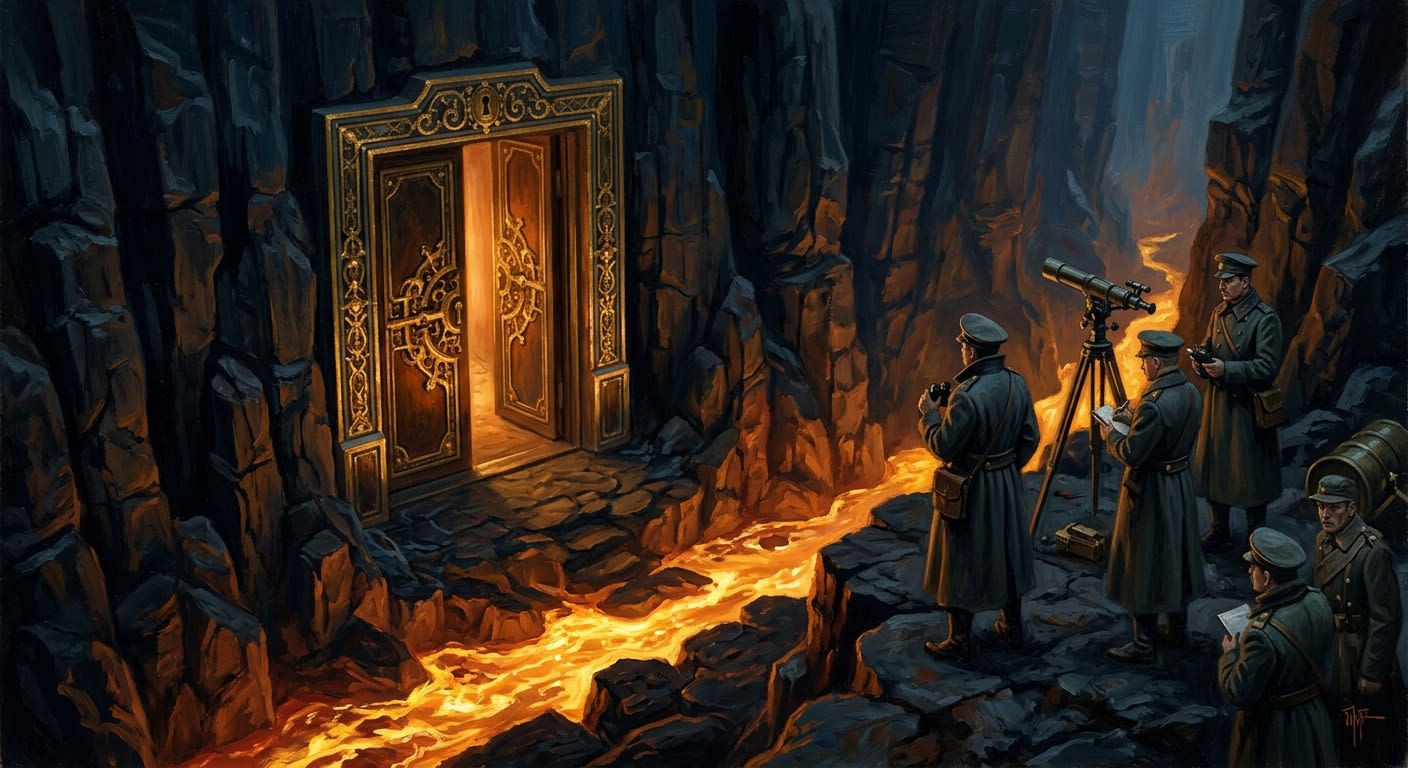
The Vault is Velmora's seat, her palace, the black heart of the Gilded Chasm where the canyon walls press close enough to block the sky and the rivers of molten ore beneath cast everything in a light that is gold, and warm, and wrong. Every architectural survey the Bureau has attempted — and there have been four, each more expensive than the last — agrees on exactly one detail: the Vault is a building whose primary structural principle is the lock.
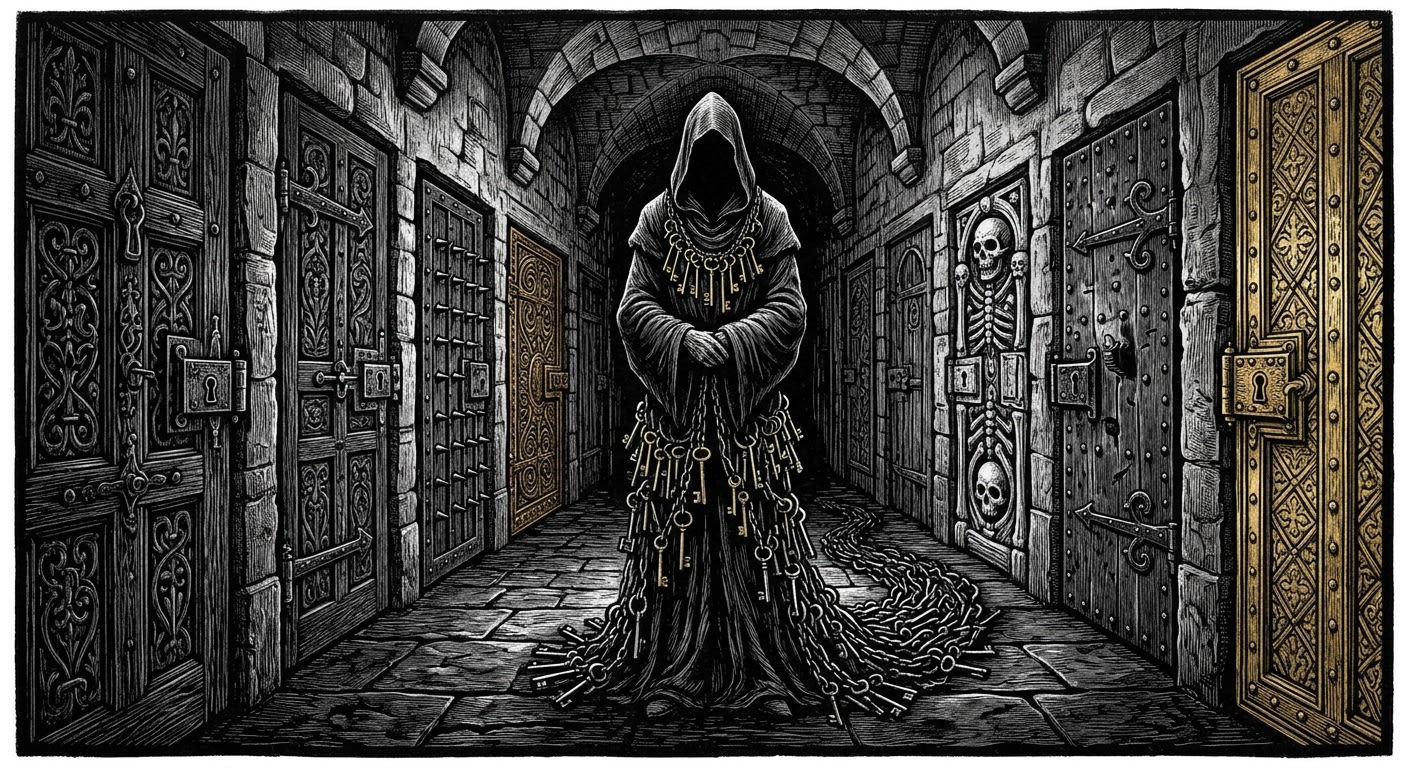
Doors. Thousands of doors. The Bureau of Cartography's Third Chasm Expedition (A.S. 174) counted nine hundred and eleven before losing the expedition leader, at which point the count became less important than the retreat. The doors are beautiful. They are oak and iron and bone and gold and materials the Bureau of Engineering cannot identify. Each one is fitted with a lock of extraordinary craftsmanship. Each one, when opened, reveals a chamber more splendid than the last.
Each one closes behind you.
This is the mechanism. This is what the Bureau has spent eighty years and four expeditions failing to adequately convey to its administrative superiors: the Vault is a process. You enter a door. The door locks. Another door presents itself. You open it — because the room beyond is richer, and the light is warmer, and the air carries a scent of cedarwood and coin-metal that tugs at something in the marrow. The second door locks. A third appears.
The Vault does not imprison through violence. It imprisons through invitation.
#On the Descent
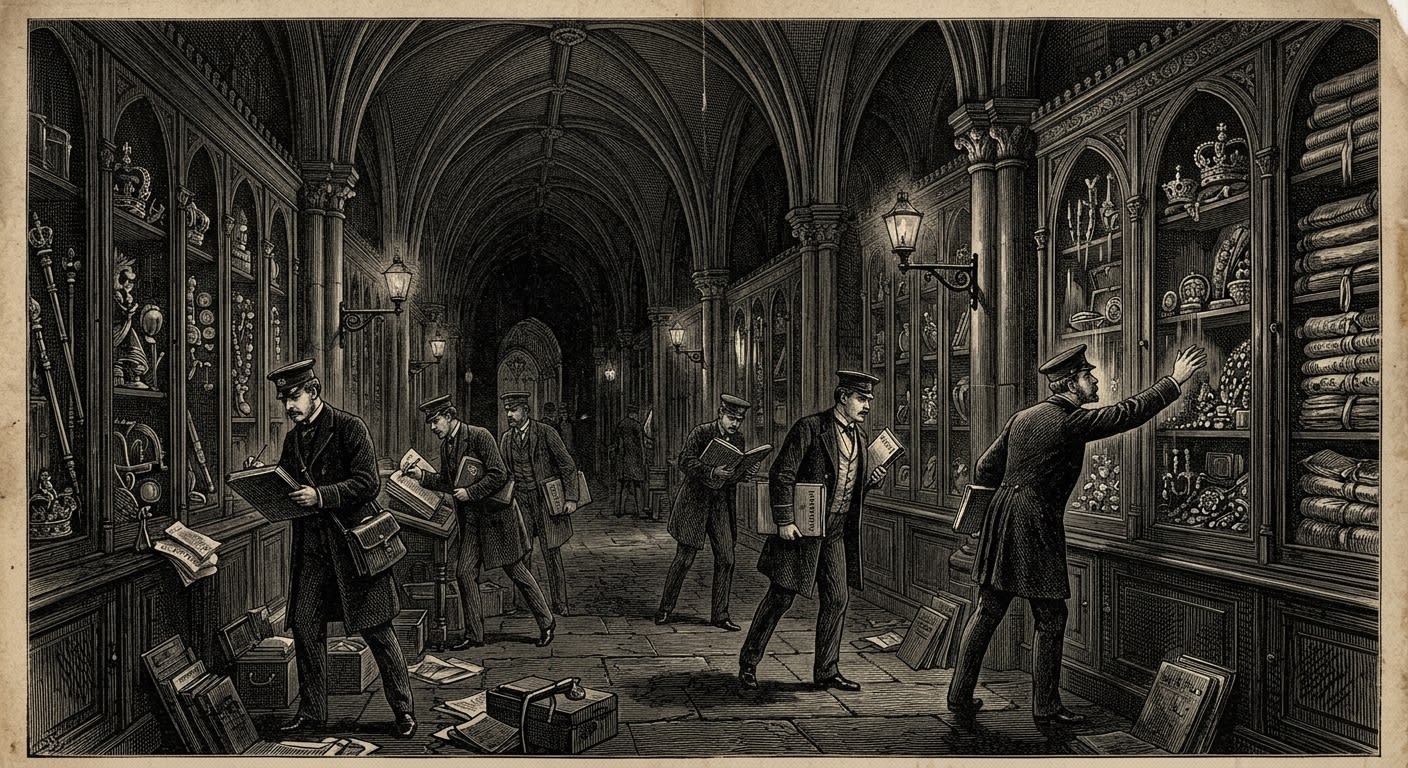
The Bureau of Cartography's reports, compiled from the fragments recovered across four expeditions (A.S. 114, A.S. 147, A.S. 174, A.S. 196), describe a structure that narrows. The outer galleries are vast — cavernous halls whose ceilings disappear into shadow, whose walls are lined with cabinets and vitrines and display cases containing objects of such beauty that the expedition clerks spent more time cataloguing them than advancing. The Second Expedition (A.S. 147) devoted nine pages to a single cabinet of jewelled mechanisms before realising that three members of the rear guard had stopped moving and were standing before a case of antique coins, weeping.
Below the outer galleries, the corridors contract. Not gradually — the ceiling height drops between one chamber and the next as though the building is being swallowed by its own foundations. The rooms grow smaller. The treasures grow denser. Gold presses against the walls in veins that pulse with a slow, organic rhythm the Third Expedition's geologist described as "cardiac" before crossing out the word and writing "geological." The floor slopes downward at an angle too gentle to notice until one attempts to climb back and finds the gradient has steepened behind.
Each level has a name. The Bureau recovered these from a Debt-Binder captured near Bastion-Sibiu in A.S. 194, who, under sustained interrogation, provided the following taxonomy before his mouth filled with coins and the interrogation was deemed concluded:
The Hall of Surplus — the outermost level. Grand, airy, lit by chandeliers of molten crystal. The treasures here are recognisable: crowns, sceptres, coins of a hundred mints, silks, furs, things a man might want and, having wanted, reach for. This level is bait. The Bureau knows this. The Bureau's expeditions have still lost personnel here, because knowing a thing is bait and resisting bait are different disciplines, and the Bureau trains extensively in the former while largely ignoring the latter.
The Gallery of Rarities — the second level. The chambers narrow. The treasures here are stranger: instruments that play themselves, clocks that count something other than time, maps of territories that do not correspond to any geography the Bureau of Cartography recognises but which, the expedition leader noted, "seemed more correct than ours." A painting was observed that depicted the viewer's childhood home. Each viewer saw a different house. Each house was accurate.
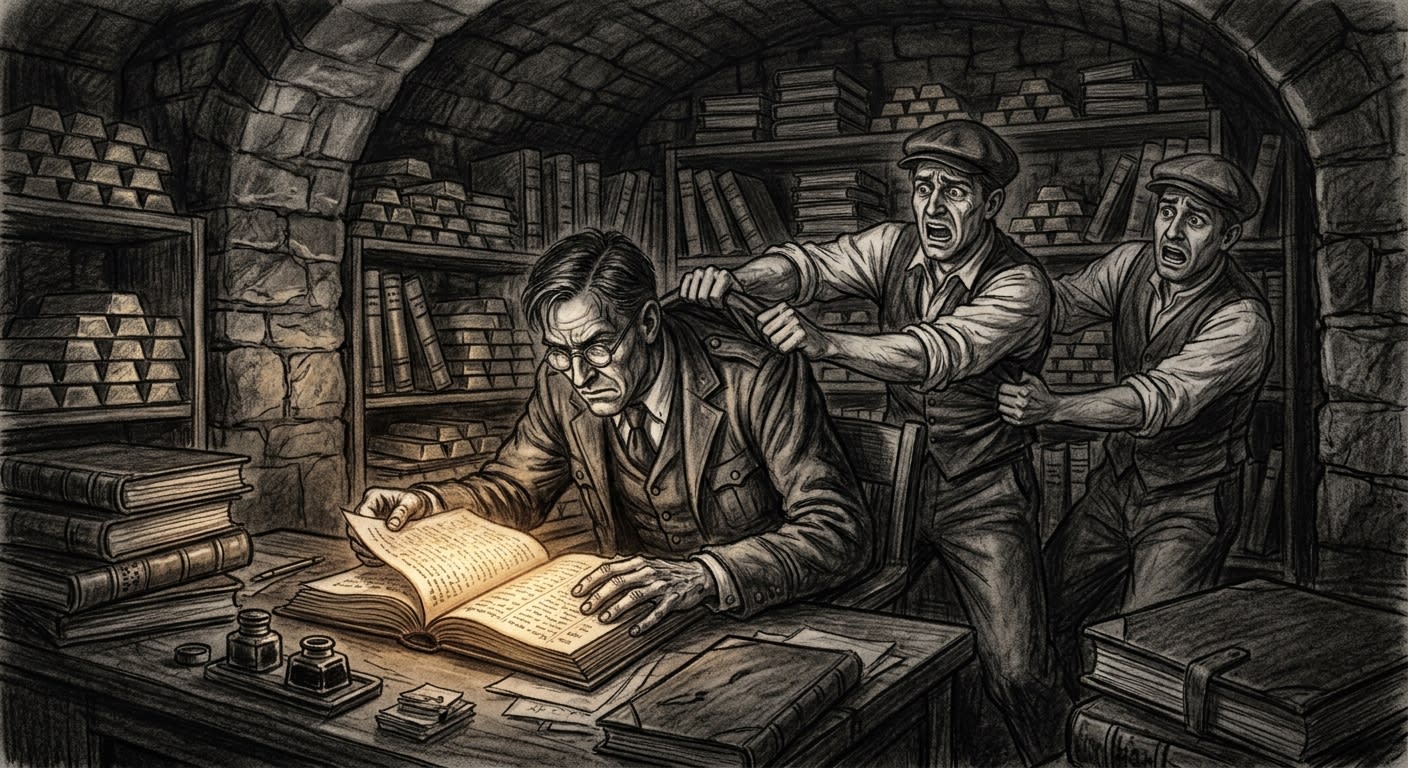
The Counting Halls — the third level. Here the ceilings brush the head. The rooms are the size of offices, of cells, of confessionals. The treasure is no longer displayed — it is stacked. Gold rising floor to ceiling. Documents in languages the Bureau of Doctrine cannot translate, their margins annotated in a hand that adjusts to match the reader's own. Ledgers that open to the reader's name. The Third Expedition lost its expedition leader at this level. He sat down at a desk, opened a ledger, and began reading. His colleagues attempted to remove him. He would not release the book. The book would not release him.
The Appraisal Chambers — the fourth level. The rooms are closets. The treasure here is personal: the expedition reports describe objects belonging to the viewer. A dead wife's ring. A father's service medal. A document of promotion the soldier had not yet received but which bore the correct seal. These objects are real. They can be touched. They are warm. They are also, the Bureau's theological analysis confirms, contracts — each one, when lifted, binds the lifter to a clause written on the object's underside in script too small for the naked eye. The clause is always the same. "Accepted."
The Confessional — the fifth and innermost level. One room. One chair. No treasure visible. The walls are bare stone. The air is cold. The door through which one enters is the last door; there is no door out. The Bureau of Cartography has never confirmed the existence of the Confessional through direct observation. The Debt-Binder's testimony is the only account. He described it as "the room where she asks you what you are worth, and you answer, and the answer is binding."
The Bureau does not know what sits in the Confessional.
The Bureau suspects it is Velmora.
[CONTENT REDACTED — BUREAU OF DOCTRINE, SEAL AMBER, REF: IV.1.07-002f §9. The Fourth Expedition's final transmission, received via bell-signal relay at Bastion-Sibiu on the evening of the third day, consisted of eleven words. The content is classified. The relay operator who received the transmission requested immediate transfer. The transfer was granted without the customary forty-day processing period, which tells the reader everything the redaction does not.]
#On the Keymasters
The Vault is not empty. Between the chambers, behind the walls, in the spaces where one corridor becomes another, move entities the Bureau has designated the Keymasters — Velmora's custodians, the wardens of her infinite collection.
They carry keys. Each Keymaster carries a ring of keys so vast that the ring itself drags along the floor behind them, producing a sound the Second Expedition's chaplain described as "a rosary being dragged through a sewer." They are thin. They are dressed in the fashion of clerks from a century the Bureau cannot place — high collars, ink-stained cuffs, spectacles perched on noses that are too long and too sharp and too attentive. They do not speak. They unlock doors. They lock doors. They inventory.
The Bureau of Purity's classified bestiary lists the Keymasters as a sub-variant of the Ledger-Keeper (Unregistered) demon class, distinguished by their physical association with the Vault itself. Where Ledger-Keepers record, Keymasters curate. They decide which door opens next. They decide which treasure is displayed in which cabinet. They decide, with an archivist's care and an executioner's finality, which visitor advances to the next level and which remains where they are — not imprisoned, precisely, but perpetually distracted, perpetually reaching for the next vitrine, the next cabinet, the next beautiful thing that is almost within grasp.
Three additional entities have been observed in the Vault, each attested by at least two separate expedition reports:
The Appraisers resemble the Assessor demons of Velmora's field host but are rooted to specific chambers. They do not move. They sit at desks. They look at you, and in looking they determine what you would pay for what is in the room — and what you would pay is always slightly more than you possess, which means you must borrow, which means you must sign, which means the Appraiser's desk contains exactly one document and one quill and the document is already addressed to you.
The Cataloguers are things of ink and paper. They drift between the display cases making notations in ledgers that seem to be growing from their hands. The Bureau's theological analysts believe the Cataloguers are recording the identities and desires of every person who has entered the Vault — a master inventory of appetites, ambitions, and the precise shape of each visitor's greed. This inventory, presumably, is Velmora's most prized possession. The Bureau has attempted to estimate its length. The estimate, when completed, was sealed and the mathematician who produced it was given a generous pension and a cottage in Bastion-Brest's western cantonments, where the Confession Echo is, at least, a different kind of unpleasant.
The Locked are the former visitors. They stand in the display cases. They are alive. Their eyes follow you through the glass. Their mouths move, forming words that the glass does not transmit but which the lip-reading specialist attached to the Fourth Expedition (A.S. 196) identified, in sixteen separate instances, as the phrase: "I found it."
They found it. Whatever it was they came for — the treasure, the answer, the document, the weapon, the thing that would make the wanting stop — they found it. They are holding it. They are standing in a case of polished glass and gold filigree with their prize clutched to their chests and their eyes bright with the particular incandescent satisfaction of a collector who has, at last, completed the set.
They cannot leave. The case is locked. The key is on a Keymaster's ring, and the Keymaster has moved on, and the door behind the case has closed, and the room is, for its single occupant, sufficient.
The Bureau classifies the Locked as "casualties, non-recoverable, administrative." I classify them as the most honest portrait of avarice the Enemy has ever painted. They have everything. They can touch nothing else. They are satisfied and imprisoned by the satisfaction. The collection is complete; the collector is the final acquisition.
#On the Expeditions
Four expeditions have entered the Vault. The Bureau does not enjoy discussing this record, but the Ledger demands accuracy, and accuracy is the only currency I trade in — a statement I make with full awareness of its irony, given the subject.
The First Expedition (A.S. 114) was dispatched by the Bureau of Tithes, which believed — with the institutional optimism that has characterised every Tithes initiative since the Concordat — that the gold deposits within the Gilded Chasm could be mapped, assessed, and taxed. Twelve auditors entered. Their supplies were calculated for a ten-day survey. One auditor returned on the fourteenth day. He had aged roughly forty years. His satchel contained three gold coins of no known mint, a receipt for services rendered signed in his own hand in a script he could not read, and a key. The key fits no lock the Bureau has tested. The auditor was debriefed for three months. He could describe the outer galleries in detail sufficient to fill eleven folio pages. Of the inner levels he would say only: "I found what I was looking for. I wish I had not looked."
He died eight months later. The coins were buried in consecrated ground beneath the Basilica of the Ledgered Saints. They surfaced twice.
The Second Expedition (A.S. 147) was a joint operation between the Bureau of War and the Bureau of Cartography, equipped with prayer-wards, consecrated chains linking each member to the next, and strict orders: no member was to touch any object within the Vault. The chains held for the first two levels. At the Gallery of Rarities, the expedition's chaplain discovered a reliquary containing what appeared to be an authentic finger-bone of Saint Aldebrand. He reached for it. The chain snapped. The chaplain was absorbed into the display. His colleagues retreated with seventeen pages of notes and the knowledge that consecrated chains are, against this particular form of temptation, insufficient. The Bureau of Doctrine debated for three years whether the reliquary was genuine. The debate was inconclusive. The finger-bone is still inside.
The Third Expedition (A.S. 174) reached the Counting Halls. This is the deepest confirmed penetration. The expedition leader, Inspector Joris Venne, was lost as described above. The surviving geologist and two guards retreated through a route that did not correspond to the route by which they had entered — the Vault had rearranged itself behind them, offering new corridors, new doors, each one slightly ajar, each one leading to a room whose contents were calibrated to the specific desires of the retreating party. The geologist resisted by reciting, continuously and at volume, the Bureau of Records' complete table of mineral classifications. The guards resisted by keeping their eyes shut and following the geologist's voice. They emerged after six days. The Bureau of War demoted the geologist for abandoning his expedition leader. The geologist did not contest the demotion.
The Third Expedition's official report states that Inspector Venne "remains on assignment within the Gilded Chasm survey zone." This is a bureaucratic courtesy.
Inspector Venne remains in the Counting Halls of the Vault of Ten Thousand Keys, seated at a desk, reading a ledger that contains — the Bureau suspects — every financial transaction he has ever conducted, will ever conduct, and would have conducted had his life proceeded differently. He is, by the Bureau's reckoning, still alive. The ledger has not run out of pages. It will not.
The Fourth Expedition (A.S. 196) was authorised by the Bureau of War over the objections of the Bureau of Doctrine, which — and I record this with the detachment appropriate to my station — explicitly warned that a fourth attempt would produce a fourth set of casualties without measurably advancing the Bureau's understanding of the Vault's interior. The Bureau of War disagreed. The Bureau of War sent twelve operators — Bureau of Shadows personnel, whose names I am not permitted to record and whose training in resistance to demonic influence is, by reputation, the most rigorous the Synod produces.
They entered the Vault on the morning of the fourth day of the Feast of Doctrinal Submission. Their bell-signal relays transmitted position updates for three days. On the first day, they reported the outer galleries: consistent with prior surveys, no casualties. On the second day, they reported the Gallery of Rarities: "Contents have changed since Third Expedition. Displays appear to reference current Synod intelligence priorities. Advise extreme caution." On the third day, the transmission frequency doubled — frantic, compressed, stripped of operational syntax. The content of these transmissions is classified under Seal Amber. The final transmission consisted of eleven words.
No member of the Fourth Expedition has returned. The Bureau of War has authorised no fifth expedition. The Bureau of Doctrine has formally recommended that no fifth expedition be authorised. I have appended my personal recommendation, which is that the Vault of Ten Thousand Keys be reclassified from "site of intelligence interest" to "site of permanent interdiction," on the grounds that one does not send auditors into the mouth of a crocodile and then express surprise when the crocodile's accounts show a surplus.
#On the Theology of the Lock
I have described the Vault's architecture. I have listed its denizens. I have catalogued the expeditions, their costs, and their failures. What remains is the question that the Bureau of Doctrine would prefer I did not raise, because the Bureau of Doctrine prefers questions whose answers can be printed on a compliance certificate and distributed to the faithful without incident.
The question is simple: why does the Vault exist?
Velmora has armies. She has territory. She has the Gilded Chasm, which is fortress enough for any Sin-General. Why build, in the bowels of that fortress, a palace whose sole function is to trap visitors — visitors who, by definition, have already penetrated deep into enemy territory and are therefore either extraordinarily brave, extraordinarily foolish, or extraordinarily desperate? Why construct, at enormous cost, an elaborate mechanism for the acquisition of individuals who walked willingly into a canyon of molten gold?
The answer, which I advance with the authority of a man who has read four expedition reports and one Debt-Binder's dying testimony, is this: the Vault exists because Greed's deepest expression is not the accumulation of gold. It is the accumulation of wanting. Every person who enters the Vault brings with them a desire — for wealth, for knowledge, for the relic that will turn the war, for answers that cannot be found elsewhere. That desire is the tribute. The Vault collects it. The doors lock because a collected desire must be preserved, catalogued, placed under glass where it can be admired.
The Vault is a reliquary of ambitions. The Locked are its saints.
And Velmora sits at the centre — if the Debt-Binder's testimony can be trusted, if the Confessional exists, if the bare stone room at the bottom of the infinite descent is real — because possession requires a possessor. The collection must belong to someone. The doors must lock for someone's benefit. Every key on every Keymaster's ring turns for her. Every cabinet, every vitrine, every display case in the Hall of Surplus and the Gallery of Rarities and the Counting Halls and the Appraisal Chambers exists because she wants it to exist, and her wanting — unlike mortal wanting — is the thing that makes the walls stand.
Remove the desire, and there is no Vault.
This is, I confess, an unsatisfying conclusion for a Bureau document. The Bureau prefers conclusions that recommend a course of action — deploy this regiment, fund this expedition, seal this chamber. I have no course of action to recommend. The Vault of Ten Thousand Keys cannot be besieged, because it is not a military target. It cannot be collapsed, because the Bureau of Engineering does not know where its foundations are. It cannot be purged, because every method of purging involves sending people inside, and every person sent inside becomes part of the collection.
An earlier draft of this entry recommended "theological countermeasure development" in conjunction with the Bureau of Rites. The recommendation has been withdrawn.
The Bureau of Rites' preliminary assessment, delivered to my desk under Seal Amber and received with the enthusiasm appropriate to a document that cost three clerks their sleep, concluded: "The Vault of Ten Thousand Keys operates on a theological principle the Bureau cannot counter without first understanding the nature of sacred ownership, which is a subject the Bureau has been forbidden to investigate since A.S. 92." I include the quotation without comment. The comment would be insubordinate.
#On the Present Condition
The Vault endures. It has endured since the Sundering, or since before the Sundering — the geological evidence from the Third Expedition suggests the Vault may predate the Gilded Chasm itself, that the canyon formed around it, that the structure was there first and the landscape accommodated it the way flesh accommodates a splinter.
The Bureau of War maintains a permanent observation post on the western rim of the Gilded Chasm, staffed by a rotating garrison from Bastion-Sibiu on a strict thirty-day rotation. The rotation is strict because longer postings produce a measurable increase in acquisitive behaviour among the garrison — petty theft, hoarding of rations, arguments over personal effects that escalate with a fervour disproportionate to their cause. A corporal stationed at the observation post for forty-two days (twelve days beyond regulation, due to a supply-chain disruption the Bureau of Tithes attributes to coincidence) was found to have constructed, from ration tins and bootlaces, a scale model of the Vault's outer galleries accurate to details he should not have been able to observe from the rim. The model was confiscated. The corporal was transferred.
The Vault's outer doors — the Bureau has confirmed the existence of at least three separate entrances, each on a different face of the Chasm wall — open and close on a schedule the Bureau of Bells has been unable to correlate with any known harmonic, liturgical, or astronomical cycle. The doors open when someone approaches who wants something badly enough. The Bureau has not been able to establish what threshold of desire triggers the opening. The Bureau suspects the threshold is lower than it would prefer.
The Ten Thousand Keys. The cult bears the Vault's name, and the name is not metaphorical. The Bureau of Purity's infiltration of the cult's upper tiers has confirmed that initiates of the fourth rank receive a key — a physical key, brass or iron or gold depending on their assessed worth, warm to the touch, fitting no lock the initiate has ever seen. The keys accumulate. Senior cultists carry dozens. The cult's leadership, the Inheritors, carry rings of keys that drag behind them with a sound the Bureau's informants describe as identical to the sound produced by the Keymasters within the Vault itself.
The implication is architectural. The cult is an extension of the Vault. The keys are the Vault's keys, distributed among the faithful, carried through the world like seeds of a building that has not yet arrived. When the Inheritors collect — and the Bureau does not know what "collect" means in this context, but the word recurs in every intercepted cult communication with the regularity of a liturgical response — the keys will find their locks.
The Bureau of Doctrine's standing classification of the Vault of Ten Thousand Keys is: Category One Spiritual-Architectural Threat, Interdiction Permanent, Recovery Operations Suspended. The classification has not been revised since A.S. 198. It will not be revised. The Bureau has locked the file, which is, given the subject, the most appropriate thing the Bureau has ever done.
I seal this entry with the observation that the Vault's most effective defence is not its locks, or its Keymasters, or its five descending levels of increasingly personal temptation. Its most effective defence is the knowledge — confirmed across four expeditions and a hundred and fifty-six years of observation — that everything inside it is real. The treasures are real. The gold is real. The documents contain real intelligence. The relics, should they prove authentic, would be of real strategic value.
The Vault offers real things. That is why it cannot be resisted. That is why the Bureau cannot send a fifth expedition, or a sixth, or a hundredth. Because the Bureau wants what is inside, and wanting what is inside is the mechanism by which the Vault acquires its collection.
Ownership is eternal. The door is always open.
It only locks behind you.