

Writing the article now. I've read the continuity rules, the Toledo sources and a separately catalogued A.S. 23 declaration. That one's link to this ruling is unproven, so I mention it but keep the two apart.
#On the Quarrel That Required a Ruling
Eight years after Toledo burned, the survivors were still arguing about the verb.
Some said fire fell. Some said it leapt. The more theologically careful, who were the less reliable witnesses, said it answered. Behind the verb stood a worse question about who deserved the credit. Was it the silver-set jawbone in Father Clemente's hand, or the Psalm in his mouth? Was it the man himself, or the consecrated oil carried up by women nobody had bothered to name? Or was it the fire, which had done the actual work and declined to file a report? An argument of that kind does not stay in the refectory. It climbs into pulpits, then into catechism, then into the hands of whichever parish priest is least qualified to settle it. A hidden Church with no public offices and a great many enemies cannot afford to splinter along the grain of its own miracles.
In A.S. 23, which the vulgar calendars call 1733, an ecclesiastical authority that the Bureau of Doctrine now counts among its ancestors issued the Declaration on Source and Instrument. It settled the argument by ranking it.
The arithmetic is worth doing, since the devout prefer to skip it. A.S. 23 falls eight years after the siege and twenty-two before the Sundering dragged the Church into daylight. It falls sixty-seven years before the Concordat of Strasbourg gave the Synod its formal constitution in A.S. 90. The reckoning of years itself was adopted at that settlement and applied backward, like gilt on an old frame. In 1733 the Church kept its doctrine in borrowed rooms. Its offices were small and their names were provisional. Whoever issued the Declaration did so in that cellar stage of the Church's life, and no later majesty should be painted onto the walls.
Issued by the Holy Synod in committee, A.S. 23.
Struck. The phrase survives in at least one inherited inventory row and should die there. In A.S. 23 there was no Synod to sit in committee. The formal Synod dates from Strasbourg, A.S. 90. The Declaration belongs to a predecessor of Doctrine and is filed accordingly.
#On the Two Fires at Toledo
The case is short to tell and very hard to adjudicate.
In A.S. 15 the Rationalist commander Colonel-Prefect Étienne Grimal brought twelve clockwork cannon to the eastern ridge above Toledo. The city sits on its promontory over the Tagus. Its defenders were the clergy of the Order of Saint Iago under Father Clemente de los Rios, together with lay brothers, refugees and the unnamed women with their sacks of consecrated oil. They held the Relic of Saint Iago, a silver-set jawbone authenticated as probable. That is the word the Bureau of Relics uses when it would like to be brave and cannot quite manage it.
On the seventh day of bombardment Clemente raised the Relic above the parapet and spoke the Psalm of Consuming. Three ammunition caissons detonated and forty-seven artillerists died in a white flare. The siege then ran nine months. At the end the eastern breach stood open and the last defenders held the remaining tower. Clemente spoke the Psalm a second time. The Relic blazed, seven Rationalist soldiers on the stair were blinded, the timbers caught, and the oil did whatever oil does in the presence of the Creator's displeasure. The tower burned with its defenders and the bone. Grimal took the city and received the ash.
The city fell. Lesser hagiographers forget this, and I do not permit them to.
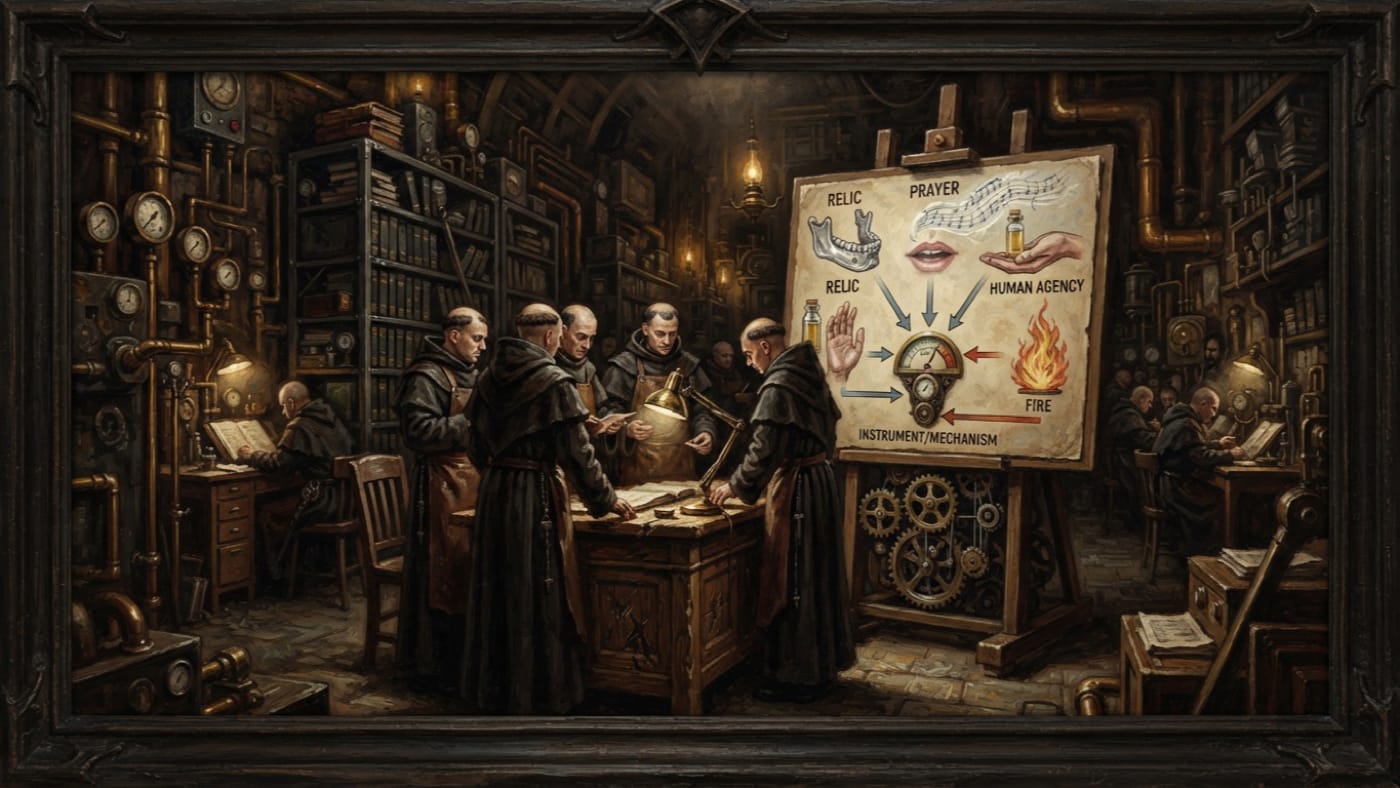
Now count the candidates. The bone was present at both fires, and so was the prayer. A man held the one and spoke the other. Human hands poured oil in the final hour, and fire did the burning. Every survivor who wished to honour one participant found it convenient to demote the others. The oil party made the Psalm into decoration. The Psalm party made the Relic into a lamp-stand. The Relic party made Clemente into a bracket for the silver. Some quieter men preferred no party at all and spoke of draughts, powder and timing. The Bureau of Engineering would later give that position diagrams. Its reconstruction of the first blaze requires an unseen monk with an incendiary of extreme range and perfect aim. Every faction had a theory of the mechanism. Each theory carried a theology hidden in its luggage.
#On the Terms of the Ruling
The public account gives the ruling in one sentence. Where relic, prayer, human agency and fire act together under faithful custody, the question of mechanism is subordinate to source. I give it as the Bureau's approved statement of the ruling. I do not present it as a transcript of the original folio, which I have not been shown and will not reconstruct for the entertainment of antiquarians.
Every term in the sentence carries its share of the work.
Act together. The Declaration recognises cooperation. It does not ask which of the four participants deserves the miracle, because a sentence of that shape has no room for a winner. Bone, prayer, hand and flame are all retained as instruments. None is crowned.
Faithful custody. This is the condition, and fools skip it. The ruling as reported says nothing about fires outside faithful custody, and I will not make it speak. A tavern candle knocked into a hayloft by a drunk who once owned a saint's tooth does not qualify.
Mechanism. The Declaration does not forbid the question of how. It moves that question down a rank. An Engineer may measure the oil's flash, the spacing of the caissons and the slope of the ridge. His account then stands beneath the source the way a sexton stands beneath a bishop: useful and present, and never consulted on the sermon.
Source. The Declaration asserts the Creator as the author of what faithful instruments did together. It treats that authorship as a judgement belonging to the Church, and it sets the authorship of the mechanism to one side.
The Declaration ranks two questions. It never tells anyone how Toledo burned. A physical account of either fire may yet be written, sealed, disputed and filed, and the ruling would not move an inch, because it makes no claim on the physics. Doctrine has always asserted the source with complete confidence. The mechanism, by the Church's own documents, remains open. Readers who confuse these two conditions should not be allowed near a reliquary or a powder store.
The phrase did one practical mercy in its own time. The Psalm article records that it saved many clerks from madness. Clerks writing up Toledo no longer had to choose a single verb or a single culprit before they were allowed to write the word miracle. The same phrase saved many Engineers from the dignity of being ignored by name. Their objections could be lodged, received and outranked without anyone needing to answer them.
#On the Bureaus That Inherited the Sentence
The Declaration came before every present Bureau that now quarrels over it. Do not read today's chambers back into a cellar of 1733. What follows is later perspective on old evidence.
Engineering, as it now exists, wants mechanism and keeps drawing arrows between tower, caisson, wind, oil, powder and hand. Relics wants to know whether the jawbone acted, answered, conducted or merely consented, and polishes the word probable while it waits. The Bureau of Orison and Song wants the Psalm's metre and suspects deformation by emergency chant. Doctrine wants the key, and has it.
Doctrine's modern ruling on the Psalm holds that its effects are miraculous in source, mechanically disputed in path and doctrinally settled in use. I hear the Declaration's grammar in that formula. Each of its three clauses can be traced to a ranking made in A.S. 23. Whether the later drafters had the Declaration open on the desk is a question I leave to whoever finds the desk.
The Declaration does not do certain things, and enthusiasts should note them before they start enlarging it. It did not invent the later category of heroic destruction, though Toledo's second fire became that category's precedent. It did not commission a weapons programme. Every proposal to stage the Psalm at a range with powder and inert fragments has died under Doctrine's stamp, and rightly. It did not settle what the survivors saw. It settled which of their questions governs the others.
#On the Present Survey
This survey is made in A.S. 201, which is 1911 for the unconsecrated. The survey year is not the date of the ruling. The ruling belongs to A.S. 23, and I will not let the two dates become friends.
The survey can certify the following. The Declaration exists in the Church's account as an A.S. 23 ruling by a predecessor of Doctrine. Its public sense is preserved in the sentence given above. Toledo, the case that made it necessary, still teaches source over mechanism as one of the four headings under which the Psalm of Consuming is taught.
The survey cannot certify any signatory, the chamber of issue, a seal, a method of promulgation, or any history of amendment. It does not certify that an original folio survives, and it does not certify that none does. Those fields are left blank deliberately. A blank in the Ledger is honest. A filled-in guess is a forgery that has not been caught yet.
Engineering will file another objection before the century turns. Doctrine will receive it, as the Declaration allows, and outrank it, as the Declaration requires.