
#On the Standing of the Doctrine
Light is grace, and its distribution is a sacrament. The rest is bookkeeping.
The Doctrine of the Lamp is the theology of the Seal-Oil Shrinefjord of Hrafnvik. It is kept by the Shrine Chapter of the Blessed Wick and can be stated in one sentence, which is more than most doctrines manage. A lamp lit in a shrine is a prayer made visible. A lamp put out in spite is heresy. Lamp-debt is sin, and a dark-house is damned. These are the Chapter's judgements, recorded in the Chapter's books. Whether the Creator signs the books as well is a question I was not sent north to ask.
I was sent to assess compliance. During my nine days in A.S. 197 I looked for the doctrine's author and found none. There was no founding sermon, no sealed instrument, no year of adoption, and no saint with a convenient vision. There were ledgers. The present Prior keeps them, as his predecessors kept them. The Bureau of Records has asked me not to conclude that the keeper of a ledger is its author, and in this one instance I will oblige it.
The Bureau of Doctrine has never ratified the teaching and has never condemned it. Ratifying it would require understanding it. Condemning it would require sending something better to a fjord, by skiff, in winter.
#On the Hours of Grace
In Strasbourg, faith is measured in ink. In Hrafnvik, it is measured in hours of oil.
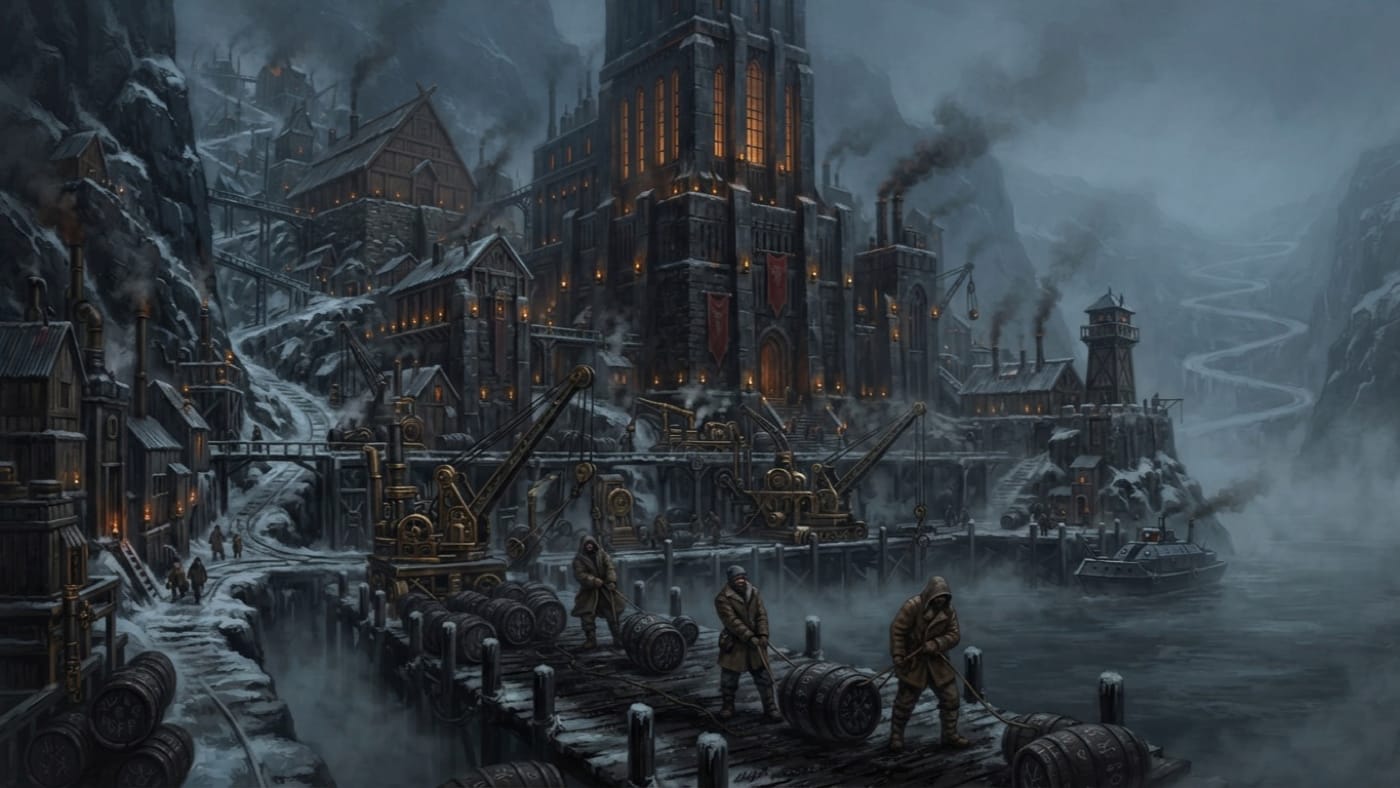
Seal-oil is the only commodity in Hrafnvik that matters, and Hrafnvik will tell you so before you have finished stepping off the boat. It lights the twenty-hour winter dark, heats longhouses when the coal from Hamburg is frozen in the strait, pays the tithe, goes south as the export, and changes hands as money. The Doctrine of the Lamp takes this substance and gives it a theology. Lamp-time, the hours of light a household draws from communal oil, can be taxed, traded, owed, withheld and confiscated. Through all of these transactions it remains, officially, a measure of the household's standing before the Creator.
The bookkeeping is carved into wood. Paper rots in the fjord damp, so barrels carry notch-codes, and the notches serve as the ledger. Oil-chits pay for large things and bone tokens for small ones. Debt is reckoned in nights of light, and a family will say it owes the shrine six nights the way a southern family says it owes the landlord a quarter's rent. I found no fixed rate of exchange between a night and a barrel, and I suspect that is intentional.
Three authorities administer this grace, and none of them answers to the others. Elder Sigrun Half-Wick and the Clan Moot set the render schedules and decide how communal oil is divided. Prior Malthus and the Shrine Chapter keep the fast calendars, the confession ledger, the exemptions and passage papers, and the reports sent south. Captain Rauk One-Eye and the Winter Watch control the ice roads and the cliff paths, and they decide who is fetched home when the whiteout comes. A household's grace is allotted by the first, recorded by the second, and reached only with the help of the third.
The confession ledger turns sin into oil. A spiritual fault, once confessed and recorded, can become a correction to a household's oil account. Debt can be paid as watch duty in a storm. A household that fails at that duty loses its communal lamp-aid.
#On the Fast and the Dark-House
Fasting purifies the North. So the Chapter says. The Chapter eats imported bread.
The fast is the doctrine's discipline, and the dark-house is its penalty.
The Chapter sets the fasting days, local observance lengthens them, and clan honour enforces them. Southern correspondence calls this voluntary penance. In Hrafnvik the saying goes that the North fasts by choice, and people repeat it the way a man repeats the name of a creditor. Anyone who breaks a fast becomes un-counted. Their name comes off the communal tally, and with it go their lamp-aid and their place in the queue for passage south.
There are other ways to end up in the dark. A household may fall behind on its oil-tithe or miss its render quota, and a shortfall can be booked as theft even when the seal season was simply poor. A confession can go badly for the confessor. Every route ends at the same point. A clerk in soot-black gloves strikes a line through a name, and the household it belonged to becomes a dark-house, cut off from communal heat.
The striking takes a moment. What follows takes days. A household without lamp-aid has no light, and in a fjord winter light and heat come from the same wick. Some dark-houses have relatives, hidden barrels or a kinder neighbour. Some do not. The ledger records the sanction and does not record what happened afterward.
The Chapter's line is Fasting purifies the North. The line repeated among the dark-houses is Fasting makes the weak disappear. As a matter of record, both statements are accurate. The Bureau files the first. The second survives in frost pits and unlit coves, where nobody files anything.
#On the Lamp Outside the Ledger
Every sacrament breeds its forgery. Hrafnvik breeds them faster.
If grace can be allotted, it can be bought. Warm papers are southern documents of every kind: identity proofs, passage permits, fast exemptions and ration stamps. The Prior issues them, oil pays for them, and the brokers at the slipways forge them. An exemption excuses a body from the doctrine's discipline, and a passage permit takes the body out of the doctrine's reach. The local proverb holds that a stamped paper can kill faster than cold. The proverb does not say which way the paper is stamped.
One thing in Hrafnvik is supposed to be beyond price, and that is a child's lamp. A child's lamp, or a child's lamp-pin, accepted as payment is grounds for a blood feud. The prohibition is absolute, and it is also broken. The brokers know both of these facts and set their prices accordingly.
Beneath this trade runs the Dark-House Circle. It hides oil in the frost pits under false storage tags, takes wicks from shrine lamps, and keeps unlit routes between the struck-out households and their caches. Its organizers have no names I could obtain, and its membership has no register. What it does have is a principle, stated more plainly than anything the Chapter has written: no child freezes because a clerk drew a line.
That principle amounts to a dispute over who gets grace, conducted with stolen wicks.
#On Bells and the Listening Fjord
Strasbourg standardizes the hours. The fjord keeps its own.
Every doctrine of the Church eventually has to reach an accommodation with the bells. The Office of Bells was constituted in A.S. 52, and its successor the Bureau of Bells administers the Bell Codex ratified in A.S. 115, which sets one rhythm for every Synodal hour. Hrafnvik's shrine-bells ring an older pattern. At Bastion-Königsberg, the Baltic anchor of the Line, the Northern Carillon rings the standard, and the garrison has recorded what is heard when the standard and the fjord-bells sound together. The northerners call the result the argument. The garrison chaplains have less flattering names for it.
ERRATUM — BUREAU OF BELLS, NORTHERN OFFICE (EXISTING CORRECTION, A.S. 199) The A.S. 195 notation classing the Hrafnvik bell-schedule as "non-compliant but harmless" was withdrawn by the Northern Office in A.S. 199. The schedule remains non-compliant. The Bureau no longer certifies it as harmless. This tract reproduces that correction and does not extend it.
The fjord complicates the doctrine in another way. On windless nights the fog answers back. It repeats prayers with the wrong saint in them, confessions containing sins nobody confessed, and names spoken in the cadence of the dead. Lamps gutter in still air, though on other nights they burn with a steadiness rendered fat has no business keeping up. The Watch's countermeasures are triple-wick lanterns, salt circles and silence on certain paths. The Watch reports that these work. The Bureau of Rites has not certified that they do.
A doctrine of grace is also a doctrine of correction: the sinner is set right, and the household is restored to the count. The Rites survey of A.S. 199 spent four days in the fjord and issued an instruction that sits awkwardly against that.
On my seventh night the fog gave me back the Creed in my own voice, and every I believe had become I remember. I did not correct it. The Doctrine of the Lamp says nothing about what is listening beneath the water, and the Bureau has classified nothing. I will not pretend to have done better than either.
#On Conditional Compliance
The south needs the oil. The doctrine comes with the barrels.
The arrangement holds because it works. Oil goes south to shrines and garrisons that cannot render their own, and the Moot, the Chapter and the Watch keep order in a place no Legate has ever wanted to winter in. The fasts are kept, more or less. The tithes arrive, mostly. Exemptions are issued, and paid for, and forged. The Fractured North appears on Strasbourg's maps as Synodal territory, and Hrafnvik pays for that appearance in barrels.
Hrafnvik's compliance was renewed in A.S. 201, pending review. That is a judgement about the settlement. It does not ratify the Lamp, and it puts no seal on this tract. The Bureau of Doctrine goes on tolerating a theology it has not read, written down by a Chapter it did not train, and the south burns oil whose doctrine it would rather not examine.
The review is still pending, and the barrels keep arriving.
Nihil obstat.