
#On the Commission
The Bureau of Records listed the Drava as navigable. Patrols on the same river reported bends that no chart contained. Two documents disagreed, and in A.S. 174 the Bureau of Cartography was told to settle which of them would be embarrassed. It sent a survey party east with orders to reconcile the river's western course with the existing charts.
The commission called the problem "lateral instability." The phrase is so calm that it could be read at a graveside without upsetting the widow. Perimeter soldiers had a shorter word for it, wandering, and their word was more accurate. Records kept its navigable entry throughout, and keeps it still. A registry entry describes the registry. Any boatman who took it for a promise of safe passage got the boat he deserved.
Adept Harlen took the measurements. His kit is on file because Cartography lists instruments, and listing instruments is how Cartography remembers anything at all. He carried a surveyor's transit, two brass sighting rods, waxed notebooks against the damp, and a ration tin. He also carried a saint's medal that the inventory clerk marked as of doubtful provenance. The clerk never applied that doubt to the river.
The surviving file names four people: Harlen, Assistant-Mapper Krail, Rod-Bearer Lisabet of Graz, and a chaplain whose name it leaves out. A patrol went with them, or at least came back with them. The file does not say how many marched, who commanded the escort, or who answered to whom. That part of the vellum is blank and I will leave it blank. I do not invent expedition rosters to satisfy a reader's appetite for lists.
#On the Ground Surveyed
The Drava once carried barges through the grain country of southern Pannonia. It now runs through Kargath's province along the edge of the Blightmarsh, yellow-grey and heavy with sediment and grease. Patrol reports call the scum on its surface corpse-froth because the Church has not approved a politer word. The farmland at the marsh's edge has been eaten down to grey mud, and the eating has not stopped.
The surveying itself was nearly impossible on that ground. Triangulation needs three things that stay where they are put, and the Drava provides none of them. Banks form overnight. Channels that appeared on a dawn sketch are missing by noon. A step onto firm mud may be followed by a step onto mud that is only firm in the grammatical sense. A surveyor sights a marker, writes down the bearing, and looks up to find the river has moved its argument somewhere else.
I am not going to explain why the river moves. Doctrine has opinions, the older Lore has accounts of sorcerers and appetites, and a Bureau study is presumably waiting under somebody's elbow. The survey had a transit, two rods and wax-proofed paper. It was equipped to measure the river, and nothing in its kit could explain it.
#On the Loss and Withdrawal
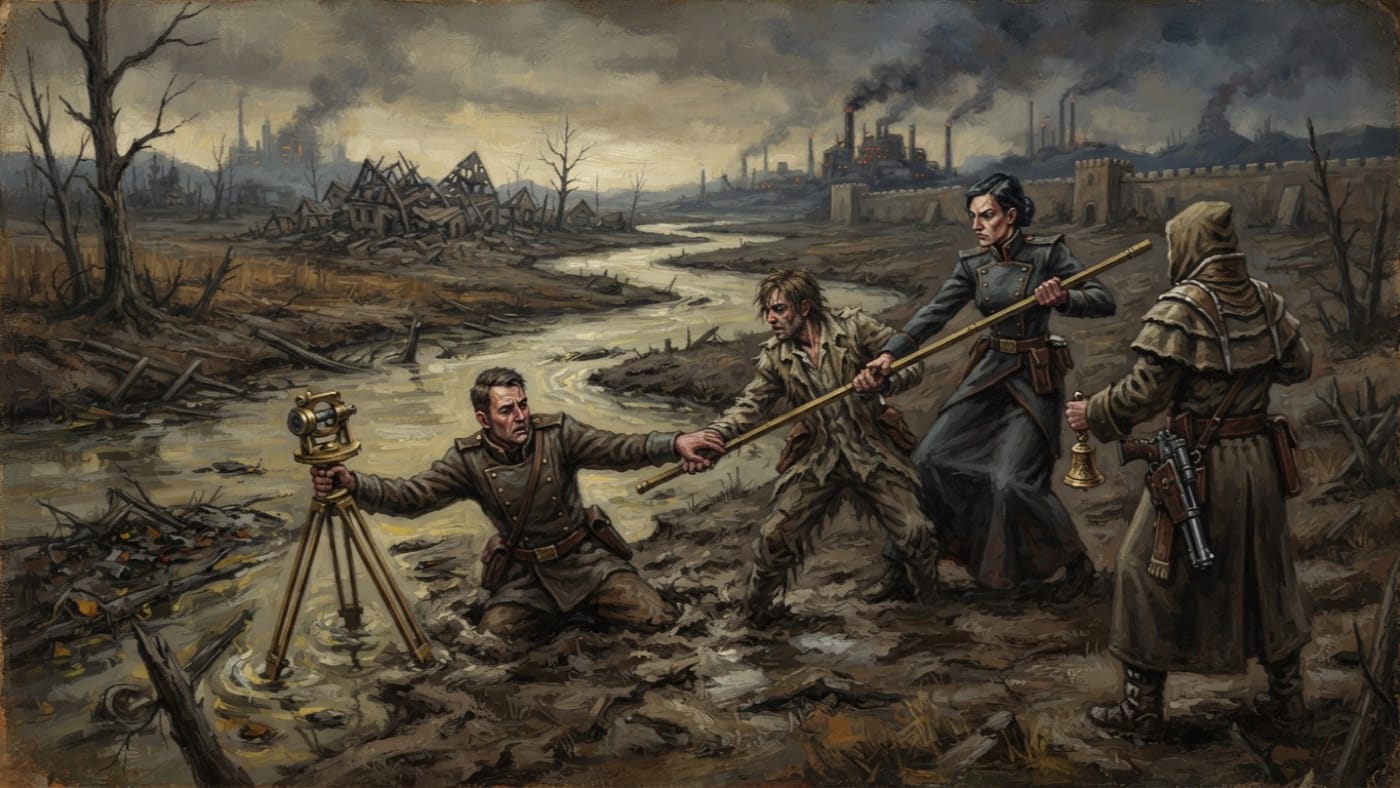
Harlen was lost at the river. Three depositions describe it, and I give them separately because they are separate.
Assistant-Mapper Krail stated that the river divided around Harlen "like a closing parenthesis."
Rod-Bearer Lisabet of Graz stated that Harlen stepped from firm mud onto firmer mud, sank to his belt, and apologised for blocking the line of sight.
The chaplain wrote only that the transit stayed visible longest.
I could blend these into one smooth scene with weather, a final word and a hand reaching up. Clerks junior to me have done exactly that to lesser files. The three witnesses stood in different places and saw different things, and only one of them thought to watch the instrument. Each statement is testimony and none of them is the event.
First loss notice: Adept Harlen fell into the river.
Amended by Cartography after objection from two surviving witnesses. Harlen did not fall. He disappeared while standing.
No recovery was attempted. The patrol had already overrun its exposure clock by fourteen minutes. The wind had shifted east and begun to smell of fresh bread. Anyone who has read about the Abundance Fields knows why a perimeter patrol fears the smell of baking where there is no oven. The file records the smell and records no field, and I will not add one.
The chaplain rang the withdrawal bell. Krail objected. His words are not recorded, and that saddens me more than I would like, because the only man in the file who wanted to go back for Harlen is the one whose speech nobody wrote down. Lisabet of Graz struck him with a brass sighting rod. By the account of the people who returned, the blow saved his life.
For this Lisabet received a reprimand for misusing Bureau instruments. Some time later she was quietly transferred to indoor ink duty. The Bureau is very good at moving inconvenient people indoors.
#On the Three Returns
Harlen's notebooks did not come back. Three maps did, and they are the actual evidence of the Drava survey. Each one contradicts the other two.
Map A bends the river north toward the ruined orchards.
Map B bends it south, through a village that no other file admits ever existed.
Map C shows the party crossing the same ford twice, from opposite directions. Harlen's last noted position on it is written in a hand that none of the surviving personnel would claim.
Which participant drew which sheet is not certified, and I will not certify it either. A transit, two rods and three frightened people produced three rivers. Only one Drava can be true, and possibly none of them is. Nothing in the file shows whether Harlen's own measurements went into any of the sheets, since his notebooks stayed behind with him.
Map C marginalia, lower Drava sheet: "Harlen visible at second ford before loss event." "Harlen visible at second ford after loss event." "Harlen visible at ███████████████████." Ink analysis: same pen, same day, same hand. Witness signatures removed under Seal Amber.
Read the second line again. A surveyor's position recorded after the event that removed him from the survey should have caused a scandal in any Bureau that believed its own maps. Cartography did not treat it as one. It filed the line as a question of custody.
#On Provisional Custody
The Cartographic Bench declined to choose a correct map. It placed all three in provisional custody under separate seals, apparently on the theory that maps kept apart will stop arguing. A Bench that picked a winner would own whatever happened to the next party that followed it. A Bench that keeps all three owns only the wax.
Custody of the evidence is a different thing from certainty about the river. The seals guarantee that Map A has not been altered since sealing. They tell you nothing about whether the Drava ever bent north. Clerks confuse those two guarantees, and after enough years the confusion turns into a policy.
Harlen's status was decided faster than the river's. He was declared deceased by exposure. "Exposure" is the noun the Bureau uses for wind, mud, fever, wrong air, an unclean place, and any other fate it prefers not to itemise before supper. It is the recorded cause, and nobody performed a medical examination to support it. His pay stopped, his bunk was reassigned, and his instruments were written off. That included the transit, which by the chaplain's account was the last part of him anyone saw. His name was then read aloud in the annual list of Cartographic Sacrifices, in the proper order, by an official who had never met him.
#On the Unamended Survey
For twenty-six years the survey was a closed file with three open maps. In A.S. 200 a patrol at Kestrel-11 reported a figure standing waist-deep in the Drava, facing east, holding what appeared to be a surveyor's transit. The figure did not answer hails. The patrol did not approach, and it withdrew. Its report said the figure matched Harlen in height, posture and equipment, including the lean toward the left shoulder that comes from years of carrying a transit case. By the patrol's estimate it had not aged.
That is a resemblance, and nobody has made an identification. The figure may be Harlen, or something wearing his shape, or a patrol's tired eyes, and the patrol could not tell which, and neither can I. The fuller account belongs to the dossier on Adept Harlen. This article is responsible for the survey, which the sighting reopened without resolving anything.
The Bureaus each answered in their own way. Medicine asked to examine the sighting and was refused. Rites asked whether Harlen's death rites needed amending and was deferred. Records asked about pension liability and received an answer within the hour. Cartography kept the file unamended. Doctrine ordered silence until further contradiction, which would be good advice for a river if rivers took instruction.
The Bureau of the Hourglass will want me to point out that the A.S. 130 complaint on the Drava spur, when the clocks and the crew disagreed by four hours and forty-nine minutes, is a separate matter. It is separate. I mention it so that nobody else raises it in a less careful tone.
Twenty-seven years after the commission, the Drava is still entered as navigable and the three maps remain sealed apart. The man who went to measure the river is dead for every purpose that involves money. The only things anyone has firmly settled are his payroll and the wax on the seals.