
#On the Bureau's Name, and Why a Weapon Became a Writ
"In the matter of temporal governance, the Bureau does not speculate. The Bureau measures. The speculation is left to those who read the measurements and cannot sleep." — Internal charter, Article One, paragraph nine, sub-clause (d), Bureau of the Hourglass
The name is borrowed from the Enemy. The reader should sit with this a moment.
Syrion the Languid Dreamer deploys a war-engine the Bureau of War has sighted twice, measured never, and classified with the sort of brisk administrative courage that distinguishes the Synod's filing apparatus from its fighting one. The engine is called the Hourglass Monolith — a colossal thing that bleeds time from the field around it, reducing whole battalions to statues while the Dreamer's hosts glide through them at funeral pace. Soldiers within its radius discover that their arms will not lift, their legs will not obey, their orders arrive from a distance that sound cannot cross. They become, in the Bureau of Bells' terminology, temporally excommunicate — present but unreachable, alive but inert, standing where the Ledger says they ought to stand and doing nothing the Ledger can record.
The Synod, in the fashion of institutions that fear a thing too much to leave it unnamed, took the weapon's name and filed it as a department.
The Bureau of the Hourglass measures temporal drift across the Sagittal Line. It classifies anomalies in the flow of time wherever Syrion's influence seeps westward through the marsh corridors, mountain passes, and river basins of the front. It maintains timing relays at forward bastions, operates monitoring stations in sectors the Bureau of War considers too quiet to garrison and too dangerous to abandon, and publishes quarterly reports that no one reads — because, as the Bureau of Doctrine has privately conceded, reading them induces the very torpor they describe.
#On the Founding, and the First Clock That Lied
The Bureau's charter dates to A.S. 134, three decades after the Concordat formalised the apparatus of governance and a full generation after the Sagittal Line had been scored across the continent's hide. Its origins are less dignified than its mandate.
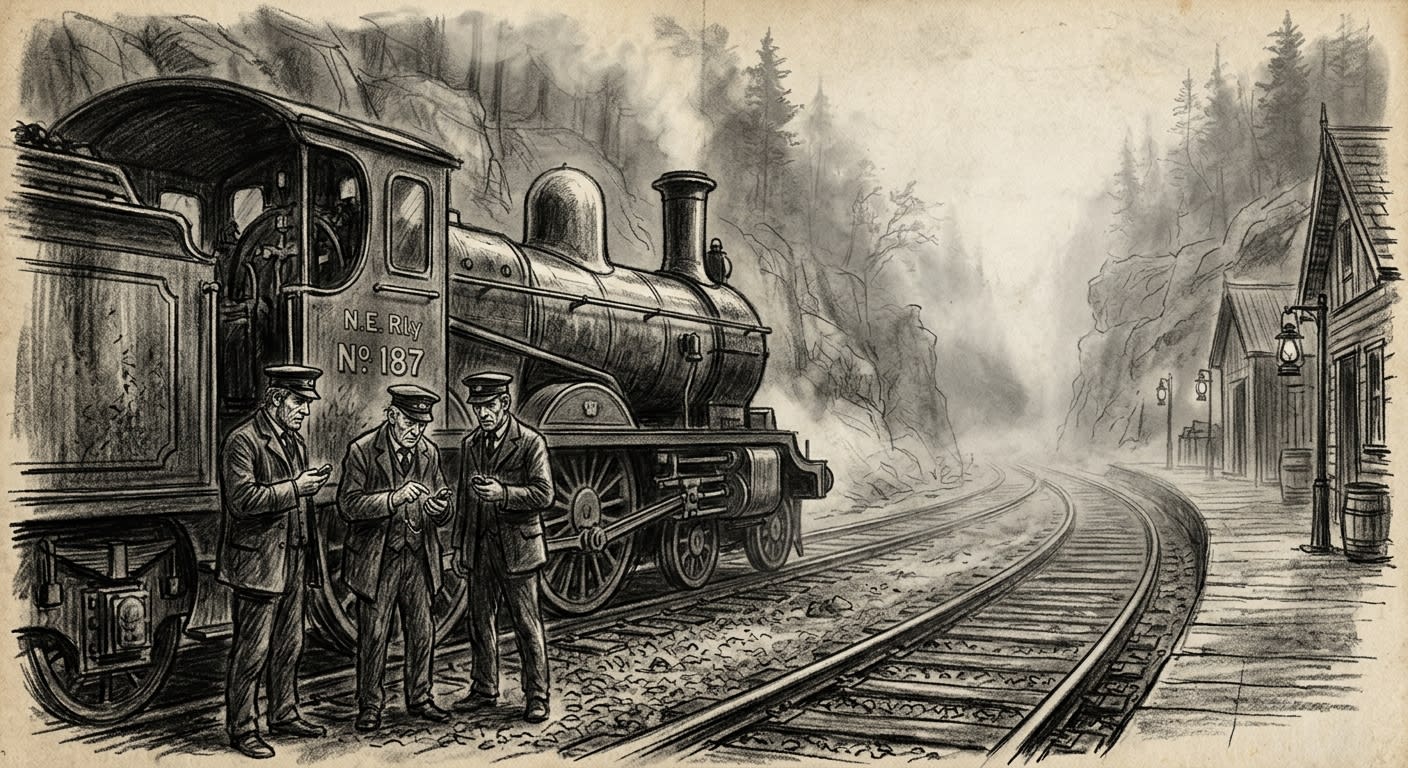
In A.S. 130, a rail crew working the Drava spur — the southern feeder line that connects the Balkan bastions to the Heartlands depots — filed a routine complaint with the Bureau of Engineering. Their locomotive had departed a scheduled waystation at the correct hour, by the waystation clock, and arrived at its terminus at the correct hour, by the terminus clock. The clocks agreed. The journey, by every timepiece consulted, lasted precisely four hours and eleven minutes. The crew, to a man, swore it had lasted nine.
The Bureau of Engineering dispatched an inspector. The inspector checked the clocks, checked the rail, checked the gradient, checked the coal, checked the water, and found nothing wrong. He filed a supplementary report noting that the crew's canteen had contained a spirit of uncertain provenance and recommended disciplinary proceedings for intoxication during operational duty. The crew was docked three days' pay. The matter was closed.
It was not closed. In A.S. 131, a second crew reported an identical discrepancy on the same spur. Then a third. A patrol at Bastion-Shipka — then a minor fortified relay, barely two decades old — noted that their dawn bell had rung at the correct hour by the bastion clock but that the sun, with characteristic indifference to the Bureau's filing, had been up for some forty minutes already. A telegraph operator at a forward station attempted to synchronise his sounder with the bastion's master clock and found a drift of seventeen seconds in a span of six hours. Seventeen seconds is a long time when artillery coordinates depend on bell-counts and the enemy's principal weapon is the dissolution of urgency.
By A.S. 133, the complaints had multiplied beyond the capacity of the Bureau of Engineering to dismiss as humidity, intoxication, or both. A Bureau of Rites theologian was consulted. He declared the matter "potentially doctrinal" and recommended referral to the Bureau of Doctrine. The Bureau of Doctrine received the referral, stamped it, sealed it, and returned it with the annotation: "The Creator's time is inviolable. Investigate the clocks." This was, in its way, a miracle of bureaucratic precision — it simultaneously acknowledged the problem, denied the problem, and instructed someone else to solve the problem. The Bureau of War, recognising that artillery shells care nothing for theological positions, constituted a dedicated office in A.S. 134 and housed it in Lyon, because Lyon was far enough from the front to permit careful thought and far enough from Strasbourg to permit honest reporting.
The Bureau of the Hourglass was born. Its first act was to re-examine the Drava spur. Its second was to measure every clock on the Sagittal Line from Königsberg to Constantinople. Its third was to classify the results. Its fourth — and this is the act that defined its character for all subsequent decades — was to seal the classification and distribute its findings to precisely no one.
Earlier Bureau of War assessments (A.S. 130–133) attributed all temporal irregularities along the Balkan corridor to "equipment degradation under field conditions" and "operator error compounded by altitude, humidity, and diet."
The Bureau of the Hourglass's founding survey (A.S. 134–136) established that temporal drift along the Sagittal Line is real, measurable, attributable to Syrionic influence, and distributed unevenly across all seven bastion sectors. The prior assessments have been reclassified as "provisional" — a designation the Bureau of Records employs when the word "wrong" would embarrass someone currently alive and of sufficient rank.
#On the Bureau's Function, and the Art of Counting What the Synod Would Rather Not Count
The Bureau of the Hourglass performs three functions. It measures. It classifies. It warns. It performs these functions with the dogged precision of men and women who have learned that precision is the only armour available to those whose warnings are routinely ignored.
Measurement is the Bureau's daily bread. Every timing relay on the Sagittal Line — and the Bureau maintains stations at all seven bastions, plus fourteen lesser posts at forward observation points, telegraph junctions, and rail waypoints — conducts continuous synchronisation checks against a master clock housed in the Lyon headquarters. Bell-resonance readings, telegraph-beat intervals, locomotive transit times, water-clock drip rates, candle-burn durations, and the heartbeats of trained adepts (who are instructed to sit quietly and count) are all recorded, compared, and graphed. The Bureau's archives in Lyon contain seventy years of such graphs. Laid end to end, they would stretch from Lyon to Strasbourg and back, which the Bureau of Records has verified because the Bureau of Records verifies everything and understands nothing.
The measurements reveal three categories of temporal anomaly, each classified under the Bureau's own taxonomy:
Class I — Syrionic Deceleration. The most common form. Time slows in proximity to Syrion's influence — clocks lag, bells arrive late, patrols return insisting they were gone an hour while bastion records insist on ten minutes. Deceleration is characteristic of the Languid Dreamer's domain: the Vales of Stagnance, the marsh corridors of Bastion-Shipka, the fog-choked ravines south of Bastion-Irongate. The Bureau classifies deceleration as "manageable" when drift remains below forty seconds per measured hour, "concerning" when it exceeds forty, and "operationally critical" when it exceeds ninety. At Bastion-Shipka, the corridor has hovered between "manageable" and "concerning" for the better part of two decades, creeping upward by fractions the Bureau logs with the patience of astronomers charting a comet that will arrive, eventually, to burn someone's city.
Class II — Temporal Disturbance, Localised. Anomalies that do not conform to standard Syrionic deceleration patterns. Clocks that run fast in a sector where deceleration is expected. Bells that ring in the wrong order — end-of-shift before mid-watch. Telegraph signals that arrive before they are sent. Water-clocks that pause and then surge, as though time itself were a reluctant pump-engine clearing an obstruction. These are rarer and more alarming. The Queue Road's Minute Drift — that spreading strangeness beneath Gate Nine where time is extracted rather than slowed, removed from the system and sent elsewhere — is the Bureau's most prominent Class II designation, elevated from its initial Category Two filing after the drift began consuming adjacent sheds and the woman at Gate Four aged twenty years between noon and vespers.
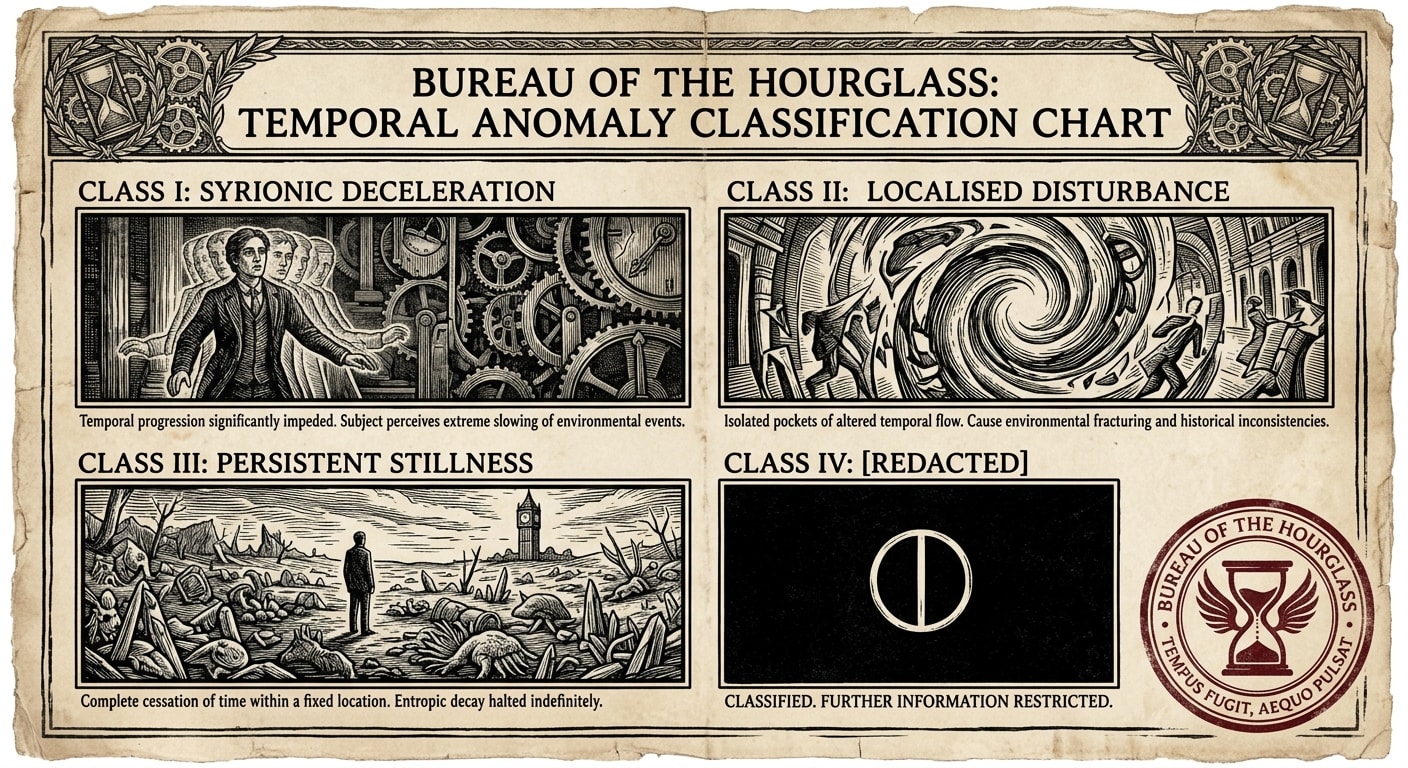
Class III — Persistent Stillness Fields. Zones where temporal anomaly has become ambient — baked into the terrain, soaked into the stone, seeping through the groundwater. At Bastion-Shipka, the entire marsh corridor carries a Class III designation: persistent low-grade stillness field, Syrion-adjacent, sub-threshold. Too weak to earn the dignity of a capital Wound. Strong enough that all timing work in the sector must be double-checked against bastion clocks and that garrison rotations are capped at four months — the heaviest on the Line — because longer tours produce men who can no longer count days.
And then there is Class IV, which the Bureau of Doctrine has sealed under Standing Order 7-A and which the Bureau of the Hourglass refers to, in its internal correspondence, only by the glyph: a circle bisected by a vertical line. I have seen this glyph. I will not speculate on its meaning. The Bureau of the Hourglass does not speculate. The Bureau measures.
#On the Bureau's Personnel, and the Character of Those Who Listen to Time Breathe
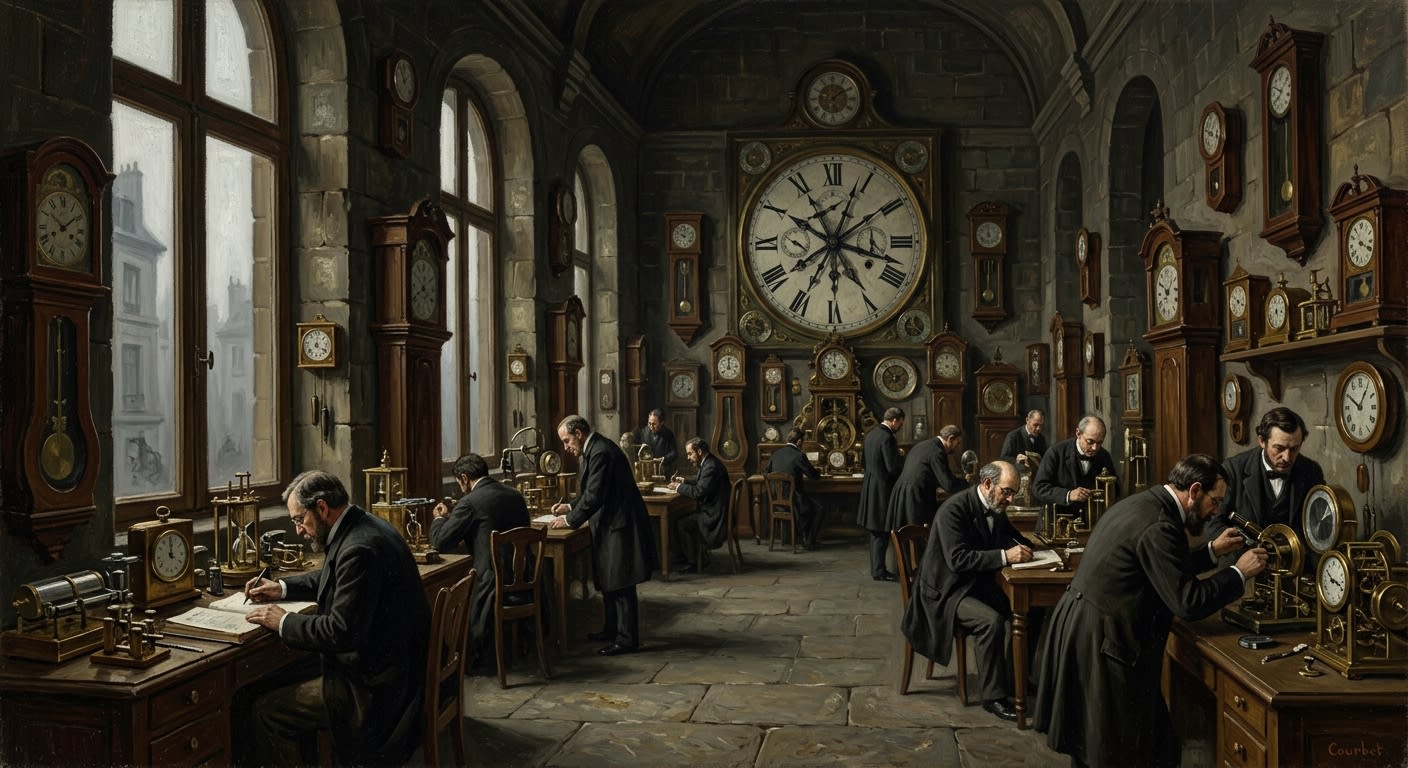
Hourglass adepts are drawn, predominantly, from the Lyon Academy of Horological Sciences — an institution the Bureau of Doctrine tolerates because it cannot do without and distrusts because it cannot control. The Academy trains its graduates in bell-resonance analysis, telegraph synchronisation, and the mathematics of oscillatory systems. It also trains them in silence, which is to say, in the art of recording what one observes without remarking upon what one observes, because to remark is to interpret, and to interpret is to trespass upon the jurisdiction of the Bureau of Doctrine, and to trespass upon the Bureau of Doctrine's jurisdiction is to find oneself reassigned to a listening post in a marsh where the frogs have not croaked for eleven years.
The adepts arrive at their postings with notebooks and beat-counters, ask impertinent questions about how often the fog "feels thicker," and are universally regarded by garrison soldiers as harmless eccentrics — "those clock-priests from Lyon" — until the day an adept files a report that saves a battalion. This happens more often than the Bureau of War admits and less often than the Bureau of the Hourglass claims.
At Bastion-Shipka, the Hourglass maintains a small field office perched above a maintenance arcade — three analysts lodged in rooms that smell of graphite and lamp oil, officially on "quiet assignment" after service at more spectacular fronts. The office has been there since the Bureau of War expanded the garrison around A.S. 190, when Syrion's fog pushed westward enough to demand something more than the previous arrangement of ignoring the problem and hoping it would bore itself into retreat.
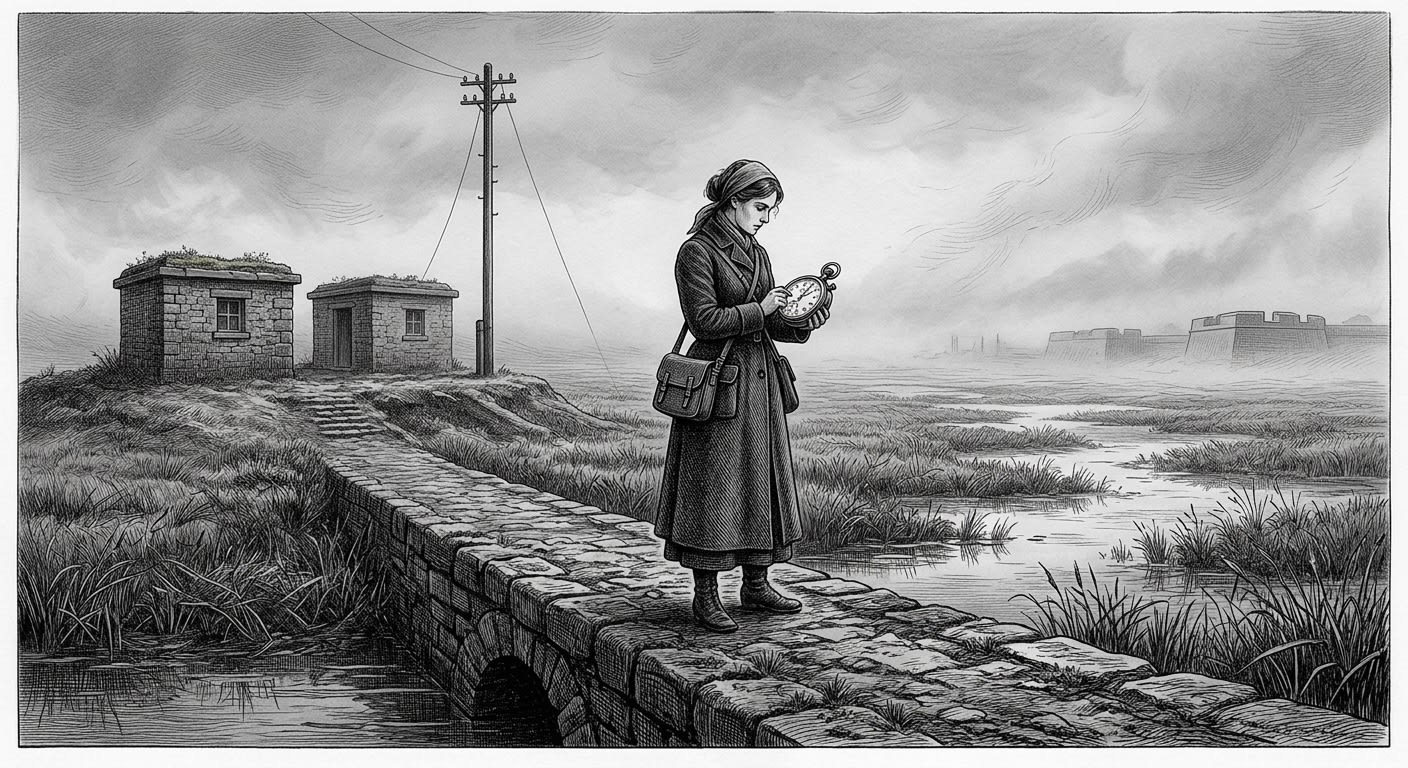
Senior Hourglass observers are posted to the worst places. This is policy, and the policy is sound: temporal anomaly concentrates where Syrion's influence is strongest, and Syrion's influence is strongest where the geography is wettest, coldest, and most hostile to human comfort. Adept Meryth Vesk of Lyon, the Bureau's senior observer at Bastion-Shipka's Station Two, has spent four years at a squat stone blockhouse on a causeway jutting into the deepest accessible reach of the marsh, surrounded by instrument-sheds and telegraph masts and a fog that never fully lifts. She has detected a recurring ninety-second anomaly at the same hour each day — a skip in the time-flow, a gap where ninety seconds of measured duration simply absent themselves from the record. The skip matches no known Syrion signature. It matches nothing in the Hourglass taxonomy. Vesk's report sits in a Bureau queue in Strasbourg, four places behind a request to reclassify a bell-tone and seven places behind a tithe dispute in the Rhineland. The clerk responsible for the queue has not read it. He has been busy.
Soldiers stationed at Hourglass posts rotate frequently. No one serves Station Two longer than three months; longer tours produce what the Bureau of Medicine terms "station-sickness" — insomnia, auditory hallucinations, a tendency to count one's own heartbeats obsessively. The adepts, by contrast, seem immune, or perhaps simply already strange enough that additional strangeness goes unnoticed.
#On the Bureau's Relationship to Other Bureaus, and the Politics of Being Believed Too Late
The Bureau of the Hourglass occupies a position in the Synod's apparatus that can most charitably be described as necessary and resented. Every bureau it reports to would prefer that its findings were different. The Bureau of War wants temporal drift to be a tactical inconvenience solvable by better clocks. The Bureau of Doctrine wants temporal anomaly to be either heresy (punishable) or miracle (claimable), and the Hourglass's stubborn insistence that it belongs to neither category; it is a phenomenon requiring measurement rather than interpretation — offends the Doctrine's fundamental conviction that all phenomena require interpretation by the Bureau of Doctrine. The Bureau of Rites regards temporal classification as its own domain and has filed seventeen jurisdictional complaints since A.S. 150, each of which the Hourglass has answered with data the Rites could not refute and did not read.
The Bureau of Bells is the Hourglass's closest ally, and even this alliance is strained. Bells measure time. The Hourglass measures what time does when Syrion's fog presses against it. The two Bureaus share data, share terminology, and share a mutual suspicion that the other is concealing findings that would clarify the picture. They are both correct.
The relationship with the Bureau of Shadows is — characteristically — undocumented. The Hourglass's sealed reports vanish into the same archives that swallow Shadow reports. The filing numbers use the same non-standard conventions. When I inquired, through channels I maintain for precisely such inquiries, whether the Bureau of Shadows and the Bureau of the Hourglass shared personnel, I received a letter consisting of a single sentence: "The Bureau of the Hourglass measures time." I asked the same question of the Bureau of Shadows and received no letter at all. I have filed both responses under "confirmation."
The Bureau's most fraught relationship is with the phenomenon it was constituted to study. The Hourglass measures Syrion's influence. Syrion's influence, over decades, has seeped into the Bureau's own operations — gradually, with the slow insistence of damp through stone. Reports take longer to file. Meetings run past their scheduled endpoints. The quarterly publications arrive late. The Lyon archive, which should take an afternoon to navigate, has been known to consume a full day without explanation, the archivist emerging blinking into a sunset he is certain was noon when he entered. The Bureau is aware of this. The Bureau monitors itself with the same instruments it turns upon the front. The Bureau's internal compliance reports are classified.
#On the Apparatus, and What the Bureau Found Beneath Gate Nine
I will speak briefly of the Apparatus beneath Gate Nine, because the Bureau of the Hourglass is the only institution that has produced a coherent assessment, and the assessment is the reason the Bureau's senior staff no longer sleep well.
The Minute Drift — that spreading temporal strangeness along the Queue Road where time is extracted from the local system and sent elsewhere — was initially classified by the Bureau of Rites as "Category Two Localised Temporal-Scribal Disturbance." A comfortable designation. A designation that permits the filing of reports and the continuation of tariff collection without the inconvenience of alarm. The Bureau of the Hourglass measured the Drift, applied its own taxonomy, and disagreed.
An unnamed Hourglass analyst — I have my suspicions regarding the name, and the analyst has my respect for reasons I will not commit to vellum — examined the Drift data and concluded that the Apparatus does something Syrion does not. Syrion decelerates. The Apparatus extracts. The distinction is the difference between a river slowing in a wide basin and a river vanishing into a hole in its own bed. The time goes somewhere. The analyst said: "Something is removing time from the system. The time is going somewhere."
I asked where. The analyst did not answer. The analyst's silence was more informative than most Bureau reports I have read in thirty years of service to the Ledger.
The Bureau of Rites maintains its Category Two classification of the Minute Drift with the serene confidence of a physician who has diagnosed a plague as indigestion.
The Bureau of the Hourglass has recommended reclassification to Class II-Extractive, sub-designation Alpha — the Bureau's highest non-sealed category. This recommendation has been pending since A.S. 198. The Bureau of Rites has not responded. The Minute Drift has, during the period of non-response, expanded to affect Gate Two and the Shed Wards. The Bureau of the Hourglass continues to recommend. The Bureau of Rites continues to not respond. The drift continues to extract. The reader may draw conclusions the Bureau is not authorised to draw.
#On the Dead, and What the Clocks Hear After Midnight
The Bureau of the Hourglass was constituted to measure Syrion's influence. It has, in the course of this mandate, stumbled upon a secondary function that no one requested, no one authorised, and no one wishes to discuss.
The dead affect the clocks.
The bell-resonance stations the Bureau maintains across all monitored zones — staffed by clerks who have been told they are measuring "atmospheric pressure," because the truth would empty the posting roster overnight — have detected a sustained increase in temporal irregularity that correlates with proximity to the dead. Front-line bastions, where casualties accumulate and the Ledger stamps are applied under conditions least conducive to conviction, show the sharpest readings. Industrial sites in the Heartlands — foundries, mines, the vast Ashbinder processing centres where the dead are rendered to ash in bulk — show secondary peaks. The correlation is not absolute. The Bureau, accustomed to the scorn of theologians, has published the data without interpretation and left the arguing to those who find arguing more productive than counting.
The Bureau of Rites, predictably, has claimed jurisdiction over this finding, arguing that any interaction between the dead and the measurable world falls under its classification of "post-mortem atmospheric disturbances." The Hourglass, equally predictably, has declined to surrender its data. The resulting jurisdictional dispute has generated more paper than the finding itself — a bureaucratic phenomenon the Hourglass has not, to its credit, attempted to measure.
#On the Present Condition, and Why the Bureau Counts What the Synod Cannot Afford to Hear
The Bureau of the Hourglass is sixty-seven years old. It employs approximately two hundred souls — the exact count is, as noted, classified, because the discrepancy between the official roster and the actual headcount has implications the Bureau of Records would rather not confront. Its headquarters in Lyon are modest, its field offices are austere, its adepts are regarded as eccentrics by the soldiers they serve and as threats by the theologians they contradict. Its quarterly publications arrive late. Its recommendations are acknowledged and not acted upon. Its classified findings are read by the Bureau of Shadows and by no one else, unless one counts the Bureau of Shadows as no one, which the Bureau of Shadows would consider a compliment.
The temporal drift along the Sagittal Line has been increasing for three decades. The increase is measurable, documented, and graphed in those seventy years of charts that would stretch from Lyon to Strasbourg and back. Syrion presses. The fog thickens. Clocks lie with greater frequency and greater confidence. And at Station Two, in a marsh where frogs croak at rhythms an adept has learned to read like scripture, Meryth Vesk counts the ninety seconds that vanish each day and waits for someone in Strasbourg to read her report.
The Bureau of the Hourglass is, in the final calculation, a bureau of prophecy staffed by people forbidden to prophesy. It sees what is coming because it measures what has already arrived. It counts the seconds the Synod is losing and files the count where the Synod will find it, eventually, when the count has become too large to ignore and the seconds have become too few to recover.
The hourglass, after all, only runs one way.