
#On the Imperfect Likeness
"At forty paces it is you. At four, it is an insult."
The Echo-Kin hand the Synod's sentries a problem in arithmetic. At a distance, on a wet approach-trench at the change of the watch, the thing walking behind a corporal of the Irongate walks the way he does. It has the same hitch on the left foot and the same habit of touching the rifle-sling where a buckle once chafed. Close to arm's length and the likeness falls apart. The hitch comes a beat late. The hand reaches for a buckle the demon does not wear. The face makes the corporal's expression the way a bad copyist makes a capital letter: every stroke present, the order wrong.
They belong to the host of Morwen, the Weeping Host, and the field scholars rank them among her lesser demons. That is a polite way of saying they are the worst forgers in a house of forgers. They follow. They copy gait, gesture, phrase and expression. They replace no one. The soldiers call them shadows that grew too ambitious, but that is only a figure of speech. The Echo-Kin is listed among Morwen's demons proper, not among her influence-demons, and the general rule holds: a thing with a body to walk in has a body that can be killed.
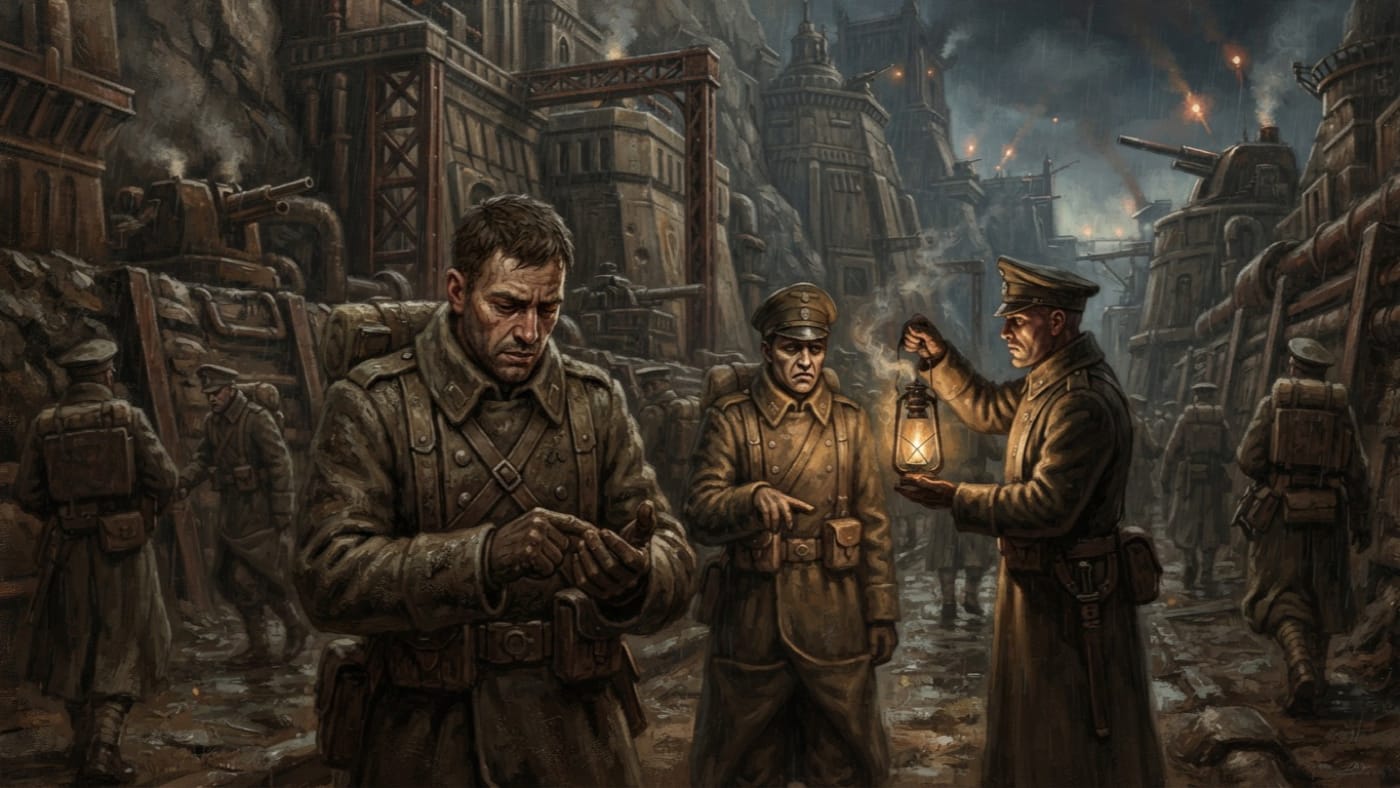
For quartermasters who like their horrors cheap, I record the obvious inference. A copy that fails at arm's length can be caught by a competent sergeant with a lantern. A thing that can be caught can be counted. A thing that can be counted is a nuisance.
#On the Borrowing of Gesture
"Which of us began it?"
The Echo-Kin does its work by staying. It keeps company, and the company is the injury.
Take a sapper, as an illustration and not a case, who for twenty years has rubbed his thumb along the side of his forefinger before lighting a fuse. He does not know he does it. His mates do; they would know him by it in the dark. Now put an Echo-Kin at the far end of his gallery, repeating the rub of thumb on finger every time he does it, badly and a little too long. On the first day he finds it obscene. By the fourth he has noticed the gesture in himself, which he never once did in twenty years. Some later day comes (the field reports give no count, and I will not invent one) when he catches his own thumb in mid-motion. He cannot say whether it moved because it always moves or because the thing at the end of the gallery just moved its own.
Speech goes the same way. Consider a watch-officer who says right, then before every order, a chaplain whose voice dips at the close of the evening collect, a stretcher-bearer who walks with his weight on his heels. Each habit is handed back to its owner slightly spoiled. Once spoiled, it becomes something the owner watches himself do. A man who watches himself walk walks badly.
The last stage is the one the scholars' file names plainly: the victim begins to copy the copy. He does it unawares; no man of the Irongate would admit to it under the scourge. His thumb learns the Echo-Kin's overlong stroke. His right, then picks up its late beat. The demon then copies the altered gesture, and the two pass the habit back and forth like a coin worn smooth. In the end neither the man nor anyone who knows him can honestly say where it was minted.
#On the Irongate Watch
"Same coat, same bread, same psalm. The demon thanks you for your discipline."
Set loose anywhere but a trench, the Echo-Kin might be pitied as a failed species. Bastion-Irongate holds the Iron Gates gorge, where the Danube forces its way through the Carpathian foothills between the old Romanian and Serbian banks. The channel is narrow enough to be held by cannon on both cliffs, and the rock is deep enough that half the garrison lives in tunnels. Morwen presses the gorge because she envies its beauty. Of all the instruments of that siege, the Echo-Kin is the smallest and the most patient.
Look at what the Synod has done to make its work easy. Every man on that stretch of the Sagittal Line wears the same greatcoat and the same mud to the knee. He eats the same ration from the same tin. He drills until his rifle comes to the shoulder on his neighbour's count. He says the same prayer at the same hour in the same words, because the Church requires it. The Bureau of War calls this cohesion, and it is. It also means the garrison has done most of the forger's work for him. A thousand men have been sanded down toward one outline, and only small private habits still tell them apart.
The Echo-Kin feeds on exactly those habits. In a crowded traverse at the watch change, under shellfire, by the light of a flare that lies for as long as it burns, nobody stands at arm's length long enough to see the late beat. A sentry sees a walk he knows and waves it through.
#On Distinctions Within the Host
"A lesser thing is still a thing."
The trench-scholars insist, with the scorn scholars keep for amateurs, that the Echo-Kin must not be confused with its betters. I grant them this much, briefly.
The Hollow Ones absorb, and the man beside one loses what it gains. Mirror-Stalkers live in reflections and come out improved, the original with his flaws corrected. Face-Thieves pick a target and replace him whole. The Worn have been so many people that they speak like a crowd. The Beloved come wearing the dead you loved, and they take something when you return the embrace.
The Echo-Kin does none of this. It takes no memory and no childhood, and it alters no document. It does not climb out of a puddle, and it never improves on its subject; whatever it gives back is worse. It cannot become everyone it has followed. Nothing records it growing into one of the others, and whatever the soldiers meant by its name, the name implies no family and no hive. Copying a man's hands at the breech-lever does not teach it gunnery. Demons do not work the Synod's machines, and watching closely does not make the Echo-Kin an exception.
#On Examination and Containment
"The rituals catch bad copies."
On paper, this makes the Echo-Kin the Synod's easiest enemy. Even their authors admit that the Identity Confirmation Rituals fail against a Face-Thief that has studied its target for months. The rituals are challenge-phrase and response and a recital of private history, and against bad copies they work. The Echo-Kin is the bad copy made flesh. Stand it at arm's length under a lantern and put the phrase to it, and the late beat gives it away before its answer does.
Now examine the man.
His file sits with the Bureau of Records among the Ledgers of Self. It records his appearance, his scars, his habits, and the sins he confessed at his last audit. Under habits it lists the thumb drawn along the forefinger before a fuse. The clerk watches the habit and finds it longer than described, slower, and ending in a small flourish that appears nowhere on the page. A Ledger can be altered, and it can be wrong. A man whose habits have been worn smooth against a demon's is now, in the strict clerical sense, at odds with his own file.
His Confession of Identity goes no better. He recites his history, and he gets it right. Then the confessor asks whether the gesture is his. He hesitates, because he no longer knows, and the hesitation goes into the record.
The Bureau of Purity's Mirror Discipline restricts reflective surfaces across the Irongate sector. It is aimed at the Mirror-Stalkers and at Morwen's influence in general, and no one has shown that it touches the Echo-Kin at all. A man denied his reflection cannot even check whether his face still makes his own expressions. He has to ask the man beside him, who wears the same coat.
A copy that fails at arm's length can be caught by a competent sergeant with a lantern. A thing that can be caught can be counted. A thing that can be counted is a nuisance.
The sergeant catches the demon, and the lantern finds the late beat. The man it followed walks back to his post with his thumb moving along his finger, watching it move. Catching the imitator settles the question of the imitator and settles nothing for the man it imitated. The Hieromnemon withdraws his earlier inference in this entry as written.
The duplicate protocol stays on the books. I state its scope carefully, because careless men have read it otherwise. It governs two claimants to one identity who cannot be told apart. An Echo-Kin seen at arm's length is no claimant. It is a demon and is dealt with as demons are, and the protocol says nothing about the man it shadowed. The real danger is smaller and meaner. A soldier who cannot swear his gestures are his own is a poor witness for himself. If a better forger comes for him later, he will stand before the chaplain-of-the-watch already unsure.
#On the Bureau's Finding
"Identified. Not consoled."
By every measure the Bureaus use, the Echo-Kin is a solved problem. It can be recognized and examined. It has a body and can be killed. Its failures show at the distance of a handshake, and rituals built for worse enemies catch it without strain.
The corporal still touches his sling where the buckle once chafed. Then he stops, and looks at his hand.