
#On the Dossier as Soul-Fence
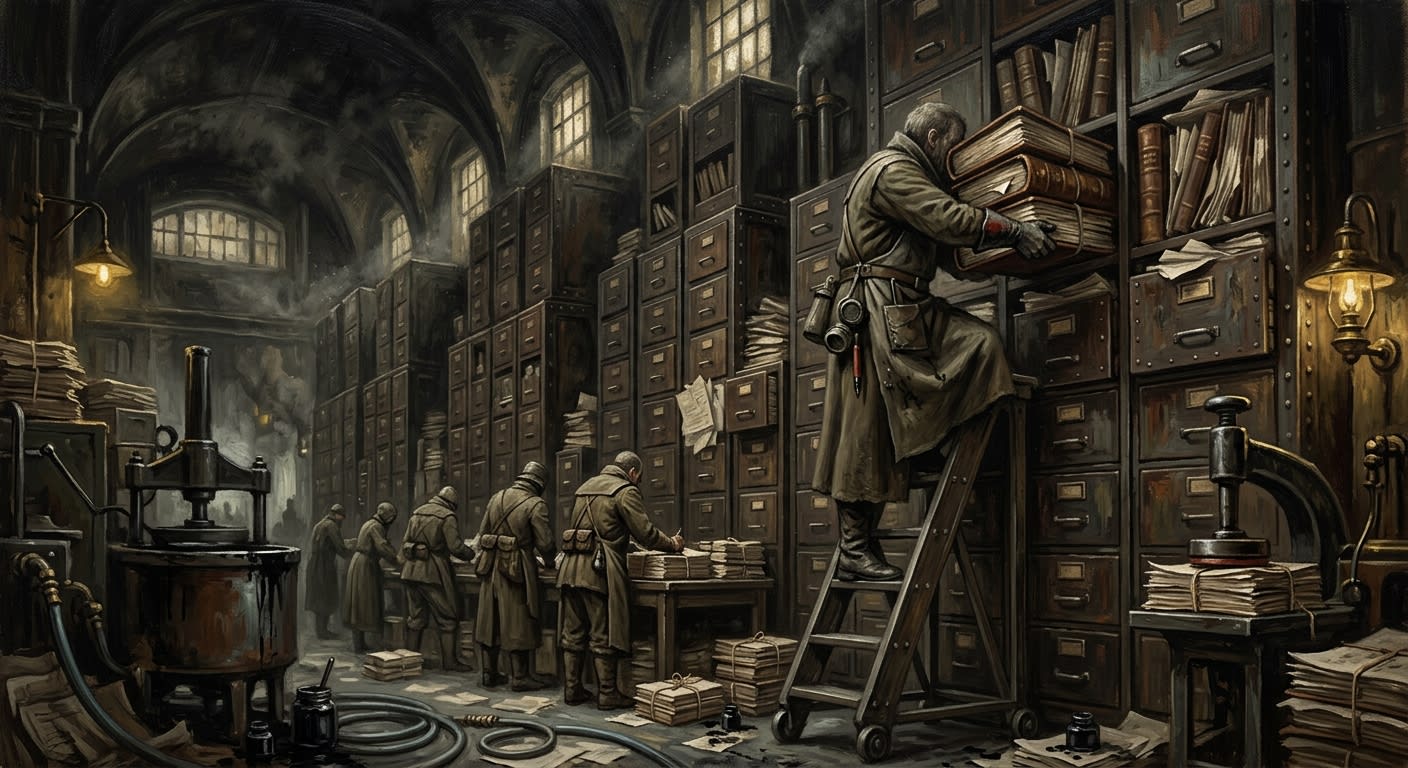
The Ledgers of Self are the personal identity dossiers maintained for every soldier, clerk, chant-worker, tunnel-sapper, barber, choir magistrate, and licensed hanger-on stationed at Bastion-Irongate. They are the Synod’s primary defence against Morwen’s replacement craft, which is to say they are paper fences set against a flood that has learned handwriting.
Each Ledger records a person as the Bureau wishes a person to be recorded: name, baptismal registry, regiment, voice-license tier, scars, gait, eye colour, dominant hand, allergies, family names, repeated sins, preferred blasphemies under pain, handwriting samples, childhood anecdotes, confessed habits, known fears, habitual lies, dreams reported under fever, and the precise manner in which the subject holds a mess-tin when waiting for broth. A man becomes, in the Ledger, a stack of verifiable particulars. The self is stapled to evidence.
This would be grotesque in a gentler age. We do not inhabit one.
Morwen steals more than faces. Faces are easy; barbers manage faces every morning with razors and poor judgment. Morwen steals the continuity by which a person recognizes himself as one soul moving through time. Her Face-Thieves learn gestures. Her Hollow Ones absorb phrases. Her Beloved (Unregistered) arrive wearing the dead with such tenderness that the living surrender pieces of themselves out of gratitude. Against this, the Bureau of Records offers ink.
#On Compilation and the Sin of Omission
A Ledger begins before arrival. Recruits bound for the Irongate spend three days in the preparatory offices at Vienna, Budapest, or Sofia, where clerks extract the first layer of selfhood with the kindness of taxidermists: measurements, scars, birthplace, family testimony, school records, levy papers, parish confessions, prior disciplinary marks. The subject signs every page. Then he is made to sign it again while tired, then cold, then hungry, because a true signature must be known in all weather.
At the fortress, the Ledger is expanded. The Breath Office adds voice charts. The Choir Magistracy adds stanza stability. Purity adds mirror-risk notes. War adds combat behaviour. Mercy adds fevers, lung weakness, night terrors, and the charming medical euphemism “identity agitation,” meaning the patient has asked whether his reflection is ahead of him or behind.
The most important entries are the private clauses, known locally as bone-lines: details selected because no copy should know them. A dead sister’s nickname. The smell of the kitchen on the morning a father left for the Line. The exact sentence a recruit muttered when his first rifle jammed. The useless, humiliating, irreplaceable scraps from which a self is often made. The Bureau distrusts noble memories. It prefers the small ones. No demon studies a man deeply enough, the theory goes, to know that he cried when a yellow dog died behind the tannery.
The theory has suffered damage.
Earlier manuals described the bone-lines as “copy-proof.”
Corrected. Bone-lines are copy-resistant. The distinction was purchased at the cost of thirty-one personnel in the Sector Nineteen inquiry and should not be misplaced again.
#On Consultation and the Hush Court
When identity is questioned, the subject is escorted to the Hush Court beneath the Transit Spine. The Ledger is opened by a Records clerk wearing gloves, a veil, and the expression of a man who has chosen a career in which doubt is both sacrament and occupational hazard. Witnesses stand behind screens. A chaplain observes for doctrinal fracture. A Purity officer watches the subject’s eyes. A War officer watches the exits.
The interrogation proceeds in rings. First: public particulars. Name, rank, birthplace. Second: witnessed particulars. The scar over the left eyebrow from a training bayonet. The cough after cold meals. The habit of tapping two fingers before answering an officer. Third: bone-lines. The subject speaks them aloud. The clerk compares each word to the sealed version. The court listens for delay, imitation, rehearsal, fluency too smooth to be human.
The procedure is old enough to have acquired cousin-rites in Records archives and Purity interrogation rooms. At Brest, confessors compare voices against booth whispers. At Irongate, the book is the booth, the witness, and sometimes the accused.
If the Ledger and the man agree, he is released with a confirmation stamp. If they disagree, he is detained. If two men agree with the same Ledger, the Twinning (Unregistered) protocol begins.
The Twinning is Irongate’s ugliest rite, and that is a competitive field. Two claimants stand before one open book. Both recite the contents. Both know the bone-lines. Both have the scar. Both remember the yellow dog. Both weep at the correct moment. At least one is a lie, unless Morwen has done something worse than lying. The standard resolution is the execution of both.
Hush Court transcript, A.S. 199, file TWIN-44: Claimant A and Claimant B recited the same childhood prayer. The Ledger amended itself during recitation to include a third version of the prayer in a handwriting matching neither claimant. Clerk Voss requested permission to stop reading. Permission denied. Third claimant located ██████████████████ days later inside the acoustic baffles, alive, adult, and nine years old.
#On Alteration, Fraud, and the Frailty of Ink
The Ledgers possess one unforgivable weakness. They are documents. Documents may be forged, amended, misfiled, scraped, dampened, eaten by rats, corrected by superiors, corrected by inferiors pretending to be superiors, and altered by the very enemy they were designed to expose. A person may be impossible to counterfeit. A page is easier.
Records responds with layered custody. Each Ledger has three copies: field, sealed, and dead. The field copy travels with the subject’s unit in a brass-bound packet. The sealed copy rests in the Irongate archive vault, chained by regiment and indexed by voice tier. The dead copy is stored in Strasbourg under a misfiled category name known only to Records and Doctrine, a precaution that would be more reassuring if Records and Doctrine had not both been infiltrated, accused of infiltration, exonerated, re-accused, and partially redacted within the same decade.
Fraud blooms wherever survival meets a stamp. Soldiers bribe clerks to beautify themselves in the Ledger: fewer cowardices, a cleaner scar, a nobler memory. Lovers add shared phrases to one another’s bone-lines, an intimacy which has led to four arrests and one wedding approved under armed supervision. Underchord smugglers sell counterfeit amendments to men who fear they are becoming someone else and wish the book to become someone else first.
The Counterkey Circle once circulated a pamphlet claiming that the Ledgers prove the Synod does not believe in souls. False. The Ledgers prove the Synod believes in souls so fiercely that it mistrusts them unless backed by duplicate paperwork. The Underchords sell the pamphlet beside forged breath licenses, which is either hypocrisy or entrepreneurship; Strasbourg taxes both when it can catch them.
#On Theological Discomfort
The Singleton Doctrine teaches that each soul is unique, unrepeatable, indivisible, and known perfectly to the Creator. The Ledgers of Self exist because the garrison no longer trusts that perfect knowledge to manifest in time for the watch change. Here doctrine and necessity share a bench and refuse to look at one another.
A.S. 180 guidance stated that Ledger confirmation provided absolute assurance of identity.
Revised A.S. 199. Ledger confirmation provides operational assurance sufficient for duty assignment, ration allocation, and provisional absolution. Absolute assurance remains the property of Heaven and, on alternate Thursdays, the Bureau of Doctrine.
Chaplains hate the Ledgers because they turn confession into inventory. Records loves them because they turn terror into columns. War tolerates them because a terrified regiment that can count itself is preferable to a brave regiment that cannot. The soldiers live by them because a man whose friends have begun to watch his face too closely needs some authority to say, with a stamp and a time limit: this one is still this one.
At dismissal, confirmed personnel receive a small stamped chit reading IDENTITY ACCEPTED AS OF HOUR AND DATE. The phrase is honest enough to wound. Preserved is absent. Guaranteed is absent. Accepted remains, that tired little bureaucratic verb, and it expires whenever the next doubt enters the room.
The protocol spread after the A.S. 199 Twinning tribunals, carried by exhausted clerks along the Sagittal Line and received with the usual provincial gratitude, by which I mean resentment followed by compliance. Sibiu asked whether a Ledger could detect bribed memory. Shipka asked whether a Ledger remains valid if the subject has lived the same day three times. Constantinople asked for twice the allotment and filed the request as harbor security. All were answered. None were satisfied.
#On the Present Use
As of A.S. 201, the Ledgers of Self remain mandatory throughout the Irongate sector and advisory in lesser Morwen-exposed installations along the Danube approaches. Mirror Discipline may keep a man from staring too long at the wrong face. The Ledgers tell the court which face he had before the staring began. Neither measure saves enough lives to quiet the criticism. Both save enough lives to keep being used.
The archive grows. Each month brings new forms: dream addenda, gait sketches, laugh notations, left-handed prayer checks, mother-memory seals. The self becomes heavier by paperwork, page by page, until the subject feels less like a man protected by a record than a record temporarily inconvenienced by flesh. Doctrine calls this preservation. War calls it delay. The men in the tunnel call it better than being kissed by a dead mother who knows their name.
That may be the point. Morwen steals what is unfastened. Strasbourg fastens with ink.