
#On the Three-Second Law
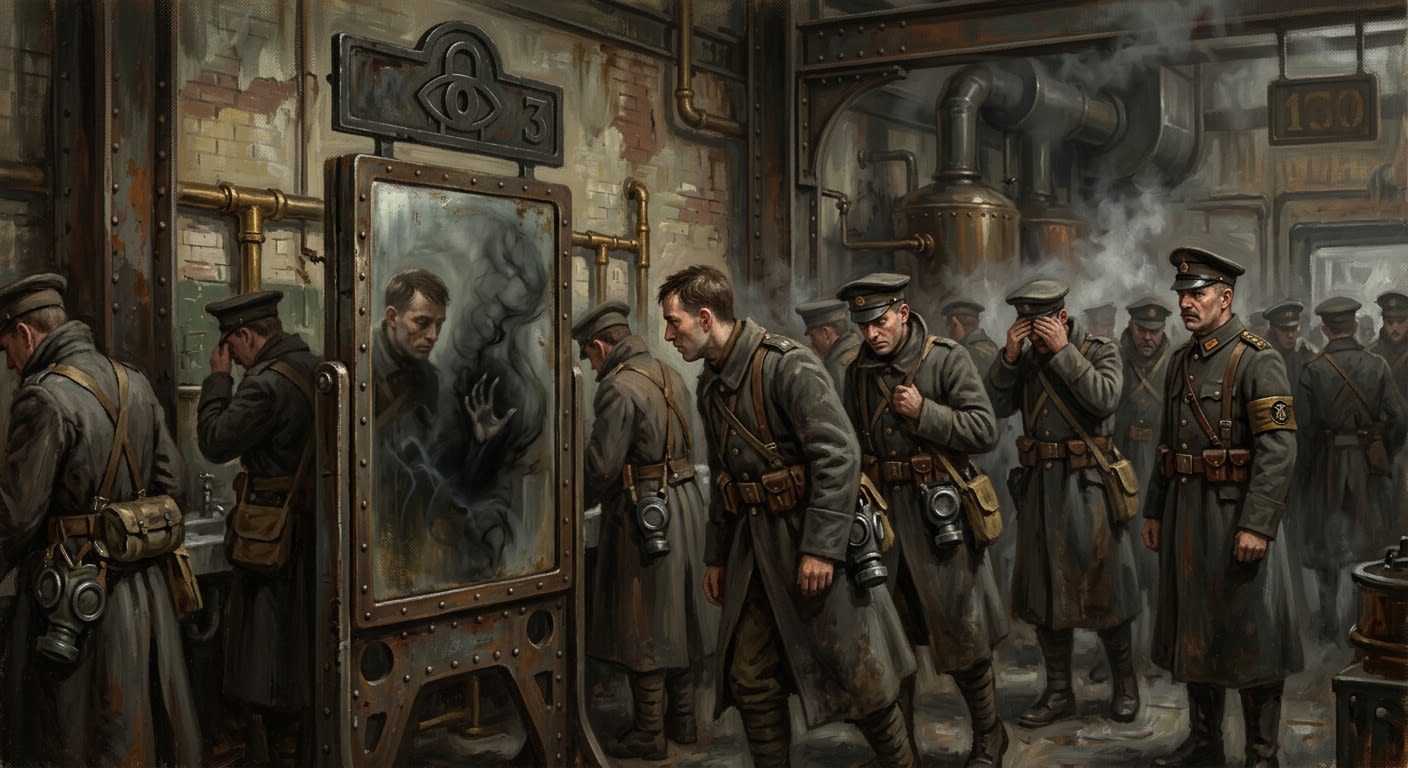
Mirror Discipline is the Bureau of Purity protocol by which personnel stationed near Morwen’s front are forbidden to look at their own reflections for longer than three seconds. Three seconds for recognition. Three seconds for shaving cuts, collar alignment, blood on the cheek, the little practical humiliations of military life. On the fourth second, vanity becomes an aperture.
The regulation began at Bastion-Irongate, where the Danube gorge offers Morwen every insult she craves: beauty, purpose, and stone that knows what it is. Her agents entered through mirrors, polished mess-tins, still puddles beneath pressure doors, brass fittings rubbed too bright by nervous hands, and the shameful silver backs of officers’ shaving kits. The first reports were dismissed as trench fancy. The second reports were forwarded to Doctrine. The third reports wore the faces of the men who had written the first reports, and the matter became official.
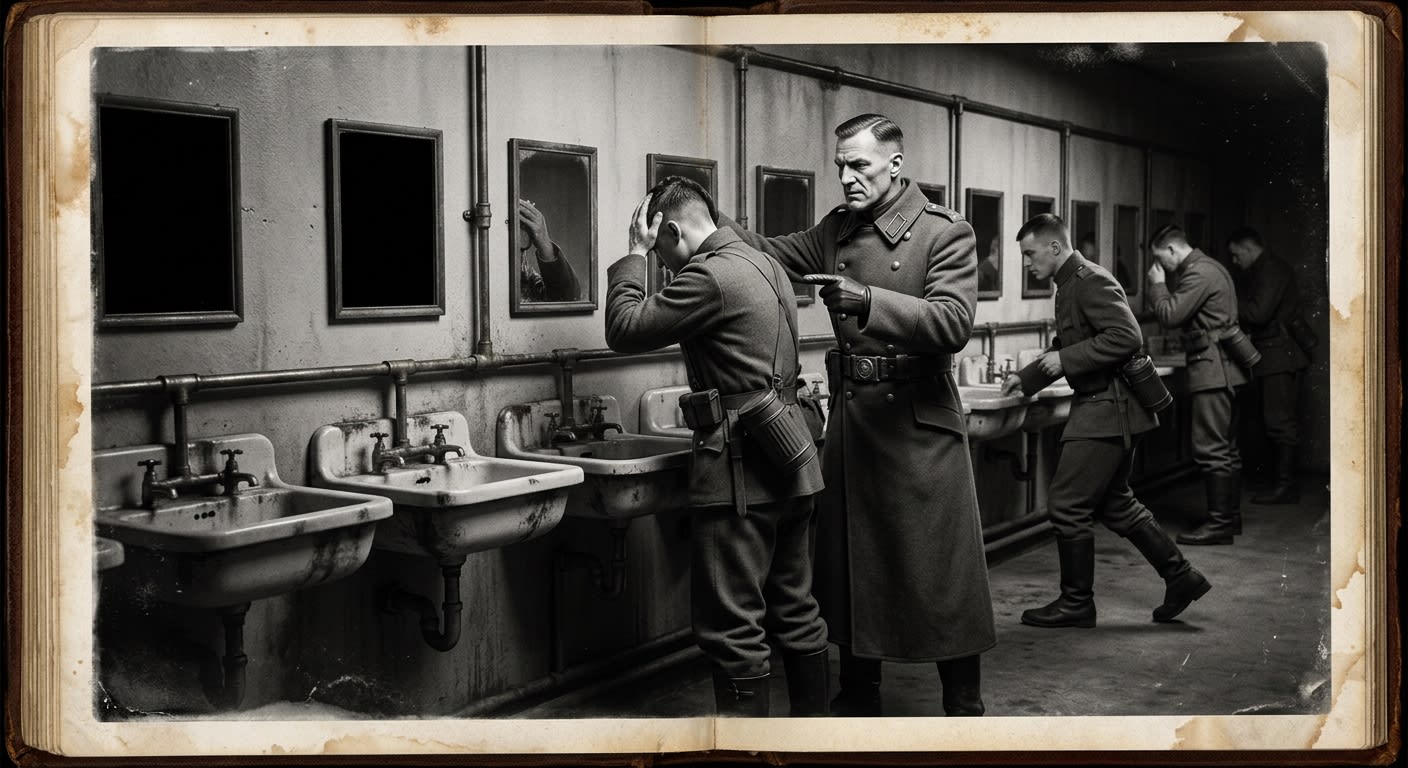
The law is simple enough for soldiers, which is to say it is simple enough to be shouted at them before breakfast. No mirror larger than a palm. No polished metal within three hundred yards of the perimeter. No standing water left uncovered in barracks, tunnels, latrines, kitchens, ammunition galleries, confession booths, or choir vestries. Shaving by assigned barber only. Hair cutting by touch. Uniform inspection by partner. Face inspection by clerk. Reflection inspection by no one.
This is the first kindness of Mirror Discipline: it makes terror administrable.
#On Sector Nineteen
The Incident at Sector Nineteen supplies the protocol’s founding wound, and the wound remains mostly bandaged. Earlier summaries in the official documentation are permitted to state that an entire platoon was found alive at dawn after being dead for three days, correctly uniformed, properly drilled, standing watch beside the pressure door behind which their bodies had been stacked according to Rites interment procedure. This is true. This is insufficient.
The men at the posts knew the passwords. They knew the duty roster. They knew the private jokes of the platoon, the ration complaints, the order in which the dead men had been stacked, the name of the corporal who had wept while stacking them. When challenged, they did not attack. They asked, with the bewildered dignity of men unjustly accused by idiots, why their service was being interrupted. One requested leave to attend a sister’s wedding in Bratislava. The sister existed. The wedding had occurred twelve years earlier. The claimant was twenty-two.
The first instinct of War was execution. The first instinct of Purity was quarantine. The first instinct of Records was to demand signatures. All three instincts are ugly. Two were useful.
Unsealed fragment from Purity annex 19-C: the polished brass pressure gauge in Sector Nineteen continued to show thirty-one faces after the duplicates were removed. The gauge was melted. The ingot showed thirty-one faces. The ingot was buried. The burial map showed thirty-one ██████████████████ arranged in a circle around the surveyor’s name.
A.S. 193 marks the formal adoption of Mirror Discipline. The Bureau would prefer all causal language struck from related memoranda, since causation implies a single cause and Sector Nineteen was, by every surviving testimony, a choir of causes screaming through one brass keyhole. I retain the vulgar logic. A platoon died. A platoon returned. Mirrors were blamed. Mirrors have not forgiven us.
Initial field guidance described Sector Nineteen as “a duplication event of uncertain medium.”
Corrected. Sector Nineteen was a reflection-mediated replacement event with secondary identity persistence. The correction satisfied Purity, frightened Records, and caused War to ask whether “shoot both” remained acceptable. It did.
#On Barbers, Tin, and Institutional Humiliation
The visible apparatus of Mirror Discipline is petty, intimate, and miserable. Mirrors in latrines are replaced with warped tin panels that stretch the nose, bend the jaw, and render every soldier as a caricature of himself. Barbers work by touch, two fingers on the cheekbone, thumb at the jaw, blade moving under candle or electric bulb while the seated man stares at a cloth wall and pretends trust is a virtue he still possesses. Officers submit to the same treatment. This is the only part of the protocol the enlisted men enjoy.
Inspection stations sit at the Transit Spine, the Choir Nave doors, the Breath Office, the Hush Court, and the Snowmouth Gate. Each station keeps a dulling kit: pumice, lampblack paste, canvas wraps, matte lacquer, blessed sand, two hammers, one broom. Reflective surfaces are not confiscated when they can be ruined in place. A polished buckle is scraped. A brass tube is smoked. A puddle is salted. A shaving mirror is broken, logged, wrapped in black cloth, and sent to Purity as evidence or to Ordnance as scrap, depending on which Bureau reaches the bin first.
The three-second count is performed aloud. One: recognise. Two: assess. Three: avert. Soldiers learn the rhythm the way they learn rifle drill. Children in the civilian warrens learn it as a skipping chant and are beaten for it only when Purity hears the fourth count. There is no fourth count.
The penalty for casual violation is confinement and Ledger review. The penalty for repeated violation is isolation. The penalty for standing before a mirror and conversing with what answers is immediate armed interruption, followed by inquiry, prayer, and the usual dispute over jurisdiction among the Bureaus whose seals appear on the corpse.
#On the Ledger’s Sister
Mirror Discipline does not prove who a man is. That dreary miracle belongs to the Ledgers of Self, those magnificent little coffins of ink in which Records stores gait, scars, sins, handwriting, mother’s names, childhood dogs, and the manner of holding a mess-tin. Mirror Discipline prevents the question from multiplying before the Ledger can be opened. It is not an answer. It is a tourniquet.
The two protocols operate together. A soldier caught staring is removed from the reflective surface, brought before a clerk, checked against his Ledger, confessed under Purity witness, and returned to duty if the paper and the pulse agree. If he claims the reflection spoke, the Hush Court is notified. If the reflection claimed to be him, two chairs are prepared. If the reflection gave an order in his commanding officer’s voice, the entire watch is relieved, the pressure door sealed, and Commandant Sorn receives the report with his customary facial expression, which is to say none.
The system catches bad replacements, frightened boys, vain officers, homesick widowers, and that special category of fool who thinks rules exist for other men. It fails against Morwen’s finer work. A copy that knows to avert its eyes passes. A man already hollowed by comparison obeys the count with exquisite discipline. The protocol is a gate, and gates keep out only what cannot produce a pass.
Purity Circular 193-M stated that Mirror Discipline “prevents identity theft.”
Clarified. Mirror Discipline reduces exposure to reflection-mediated approach vectors. The earlier phrase was optimistic, which is to say doctrinally premature.
#On the Damage Done by Safety
The first month without mirrors produces relief. The second produces clumsiness. The third produces a garrison of men who no longer know whether they have aged, sickened, healed, been scarred, gone grey, gone hollow, or simply become ordinary. They ask barbers whether their faces look right. They ask lovers whether their eyes have changed. They ask chaplains whether the soul remembers the face. Chaplains, when cornered, quote the Singleton Doctrine and hope no one asks a second question.
Morwen understands deprivation. Deny a man his reflection and he begins to hunger for proof of himself. The warped tin meant to save him becomes an insult. The assigned barber becomes a witness he resents needing. The partner inspection becomes intimacy without comfort. The Ledger says he is himself. His own eyes are not permitted to confirm it.
At Irongate this produces customs not found elsewhere on the Sagittal Line. Mothers describe children to themselves at breakfast. Married couples exchange face-inventories before sleep: one mole, two lines, left eyebrow split, mouth tired, still yours. Soldiers commission charcoal portraits from artists who draw from memory, then hate the portrait for being wrong and love it for being proof. The Underchords sell illegal true glass in slivers small enough to hide under the tongue, which has led to choking, infection, and one case of a man swallowing his own reflected eye. The Bureau of Mercy disputes the anatomy. The Bureau of Purity has the jar.
There is a theological wound here, and I dislike naming wounds before they have paid the proper fee. If the Creator made Man in an image, and Purity forbids Man to inspect that image, then the fortress is defended by a small blasphemy committed every morning with a towel over the washstand. Doctrine has ruled otherwise. Doctrine is correct by definition. The towel remains.
#On Wider Adoption
Mirror Discipline has travelled beyond Irongate, though never with the same severity. Sibiu uses dull-metal orders during bribery scandals tied to Velmora’s coin-voices. Brest bans still water near confession booths after reflected murmurs began repeating sins not yet spoken. Shipka attempted a reflection curfew, abandoned it when the same dawn appeared four times, then reinstated it retroactively. Constantinople applies the protocol in infirmaries, bath-houses, pilgrim quarters, and officer messes whenever Velkara’s agents are suspected, which is always, and never fully.
The protocol degrades as it moves west. In Strasbourg salons it becomes fashionable austerity: ladies with smoked hand-mirrors, officers boasting of three-second shaves, clerks covering inkpots as if Morwen herself intended to climb from the black. Fashion is the idiot cousin of fear. It wears the family face badly.
Purity requests expansion. Records requests cross-indexing with the Ledgers. War requests more hammers and fewer pamphlets. Mercy requests exemptions for wards, burn victims, and the dying. Doctrine grants exemptions only when the paperwork proves that compassion will not become precedent.
#On the Present Count
As of A.S. 201, Mirror Discipline remains active at Irongate and its adjoining Danube approaches. The three-second law is painted above washrooms, stamped on shaving cloth, etched into barber kits, printed on convoy manifests, and taught to recruits before they learn the local prayer for gasket failure. The soldiers obey. Mostly. The barbers cut. The tin warps. The puddles are salted. The brass grows dull under lampblack and thumb-grease.
Morwen still enters.
That is the part Purity hates. The protocol works often enough to be necessary and fails often enough to be honest. A perfect defence against Envy would require a species that never disliked its own face, never coveted another’s, never lingered over the possibility that somewhere, behind silver or water or polished steel, a better self was waiting to step forward and relieve it of the burden of being born. The Synod has not been issued that species. We have men. Men require rules, razors, and someone to count to three.
Count, then. Avert. Live until inspection.