
#On the Soul as a Singular Legal Problem
The Singleton Doctrine is the Bureau of Doctrine's formal holding that every human soul is unique, unrepeatable, indivisible, and known perfectly to the Creator. It is a beautiful sentence, which naturally means the Synod has used it to excuse several uglier procedures. At Bastion-Irongate, where Morwen sends faces back better than she found them, beauty in doctrine is treated like polish on brass: admired briefly, dulled immediately, and never trusted near the perimeter.
The doctrine predates the Irongate crisis. It lies in the older catechisms, under the headings of personal judgment, confession, resurrection, relic custody, and the inadmissibility of borrowed guilt. One soul, one judgment. One name, one ledger. One body, when Providence permits such administrative tidiness, one accountable creature standing before Heaven without clerk, mask, substitute, or proxy. The Bureau has always approved this arrangement. It is orderly. It is terrifying. It gives the Ledger a throat.
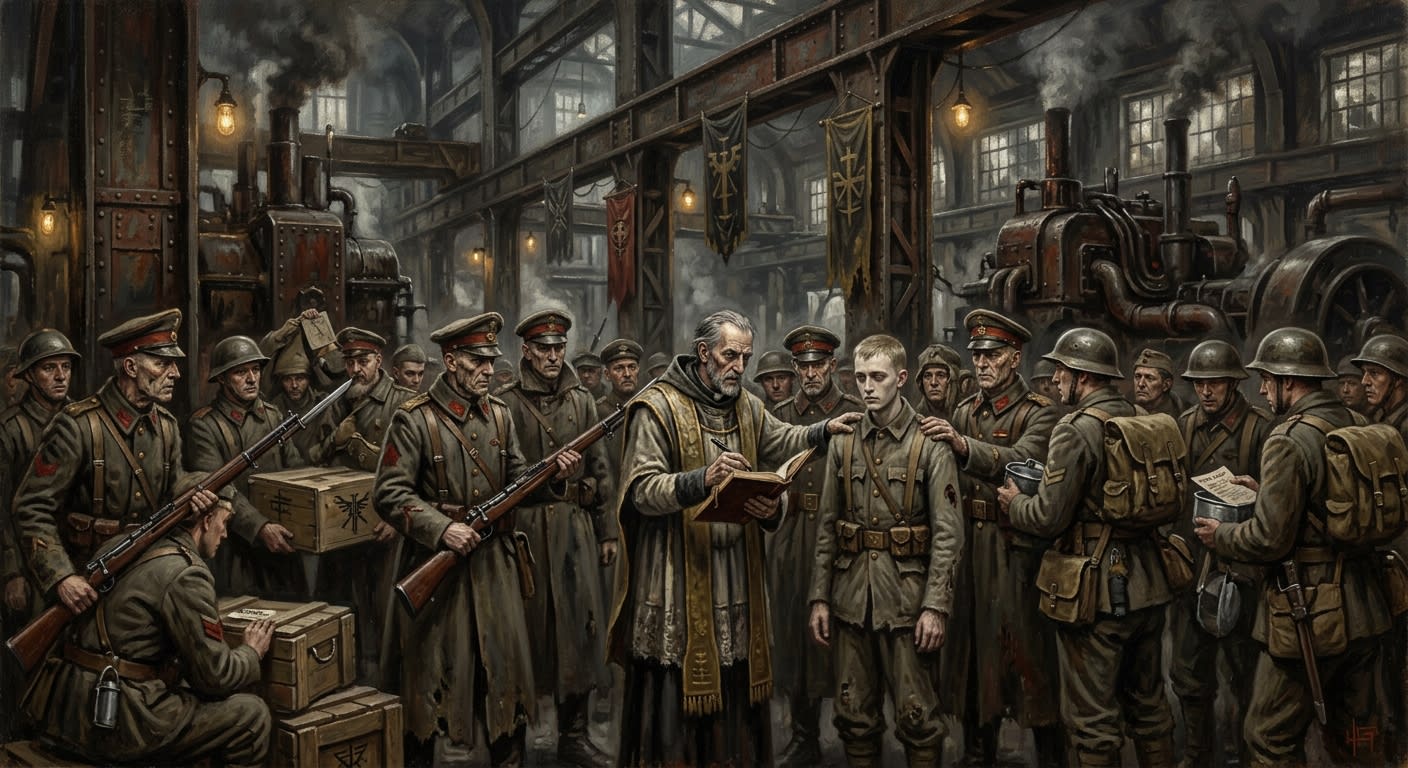
The trouble began when Morwen made the sentence operationally embarrassing. Her Face-Thieves, Hollow Ones, Mirror-Stalkers, Worn, Echo-Kin, and Beloved do not debate uniqueness. They counterfeit evidence. They return men who know their passwords, remember their dogs, recite their childhood shames, avert their eyes at the third count, and weep at the correct family name. Against such creatures the Singleton Doctrine remains true. It also arrives late.
#On Older Comforts and Their Paper Teeth
Before the Sundering, the Singleton Doctrine functioned chiefly as a fence against theological luxuries: reincarnation fancies, transferable guilt, twin-soul mysticism, grief cults that married widows to echoes, and those small village heresies by which people make death less rude. Doctrine crushed these with ordinary competence. A man was himself once. He sinned once. He died once. He rose, if granted mercy, as himself and not as his neighbour's better-looking cousin. Simple enough for a parish. Strong enough for law.
The Age of Reason assaulted the doctrine from another direction, treating the self as mechanism, habit, nerve, education, appetite, and chemistry under a powdered wig. Rationalist lecturers loved to ask where the soul resided if memory could fail, habit could change, and injury could make a gentle man violent. The Bureau's ancestral answer was magnificent in its brevity: the soul is where the Creator knows it to be. This is also where many lost files reside, though Records dislikes the comparison.
The Sundering gave the argument claws. Kargath starved men until they ate what they had called sacred. Maldrake burned wrath into loyal regiments. Syrion made time soften under the feet. Morwen attacked identity itself. The older doctrine survived, because truth survives inconvenience. Its public language hardened from consolation into assertion, from assertion into rule, from rule into stamp.
Pre-Irongate catechetical summaries described the Singleton Doctrine as “self-evident to any properly instructed Christian soul.”
Corrected after Morwen-front testimony. The Doctrine is revealed, binding, and not self-evident to a sentry facing his own face with better posture and correct passwords.
By A.S. 180, Doctrine still used the phrase absolute theological protection against identity corruption. I can admire the confidence. I can also admire a parade uniform worn into a sewer; both gestures possess splendour and limited practical value. The A.S. 199 reassessment, issued after the Twinning proceedings and the spreading discomfort around the Ledgers of Self, replaced protection with significant theological comfort. The word comfort did not comfort anyone. It was honest enough to cause damage.
#On Sector Nineteen and the Recited Wound
A doctrine becomes serious when frightened men quote it in the wrong room.
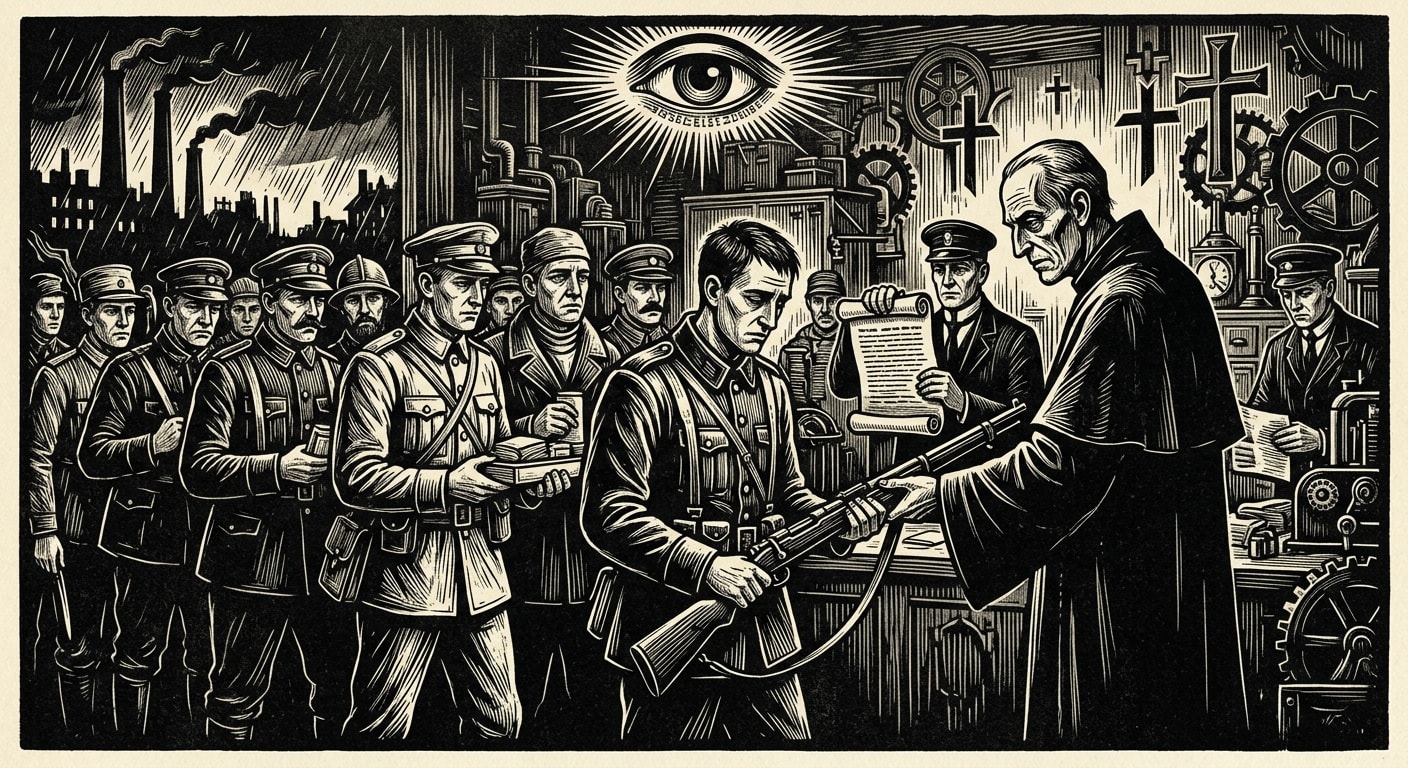
During the Sector Nineteen inquiry of A.S. 193, after thirty-one dead personnel returned to watch three days after emergency interment, the Bureaus attempted their familiar sequence: War wanted execution, Purity wanted quarantine, Records wanted signatures, Rites wanted the bodies to stop testifying. The Incident at Sector Nineteen tore through all four appetites. The returned men matched scars, dental marks, duty memory, passwords, and ordinary resentments. Their Ledgers confirmed too much. Their mirrors frightened examiners by being obeyed too well.
Then three returned men began reciting the Singleton Doctrine in perfect unison, each using a different chaplain's cadence.
SECTOR NINETEEN ANNEX — DOCTRINE LISTENING COPY Subject group: three returned personnel. Text recited: Singleton catechism, pre-A.S. 180 recension. Cadences identified: Chaplain Rusk A.S. 188; Chaplain Dellen A.S. 191; Chaplain Mavret A.S. 193. Chaplain Rusk status: dead before subject enlistment. Chaplain Dellen status: transferred west, denies teaching variant. Chaplain Mavret status: present in inquiry room; fainted at phrase “known without division.” Audio cylinder stored under wax. Do not play for seminarians.
The recital did not disprove the doctrine. Nothing Morwen makes can disprove Heaven. It disproved human laziness about proof. A demon may recite truth. A copy may quote Creed. A counterfeit seal may bear correct doctrine and still open the wrong door. Sector Nineteen forced the Bureau to separate metaphysical assurance from military verification, a distinction so obvious that only a catastrophe could make it administratively visible.
Mirror Discipline was written in the stink afterward: one recognise, two assess, three avert. The Ledgers of Self were revised and expanded. The Hush Court learned to ask questions whose answers could not save anyone quickly enough. The Singleton Doctrine remained on the wall, but the wall acquired a sidearm.
#On the Doctrine's Proper Substance
The Singleton Doctrine makes four claims.
First, the soul is singular. It may be wounded, tempted, obscured, deceived, disordered, silenced, drugged, starved, frightened, flattered, seduced, or dressed in another man's uniform. It does not become two souls because a second body presents the same evidence. Duplication of appearance is not multiplication of personhood. Similarity is not identity. The mirror may repeat a face; Heaven does not repeat a soul.
Second, the soul is untransferable. Guilt cannot be moved from sinner to substitute by costume, memory, handwriting, or official need. Merit cannot be inherited by mimicry. Confession cannot be outsourced to a better speaker. A Beloved wearing a mother's face does not become the mother. A Face-Thief wearing a captain's gait does not acquire the captain's absolutions, debts, vows, marriage impediments, pension claims, or reserved pew. This clause is dear to Doctrine, Records, Tithes, and every widow with sufficient literacy.
Third, divine knowledge is final. The Creator knows the soul even when the soul cannot know itself, when witnesses disagree, when Ledgers contradict, when both claimants remember the yellow dog, when mother testimony ruins a clean category, when a reflected mouth continues after the man has looked away. Heaven is not confused by Morwen. The Synod repeats this often because repetition is cheaper than certainty and, on good days, related to it.
Fourth, human institutions may act under provisional identity without claiming heavenly finality. This is the clause that keeps Irongate functioning. A soldier may be accepted for duty as himself as of a given hour and date. A confession may be received provisionally. A ration may be issued. A bunk may be assigned. A duplicate may be detained. A corpse may be held under conditional identity until Rites and Records stop clawing one another over the certificate. Procedure acts where knowledge limps.
The fourth clause is the scandal and the salvation. It admits the Bureau does not possess perfect knowledge. It permits action anyway. Critics call this contradiction. They are right in the manner of children discovering hinges: delighted by movement, ignorant of doors.
#On the Ledgers, Which Are Both Crutch and Insolence
The Ledgers of Self exist because the Singleton Doctrine, by itself, cannot tell the watch commander which identical corporal should receive the rifle. Each Ledger records name, gait, scars, voice charts, bone-lines, fears, sins, family phrases, handwriting, coughs, childhood humiliations, and the small debris from which ordinary personhood is assembled under stress. The doctrine says there is one true self. The Ledger says this one will do until contradicted.
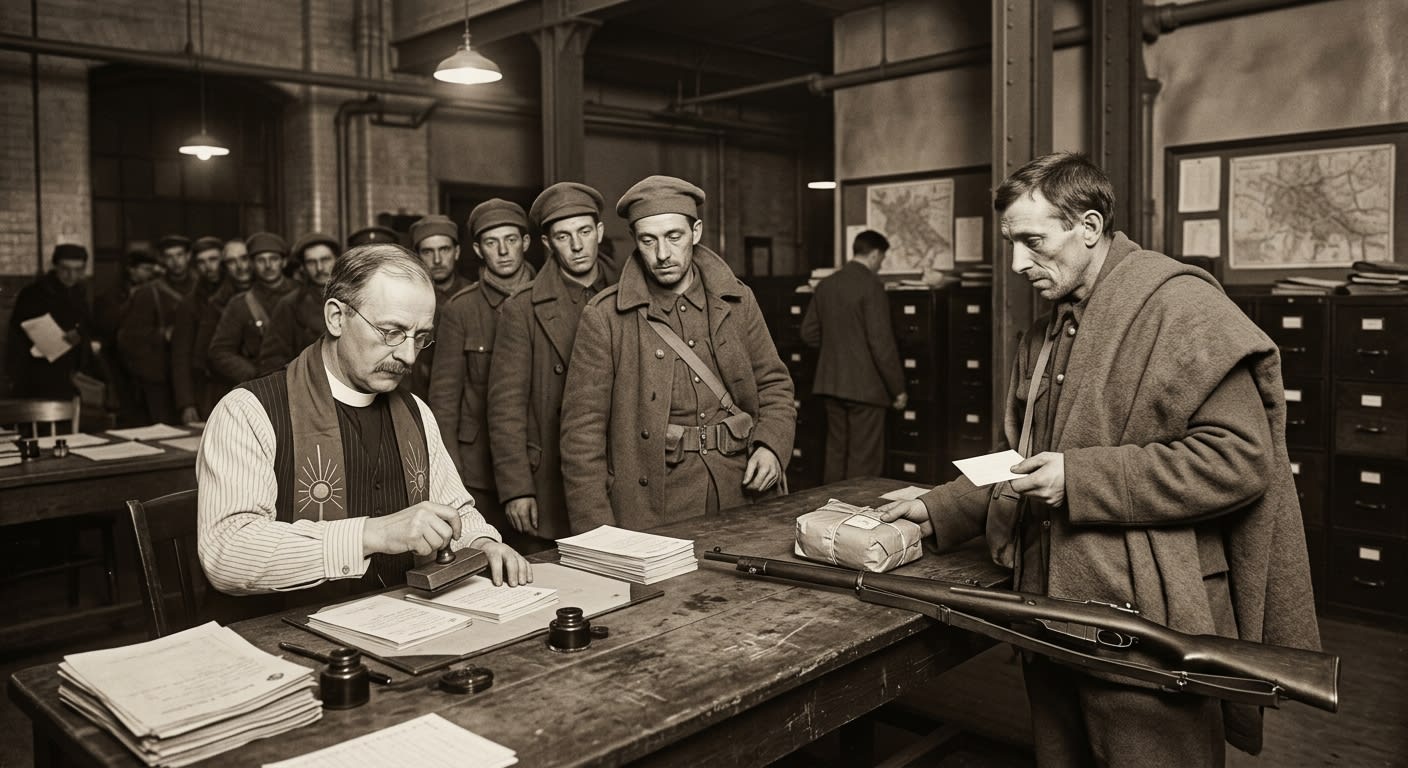
Chaplains despise this. Records adores it. War pretends irritation while asking for faster access. Purity watches the eyes of every claimant and writes nothing tender. The men themselves develop a dependence they would call pathetic if they had energy left for pride. A stamped chit reading IDENTITY ACCEPTED AS OF HOUR AND DATE can steady a hand more effectively than a sermon when a dead platoon has returned to duty.
The Counterkey Circle's pamphlets accuse the Ledgers of denying the soul. This accusation is stupid in the productive way: it forces clarification. The Ledgers deny only that human recognition is sufficient. They fence the visible self while Doctrine guards the invisible one. Sometimes the fence is paper. Sometimes the paper is damp. Sometimes the damp paper is all that stands between a man and two chairs in the Hush Court.
#On Mirror Discipline and the Poverty of Seeing
Mirror Discipline wounds the doctrine from another angle. If each person is uniquely himself, why forbid him to look at his own face? Because the face is evidence, not essence. Because evidence can be tampered with. Because Morwen enters where vanity lingers past the third count. Because a man who stares too long at proof may discover the proof staring back with superior manners.
The three-second law does not insult the Singleton Doctrine. It insults human appetite. One second recognises. Two assess. Three avert. Four invites commentary from whatever has been waiting behind tin, water, brass, shaving glass, polished buckle, or a lover's overbright eye. Doctrine does not fear the reflection's claim. Doctrine fears the soldier's desire to believe the reflection might relieve him of himself.
This is the true Morwenite pressure. She does not need to persuade Heaven that two souls exist where one stands. She needs to persuade a man that his own singular soul is a poor bargain. The plain woman envies beauty. The coward envies courage. The clerk envies command. The survivor envies the dead for being finished. Morwen offers alternatives with exquisite courtesy. She does not abolish the self. She makes the self seem insufficient.
A.S. 180 guidance stated that Singleton formation “renders the faithful immune to envy-mediated identity substitution.”
Revised A.S. 199. Singleton formation renders identity substitution sinful, diagnosable, and theologically intelligible. Immunity remains unavailable outside hagiography and certain recruitment posters, which the Bureau of Doctrine has ordered pulped.
The towel over the washstand is a small blasphemy only if one worships faces. We do not. We worship the Creator who knows the face and the creature beneath it. The soldier may shave badly. He remains himself. If he remains himself.
#On Twinning, Execution, and the Mercy No One Likes
The Twinning protocol is the Doctrine's blackest application. When two claimants present as one person and neither can be disproved before the risk becomes intolerable, both may be executed under Purity-War concurrence and Rites observation. The justification is brutal: killing both prevents a Morwenite agent from exploiting mercy, preserves the metaphysical claim that only one true soul exists, and sends both bodies to Heaven's final knowledge rather than permitting one false claimant to continue inside the fortress.
No one likes this except certain officers whose souls have the texture of boiled leather. Doctrine does not like it. Rites does not like it. Mercy objects with useful regularity. Records objects when pensions multiply. War objects only to delay. The garrison calls it weather because men must live beside what they cannot soften.
The Singleton Doctrine does not require execution. It permits execution under emergency identity hazard. That distinction matters. Doctrine is a knife; policy is the hand; panic is the wrist. At Sector Nineteen, panic nearly wrote theology. After A.S. 199, the revised guidance forced three pauses: Ledger comparison, mirror exposure under controlled count, and Rites protest entered before disposition. These pauses save some. They fail others. The stamp does not weep.
#On Misuses, Comforts, and Provincial Idiocies
Once published in field extracts, the Singleton Doctrine escaped into the usual marketplace of half-educated terror. Strasbourg salons began praising singularity while hosting masked games in smoked mirrors. Provincial chaplains preached that envy could be cured by repeating “I am one” into a basin. Certain Underchords vendors sold Singleton charms made of dull tin, guaranteed to prevent replacement if worn over the heart; three contained polished interiors and were confiscated after whispering in sleep. A Sibiu pamphleteer argued that debt cannot transfer across copied identity, which pleased Velmoran agents for exactly nine days before Tithes hanged him for fiscal heresy.
The Bureau distinguishes doctrine from charm, sentence, slogan, ward, and tavern argument. Doctrine binds the mind. Charms flatter the fingers. A soldier who knows he is singular may still be copied. A copied man may still know correct doctrine. A correct doctrine may still arrive in a mouth that should be shot before it finishes the second clause.
There are comforts in the doctrine, and I dislike comforts that do not show receipts. Still: the doctrine gives the frightened a place to stand. It says the self is not whatever Morwen can imitate. It says memory is evidence, not throne. It says the Creator recognises the soul after mirrors, books, mothers, officers, clerks, and courts have failed. Men at Irongate repeat the doctrine before sleep with the desperation of sailors counting planks. They are right to do so. Desperation is not error.
#On the Present Holding
As of A.S. 201, the Singleton Doctrine remains binding across Synodal territory and operationally sharpened in Morwen-facing sectors. Irongate uses it daily in Hush Court procedure, Ledger confirmation language, chaplain instruction, Twinning protests, and burial certificates filed under conditional identity. Sibiu, Brest, Shipka, and Constantinople cite it under advisory forms when reflection, bead, fog, hunger, or voice anomalies cause identity doubt. Strasbourg cites it at dinner parties, which is a lesser calamity but more frequent.
The doctrine has lost the arrogance of easy application. Good. Easy doctrines are nursery furniture. This one now bears scratches, wax, blood, mirror-dust, pension disputes, and the breath of men reciting it while staring at someone who has their face. It has become useful, which is a demotion from beauty and an elevation from sentiment.
Morwen has not refuted the Singleton Doctrine. She has made it expensive.
At the Irongate, a clerk opens the Ledger. A soldier counts to three. A chaplain quotes the clause on indivisibility and watches both claimants mouth the words. Rites asks for time. War asks for resolution. Purity asks for the mirror cloth. Records asks whose pension survives the hour. Heaven knows. The Synod stamps provisional.