
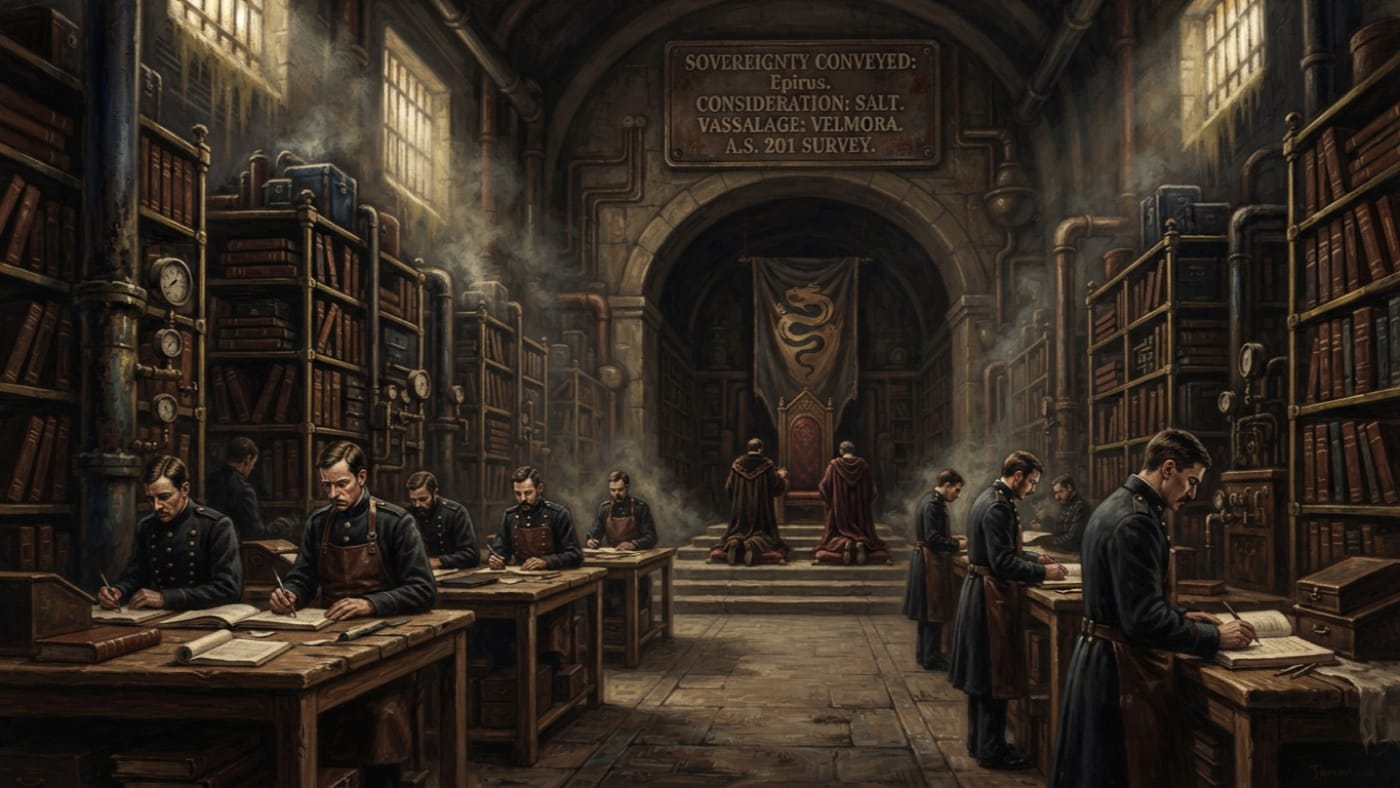
#On the Scope of This Survey
This file is the documentary survey of Epirus as it stands in the Bureau's records in A.S. 201. It is not a history of Epirus. The Bureau holds no history of Epirus that deserves the name. It holds one sentence, copied several times, and a single clause added to it.
The Codex entry on Velmora records that the Covetous Serpent "traded salt for sovereignty in Epirus." The tract on the Ten Thousand Keys lists the cult's method by its famine origins and gives the same transaction in four words: salt purchased sovereignty. The Bureau's older descriptive account of the Serpent, the master record from which both later entries draw, adds a clause that neither Codex entry carries. The rulers of Epirus, it says, "still kneel as vassals in her name."
That is the whole of the evidence: something paid, something given up, and a posture kept. Careers in the Bureau of Doctrine have been built on less. Most of them are filed under Strategy.
#On the Bargain
Salt is the consideration. The record names the substance and what it bought, and nothing more. It gives no amount, no source, no road, no ship, no negotiator, no witness, no seal and no clause. It does not say why Epirus wanted salt badly enough to pay for it with the thing princes normally refuse to sell. It does not say whether famine, a failed curing season or a frozen fishery was the reason. Those are questions, and I have no answers to file.
Salt is the most respectable of goods. It does not glitter. No preacher has ever thundered against it from a pulpit. It goes into every kitchen in a province and comes out as the reason a family is still alive in February. It preserves meat, fish and the household that eats them. A province offered salt in a lean year is being offered time, and time is the one commodity the desperate cannot make for themselves.
Nothing in the account says the salt was tainted. As far as the record goes, it was salt. That is the worse reading.
What it bought is the part that disturbs a clerk. Sovereignty cannot be weighed on a merchant's scale or measured by the bushel. Canonists have spent careers arguing about where it lives: in the crown, in the anointing, in the consent of the governed, or in the Creator's patience. Velmora's answer seems to have been simpler. It lives wherever it can be exchanged. The account treats a territory the way a ledger treats a purchase. One side records a commodity received and the other a right conveyed, and the province is now an entry in a book.
The bargain carries no year. The Hierarchy of Debt first appears in Sibiu sector archives in A.S. 160, which dates the Bureau's knowledge of the cult's structure and says nothing about when Epirus was bought. Anyone who borrows that year for this file will be corrected in ink, and then in person.
#On the Rulers Who Remain
The master record says the rulers still kneel. It does not say who they are. It gives no names, no house, no rule of succession, no tribute calendar and no list of what was signed over. It does not say whether the original signatories still live or whether their heirs inherited the posture along with the furniture. It says only that Epirus has rulers, that they kneel, and that they do it in Velmora's name.
Read closely, that is a precise arrangement. The rulers kept their office. They did not keep their sovereignty. A throne can stay occupied after the authority behind it has been sold, the way a chapel can stay roofed after the bishop has sold the benefice. Ceremonies continue. Proclamations go out under a familiar hand. Whatever authority those proclamations carry is borrowed, and the record names the lender.
Vassalage is an old form, and the Church knows it well. A lord holds land from a greater lord, owes service for it, and kneels to show he understands the terms. The Bureau of Doctrine prefers that this resemblance not be dwelt upon.
One more thing needs to be entered against the gloomier readings. A ruler who kneels has not been unmade. Doctrine is plain: no demon overrides a human will, and no contract with the Pit binds the choice of the one who signed it. Each time a vassal of Epirus kneels, if the account is still true, a person is choosing to kneel again. Fear may fill the room. Dependency, gratitude, threats and the habit of years may stand at the vassal's shoulder. None of that removes the choice. The account records submission. It does not record that the will was taken, and I will not write that it was.
That is more damning than possession. It is also more hopeful. The Bureau has never found a way to say both at once in an official circular.
#On Obligation and Its Instruments
The record does not say who carried the salt or who wrote out the terms. The Ten Thousand Keys show what such a bargain usually looks like elsewhere, and that is as far as the evidence goes.
The cult's known method begins with relief. Kargath strips a country of its harvest, and Velmora's agents arrive afterwards with stores. In the Sibiu corridor, highland villages blame "Velmora's Blightbearers" because Ten Thousand Keys grain follows Blightbearer famine. The Bureau's correction stands: the famine comes from Kargath, and the bill comes from Velmora. No record places a Blightbearer in Epirus, so none is placed there now. Gluttony and Greed have a long feud. Their method of acting one after the other is a pattern the Bureau observes in other provinces, not a partnership proven here.
The instruments are human. They are lenders whose terms look merciful, notaries whose seals are clean, grain factors whose ledgers are modest, and charitable founders whose bread really does feed people. The cult is ordered by the Hierarchy of Debt: Debtors, Creditors, Assessors, Ledger-Keepers and Inheritors. That hierarchy belongs to the congregation. It is not a constitution for Epirus, and no rank in it is assigned to any official there. The Ten Thousand Keys may have members in Epirus. They may have none. The survey makes no claim on the matter, and it certainly does not declare that a whole people has joined a cult because its princes once bought salt.
Contract Theurgy is the Bureau's name for Greed's sorcery. At the Gilded Chasm it has done things to flesh that the Bureau of Records keeps in iron-strapped boxes. In the counting-house it does less spectacular work, and more of it. It cannot bind a soul. What it can do is arrange the terms until the wrong choice looks like the only sensible one.
Earlier editions of the Codex named Velmora's primary sorcery "cursed coinage."
The Bureau of Doctrine has revised the classification to Contract Theurgy. The difference matters for this file. Salt could be confiscated if it were cursed, but a binding is something a person agreed to, and nobody can confiscate an agreement.
#On the Limits of the Account
Three bargains appear side by side in the record, and lazy clerks keep merging them.
The first is Thessalonica. A single winter's provisions bought a kingdom, and Velmora repossessed it the following spring when the harvest failed. That is a separate transaction with a separate payment and a separate ending. The fragments of Thessalonica now appear among the Counting Kingdoms. Epirus does not. No repossession is recorded for Epirus. On the master record's account, its rulers are still in place.
The second is the Transylvanian highlands facing Bastion-Sibiu. There, crop failure handed Velmora whole villages, and each one went into the Ledger as a grateful debtor. That is a highland pattern, a front-line problem and a matter for the Sibiu garrison. Epirus is not one of those villages, and it was not bought with a failed harvest as far as anyone has written.
The third is Epirus: salt, sovereignty and the continuing kneel.
The Gilded Chasm of Macedonia is Velmora's seat. It is not, on any record consulted, the geography of Epirus. This file does not put Epirus inside the Chasm, against any frontier, in any administrative district of Velmora's or under any cult headquarters. Where the borders run is unrecorded, and the survey leaves it unrecorded.
An unrecorded ruler has not been redacted. Silence in the archive means only that nobody wrote anything down. The Bureau has enough real secrets without manufacturing extra ones.
#On the Present Survey
As of A.S. 201, the Bureau's account of Epirus stands as it was received. Salt bought sovereignty. The rulers, according to the master record, still kneel as vassals in Velmora's name. No newer document contradicts this, and none confirms it from inside Epirus. No rebellion is recorded, no liberation has been announced, no inspection is scheduled, and no army is marching. The file is open because no one has had grounds to close it.
What the account preserves is a method more than a battle. A province was offered something it needed, paid with something it should not have been able to sell, and kept its princes after it had given up its independence. The princes kept kneeling. The record does not say whether they still mean it.
The Bureau records the arrangement, refuses to excuse it and draws no conclusion it cannot prove. Salt keeps meat from rotting. In Epirus it has also kept a bargain in force.