
#On Their Nature
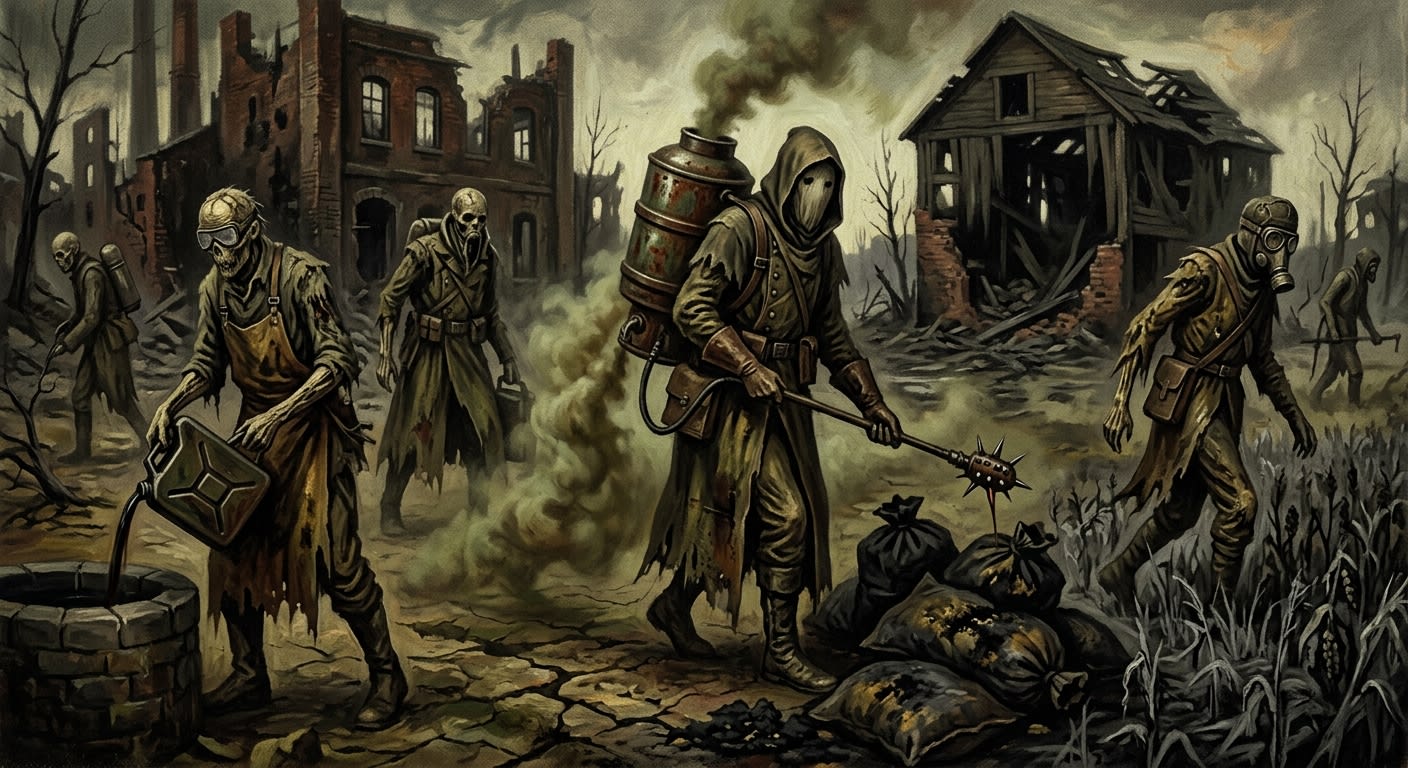
The Blightbearers are Kargath's walking famine: carrier-demons whose mouths are incidental, whose claws are decorative, whose true weapon is the fact of having passed through a place and left the place unable to feed anything that still insists on being alive.
A Maw-Born eats. A Hollow-Walker begs and then eats. A Gorged sits in obscene receipt of supply until geography itself must be amended around its appetite. The Blightbearer performs a quieter office. It walks. Crops rot in the furrow. Stored grain warms, sweats, and blackens. Milk curdles in sealed jugs. Meat turns grey beneath salt. Water develops the copper-bile taste that soldiers on the southern front recognise before the officers have finished lying about it.
They do not consume directly. This is the part that unsettles the theologians, who like their sins with tidy verbs. Gluttony eats; Kargath's servants are expected to eat; any servant that declines the verb has offended the filing system. The Blightbearer offends it magnificently. It carries hunger outward, as a censer carries incense, as a notary carries ruin in a leather folder, as a tax-cart carries the peace of the state away from the household that believed peace would be cheaper.
#On Their Appearance
A Blightbearer looks underfed. This is obvious and insufficient. The body is tall or short according to whatever human or near-human scaffolding Kargath began with, but all specimens share the same wrong thinness: the drained flatness of a field after locusts rather than the angularity of starvation. The skin hangs in pale sheets, mottled green at the joints, dark at the mouth, cracked around the eyes with powdery deposits the Bureau of Medicine calls famine-salt. The salt forms where sweat should form. It tastes, according to one medic whose curiosity exceeded his obedience, like old flour and grave dust. He survived. His tongue did not recover sensation.
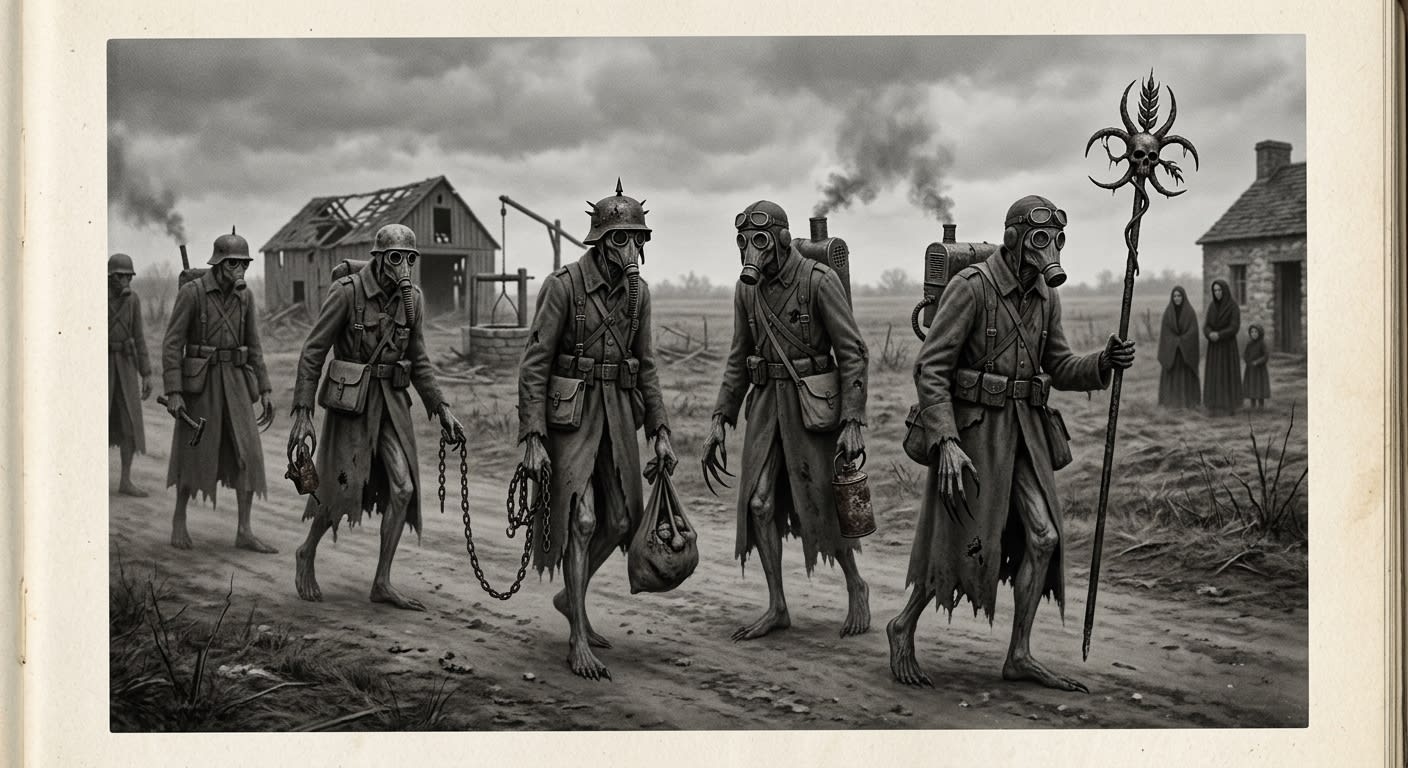
They carry smell before sight. Sour grain. Dead orchard. A cellar opened too late. The scent enters a post before the body appears, and every rat in the walls goes silent. Dogs refuse to bark. Horses back until the harness tears. Chickens, those stupid and useful prophets, fall from their perches and lie rigid with their beaks open.
Their hands are usually empty. This has led recruits to underestimate them, since human courage has a vulgar dependence on visible weapons. The Blightbearer's hands do not need blades. A finger dragged across a sack of barley can condemn a battalion's breakfast. A palm laid on a well-stone can turn a parish thirsty by dawn. A footprint through a vegetable patch can make every root in it fill with grey threads and collapse into slime when pulled.
Inside, they are starvation organised into organs. Captured remains reveal a body without meaningful digestion: shrivelled stomach, desiccated gut, lungs packed with black pollenlike dust, marrow reduced to a powder that clumps when exposed to blessed water. The entity is hungry. It remains hungry. It spreads hunger because the hunger has no inward chamber left in which to reside.
Early manuals stated that Blightbearers “poison” food and water.
Corrected. Poison implies a substance added. Blightbearing is subtraction given motion. Nutrition departs. Spoilage arrives as the visible certificate of absence. The distinction matters to alchemists, physicians, and anyone foolish enough to believe boiling the soup will save it.
#On Their Passage
The first sign is arithmetic. Stores that should last thirty days last eleven. Flour sacks weigh the same but bake into bread that leaves the eater faint within the hour. Salted pork retains its shape and loses its nourishment. Children ask for second bowls after finishing first bowls, then third, then anything at all. The village clerk records discrepancies in ration ledgers. The priest preaches moderation. The mothers stop listening.
Then the animals fail. Milk cows dry overnight. Goats chew fence rails until their gums bleed. Pigs lie with their snouts in full troughs and starve. Horses develop the sunken flank seen on long campaigns, even when fodder is stacked to the rafters. The Bureau of Medicine has named this condition inanitio externa: external emptiness, which is a handsome phrase for the discovery that abundance can be rendered fraudulent without changing its visible quantity.
FIELD REPORT — VILLAGE OF SZARVAS-WEST (Unregistered), A.S. 186 “Stores inspected: full. Wells inspected: clear. Livestock inspected: alive. Children inspected: ████████. By third day, villagers had eaten all stored grain and remained hungry. By fifth day, no dogs found. By sixth day, church doors barred from inside. By seventh day, singing ceased. Entered on ninth. No hostile entity present. Blight trace on north road confirmed.” — Bureau of War survey detachment, file closed under Seal Amber
A Blightbearer does not need to remain. In fact, staying is tactically inefficient, and Kargath's hunger, for all its metaphysical squalor, possesses a butcher's practical intelligence. The carrier crosses a road, a canal quarter, a threshing yard, a market square. It touches what hungry people require. Then it leaves. The community performs the rest of the work by trusting inventory more than appetite.
#On Theatres of Contagion
Blightbearers are most common along the Blightmarsh boundary, where the former Hungarian breadlands rot outward at the pace of a patient creditor. The western rim produces short-range incidents: farmsteads soured, wells tainted, herds gone sterile, parish seed-grain rendered decorative. Observation posts at Kestrel 4 and Kestrel 9 maintain ash-lines across the roads and inspect them at dawn. When an ash-line has been crossed and no footprint remains, the post burns its stores anyway.
At Bastion-Constantinople, Blightbearers are treated as siege artillery disguised as weather. One crossing of the eastern supply road can force ration reduction across three ravelins. One touch at a mule station can cripple a convoy without killing a single mule until two days later, when they all lie down at once and decline the polite fiction that they are still animals.
The Sibiu records contain a confusion worth correcting before some clerk makes a doctrine out of an error. Highland villages speak of “Velmora's Blightbearers,” because crop failure there is followed by the arrival of the Ten Thousand Keys with generous loans and infernal paperwork. The carrier-effect remains Kargath's. Velmora profits from it. Greed, with typical elegance, has learned to invoice famine.
Farther west, confirmed incursions are rare, which is why every confirmed incursion produces hysteria, requisitions, and three contradictory pamphlets from the Bureau of Purity. The A.S. 193 Cologne Flour Alarm, eventually traced to ordinary mould and not a Blightbearer, caused six bakeries to be burned, two innocent millers to be interrogated, and one bishop to recommend fasting as a civic precaution. The bishop was applauded until the bakers' guild pointed out that fasting after burning the bakeries lacked the splendour of voluntary piety.
#On Failed Remedies
The Bureau of Purity has no counter-ritual. The Bureau dislikes this sentence. It has circled the sentence in drafts, objected to its cadence, proposed revisions involving “no universally ratified counter-ritual,” and once suggested that I write “counter-ritual pending.” I refused. Pending is what cowards call absence when the minutes are being taken.
Fire cleans infected matter only by destroying it. Burn the grain, and no one eats the grain. Burn the well-house, and the water remains suspect. Burn the field, and spring arrives with black shoots that crumble between the fingers. Blessed salt slows surface rot but cannot restore nourishment. Lime masks the smell. Silver discolours. Relics sweat. Choirs singing the Psalm of Satiation report dizziness by the fourth verse and hunger by the sixth.
The Bureau of Medicine can measure the field. It can identify the radius, chart the spoilage curve, distinguish Blightbearer emanation from the Famine Pits' human grief-signature, and tell a commander, with devastating precision, how many days remain before a storehouse becomes nutritionally fraudulent. Then Medicine folds its hands and declines to recommend. This is not negligence. This is survival. The Bureau of Agriculture made recommendations. The Bureau of Agriculture is now a cabinet in Strasbourg with a missing key.
Countermeasure, then, is military rather than miraculous: quarantine, burning, distance, redundant stores, sealed water, animal testing, ration rotation, and immediate execution of any supply clerk who argues that the ledger says the grain is sound. I exaggerate only in the matter of immediacy. The execution usually waits for a signature.
An A.S. 171 field circular advised that suspected Blightbearer-contaminated food be distributed first to “lower-priority mouths” pending confirmation.
Rescinded after the Kruševac ration scandal, in which the lower-priority mouths proved to include two artillery crews, a bridge crew, and the only man in the sector who understood the pump engine. The current circular reads: “No mouth is low priority when the enemy is famine.” This improvement required seven deaths and a memorandum.
#On the Carrier's Hunger
The Blightbearer is starving while it spreads starvation. This is the fact that separates it from ordinary plague and makes it eligible for the Bureau's most useless pity. It does not rot food because it is full. It rots food because hunger pours from it as heat pours from a furnace. It cannot keep nourishment, cannot receive it, cannot approach plenty without rendering plenty false. The thing it needs dies at its touch.
Captured specimens kept under iron glass have been offered bread, meat, milk, marrow broth, consecrated wafers, raw grain, and one regrettable experimental pudding from the Bureau of Medicine's metabolic kitchen. All spoiled before contact. The Blightbearer reached for each offering with visible desperation. The hands trembled. The mouth opened. The food blackened inches from the lips. The specimen keened until the glass filmed with famine-salt.
Kargath's cruelty here is exact. The Maw-Born can at least eat. The Hollow-Walker can steal seconds of lucidity after feeding. The Gorged receives cartloads, inadequate though they remain. The Blightbearer is denied even the sacrament of failure. It approaches food and abolishes the quality by which food could answer hunger. It is a beggar whose hands turn coins to ash before the alms can be received.
The soldiers do not pity them for long. Pity has a short ration on the Line. When a Blightbearer is sighted, the guns fire at once, the kitchens are shuttered, the wells are sealed, and every man with a private hoard of biscuit learns whether he fears the quartermaster more than Kargath. He should fear Kargath more. The quartermaster will take the biscuit. Kargath will make it meaningless.
#On the Ratified Warning
The Blightbearer proves that famine exceeds the absence of food. Famine can be carried. Famine can be deposited like a seal on a document. Famine can walk through a city in the shape of a thin man with famine-salt at the eyes and leave every pantry full, every pot boiling, every table set, and every child asking why supper does not help.
At the eastern posts, the standing order is written above the ration stores in black paint: IF THE FOOD IS FULL AND THE MEN ARE HUNGRY, BURN THE FOOD. It is the kind of sentence civilians call wasteful until they have seen the alternative. The alternative is a parish ledger listing adequate stores beside a death roll. The alternative is a well that looks clean. The alternative is a harvest that weighs correctly in the hand and feeds no one.