
#On the Ledger as Congregation
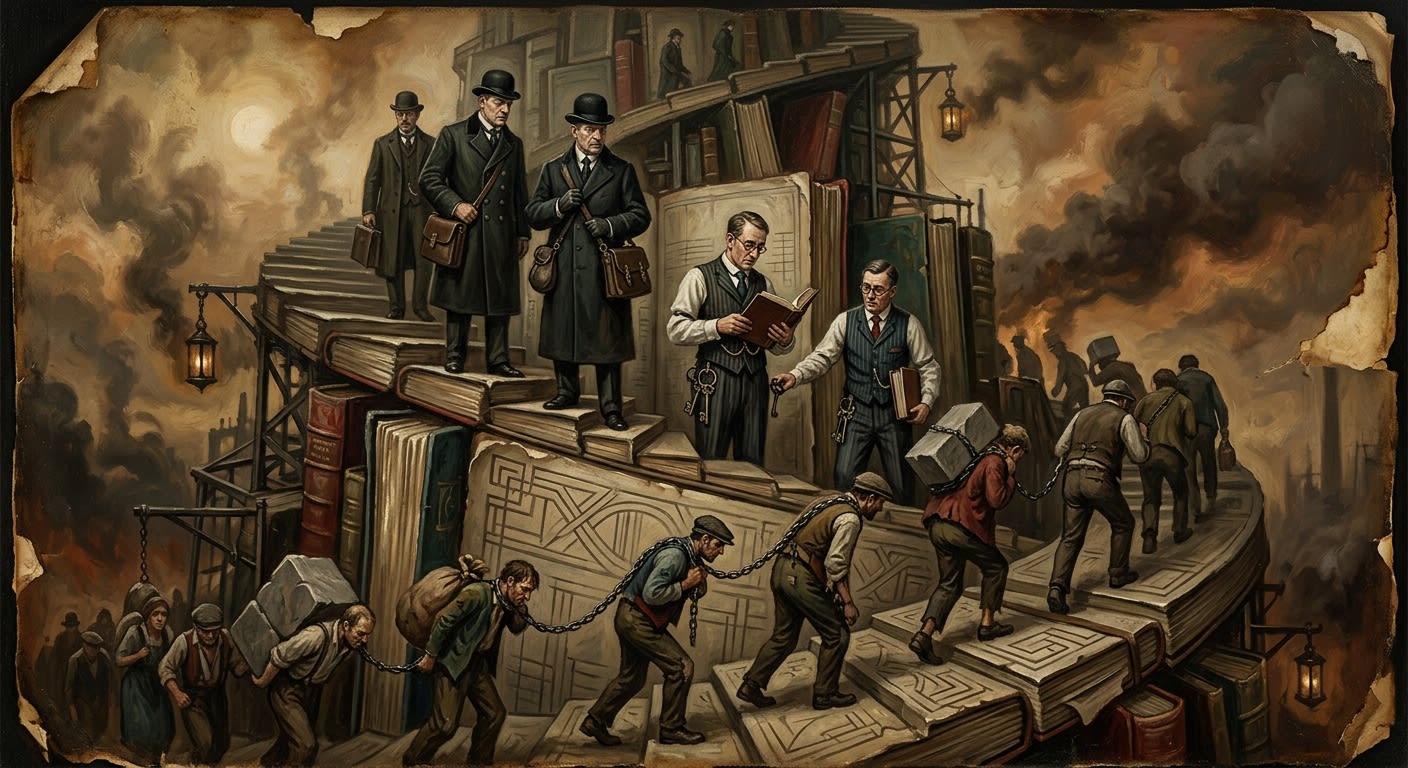
The Hierarchy of Debt is the cult-structure by which Velmora governs her human servants, and I use the word governs with professional irritation, since the arrangement displays an administrative elegance that no servant of Hell has any right to possess. We in Strasbourg built twelve Bureaus, three thousand sub-offices, and enough countersignature procedures to make angels beg for numerals. Velmora built a ledger and made men climb it.
The result is the Ten Thousand Keys, a congregation without altar, choir, parish roll, or public creed. Its chapel is the counting room. Its confessional is the contract desk. Its hymn is the scratch of a quill across skin-coloured paper. Its sacrament is extension: another week before collection, another payment accepted, another debtor persuaded that relief is only one signature away.
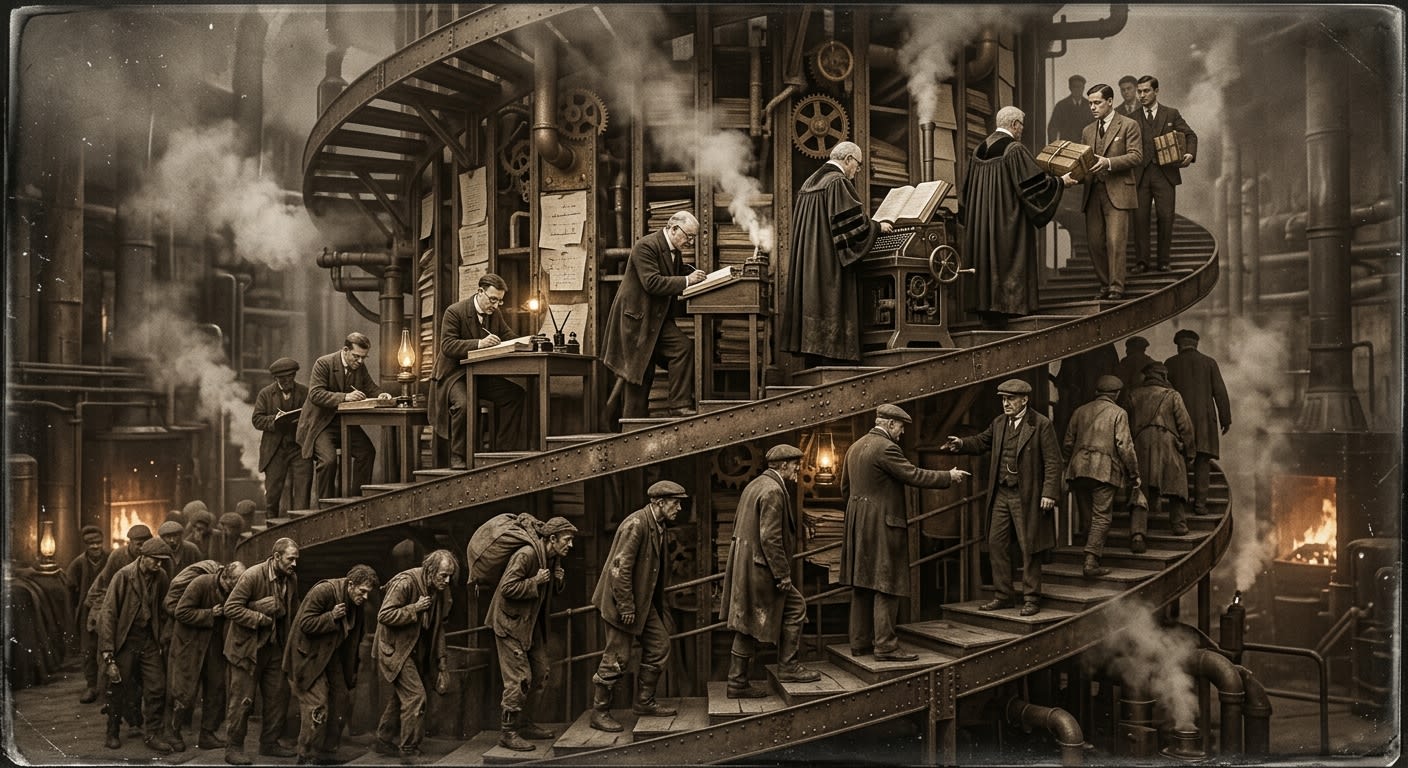
The Hierarchy runs five tiers deep: Debtors, Creditors, Assessors, Ledger-Keepers, Inheritors. The names are plain because temptation prefers clarity. A man asked to join the Circle of Infernal Acquisition might hesitate. A man asked whether he would like his balance reduced by introducing a friend to favourable terms will invite the friend to supper.
This is the genius of the thing. The Hierarchy does not require faith at entry. It requires need.
#The Debtors
The Debtor is the base unit of Velmoran society. He owes.
That sentence contains his biography, his theology, his calendar, his permitted dreams, and the shape of his future grave. He owes money, favours, labour, secrecy, names, passage, warmth, time, a lock of hair from a child not yet born, a memory of his mother's hands, the right to refuse a later term. The first debt is usually merciful. This is important. Velmora's agents rarely begin with cruelty. They begin with rescue.
In the Transylvanian highlands near Bastion-Sibiu, a Debt-Binder arrives after failed harvest. He offers grain at low interest. He offers seed on credit. He offers medicine for a coughing son, burial fees for a dead husband, a mule for the road to market, a roof before snow. The contract is legible. The terms are clear. The borrower signs because refusal would be monstrous. Later, the collateral clarifies itself.
Debtors serve to reduce their balances. They carry letters, introduce neighbours, misplace inspection schedules, sell honest coin for slightly better coin, recommend the kind lender to cousins, then cousins' cousins, then anyone whose desperation has begun to show through the skin. Every recruit reduces the recruiter's own principal by a negotiated fraction. The number never reaches zero. It approaches zero with liturgical courtesy and mathematical malice.
The Debtor is not absolved by knowing. Many know. Some know from the first signature. Velmora's corruption does not abolish choice; it improves the wrong choice until the right one looks like suicide. A man can refuse. He can starve instead of signing. He can watch his daughter cough blood into a rag and preserve his doctrinal cleanliness while she dies. The Bureau praises such purity. The Bureau does not have to live in the room afterward.
#The Creditors
Creditors have survived owing long enough to lend.
They are the most socially useful members of the cult, which makes them the most dangerous and the hardest to burn without public complaint. A Creditor funds orphan kitchens. A Creditor endows chapel repairs. A Creditor pays the arrears of soldiers' widows, sponsors guild feasts, advances seed money to farmers, arranges dowries, buys winter coal for a school whose headmistress will later testify, with perfect sincerity, that no man so generous could serve the Enemy.
His generosity is genuine. That is the poison.
Early Purity manuals described Creditors as “fraudulent benefactors.”
Corrected A.S. 187. The benefactions are materially real. Bread purchased by a Creditor nourishes. Coal purchased by a Creditor warms. A debt incurred through kindness is still debt, and kindness may be the most durable collateral in the human inventory.
A Creditor binds downward because he remains bound upward. His ledgers mirror Velmora's ledgers in miniature. Each favour he dispenses becomes an entry. Each entry bears interest. The favoured person remains free, of course. The favoured person may decline the later request. The favoured person may refuse to pass a sealed packet through a gate, to forget a serial number, to endorse a supplier, to testify that the strange brass key belonged to no one. Refusal is possible. So is ingratitude. Human beings tend to find ingratitude more shameful than treason when treason arrives carrying a receipt.
The Bureau of Tithes particularly loathes Creditors because they imitate us. They collect, audit, extend, seize, forgive strategically, and preach discipline over appetite. The difference is that Tithes feeds the Synod, while Creditors feed the Chasm. This difference is immense, sacred, and sometimes visible only in the payee field.
#The Assessors
Assessors determine worth.
A demonic Assessor, as recorded in the Velmora file, can look at a soldier and know the precise price at which he would sell a comrade. The human cult-rank is less efficient, which is a mercy to humanity and an insult to training. They watch. They listen. They attend market, Mass, tavern, trial, funeral, ration queue, and childbirth. They learn what a person values before the person knows value has entered the room.
An Assessor does not ask, What do you own? Ownership is crude. He asks, What could be priced if pressure were applied correctly? A son's apprenticeship. A widow's reputation. A magistrate's fear of scandal. A quartermaster's pride in punctual convoys. A priest's private doubt. A garrison's need to believe its scrip is clean. The Assessor turns human life into columns, and columns into pressure, and pressure into recruitment.
The Bureau has identified three schools of Assessor practice. The Highland School values subsistence pressure: hunger, winter, medical need, tax arrears. The Merchant School values ambition: expansion, guild rank, monopoly, safe transport. The Interior School values respectability: reputation, marriage prospects, sealed embarrassments, advancement within Synod offices. This last school irritates me personally. A man may tolerate Hell in a mountain pass. Hell in a filing office shows poor taste.
A.S. 196 Sibiu interrogation transcript, sealed after line 44: QUESTION: What did you assess in Captain Erdel? ANSWER: His loyalty. QUESTION: What was its price? ANSWER: ████████████████ QUESTION: Did he accept? ANSWER: He had accepted before we asked. Transcript terminates here. Captain Erdel's service record remains active. His pension has been paid quarterly to an address that does not exist.
Assessors often develop the Eye, the cult's own phrase, which Purity files as visual fixation, Category Greed-adjacent. They cease seeing faces. They see collateral. A child's laugh becomes future influence over a parent. A scar becomes shame. A strong back becomes labour-years. A good name becomes something one might pawn in emergency. This is the first major internal transformation of the Hierarchy. Debtors still suffer debt. Creditors manage debt. Assessors become debt's sensory apparatus.
#The Ledger-Keepers
Ledger-Keepers know what everyone owes.
In Velmoran congregations this rank outranks wealth. A Creditor may command gratitude, but a Ledger-Keeper commands the balances behind gratitude, and balances are the bones of the cult. The Keeper knows who recruited whom, whose interest was suspended, which child was pledged under clause fourteen, which key was surrendered, which chapel fund concealed procurement money, which Purity examiner accepted assistance during his mother's illness and never reported the contact.
The Keeper does not need to threaten. Threat is vulgar. He corrects.
A misplaced entry can destroy a Creditor's authority. A revealed debt can move a village. A quiet alteration in the maturity date of one contract can send three families into panic, a gatehouse into bribery, and a convoy inspection into pious confusion. The Keeper's quill moves; other people call the movement fate.
Doctrine infiltration teams have identified seventeen suspected Ledger-Keepers operating inside Synod territory since A.S. 160. Three were apprehended. One died under questioning after producing a small brass key from beneath his tongue. One recited four hundred names not present in any Bureau index, after which four hundred requisition files went blank. One asked to see his own file and laughed until the room's lamps dimmed.
The fourteen unapprehended Keepers remain a clerical wound. Their identities were once recorded. The files later vanished, along with two Records clerks, one Purity courier, a shelf of convoy permits, and the left-hand drawer from a desk belonging to Sub-Examiner Voigt (Unregistered). The drawer has been sighted twice since in unrelated offices. It was locked both times. No key fits it.
A.S. 191 Doctrine bulletin declared the Sibiu Ledger-Keeper network “substantially broken.”
Corrected A.S. 192 after the bulletin's distribution list began receiving invoices for its own printing costs from an unregistered creditor in Wallachia. The network was not broken. It had acknowledged correspondence.
#The Inheritors
The Inheritors wait at the top of the Hierarchy, which is another way of saying they stand nearest the empty place above it.
They are promised receipt when the collection completes. Velmora's agents call this the Great Maturity. They speak of it as an inheritance, a balancing, a final distribution in which every accumulated debt, favour, pledge, forfeiture, and surrendered key will resolve in their favour. Families have preserved Inheritor status across four generations. They keep houses with no visible luxury and vaults no auditor has entered. They marry carefully. They lend rarely. They sign almost nothing. Their patience is not virtue. It is appetite trained to sit still.
The Bureau has no confirmed case of an Inheritor collecting. We possess rumours: a merchant house in Varna whose eldest son opened a sealed room and emerged speaking in plural accountancy; a Wallachian notary family whose portraits gained rings on their fingers decade by decade; a Sibiu widow who inherited seventeen debts she had never issued and died smiling with gold leaf under her nails. Rumour is not evidence. It is evidence waiting for a clerk brave enough to stamp it.
The theological danger of the Inheritor is hope. Debtors act from fear. Creditors act from advantage. Assessors act from appetite disciplined into method. Ledger-Keepers act from control. Inheritors act from promised vindication. They believe the whole vile book will one day prove that their patience was wisdom, their cruelty prudence, their restraint investment, their waiting a kind of sanctity. There are no fanatics colder than those who expect arithmetic to canonize them.
#On Keys, Contracts, and the Fiction of Escape
Every formal induction into the Hierarchy uses a key.
The key is brass in low cases, silver in merchant cases, gold in those involving provincial office, relic custody, or inherited land. It opens no lock the signatory owns. The borrower surrenders it at signing. When Purity confiscates such keys, the borrowers often weep harder for the key than for the contract. They cannot explain why. This, for once, is wise of them.
The key is permission made object. A door somewhere has been admitted into the agreement. Which door, whose door, and when it will open are matters filed beyond ordinary sight. The Vault of Ten Thousand Keys is said to contain the originals of all surrendered keys. I dislike the verb said here. Too many unrelated witnesses use the same phrasing. Too many seized keys are warm when catalogued. Too many confiscation drawers are empty by morning.
Contracts themselves remain, in strict theology, unenforceable against the soul. The human will remains free. The Bureau is firm on this point because if demons could bind the will directly, half our doctrines would collapse and the other half would apply for transfer. Velmoran contract-theurgy works by arranging consequence until surrender feels chosen. The Debtor opens the door. The Creditor offers the candle. The Assessor priced the room. The Ledger-Keeper recorded the path. The Inheritor waits beyond it.
One may still refuse.
One may still refuse at any point.
The Hierarchy exists to ensure refusal arrives looking like ruin.
#On Counter-Accounting
The Synod fights the Hierarchy with audits, annulments, tithe-preaching, key-burnings, serial reconciliations, confession drives, solvency inspections, and the periodic arrest of men whose manners are too charitable. These measures work often enough to justify themselves and fail often enough to require expansion, which is the natural condition of all Bureau measures.
At Sibiu, every loan above three Crowns must be witnessed by Tithes. Every private grain advance must be declared before the third bell. Every brass key found in a household is grounds for inquiry. Every notary in the highland corridor undergoes annual Ordeal, and every year a few fail, and every year their clients protest because the failed notary had, until that morning, been unfailingly kind.
The Bureau of Doctrine's approved pastoral instruction is simple: owe the Synod first. This is prophylaxis. A tithe paid upward cannot be collected eastward. A debt to Heaven crowds the ledger. The soul with approved obligations has fewer blank spaces for Hell to annotate.
The Hierarchy of Debt persists because it does not ask men to worship Greed. It asks them to survive today and account for tomorrow later. Tomorrow arrives with witnesses.