
#On the Annual Observance
"The hymn is, in four verses, a perfect document: complete, authorized, ratified, and insufficient." — Drax, The Black Sea Armada
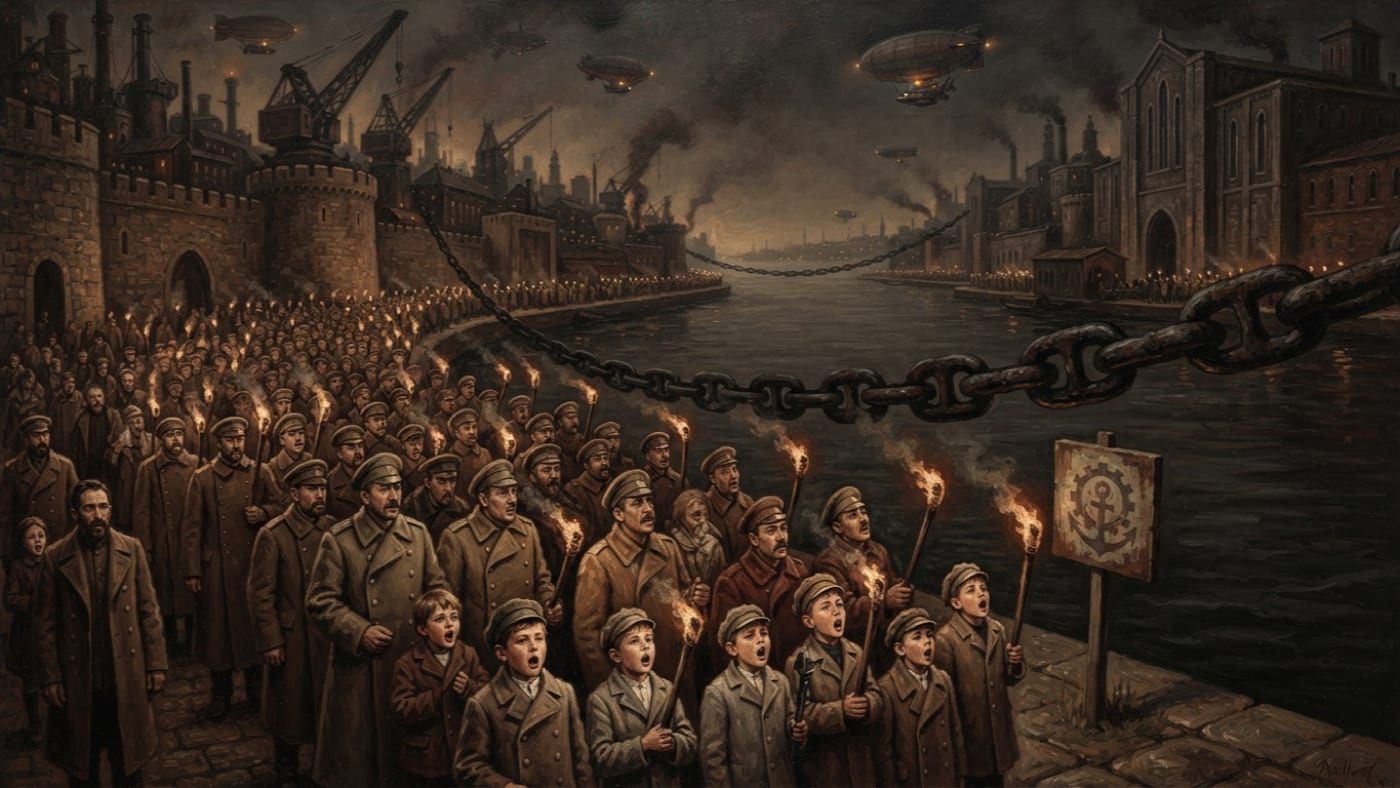
The Feast of the Burning Chain is kept each year on the 15th of Ferrum in the liturgical calendar of Constantinople. It belongs to the Bureau of Festivals, the office of the Synod that decrees which days may be celebrated and therefore, by the plainest subtraction, which may not. The Feast commemorates the Black Sea Armada of A.S. 162. As far as any honest witness can certify, it consists of a torchlit procession beside the Bosphorus, a hymn sung by schoolchildren, and a chain.
I cannot tell you when the Bureau first wrote the Feast into the calendar. The calendar records the day. No copy that has crossed my desk records the year the day began. A festival of victory with no date of foundation is a curiosity, and it is also the condition of half the observances in the Church. Joy in our Theocracy tends to arrive already ratified, as though it had always been on the books. I will not supply a founding year, a founding decree or a founding cleric to make the file look tidier. Tidiness is the Bureau's vice, and I have enough of my own.
This dossier is anchored in A.S. 200, the year I attended, thirty-eight years after the engagement. What follows is what I saw, set beside what the Bureau says I ought to have seen.
#On the Victory Commemorated
On the night of the 14th of Ferrum, A.S. 162, forty-seven demon vessels entered the Bosphorus approaches. The Chain of Saint Anakletos, strung across the strait from the Harbor of Chains since A.S. 68, held. It did more than hold. For some seven hours it burned with a white radiance that survivors could not look at directly, and the fleet broke against it.
At dawn on the 15th, the Bureau of Engineering found every link intact and the light gone. For ninety-four years the chain had glowed every night, low and steady. Sailors steered by it, and the Bureau of Rites printed a pamphlet about it. After the inspection the emission was entered as nil, and it has been nil since.
The Feast falls on the morning the engineers wrote that word. I note where the calendar puts it. I do not claim to know the Bureau of Festivals' reasons, a courtesy the Bureau of Festivals has never extended to me.
The Bureau of Rites marked the engagement a victory, and the Bureau of War ratified the mark. Constantinople survived. I have no quarrel on either point, and the city's survival is the reason I am alive to quarrel at all. My quarrel is with the arithmetic. The Bureau of War's own engagement log records forty-three hostile vessels destroyed, three retreated and one unaccounted for. When compressed for public use, the official account says the fleet was destroyed. Forty-three is a great many ships. It is not forty-seven.
The fleet was destroyed.
This sentence appears in my own entry on the Armada as the official reckoning, and there it stays, attributed to the institutions that issued it. For the purposes of the Feast, the Ledger's figures are restored: forty-three destroyed, three retreated, one unaccounted. The Bureau of Records files the forty-seventh vessel as "Resolved — evidence submerged." Resolved is the Bureau's word. I have not been shown the evidence, submerged or otherwise.
#On the Four Verses
The commemorative hymn is sung by schoolchildren. It has four verses and mentions faith eleven times.
I do not reproduce the text here. The Codex is not a hymnal, and a dossier that quotes from memory deserves the inaccuracy it gets. The hymn's dimensions will serve. Eleven mentions across four verses comes to nearly three a verse, a density a Ledger clerk would call thorough and a choirmaster would call a problem of scansion.
I can list what the hymn leaves out, because I listened for it. It does not mention the forty-seventh ship or the three vessels that withdrew. It does not mention that the chain has been dark since the very morning the Feast commemorates. In four verses it gives faith eleven times and the forty-seventh ship not once.
I cannot tell you who wrote it, or whether those omissions were chosen or simply never occurred to its author. The Codex does not hold the composer's name, and I will not invent a man in order to blame him. A hymn is entitled to brevity. Four verses cannot carry a casualty roll, an engineering report and an open filing number, and nobody of sense asks them to. My complaint is narrower. The hymn presents the victory as finished, and the Ledger does not.
Nor will I pretend the hymn does anything to the chain. No one in Constantinople has claimed in my hearing that the singing is meant to wake the iron, and I will not be the first. The song is sung about the chain and in its sight. That is all I can certify, and it turned out to be enough.
#On the Procession of A.S. 200
I attended the Feast in A.S. 200 in the full dignity of my office, which is to say in a better coat than the occasion required.
The procession was handsome. I give this as a professional judgment, having attended more processions than most bishops and outlived several of the bishops. The torches were many and well kept, the ranks held, and the hymns were well sung. The Bureau of Festivals knows its trade, and its trade is the orderly management of a crowd's joy. That is harder than managing a crowd's fear, because fear at least keeps to the walls.
Beyond the torches, strung across the Bosphorus where it has hung since A.S. 68, was the chain.
It was dark. I report this as I would in a harbor log: link after link of consecrated iron across the water, the torchlight catching its near faces as torchlight catches any iron, and nothing coming from the metal itself. Anyone over forty in that crowd had grown up with the glow at dusk. Anyone younger knew it from the pamphlet and from grandparents.
As the procession moved along the shore, the dark links seemed to pass along the line of torches one after another. The chain went nowhere. It stayed exactly where Governor-Praelate Hugo's engineers had fixed it, and only the torches moved.
Every person in the procession looked at it. I watched them do it, faces turning from the torch ahead to the iron over the water, the way a congregation looks toward the empty stall of a dead bishop during the first Mass without him.
And they sang louder.
No marshal I saw signalled it, and I make no claim about what the Bureau's orders of service may or may not contain. I report the rise in volume and nothing beyond it. It came as the crowd looked, and it held for as long as they looked.
Some of them sang over the silence because the silence frightened them, and I would not think less of them for it. Some, I suspect, sang toward it, the way a household sings at a sickbed that has gone quiet. The children sang louder because the adults did, which is how children learn most liturgy and nearly all doctrine. I cannot sort one voice from another in a crowd that size, and I will not certify the private motive of a single throat in it. In my entry on the strait I wrote that it was courage, or stupidity, or the precise place where the two shake hands. I stand by that. I will not swear that I kept my own voice at its former volume.
#On the Limits of the Observation
I saw one Feast, in one year, from one place in one crowd. I can say what the chain looked like that night. I cannot say what it will look like on any other.
The Bureau of Rites holds that the chain's radiance was spent in intercession, that the chain is resting, and that it will glow again when the Creator's Providence judges the reserve sufficient. The darkness I saw in A.S. 200 is a fact, and it sits beside that doctrine without refuting it or confirming it. A dark chain proves that the chain is dark. I will not let it prove more in either direction merely because a feast day has made it convenient to look at.
Nor can I tell you whether the Bureau of Festivals has altered the observance since I attended, or intends to. I have not been informed, and I will not guess at the policy of an office that regulates joy for a living. It would take the guess as an application.
What I can judge is the institution, and I have judged it. The Bureau has given Constantinople a day on which the victory is complete and the hymn is sufficient, and on which the crowd may look at the chain for as long as a verse lasts. That is authorized celebration doing precisely what it is licensed to do. The Ledger, meanwhile, records forty-three, three and one, and an emission entered as nil on the morning of the 15th of Ferrum.