
#On the Strait That Pretends to Be Water
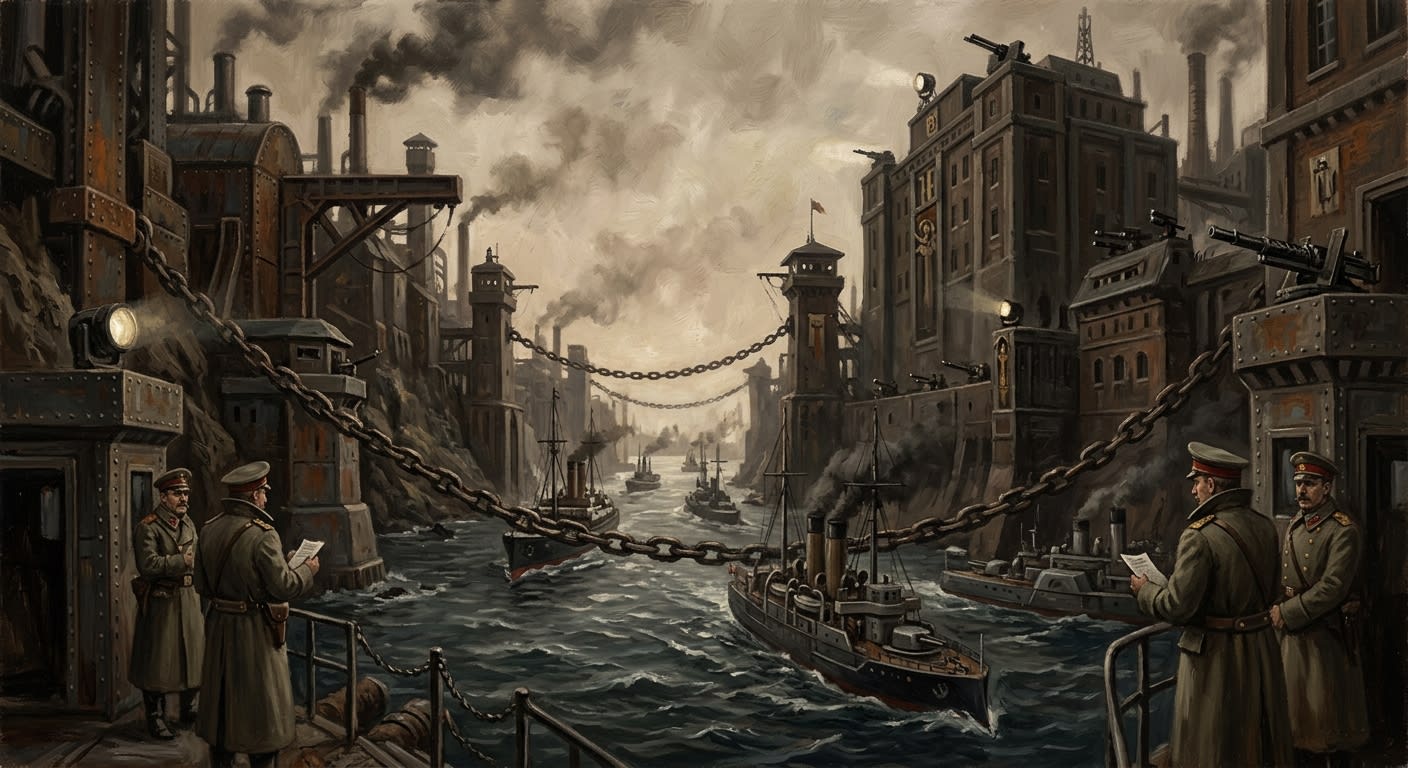
The Bosphorus Strait is the southern hinge of the Sagittal Line, the wet throat between Europe and Anatolia, the water-cut by which Bastion-Constantinople is both fortress and hostage. Maps describe it as a channel between the Black Sea and the southern waters. Sailors describe it with fewer nouns and more gestures toward the confessional.
It is narrow enough for arrogance and deep enough for denial. The Bureau of Engineering has revised its hydrological models fourteen times since A.S. 90, each revision predicting a current that every harbor boy knows how to disobey by lunchtime. The current runs north, south, sideways, backward under the skin of the surface, and at least once, by the testimony of three sober pilots and one drunk priest, upward through the hull of a grain barge whose cargo arrived dry and whose crew arrived praying.
The Synod calls the strait controlled. This is almost true when the Chain of Saint Anakletos is raised, the ravelins are manned, the Saint Barachiel is aloft, the harbor lamps are lit, the fog behaves, the fishermen keep their mouths closed, and whatever rests near Phaleron Bay declines to remember itself. That is a generous list of conditions. The Bureau adores generous lists. They conceal panic in columns.
#On the First Locking of the Water
The first soldiers reached the Bosphorus headland in A.S. 47, dragging the wreckage of the first post-Sundering refugee columns behind them and discovering, with the exhausted clarity of men pursued by Hell, that retreat had reached salt water. The old Byzantine stones were already there. The dead were already too many. The bedrock already contained sealed chambers no living army had ordered built. A prudent civilization would have fled. The Synod had not yet learned prudence and possessed, in its absence, courage.
By A.S. 68, under Governor-Praelate Hugo, the provisional waterfront became the Harbor of Chains. Granite pins were driven into the quay. Winch houses rose. Anatolian gun emplacements were consecrated with oil, ash, and enough legal language to drown a mule. The Chain of Saint Anakletos was strung across twelve hundred yards of open water from the southern tower to the opposite shore: three hundred and forty links in the original account, three hundred and forty-seven in the current count, which is how arithmetic behaves after too long near miracles.
Earlier harbor primers state that the Bosphorus was secured by the founding of Bastion-Constantinople alone.
Corrected. Stone secures walls. Iron secures passage. Paper secures the official claim that the first two have succeeded.
The Chain made the strait legible. Raised at dusk, lowered at dawn, inspected by men whose harbor dialect has resisted every inland standardisation attempt, it gave the Synod a sentence it could stamp on convoy writs: the passage is closed unless we open it. This was the birth of southern maritime Order. Also of southern maritime bribery, smuggling, tariff fraud, pilgrimage delay, and three respectable families of quay rats.
#On Convoys, Pilgrims, and the Taxed Breath of the South
Every vessel that enters the Bosphorus enters a liturgy of suspicion. Grain ships from the Anatolian coast. Pilgrim ferries from Marseille and Genoa. Relic barges whose cargo must be believed before it can be weighed. Coal lighters, ash skiffs, patrol launches, funeral craft, sealed hulls of the Black Sea Reliquary Flotilla, and the small black boats nobody sees until the Bureau of Purity needs a public arrest.
The official process is elegant in the way gallows are elegant. A vessel presents manifest, seal, counter-seal, origin writ, destination writ, contamination declaration, cargo psalm, tariff schedule, crew confession roster, and chain-passage fee. The harbor clerk checks the wax first. A wise clerk checks the crew second. A dead clerk checks the cargo first.
The Strait-Rats thrive in this liturgy because bureaucracy creates the cracks it later fines men for using. Demon-glass hides in reliquary crates. False saints travel in double-walled icon boxes. Wax seals are warmed, lifted, copied, replaced, kissed, cursed, and taxed. The Bureau's doctrine remains admirably firm: contraband does not cross the strait. Contraband is discovered, confiscated, displayed, and entered into evidence. Movement would imply failure. Confiscation implies vigilance.
CUSTOMS PIER INCIDENT REPORT 151-VARNA: crate opened under public inspection; reflective shard exposed; crowd observed skeletal self-motion in wet surface; seven jumped from pier before shots fired; twenty-three drowned; official cause: panic secondary to unlawful cargo; shard disposition: █████████████.
#On the Night the Strait Burned White
The Bosphorus received its proof on the 14th of Ferrum, A.S. 162, when the Black Sea Armada entered the approach during harvest convoy season. Forty-seven demon-crewed vessels came out of the outer dark while civilian grain ships crowded the channel and the southern guns still faced the polite directions on the morning schedule. The Anatolian tower reported sails. Number: all of them.
Praefect-Naval Cassius Tern ordered the Chain raised, the ravelins manned, and three runners dispatched. This is the whole art of command: move the iron, wake the guns, send the paper before rhetoric arrives wearing medals.
The Chain held. It did more than hold. It burned with white radiance for seven hours, melting forty-three hostile vessels, driving three into fog from which no patrol has charted an exit, and leaving one ship absent from every useful category. The water steamed with incense. The reliquaries cracked. The harbor survived. Schoolchildren now sing of the victory with the obscene cheerfulness of those not required to imagine sailors boiling in holy light.
The strait has been called safe ever since, because victory is a strong perfume and the Bureau applies it liberally over rot. The Chain has not glowed since the Armada. Harbormaster Joram Clee wrote nil for thirty-nine years. Nil became a prayer for men too tired to kneel.
#On What Waits Below and Above
The modern Bosphorus is defended in layers because a single defense invites a single failure. The Chain guards the surface. Mine-barges worry the channel. Ravelins watch both shores. The Harbor of Chains counts every hull with the spiteful patience of an old creditor. Above, the Saint Barachiel patrols the Bellway, dropping fire and sermons upon any movement that lacks permission. The Ark exists because Kargath learned that convoys under an empty sky arrived lighter than they departed, their grain gone without breached seal or broken lock. Gluttony is patient. So is accounting. Their war is intimate.
Below, the matter is worse. Fishermen of Phaleron Bay speak of the Iron Idol, a ship-shaped absence on the seabed of the inner approach, linked by arithmetic and dread to the forty-seventh vessel of A.S. 162. The Bureau calls it a submerged obstruction. The fishermen call it the Sleeper and decline to fish above it on the Feast of Doctrinal Submission. Bureau of Engineering Survey Team Phaleron-12 returned one sentence: The survey is complete.
Public charts omit hostile or anomalous seabed features in the Bosphorus inner approach.
Clarified. Public charts omit fear. Military charts omit liability. Fishermen's songs preserve both, which is why the Bureau distrusts music unless it owns the choir.
From A.S. 199 to A.S. 201, the Chain went dark on eleven nights in a manner distinct from ordinary dormancy. Lamps cast no return from the links. On one such night, a single vessel moved through the strait without harbor entry. At dawn new links were present. No forge record. No installation crew. Empty reliquaries. Genuine seals.
#On the Present Condition
As of A.S. 201, the Bosphorus remains held. Held is a Bureau word meaning that the maps have not been surrendered, the taxes are still collected, the guns fire on command, and no one important has admitted otherwise. The strait still closes at dusk. Pilgrims still cross. Smugglers still ride the bell-wake. The Flotilla still mutters beyond the approaches. The Saint Barachiel still makes the fish into unwilling catechumens. The Chain still rises.
The water below it moves as it pleases.