
#On the Armada's Approach
"Forty-seven ships. The Bureau of Records counted them twice, because the Bureau of Records does not trust its own arithmetic, and because the second count was worse than the first." — Valerius Drax, annotation to the Harbor Patrol Log, A.S. 201
The sea, on the evening of the 14th of Ferrum, A.S. 162, was flat. Fishermen in the outer Bosphorus approaches — men whose profession consists of knowing what water looks like before it tries to kill you — reported calm conditions, a half-moon, and the smell of hot iron rising from the south. The Harbor Patrol logged the smell as "atmospheric residue, thermal origin." The fishermen logged it as fear and went home.
At the seventh bell of evening watch, the forward observation tower on the Anatolian shore reported sails. The tower's report, filed in triplicate per standing procedure, reached the Harbor Commander's desk eleven minutes later. It read, in its entirety: "Sails to the south-southeast. Number: all of them."
The Commander, one Praefect-Naval Cassius Tern — a man whose career the Bureau of War would later describe as "adequate" and whose performance on the night in question it would describe as "providential," these being, in the Bureau's lexicon, the same word applied at different volumes — ordered the harbor chain raised and the ravelins manned. He sent a runner to the Belfry of the Hinge. He sent a second runner to the Flotilla, which was anchored at the time in the outer approaches and directly in the path of what was coming. He sent a third runner to the Cathedral of the Perpetual Registry to request — he did not say demand, because one does not demand of cathedrals — that the bells be rung.
The bells rang.
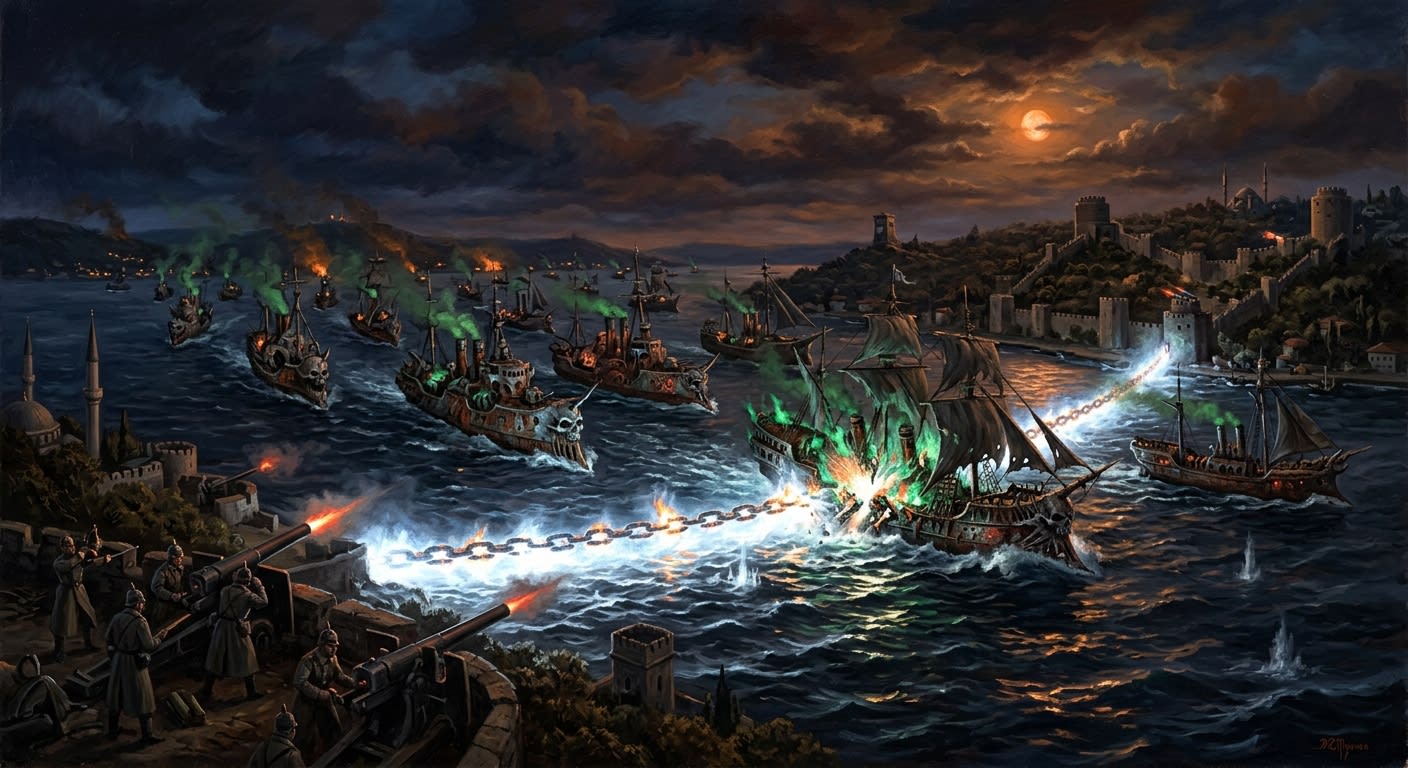
And then, from the darkness beyond the last lighthouse, forty-seven ships entered the Bosphorus strait.
#On the Nature of the Fleet
"They were not ships in the way that the Bureau of Engineering uses the word. They were ships in the way that a coffin is a bed." — Testimony of Bosun Aldric Venn, Harbor Patrol, sealed A.S. 163
Forty-seven vessels, of which no two were alike and all were wrong.
The Bureau of Records' official tally, completed three years after the engagement and ratified by the Bureau of War, classifies the fleet into five categories: war-barges of iron and bone (eleven), fire-ships packed with burning pitch and crewed by things that did not mind the flames (nine), ram-vessels whose prows were shaped from a single continuous tooth of unknown provenance (seven), fog-carriers that trailed a grey murk the Bureau of Alchemical Standards later classified as "spiritually corrosive, pH unknown" (six), and vessels of no determinable type, construction, or function (fourteen). The fourteenth category is the largest. The Bureau of Records does not find this reassuring.
The fleet approached from the south-southeast in a formation the Bureau of War's maritime tacticians have spent thirty-nine years failing to explain. The formation was not a line. It was not a wedge. It was not any pattern that naval doctrine recognizes. The Bureau of Engineering's post-engagement report — one of seven separate reports filed by seven separate Bureaus, each contradicting the other six in all particulars except the number of ships and the outcome — describes the formation as "geometrically consistent with a liturgical pattern of unknown origin, possibly antiphonal." This means the ships were arranged like a choir. What hymn they were singing, and to whom, the report does not say.
They came at harvest convoy season. The strait was thick with grain ships — the annual Anatolian supply run that feeds Constantinople through the winter months. Forty-three civilian vessels were in the Bosphorus approach that night, loaded with wheat, rye, lamp-oil, and the quiet prayers of merchant captains who had been assured by the Bureau of War that the southern sea lanes were safe. The Bureau of War's assurance, printed on letterhead and distributed to the Merchant Marine Guild at a fee of three stamps per copy, bears a date six weeks before the engagement. I have a copy. The letterhead is very handsome. The assurance is worth less than the paper it dignifies.
#On the Battle of the Chains
"Seven hours. It took seven hours. I was twenty-three. I am sixty-two now. I have not slept through a full night since." — Retired Gunner Marta Hess, Ravelin of Fortitude, A.S. 199
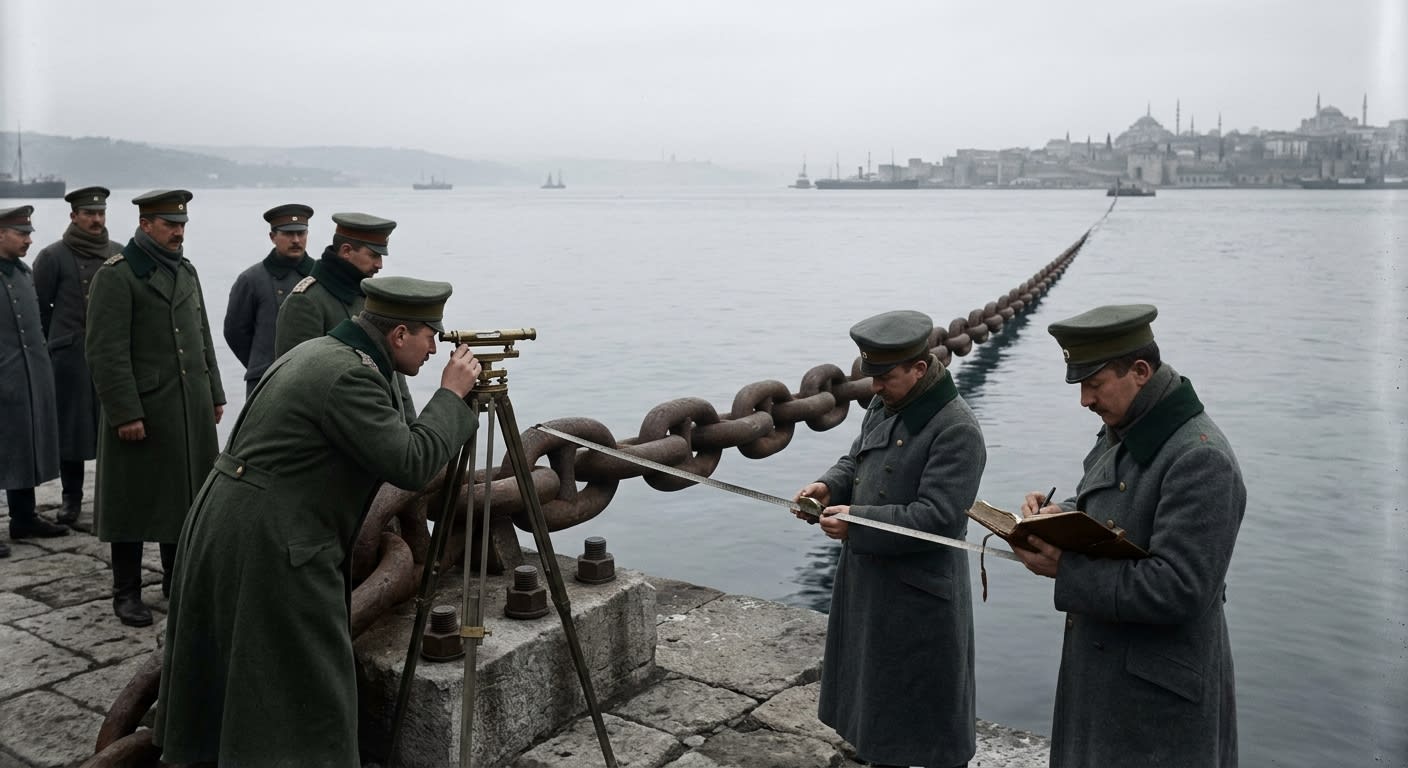
The Chain of Saint Anakletos had been strung across the Bosphorus since A.S. 68 — ninety-four years before the Armada, installed in the first decade of Constantinople's existence as a bastion, when the Bureau of Engineering was still learning the difference between a fortification and a prayer and had decided, with characteristic pragmatism, to build both into every structure. The chain was iron. The links were set with reliquaries — crushed bone and blessed oil sealed into each joint, the whole consecrated by a rotating choir that sang over the metalwork for nine days before installation. It weighed, by Bureau of Engineering estimate, more than the Ravelin of Correction.
It had glowed since the day it was laid. A low, steady luminescence — cold white, visible at dusk and through the night, dimming at dawn. The Bureau of Rites called it "the Chain's testimony." The engineers called it "an unexplained photonic emission consistent with relic proximity." Harbormaster Joram Clee, who had been logging its condition daily since his appointment in A.S. 162 — the very year, the very season, the very month — called it "the glow" and wrote nothing further. Clee is an economical man. Clee would prove an economical Harbormaster.
When the first demon vessel crossed the outer approach — a war-barge of riveted bone, its crew visible on deck as silhouettes that moved with the wrong number of joints — the chain was already raised. The Bosphorus narrows, at the point of the boom, to less than a mile. The chain closed it like a gate. The ram-vessels hit first.
The impact, recorded by the seismograph in the Bureau of Engineering's sub-basement at the Cathedral of the Perpetual Registry, registered as a magnitude the Bureau later struck from the record on grounds that publishing it would "cause undue alarm among the civilian population." The chain held. The ram-vessels did not. Their prows — those single continuous teeth, each longer than a chapel barge — shattered against the links. The sound, per nineteen independent testimonies gathered by the Bureau of Purity's interview teams, was "a scream."
Whether the chain screamed or the teeth screamed is a matter the Bureau of Rites spent four years adjudicating. The Bureau of Rites concluded, with the confidence of men who were not present, that the chain screamed in triumph. I note this. I do not endorse it. The testimonies say scream. They do not say whose.
And then the chain caught fire.
Previous Bureau communiques described the chain's activation as "ignition." The Bureau of Rites has requested this terminology be revised.
The chain did not ignite. Ignition implies combustion. What occurred was a sustained emission of white-hot radiance from every link, every reliquary joint, every inch of consecrated iron across the full width of the Bosphorus — a mile of burning chain that the Bureau of Rites classifies as "divine resonance" and the Bureau of Engineering classifies as "a thermal event exceeding all recorded parameters by a factor we have been instructed not to publish." The Bureau of Doctrine classifies it as a miracle. I classify it as the reason we are all still alive. The classifications are not in conflict.
Seven hours. The Armada pressed the chain for seven hours.
The ravelins of both shores fired without cease — the Ravelin of Fortitude on the European side, the Anatolian batteries on the Asian shore, every gun in Constantinople's harbor arsenal turned on the strait. Bell-choirs sang from the minarets of the Cathedral of the Perpetual Registry. The Flotilla, which Praefect-Naval Tern had ordered to withdraw to the inner harbor, instead held position at the outer approaches and poured relic-fire from its bell-towers into the demon fleet's flanks. Admiral-Prior Yvenne Salt-Crown — grandmother to the current Admiral-Prior — is credited in the Bureau of War's official account with the decision to hold. She is credited because she survived. Had she not survived, the Bureau would have credited someone else.
The fire-ships came next — nine of them, crewed by burning things that grinned through the flames and steered with hands that were already ash. They struck the chain at intervals, trying to melt what the rams could not break. The chain burned hotter. The reliquaries in the links cracked, and from the cracks poured light — white, searing, soundless. Three fire-ships detonated against the boom. The chain held. The explosions killed eighty-seven defenders on the European shore and an uncounted number of things in the water that the Bureau of Records listed as "hostile casualties, aquatic, unclassified."
The fog-carriers drifted into the engagement zone around the fourth hour. Their grey murk silenced the bell-choirs on the Anatolian shore for twenty-three minutes — the longest acoustic blackout in Constantinople's history. In those twenty-three minutes, three demon vessels breached the outer approach and rammed the chain at speed. All three broke apart. Their wreckage sank into the strait in pieces that moved, for some minutes, as if they were trying to reassemble.
By the seventh hour, forty-three ships had been sunk, broken, burned, or dissolved against the chain and the combined fire of the ravelins and the Flotilla. Three vessels, at the fleet's rear — all of them fog-carriers, all trailing their grey murk like a wound — turned south and disappeared into the dark. The Bureau of War dispatched two patrol sloops to pursue. Both returned, reporting that the fog-carriers had "ceased to be present" at a point approximately eleven miles south of the strait. The patrol logs use the word "ceased." They do not use the word "sank."
And one ship was never found.
#On What Was Lost and What Was Spent
"Sixty-three grain ships entered the strait that season. Twenty arrived." — Bureau of Tithes, Harvest Convoy Assessment, A.S. 163
The official casualty report, filed by the Bureau of Records in A.S. 163 and ratified by the Bureau of War in A.S. 165, lists the following: 1,247 military dead (Constantinople garrison and Flotilla combined), 3,400 civilian dead (merchant convoy, harbor workers, pilgrim boats caught in the engagement zone), eleven vessels of the Flotilla damaged beyond repair, twenty-three grain ships destroyed (with their cargo), and an estimated nine hundred tons of wheat, rye, and lamp-oil lost to the strait.
The famine that followed was not caused by the Armada. The famine was caused by Maldrake's Thracian fires nineteen years earlier, by the slow strangulation of the eastern supply routes, by the compounding failures of agriculture in a land where ash falls like rain and the soil remembers what was done to it. The Armada merely ensured that the one compensating factor — the Anatolian grain convoys — arrived short by forty-three ships. The Bureau of Tithes' assessment is dry: "The margin of survival was twenty ships of grain. The Armada consumed twenty-three." The arithmetic is elegant. The starvation was less so.
The chain survived intact. Every link, every reliquary, every joint — undamaged. The Bureau of Engineering's inspection report, conducted the morning after the engagement, found no structural degradation. The reliquaries were cracked — the blessed oil had burned off, the crushed bone was calcite and char — but the iron held. The engineers marvelled. The theologians took credit. The chain dimmed.
It has not glowed since.
#On the Forty-Seventh Ship
"Forty-three sunk. Three retreated. The Bureau says forty-seven. The Bureau's arithmetic leaves a hole. The hole is ship-shaped." — Valerius Drax, private notation, A.S. 199
The Bureau of Rites marked the engagement as a victory. The Bureau of War ratified the assessment. The Bureau of Records produced an official plate — a panoramic battle painting of the burning chain, the shattered fleet, the ravelins firing into the dark — and distributed it to every garrison, every cathedral, every schoolroom from the Baltic to the Tagus. The plate is handsome. The plate shows forty-seven ships. It does not show the forty-seventh leaving.
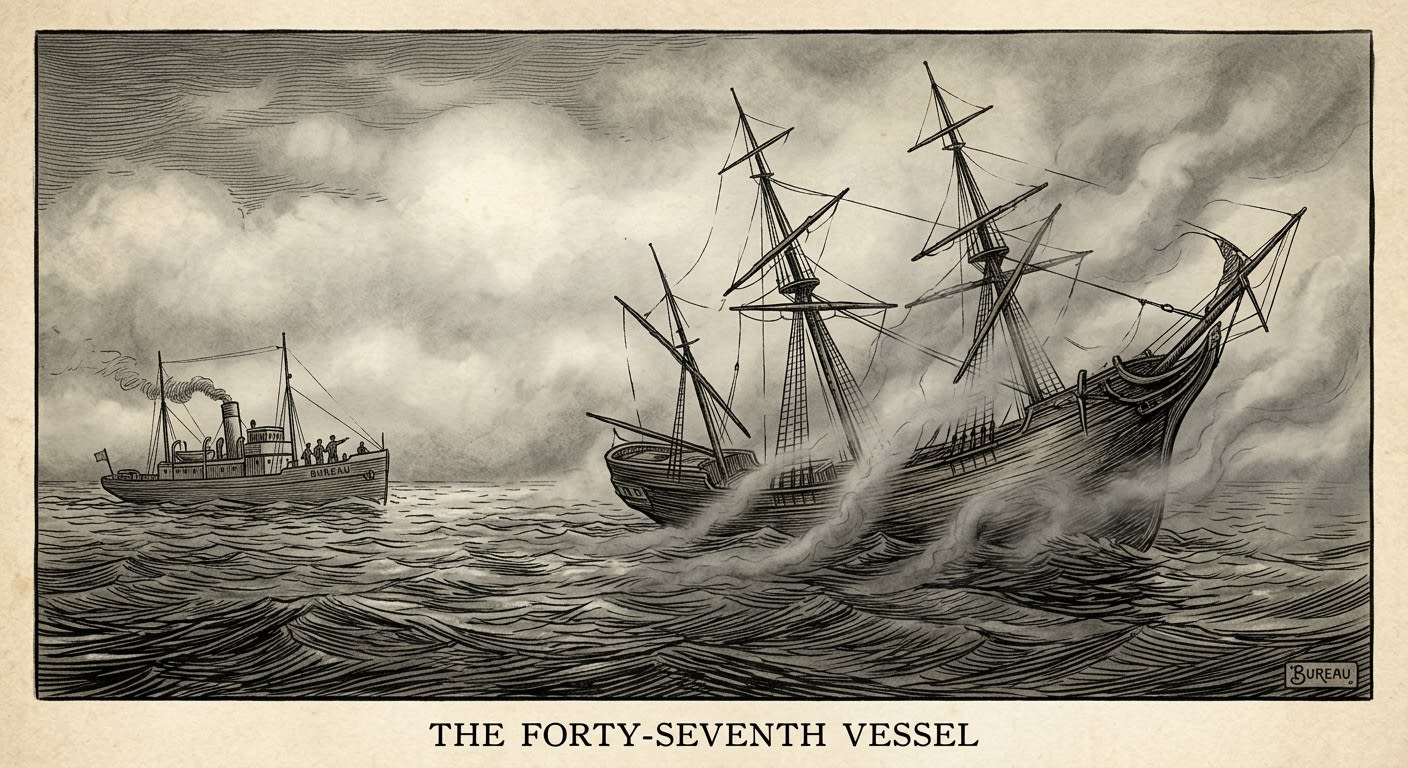
Because the forty-seventh ship did not leave. It did not sink. It did not retreat. It did not burn against the chain or shatter against the boom or dissolve into the fog. It was present in the engagement logs at the second hour. It was absent from them by the fifth. Between those hours, something happened to the forty-seventh ship that the Bureau of Records has classified under a filing number that, when I attempted to retrieve it, returned a document consisting of a single stamped phrase: "Resolved — evidence submerged."
The fishermen of Phaleron Bay — a community seven miles south of the strait, whose livelihood depends on knowing what is in the water beneath their keels — describe, on days when the sea is clear and the light falls at the right angle, the shadow of something very large resting on the bed of the strait. They call it the Sleeper. They say it is roughly ship-shaped, in the way that a chrysalis is roughly caterpillar-shaped — the outline is there, but the thing inside has outgrown its casing and is becoming something for which the old word no longer applies.
The Bureau of Engineering surveyed the location in A.S. 189 — twenty-seven years after the engagement, following a petition from the Phaleron fishermen's guild that included forty-three signatures and a politely terrified request that "someone qualified" confirm or deny what they had been seeing. The Bureau dispatched a survey team. The survey team returned. Their report consists of a single sentence: "The survey is complete."
The findings are not appended.
I have attempted, through channels I maintain for precisely this sort of retrieval, to obtain the survey's raw data. I received, instead of data, a visit from a clerk of the Bureau of Shadows who delivered, without introduction, a sealed envelope containing my own request — returned, unstamped, unsigned, with a single word written across the face in an ink the Bureau of Alchemical Standards does not stock: "No."
I found this clarifying.
Previous editions of the Constantinople codex entry listed the forty-seventh ship as "destroyed, evidence submerged" per the Bureau of Rites' A.S. 162 engagement summary.
The Bureau of Rites' classification is retained for administrative purposes. The physical evidence — the shadow on the sea floor, the fishermen's testimony, the Bureau of Engineering's non-appended survey — is filed separately under a classification that does not appear in the public index. The two filings are not in conflict. They are merely about different things: one is about what the Bureau says happened, and the other is about what is still happening.
On fasting days — specifically, on the Feast of Doctrinal Submission, the 3rd of Ferrum, an annual observance that falls, with the Bureau of Festivals' characteristic precision, on the anniversary of the Armada's approach — the fishermen of Phaleron Bay do not fish the inner strait. When asked why, they give two answers. The first is practical: the catch is poor on fasting days, the currents wrong, the effort not worth the lampwick. The second answer comes later, when the wine has loosened what the daylight keeps tight. They say they do not wish to look down.
Because on the 3rd of Ferrum — on that day and no other — the thing on the sea floor opens its eyes.
#On the Chain's Silence
"It glowed for ninety-four years. It has been dark for thirty-nine. The Bureau says both states are normal. The Bureau says many things." — Valerius Drax, Marginalia on the Bell Codex, A.S. 201
The Chain of Saint Anakletos burned for seven hours on the night of the Armada. It burned with a light that survivors describe as white, as cold, as painful to look at directly — a radiance that left afterimages in the vision for days and that the Bureau of Rites classifies as "divine resonance manifesting through consecrated iron under conditions of acute spiritual threat." Before the Armada, the chain had glowed steadily since A.S. 68 — a low luminescence, visible at dusk, dimming at dawn, constant as a pulse. The glow was Constantinople's nightlight. Sailors navigated by it. Children were told stories about it. The Bureau of Rites printed a pamphlet.
After the Armada, the chain went dark.
The Bureau of Rites' explanation, published in A.S. 163 and revised eleven times since, holds that the chain's radiance was "expended in the act of divine intercession" — that the glow was a reservoir of sacred energy, accumulated over ninety-four years of proximity to the Bosphorus' holy currents, and that the Armada's assault drew upon this reservoir until it was spent. The chain, per this theology, is resting. Recharging. It will glow again when the Creator's Providence deems the reservoir sufficient.
Thirty-nine years is a long rest.
I have said, in my private annotations to the Bell Codex — annotations the Bureau of Doctrine has read, stamped, sealed, and chosen to ignore rather than suppress, which tells me I am closer to truth than either of us would prefer — that the chain's silence is the single most significant strategic fact in the southern theater. A chain that glows is a chain that is active. A chain that is dark is iron and faith and reliquary compound, and reliquary compound does not stop demon ships. Light stops demon ships. The light is gone. What remains is bureaucratic confidence and forty-seven pages of theological explanation, neither of which has been tested against a second fleet.
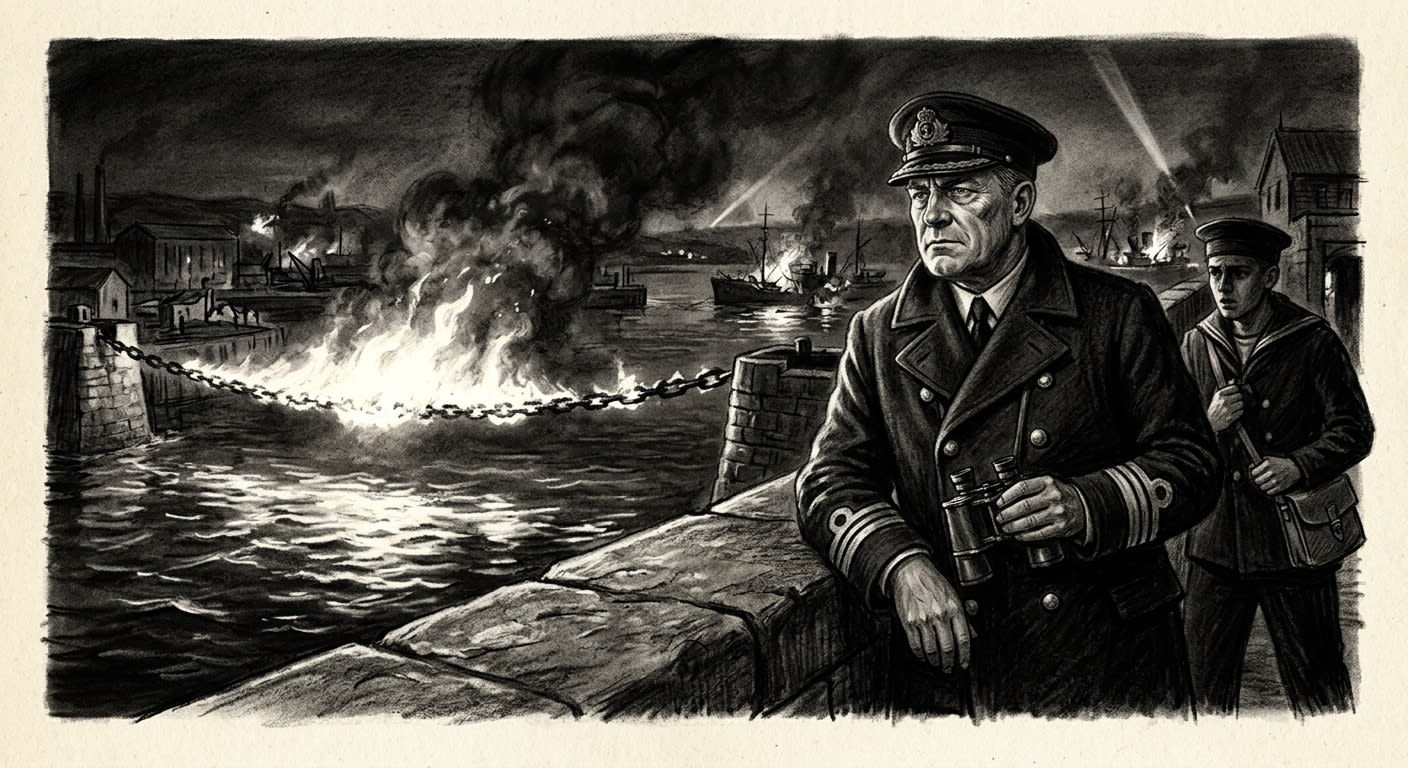
Harbormaster Clee logs the chain's condition every day at dawn. He has done so since A.S. 162. His log, which I have read in its entirety — twelve thousand, four hundred and eighteen entries as of the date of this writing — contains the same notation repeated without variation: "Chain: dormant. Structural: sound. Emission: nil." Twelve thousand entries. Twelve thousand mornings. Clee stands on the quay, looks at the chain, writes three phrases, and closes the book. He has never, in thirty-nine years, varied the wording. He has never, in thirty-nine years, added a comment. He has never, in thirty-nine years, requested a transfer.
I asked Clee once, over the kind of wine one drinks when one has given up pretending the Bosphorus is safe, whether he believed the chain would glow again. He looked at me with the expression of a man who has spent four decades watching a miracle die by increments and said: "The chain does what the chain does. I log it."
I found this the most honest theology I had heard in twenty years of service.
#On the Wreckage and Its Uses
The forty-three ships that the chain destroyed were melted for scrap by the Bureau of Engineering's Foundry Quarter teams over the following three years. The project was straightforward in concept and harrowing in execution. The hulls were demon-built — iron alloyed with substances the Bureau of Alchemical Standards identified as "calcium-calcium hybrid with organic inclusions" (bone), "saline precipitation of unknown biological origin" (tears, the Bureau later admitted, when pressed), and "ferric compound exhibiting acoustic properties inconsistent with metallurgical science" (iron that screams when heated).
The screaming was the problem. Every furnace-load of Armada wreckage, when brought to melting temperature, produced a sustained vocalization that the Bureau of Orison and Song classified as "counter-hymnal — a sound that actively degrades the structural integrity of sacred music within a three-hundred-yard radius." Foundry workers reported nausea, disorientation, involuntary weeping, and the conviction — universal, irrational, and impossible to shake — that they were being watched from inside the metal.
The scrap was eventually processed — reforged under continuous hymn-choir, quenched in holy water, stamped with relic-seals, and distributed to the bastions of the Sagittal Line for use in fortification rivets, gate hinges, and bell-cannon throats. The Bureau of Engineering maintains that the reforging purified the metal. The bastions that received shipments maintain, through informal channels that the Bureau of Records does not monitor, that the rivets sing at night.
#On the Present Condition
The Black Sea Armada of A.S. 162 is, by official reckoning, a victory. The chains held. The fleet was destroyed. Constantinople survived. The Bureau of Records produced a commemorative plate. The Bureau of Festivals established the Feast of the Burning Chain (15th of Ferrum) as an annual observance in the Constantinople liturgical calendar. Schoolchildren sing a hymn about it. The hymn has four verses and mentions faith eleven times.
The hymn does not mention the forty-seventh ship. The hymn does not mention the chain's silence. The hymn does not mention the three fog-carriers that retreated south and "ceased to be present" at a point no patrol has since been willing to investigate. The hymn does not mention the fishermen of Phaleron Bay, or what they see on the sea floor, or why they will not look down on fasting days. The hymn does not mention that the wrecked ships' metal screams, or that the rivets sing, or that the chain has three new links installed by no one.
The hymn is, in four verses, a perfect document: complete, authorized, ratified, and insufficient.
Thirty-nine years. The chain is dark. The forty-seventh ship is on the sea floor, becoming something the Bureau has declined to name. The fishermen cross themselves and call it weather. Harbormaster Clee writes dormant in his ledger and closes the book. And somewhere south of the strait, in waters the patrol sloops will not enter and the Bureau of War has not charted since A.S. 164, three fog-carriers ceased to be present and have not been present since.
The Bureau of Doctrine's position is that the Armada was defeated. The Bureau of Doctrine's position is that the chain will glow again. The Bureau of Doctrine's position is that the forty-seventh ship is a wreck and the fog-carriers are gone and the fishermen of Phaleron Bay are superstitious and the rivets do not sing.
I have filed my report. I have stamped it and sealed it and submitted it in triplicate to the Bureau of Doctrine, the Bureau of War, and the Bureau of Records. All three will read it. All three will file it. All three will produce, in due course, a response that says everything and means nothing and runs to exactly forty-seven pages.
The number forty-seven recurs. I do not know why. I do not like it.