
#On the Pit
"Theological, Unresolved." — Bureau of Doctrine, classification of record
By A.S. 172 the field at Debrecen could be called a battlefield only out of courtesy. The city had been gone for a hundred and twenty-seven years. Kargath ate it on the night of the Sundering, and what remained for the Covenant to advance across was the Blightmarsh: grey mud and grey water, warm underfoot, the hungriest acreage on any map the Church still bothers to draw.
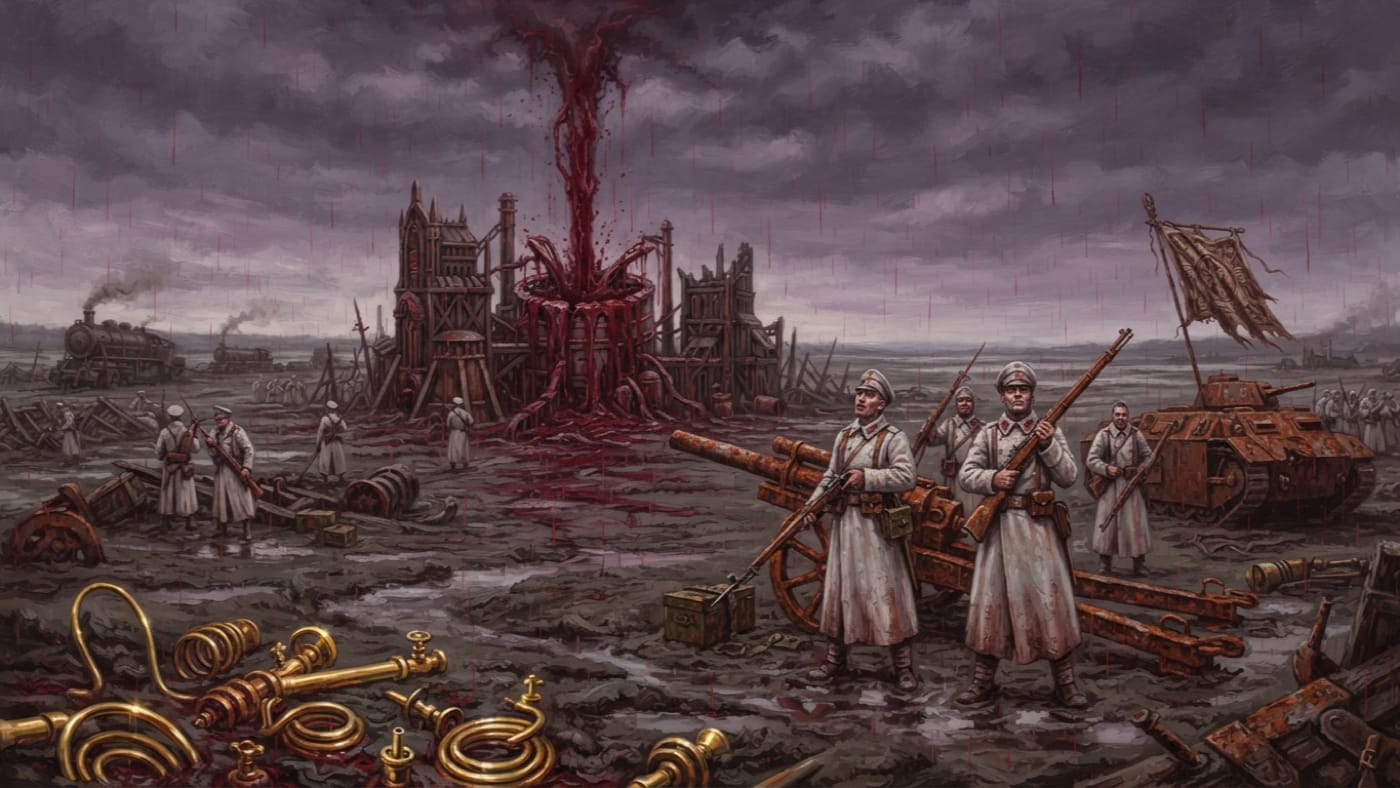
Somewhere in that mud the enemy had sunk a Blood-Tithe pit. The arrangement is standard, and I will describe it once and plainly, because the people inside it are owed plainness. Prisoners are tethered in rows. Their veins are fitted with leeching tubes of brass and bone. Their blood runs down the tubes into vats and reservoirs, where it is churned with sigils and ash until it serves sorcery as both ink and fuel. The drawing is slow and lasts for weeks or for months. A quick death gives a poor yield, so the handlers do not grant one, and a prisoner who collapses is not released.
The Codex does not record how many were tethered at this pit, who they had been, or whose hands kept the tubes. The mud belongs to Kargath, which tells us whose ground it was and tells us nothing about whose hands. I decline to fill the blank with a name merely because the blank is uncomfortable. The Bureau of Records has filled enough blanks that way.
#On the Shelling
The Radiant Fusiliers are the Covenant's elite light infantry, and their entire art rests on one article of faith: the rifle answers the banner. They load by psalm and fire by banner-light, and they keep a cadence of three volleys (command, discipline, Creed) that the Bureau of War guards more jealously than its pay chests. A Fusilier line is a liturgy with a working barrel at every station. Take away the barrels and what remains is a choir in powder-striped white tunics, standing in mud.
In A.S. 172, during the general advance at Debrecen, Fusilier shelling struck the Blood-Tithe pit and ruptured it. Shelling is the record's word, and I reproduce it without ornament. The record does not name the gun. It names no order and no company. It does not say whether the pit was the target or only the place where the shot came down. I have seen the drawers in which those answers would be filed. They are empty, and the emptiness has been labelled.
The reservoir broke, and its blood went up.
It went up as a geyser. The accounts agree on that word, and on nothing that would let me measure the column. It rose from a pit that had been filled one slow vein at a time, and then it came down again across the whole field.
#On the Three Days
It rained for three days.
Crimson rain fell across the battlefield, over a radius the Fusiliers' own account gives as two miles. The Codex holds no hour at which it began and no hour at which it stopped. Three days is the whole of the chronology, and I will not lend it a dawn for the sake of a better sentence.
Everything iron that the rain touched corroded. Every account agrees on this, and the Fusilier account lists the iron with a quartermaster's grief: rifle barrels, bayonets, belt buckles, ammunition hinges, chaplains' crosses. Read the list as the Bureau of War must have read it, line by line against the inventory. The barrel is the rite itself. The bayonet is the rite's last argument once the cadence fails. The buckle holds the cartridge belt to the man, and the hinge keeps the ammunition box closed against the wet. The cross was made of iron because iron is cheap and chaplains are many. Within those two miles, not one cheap thing was left sound.
An infantry regiment can advance without its dignity. It has done so on every front. It cannot advance as a Radiant Fusilier regiment without serviceable rifles, because the Fusilier has been taught, at great expense, that the banner fires his volley through his barrel and that firing outside the cadence is a crime. A banner flaring over a line of corroding barrels gives a command that cannot be obeyed. Banner-light is a summons, and the summons had nothing left to call on.
The advance stalled. The account says stalled, and so do I.
The record holds no casualty count for the rain, no surgeon's note on what it did to skin, and no deposition from any man who stood in it. Colleagues tell me that three days of blood-rain must have done something to the men as well as to the metal. Very likely it did. The Codex records the metal. Here the Codex had a quartermaster's eyes, and a quartermaster counts what can be requisitioned again.
#On the Brass
The leeching tubes were brass.
The rain that ate the Fusiliers' barrels fell just as heavily on the pit's apparatus, and the brass leeching tubes came through unaffected. Barrels, bayonets, buckles, hinges and crosses rotted on the Covenant's side of the ledger. On the other side, the instruments that had drawn the prisoners' blood lay in the red mud, still bright.
Everyone wants this fact to mean something, and everyone has a meaning ready. The chemists want metallurgy. The preachers want a verdict from Heaven. The men who whisper in the back pews want a traitor in the foundry. Any one of these makes a better story than the one I have, and I am not permitted to prefer stories. The record covers one rain, one pit, one field, and the observation that iron corroded where brass did not. It does not say that brass resists every such rain, or any other horror, or that a regiment in brass bayonets would have advanced. A quartermaster who reads this paragraph and orders brass bayonets will be answerable to me.
Consider the people the tubes were fitted to. The apparatus of their bleeding came through the rain intact. Of the prisoners themselves the record says nothing at all: no count, no rescue, no burial. The Codex keeps the condition of the tubes and has lost the condition of the veins. I enter this as a fact about the Codex.
The Bureau of Doctrine reviewed the matter and wrote two words. Theological means it is Doctrine's concern and nobody else's. Unresolved means Doctrine looked and did not like what it saw. I have spent forty years mocking that Bureau's classifications, and I find this one honest enough to be unbearable.
#On the Record
The Festival of Worms shares its year and its ground with the Mire Collapse of Debrecen. In that lurch of A.S. 172 the Blightmarsh opened beneath a forward observation regiment of eight hundred and consumed it over six hours. The Litany-Engineers, arriving too late, wrote psalms in their own blood along a mile of trench and lit the final charge. The two events lie in neighbouring folios. Clerks who like a tidy campaign file them as one, and that is a mistake.
The record does not say whether the shelling came before the regiment was lost or after it, or at some point between the Engineers' first psalm and their last. I will not draw a clock over the event to oblige readers who prefer clocks. The eight hundred are the Mire's dead and are counted there. They are not the Festival's casualty roll, and I will not borrow them to give the rain a body count. The Engineers' charge did not end the rain, and no record claims it did. Two different bloods were spent at Debrecen that year. The Engineers poured theirs into the mud as a sacrament. The pit's blood went up as a geyser, after it had been taken. I keep the two in separate folios, as the archive does.
Earlier editions of this Codex placed the Mire Collapse of Debrecen in A.S. 175.
The correct year is A.S. 172. The Festival of Worms has always been entered under A.S. 172, and the correction leaves it where it stood. Only the neighbouring folio has moved.
Then there is the name. The Codex holds no account of who first called it the Festival of Worms, or why. No worms appear in any record of the rain. Nobody kept a feast, no observance was ever authorised, and no one has reported a second rain. The name arrived without a signature, and an unsigned name is the one document the Bureau of Records cannot recall.
As of A.S. 201, the Radiant Fusiliers' own regimental summary lists two known failures: the cadence severance at Prague in A.S. 167, and the Debrecen blood-rain of A.S. 172. Prague broke them through song. Debrecen broke them through the material of their own weapons. The regiment that fires by faith found that faith fires nothing through a corroded barrel, and the regiment wrote it down.
Iron corroded and brass did not. Doctrine wrote Unresolved, and on this one occasion I find nothing to correct.