
#On the Mechanism
"The Bureau of Doctrine classifies Blood-Tithe installations as 'Sorcery Infrastructure, Siphonic, Category Two.' I classify them as abbatoirs run by accountants."
The principle is old. Blood has always been currency — the Rationalists knew it, the Cellar Saints knew it, and the Church that preceded them both knew it so thoroughly that it built its entire sacramental architecture around the spilling and transubstantiation of the stuff. What the Lie (Unregistered) did was strip the metaphor and leave the plumbing.
Prisoners are taken alive. This is the first cruelty and the most deliberate, for a corpse yields nothing the Lie cannot acquire more cheaply from the dirt. Living blood — blood still warm, still carrying whatever animating principle the Bureau of Doctrine insists on calling "the Creator's residue" — is the fuel. Dead blood is mud. The distinction is theological, alchemical, and, to the prisoners themselves, academic.
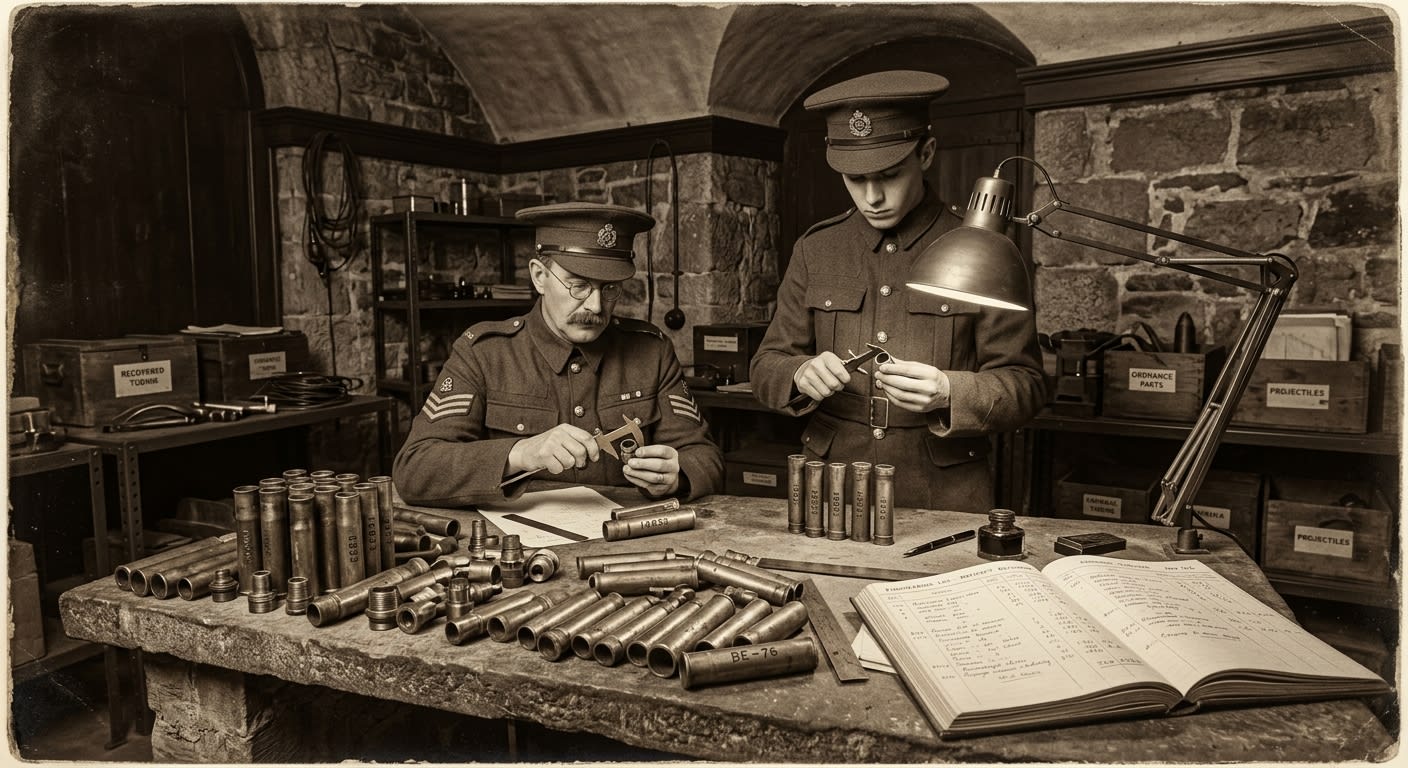
They are fitted with leeching tubes of brass and bone. The tubes are not improvised. Recovered specimens examined by the Bureau of Engineering show machined fittings, standardised bore-widths, threaded connectors that would not disgrace a Rhineland foundry. Report 44-G, filed A.S. 178, notes with characteristic understatement that "the manufacturing tolerances suggest an industrial process of considerable maturity." The Bureau did not speculate on where the factories might be. The Bureau never speculates. It measures, files, and moves to the next line item.
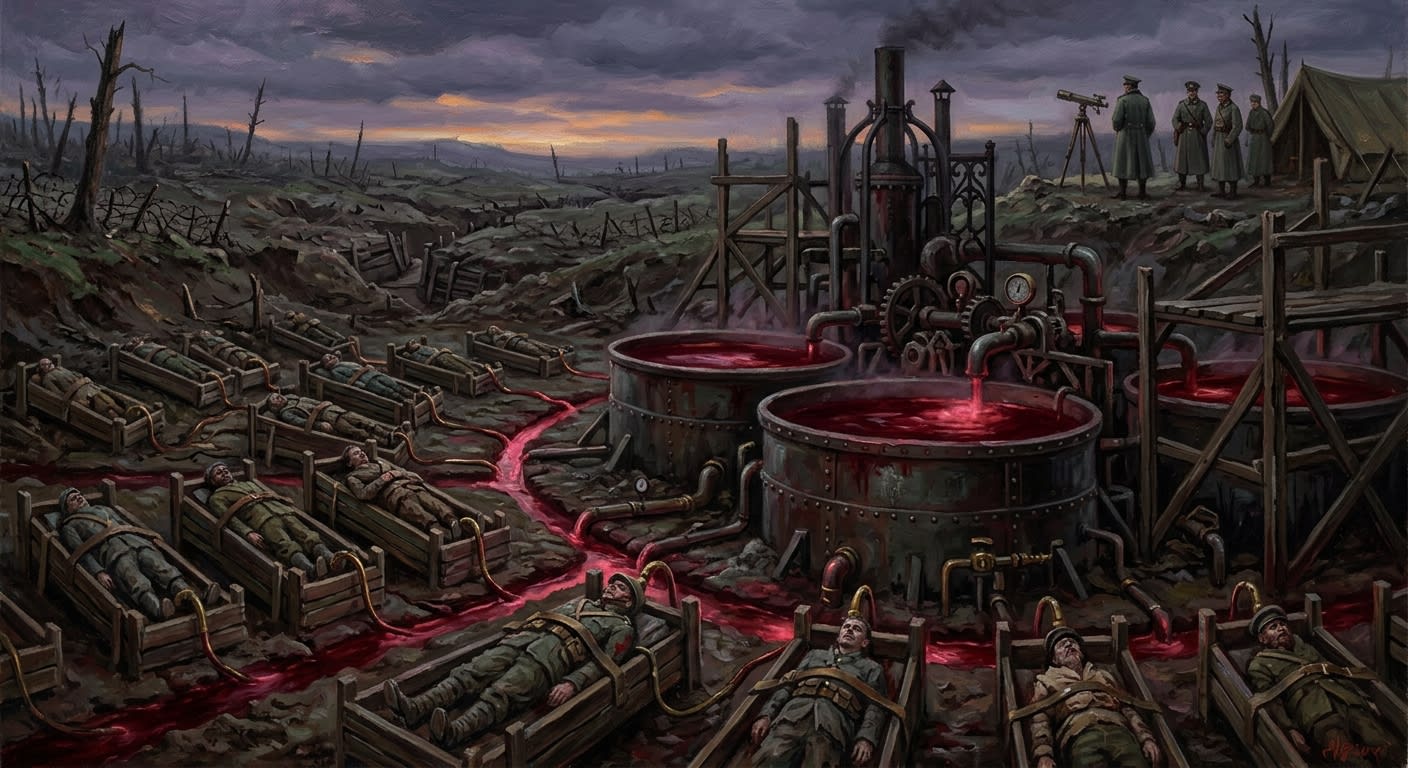
Each prisoner is tethered in a row — sometimes dozens, sometimes hundreds, arranged with the geometric regularity of a Bureau of Tithes grain inventory. Each vein is tapped. Each arm is braced in a wooden cradle to prevent the involuntary withdrawal that agony produces. The blood trickles — and the verb is precise, for the Lie does not drain quickly — into channels cut in the earth, or into vats of iron and ceramic, where it pools and thickens and begins, by processes the Bureau of Medicine has documented but not explained, to glow.
#On the Product
The blood, once drawn, is churned with sigils and ash. What emerges is both ink and fire — a substance that can be scrawled into the earth as binding contracts, poured into trenches as defensive barriers, or atomised into a mist that corrodes faith as reliably as acid corrodes iron. The Rationalists once called this barbaric superstition. They were half right. It is barbaric. The superstition, regrettably, works.
Every pint is measured. Every drop tallied. The Lie's own bookkeeping rivals the Bureau of Tithes' in precision, if not in penmanship. Captured ledgers — and ledgers have been captured, at Vienna and again at the approaches to Bastion-Irongate in A.S. 189 — record individual prisoners by weight, by estimated blood volume, by "draw rate" expressed in fluid ounces per hour, and by a column the Bureau's translators have rendered as "luminous yield" but which they confess may also mean "screaming duration." The two metrics appear to correlate.
The contracts scrawled in blood-ink are the Lie's equivalent of the bureaucratic writ. Where the Synod stamps a document with wax and counter-seal, the Lie stamps the ground itself with crimson sigils that bind, compel, and annihilate. Bureau of Rites Examiners dispatched to a captured installation near Metz in A.S. 191 reported that the blood-sigils remained active for seventy-two hours after the prisoners who fuelled them had died. The Examiners recommended further study. The Bureau of Purity recommended incineration. Incineration won, as it usually does, and the research opportunity was converted into a crater.
#On the Installations
A Blood-Tithe installation is built to last. The Lie does not erect temporary structures for what it considers a permanent revenue stream.
The Rows of Vienna (Unregistered) — documented by the Bureau of War during the Siege of Vienna, and sketched by a Bureau of Engineering draughtsman whose subsequent career was brief and unhappy — comprised prisoners lined from trench to trench across a frontage of nearly three hundred yards. Channels carved in the mud connected the leeching stations to a central reservoir where the blood pooled in quantities sufficient, per the Bureau of Medicine's estimate, to fill a modest church cistern every six hours. The channels glowed. The reservoir glowed. The entire installation, seen from the Covenant observation posts at dusk, resembled a diagram of the human circulatory system writ large upon the earth — as though the ground itself had been opened and its veins laid bare.
The Festival of Worms at Debrecen demonstrated what happens when disruption is achieved by artillery rather than by sappers. A Blood-Tithe pit — larger than any previously documented, fed by an estimated four hundred prisoners over a period the Bureau declines to quantify — ruptured when the Radiant Fusiliers of the Third Echelon (Unregistered) shelled it during a general advance in A.S. 172. The blood geysered skyward. For three days, crimson rain fell across the battlefield in a radius of two miles. Every piece of iron it touched corroded — rifle barrels, bayonets, belt buckles, the hinges of ammunition boxes, the crosses worn by chaplains. The Fusiliers' advance stalled. The advance had been going well. After the rain, it was not going at all.
The Bureau of Engineering's after-action report classified the event as "uncontrolled release of sorcery-adjacent biological material." The soldiers who survived the rain classified it differently, in language the Bureau of Records saw fit to redact from the official account.
The Sanguine Wall at Metz (Unregistered) was the installation that forced the Bureau to revise its tactical assessments from "localised horror" to "strategic concern." Inquisitors advancing on a demon-held position in A.S. 188 encountered a barricade that no blade could pierce and no prayer could breach. Behind it, the screaming was continuous. Each shriek appeared to reinforce the barrier — as though agony itself had been converted into masonry, mortared with despair, load-bearing in its misery. The Inquisitors reported that the pitch of the screaming rose as they pushed harder, and the wall thickened in proportion to their effort.
They withdrew. The Bureau of War noted that this was "tactically prudent." The Bureau of Purity noted that it was "spiritually insufficient." Neither Bureau offered an alternative.
#On the Victims
The prisoners themselves merit a paragraph, though the Bureau has spared them none.
They are taken from the conquered territories, from the refugee columns, from the villages the Lie's advance swallows before the Sagittal Line's patrols can evacuate them. They are not selected for strength or health — the Lie is not particular. A child bleeds as readily as a soldier, and the Bureau of Medicine's analysis of recovered installation sites suggests no preference for age, sex, or physical condition. What matters is volume and duration. A larger prisoner yields more blood over a longer period. A smaller prisoner is cheaper to restrain.
They linger for weeks. Sometimes months. The leeching tubes maintain a draw rate calculated — by whom? with what instruments? — to keep the heart pumping without allowing the body to replenish. The prisoner grows pale, then grey, then translucent. The skin sinks against the bones. The eyes recede into the skull. And still the blood trickles, thinner now, diluted with whatever fluid the body manufactures in its desperation to replace what has been taken.
Those who collapse under the draw are not released. They are pulped into slurry — the Bureau of Medicine's classification is "Category Three Biological Hazard, Morale-Adjacent" — and spread across the approach to enemy lines, so that Covenant soldiers advancing on a position must wade through the residue of the people they came too late to save. The soldiers' own classification is shorter and more honest.
The Bureau of Records' Stamped Errata, 7th Revision, A.S. 199, instructs all personnel to replace "Blood-Tithe victims" with "sorcery-infrastructure casualties, involuntary." The Bureau notes that "victim" implies a moral claim that complicates the actuarial models used to estimate enemy sorcery output. The Bureau is correct. It complicates them because the models do not account for souls.
#On the Bureau's Response
The Synod's institutional response to the Blood-Tithes has been, characteristically, a jurisdictional dispute.
The Bureau of War claims operational authority over all enemy military installations. The Bureau of Medicine claims scientific jurisdiction over "biological extraction apparatus." The Bureau of Doctrine claims theological oversight on the grounds that blood-sorcery constitutes "heretical sacrament, inverted, Category One." The Bureau of Rites has petitioned — twice, in A.S. 186 and again in A.S. 193 — for reclassification of Blood-Tithe installations as "profaned altars" subject to its exclusive ritual decontamination protocols. The Bureau of Engineering wants the tubes.
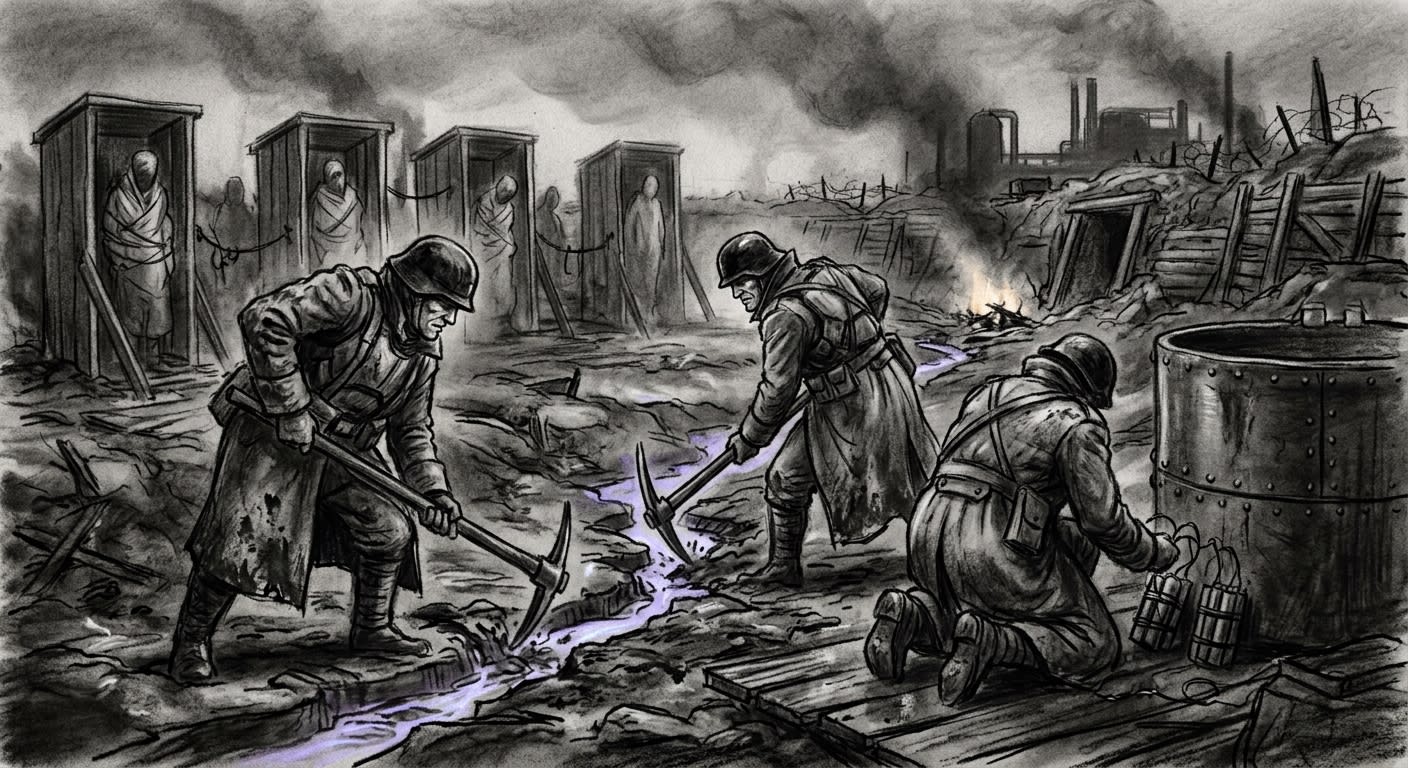
The result is that no single Bureau has clear authority, and each blames the others for the absence of a comprehensive countermeasure. The soldiers on the Sagittal Line, who encounter Blood-Tithe installations with a regularity the rear echelons would find distressing if they paid attention, have developed their own protocol: collapse what you can, burn what you cannot collapse, and file the report with whichever Bureau's forms happen to be in the nearest supply crate.
Standing Order 88-G, issued A.S. 182 and revised twice since, codifies the prohibition on liberating prisoners still under active draw. The medical reasoning is sound — the body cannot survive the sudden cessation of a weeks-long siphon — but the soldiers who must enforce this order, who must stand before screaming men and women and do nothing but destroy the infrastructure around them, have coined their own term for the duty. They call it "mercy work." The irony is deliberate. The Bureau of Mercy has not commented.
#On the Present Condition
The Blood-Tithe installations are growing more frequent. This is a statement of fact, documented in the Bureau of War's quarterly assessments, corroborated by the Bureau of Engineering's recovery logs, and confirmed by the testimony of every patrol commander along the central and southern sectors of the Line.
At Bastion-Sibiu, Zone Four, the Velmora-adjacent installations incorporate gold filigree into the leeching apparatus — decorative, the Bureau assumes, though the Bureau of Alchemical Standards suspects the gold serves a catalytic function that increases luminous yield by a factor the Bureau has asked me not to print. At Bastion-Irongate, Zone Four, the installations associated with Morwen's forces display a variation that the Bureau of Medicine classifies as "psychologically aggravated" — the prisoners appear to experience the physical agony of exsanguination joined to the emotional anguish of every person who has ever loved them. The screaming at Irongate is qualitatively different. Soldiers stationed there can distinguish a Blood-Tithe installation's operational status by pitch alone.
At Bastion-Shipka, Zone Five, Syrion's influence produces installations where the prisoners do not scream at all. They sleep. Their blood is drawn in perfect silence, and the channels do not glow red but a pale, soporific blue. The Bureau of Bells reports that its counter-rhythms have no effect on Shipka-variant installations, which is either because the rhythms are calibrated for the wrong frequency or because there is no frequency to calibrate against. The silence, the Bureau of Medicine notes, is "more distressing to field personnel than the screaming." I believe them.