
#On the Ground That Remembered
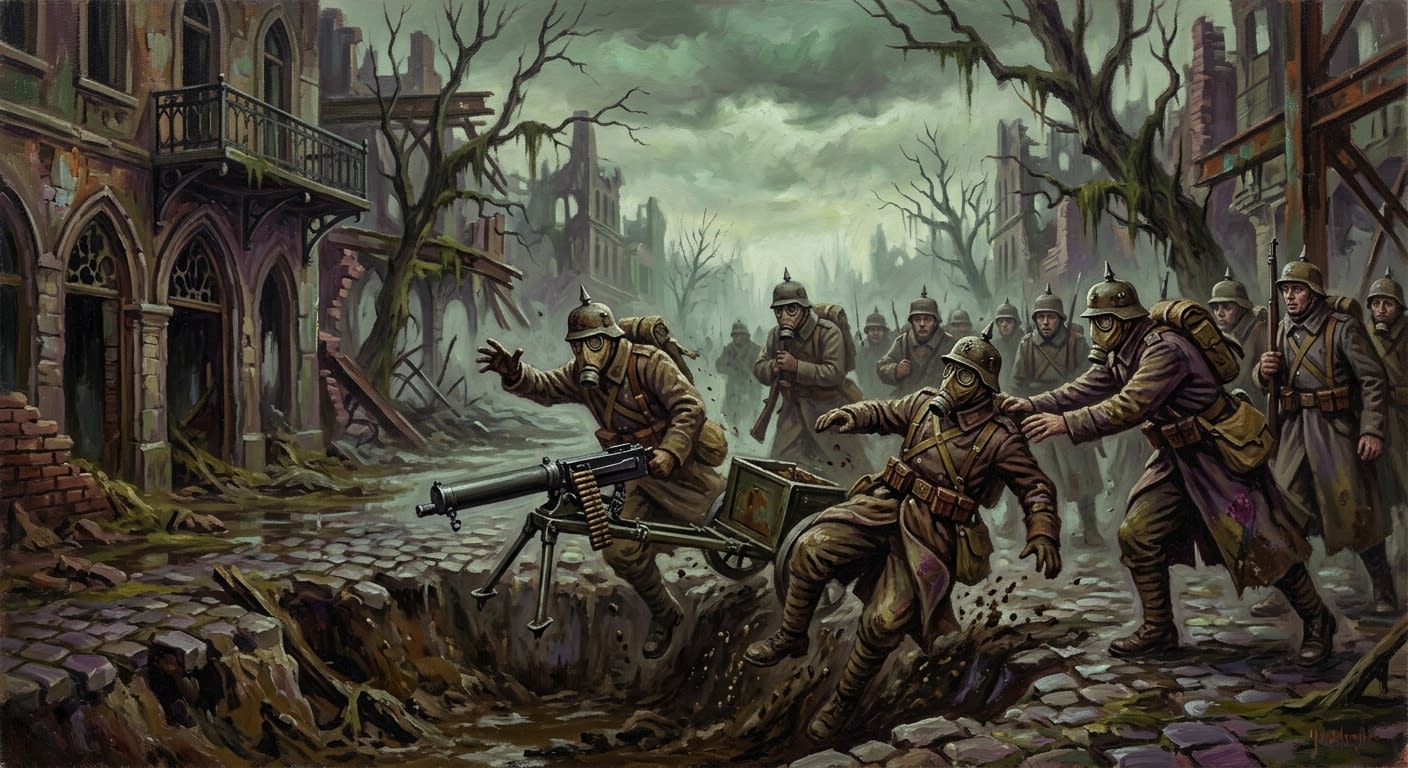
The Mire Collapse of Debrecen occurred in A.S. 172, though the verb remains under review by the Bureau of Records. Ground collapses. Mines collapse. Morale collapses, especially after the quartermaster serves bean-paste with devotional vinegar for the ninth consecutive supper. Debrecen did something more exact and less polite. It opened along streets that had not existed in the world for one hundred and twenty-seven years.
The Blightmarsh remembered the city.
Debrecen had been eaten by Kargath on the night of the Sundering, its forty-two thousand souls and forty-mile provision radius devoured before dawn. By A.S. 172, it was a name in maps, sermons, rationary curses, and the private mutterings of old campaigners who had learned never to trust grain east of the Danube. The city itself lay beneath the Marsh, or within it, or behind it; prepositions fail when geography has been digested.
#On the Regiment
The lost regiment had been posted too far forward because every disaster begins with a map proving that the next safe position is elsewhere. Their formal assignment was observation, boundary measurement, and engineer support. Their practical assignment was standing in a place no sane officer wished to stand, writing down whether Hell moved closer before lunch.
They had Litany-Engineers with them. This detail matters. The Bureau of Engineering prefers to pretend its men merely calculate, brace, measure, and curse under their breath. In the eastern theatre, an engineer also writes psalms into mud with his own blood when the fuse-line runs short and the chaplain is dead. Engineering denies romance. Engineering practices it constantly.
The regiment’s last complete report notes “sub-surface strain,” “vertical bubbling,” “faint choral return,” and “bread-smell from eastern fissures.” The bread-smell should have triggered immediate withdrawal under Standing Order 119-F adjacent advisories, but the order had not been appended to that regiment’s field packet because the packet was printed before the advisory revision and no one had initialled Form 77-K(ii). Eight hundred men died in the gap between two pieces of paper.
Earlier memorial pamphlets stated that the regiment advanced under direct assault by Maw-Born entities.
Corrected. The assault began after the ground opened. The regiment advanced against terrain, which is to say against the enemy’s handwriting.
#On the Opening
At the third hour after Sext, the surface split.
The first fissure ran north to south in a line later matched to Piac Street (Unregistered) on pre-Sundering civic plans. The second opened at an angle corresponding to the old market approach. Then the side lanes appeared. Then courtyards. Then wells. A sedated cartographer, recovered alive for nineteen hours, drew the pattern in a field hospital and wept because the map was beautiful. He apologised for the beauty twice. He died before the Bureau could reprimand him.
What rose from those fissures has never been given a stable name. Maw-Born, sub-surface variant, Category Unassigned; Charnel Mouths; Drava Throats; Street-Jaws (Unregistered). Soldiers used shorter terms. The mouths opened vertically from the mud. Some were the size of wells. Some were the size of gun-carriages. One, reported by three men before their deposition coherence failed, had teeth arranged like cobblestones.
Recovered signal scrap, Debrecen perimeter, A.S. 172: “Left company gone into Várad Street (Unregistered). There is no Várad Street. Request artillery on coordinates ███████. Correction: request bells. Correction: request mother. Correction: it is chewing through the hymn.”
The sound carried forty miles. Sentries at Bastion-Constantinople recorded a low vibration in the walls, at first mistaken for distant artillery from Maldrake’s sector. The Bellwardens noted sympathetic tremor in three chapel bells. One bell rang once without rope-touch. The Bureau of Bells filed this as “unscheduled participation.”
#On the Litany-Engineers
The engineers attempted consecration under collapse conditions. This is the phrase in their posthumous citation, and it has the usual Bureau elegance: exact, evasive, bloodless as a saint’s accounting table. What happened was uglier and more worthy of respect.
They laid fuses end to end like rosaries. They cut their palms when the ink washed away. They wrote psalms into the mud while the mud pulled at their boots. One mile of trench received the Litany of Refusal, the Third Brace-Prayer (Unregistered), and at least six unauthorised engineering annotations concerning load, slope, and the unacceptable behaviour of clay. The Bureau of Doctrine later removed the annotations from the clean memorial copy. The mud, by all reports, kept them.
The charge detonated at Vespers. The ground heaved inward. Fire burped from beneath the muck on three successive nights, blue on the first, yellow on the second, colourless on the third. From under the Marsh came a muffled choir, singing off-tempo through packed mud. Survivors called it the Choir Beneath. The Bureau called it acoustic after-effect. The Bureau has many little comforts. It takes them like tea.
#On the Accounting
Eight hundred men were consumed in six hours. That number is official, which means it contains lies of omission, not necessarily lies of arithmetic. Camp followers are absent. Penal diggers are absent. Two Bell assistants appear as equipment losses. The chaplain’s mule appears twice, once as draught animal and once as “portable liturgical support,” proving that even in catastrophe the Bureau can still duplicate livestock.
The Bureau of War designated the site a permanent exclusion zone. The Bureau of Records amended its maps. The Bureau of Doctrine composed a memorial service for delivery at Bastion-Constantinople, where I stood before men who had heard the chewing in the walls and told them that sacrifice had sealed the breach. This was true. It was insufficient. Truth is frequently too small for funerals.
An early casualty ledger listed the incident under “Debrecen — Terrain Reclassification.”
Retained, with correction. The loss of eight hundred men is now cross-filed under “Catastrophic Personnel Translation,” “Eastern Theatre Consumption,” and “Instructional Cartographic Instability.” The Bureau of Records assures grieving families that the new arrangement improves retrieval.
#On the Exclusion Zone
The fissures remain. They fill with mud, flatten, and return after rain. Survey teams sent close enough to verify closure report bread-smell, street-noise, and market bells from below. One team heard a child calling prices in pre-Sundering Hungarian. Another heard a sergeant from the lost regiment asking whether the line had advanced. The correct answer is no. The merciful answer is also no. Mercy and accuracy occasionally share a bench.
The exclusion posts are marked with black stakes and triple seals. Patrols are ordered to remain beyond the listening distance, which varies by weather, fasting status, and guilt. Men who hear the Choir Beneath are rotated west for examination. Men who hum with it are quarantined. Men who answer are erased from duty sheets before their boots cool.
The Mire Collapse changed eastern doctrine. It proved that the Blightmarsh does not merely occupy ground; it edits it, retrieves it, stages it, opens old streets under new boots. It proved that Kargath’s dominion can weaponise memory without sentiment. It proved that a dead city may remain operational if Hell has retained the floor plan.