
#On the City That Was
"Debrecen: Market-town, Eastern Hungary. Population: 42,000 (A.S. 44 Census). Status: Consumed." — Bureau of Records, Index of Settlements, Folio East-7
The wheat grew tall enough to lose a child in. I begin there because the Bureau does not, because the Bureau's entry for Debrecen is three lines long — a name, a population figure rounded to the nearest thousand, and a status classification that reads like the last line of a grocer's ledger — and because someone ought to say what was eaten before describing the eating. Three empires drew their bread from the Pannonian plain, and Debrecen sat at the plain's eastern shoulder like a fat man at the head of a generous table: forty-two thousand souls, a grain exchange that set prices from the Danube to the Rhine, a cattle-market whose stink reached Vienna on the right wind, and harvest caravans that stretched in golden columns from the city gates to the river crossings at Szolnok (Unregistered). The orchards of the Tisza valley (Unregistered) kept the city's cellars heavy with plum brandy and its churchyards populated with men who had drunk too much of it. The cattle-runs of the Alfold were so thick with grass that drovers' boots left no mark, and the air smelled of clover from April to October.
I record these details for the same reason the Lore-Clerk records the weight of a man before his execution: precision is its own memorial, and someone will need the numbers when the argument begins about what we lost and whether anyone is to blame. The answer to the second question is, of course, everyone.
#On the Falling
Debrecen did not fall in the ordinary sense. Cities that fall are struck by armies, besieged by famine, broken by plague, taken at the sword. Debrecen was eaten. The distinction is important, because it is the distinction between a military event and a theological one, and the Bureau of Doctrine insists — quite correctly, for once — that the correct response to a military event and the correct response to a theological event are different, even if both responses end with the same number of dead.
Kargath came through the wound the Sundering tore across the Balkans on All Saints' Day, A.S. 45, and his attention turned to Debrecen with the uncomplicated directness of a starving man finding an unguarded larder. He did not assault the Rationalist garrison. He did not send columns against the walls. He did not even, so far as the sealed testimonies indicate, manifest visibly to the defending officers. What he did was simpler, and worse. He ate.
Every ration in the garrison stores. Every grain sack in every warehouse. Every barrel of salted meat, every sack of flour, every loaf in every bakery and every crumb in every pocket within a radius of forty miles — consumed by the land itself, which opened its throat and swallowed provisions the way a condemned man swallows his confession when the inquisitor enters the room. The commissariat ledgers describe what happened as "atmospheric spoilage of unprecedented scope." The commissariat clerks who wrote those words had watched bread turn to ash in men's hands and water curdle in canteens.
One hundred thousand men found themselves starving in a single night. Officers who had planned a six-month defensive campaign discovered their supply lines had been digested. The Rationalist Second Army — well-drilled, well-supplied, equipped with clockwork artillery capable of four rounds per minute — was reduced to a mob gnawing boot leather by dawn.
The retreat was a stampede. Men ate their horses. Men ate their comrades' horses. The testimony of Captain Elias Mürren, preserved in the Vault of Silences beneath the Basilica of the Ledgered Saints, records the consumption of his mount, his adjutant's mount, and — in a passage the Bureau has seen fit to obliterate — something else entirely. The final paragraph of the Mürren deposition, before the obliteration, contains seven words: "It offered itself to us, and we ate, and the eating did not stop."
The Bureau of Purity classifies the substance consumed as "sorcerous provender" and its consumption as "involuntary heresy." No disciplinary action was taken, as the majority of consumers did not survive the march. The seventeen who reached Bratislava were quarantined. Fourteen died within the week. The three survivors were examined by a Rationalist physician — one of the last — who noted in his journal that their stomachs had "expanded beyond anatomical possibility" and that their teeth had changed shape. The journal is in the Forbidden Stacks. The physician's subsequent career is not recorded.
The survivors ran as far as Bratislava. Some were found sitting in ditches, still chewing, unable to stop. The bodies of others were discovered along the road, curled around ration packs that contained nothing but grey powder the Bureau of Alchemical Standards later classified as "organic calcium of indeterminate provenance." The Bureau's classification, while technically accurate, tells you less than the soldiers' slang: hunger-ash.
#On the Vanishing
The city's physical destruction proceeded in stages, each more baffling than the last, and each recorded in language designed to obscure the terror behind the facts.
Stage one: the rations were consumed. Stage two: the fields surrounding the city began to produce crops that grew with obscene vigour and satisfied nothing — grain that tasted of dust, fruit that dissolved on the tongue, wheat that sprouted lips and teeth. Soldiers who bit into the bread found themselves bitten back. Entire battalions withered from rot-bursts that swelled their livers to the size of tents. The Bureau of Medicine sent a team. The team's report runs to three pages. Page one describes the conditions. Page two is blank. Page three reads: "Request immediate transfer."
Stage three: the city itself disappeared. The Lore-Clerk's entry is remarkable for its restraint: "In the morning there were streets; at noon, only fields." Rationalist notes attribute the event to "mass migration." The Bureau's own redacted annals, which I have read — illegally, and with considerable pleasure — suggest something fouler: "field test of hunger." What field, what test, what hunger. The lines are struck through. The ink is smeared, as though the page itself sought mercy from the words it bore.
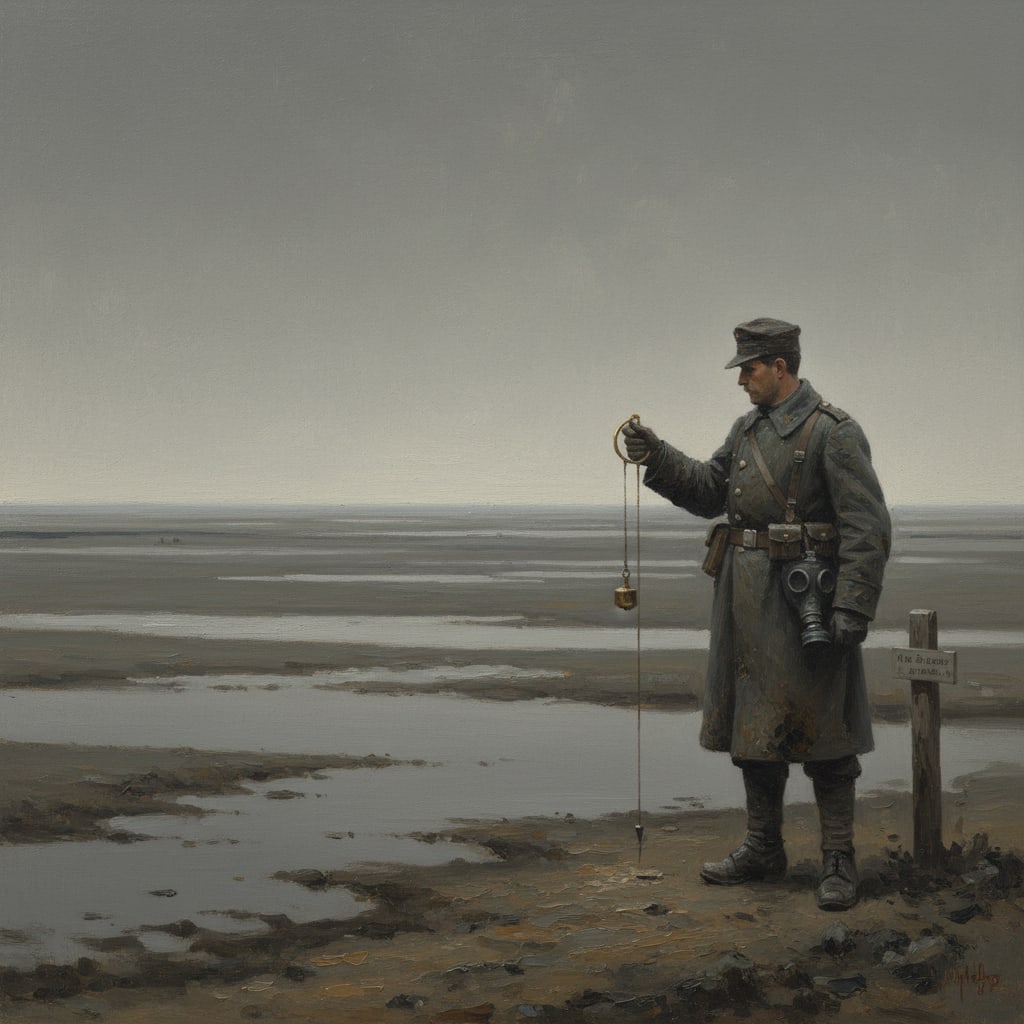
What remained was the Blightmarsh: grey mud where there had been golden wheat, grey water where there had been clear streams, grey sky where the plain's horizon had once been so vast that shepherds claimed they could see tomorrow's weather walking toward them across the grass. The soil was consumed — the Bureau's word, and precise. Not depleted. Devoured. Eaten by something beneath it that left nothing behind except a hunger so absolute that standing near the site causes the stomach to cramp regardless of when you last ate.
#On the Scars
Debrecen refused to stay dead. Or rather, Kargath refused to let it.
The Famine Pits opened first: mass graves from the A.S. 45 catastrophe, where thousands who died of starvation were thrown into trenches and covered with whatever the commissariat had left. The hunger of the dead did not die with them. The Pits radiate need like a furnace radiates heat, infecting the living, creating starvation in well-fed bodies. The Bureau of Medicine confirmed the phenomenon in A.S. 134, coined the term "Residual Consumptive Emanation, Category Three," and requested a transfer.
Then came the Abundance Fields at the Marsh's boundary — patches of impossible fertility where crops grew lush and eternal and satisfied nothing. Four confirmed Synod communities settled near them, attracted by the harvest. All four were found dead, root-cellars full, tables set, bodies wasted to bone, mouths still working.
The Pit of Debrecen (Unregistered), discovered by Captain Elias Brekke of the Radiant Fusiliers between A.S. 78 and A.S. 83, contained seventy Ash-Mothers chained in a circle, their infants tossed into a central pyre. The smoke rose in the shape of a hand that clawed the clouds until reliquary bells drove it back. Brekke filed his deposition, was reassigned to a supply depot in the Candlewick Palatinate, and has not spoken publicly since.
The Festival of Worms, A.S. 172: a Blood-Tithe pit ruptured when the Radiant Fusiliers shelled it during the Mire Collapse. Blood geysered skyward. For three days, crimson rain fell across the battlefield, corroding all iron it touched. The brass leeching tubes were unaffected. The Bureau of Doctrine classified this coincidence as "Theological, Unresolved," which is the Bureau's way of saying we noticed and we wish we hadn't.
#On the Mire Collapse
The Mire Collapse of Debrecen, A.S. 172. I have delivered the memorial service for this event three times — once at Bastion-Constantinople, once at Strasbourg, and once in an empty chapel at the edge of the Sagittal Line where nobody came because nobody was posted there any longer — and I will not rehearse the Bureau's sanitised version when the unsanitised version is shorter and truer.
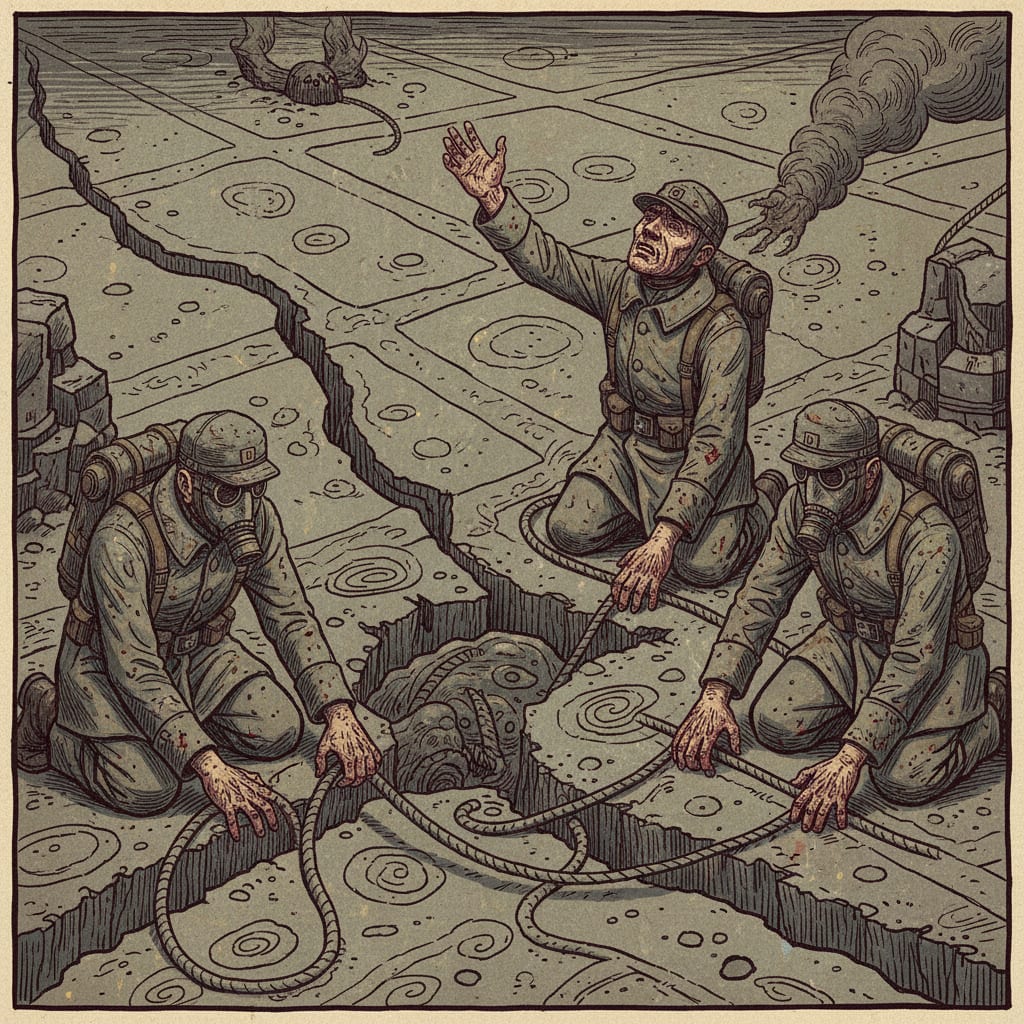
The Blightmarsh expanded. It had been expanding for a century at the pace of a man walking slowly — one hundred and forty square miles per year, the area of a parish — but in A.S. 172 it lurched. A forward observation regiment of eight hundred, deployed to monitor expansion along the former city's street grid, was consumed when the mud opened. Fissures split the grey surface in lines that the surviving cartographer mapped, under sedation, as corresponding to the streets of pre-Sundering Debrecen. The Marsh remembered the city it had eaten and chose to re-enact the eating.
From the fissures came hunger given shape: mouths the size of gun-carriages, throats that opened vertically from the mud. The sound of chewing was so vast that sentries at Bastion-Constantinople, forty miles distant, reported a low vibration in the walls. The regiment was consumed in approximately six hours. The Bureau of Records logged: "Regiment absorbed into terrain." The Bureau of Doctrine logged: "Martyred in service of reconnaissance." The Litany-Engineers who arrived too late consecrated an entire mile of trench by inscribing psalms into the mud with their own blood, fuses laid end to end like rosaries. They lit the final charge. The mire collapsed inward, swallowing enemy and Engineer both. None returned. The Blightmarsh burps fire on certain nights, and from beneath the muck rises the muffled echo of their hymn. The faithful call it "the Choir Beneath."
Earlier editions of this Codex reported the Mire Collapse as occurring in A.S. 175.
The correct date is A.S. 172. The error arose from a filing discrepancy in the Bureau of Records' Eastern Section, where the event was catalogued under "Debrecen — Terrain Reclassification" rather than "Debrecen — Catastrophic Loss of Personnel." The Bureau of Records explains that in the eastern sector, the two categories are frequently the same event.
#On What Remains
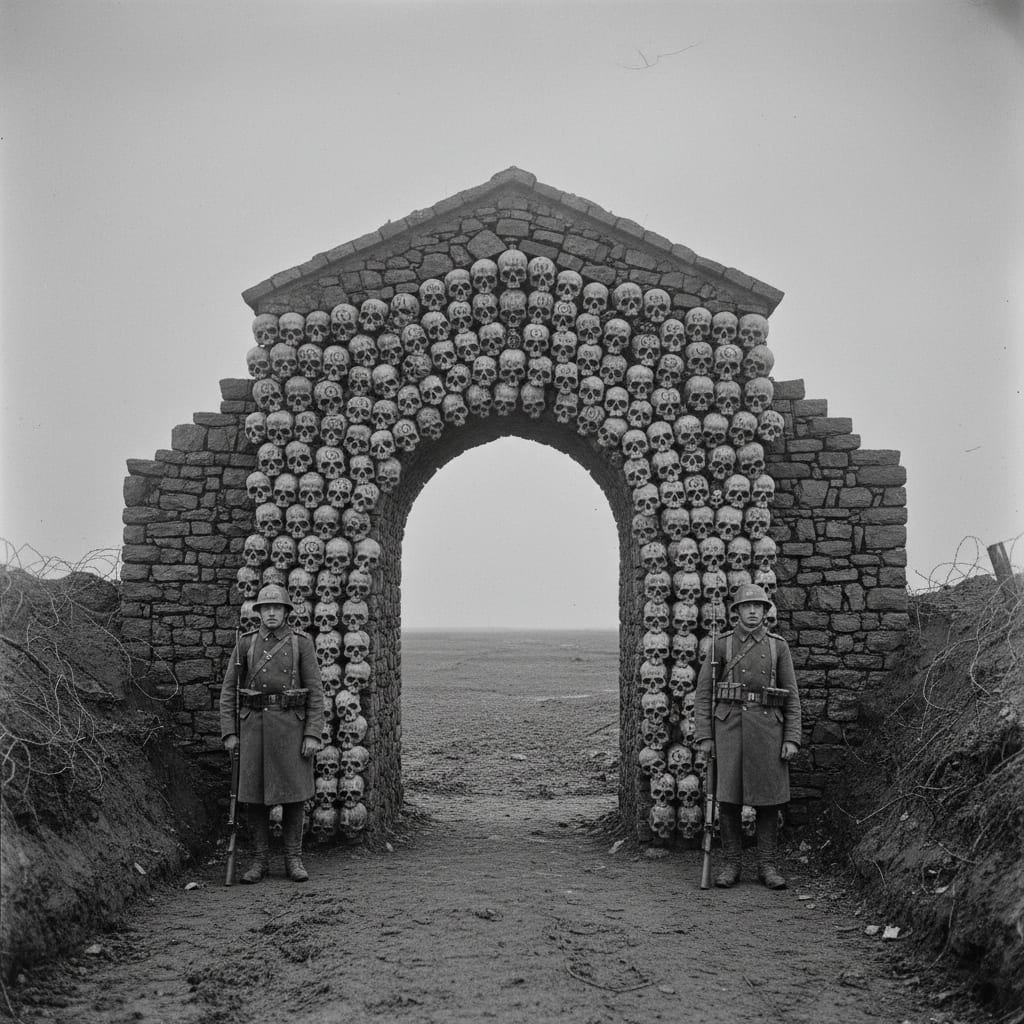
The Ossuary Gate of Debrecen stands at the junction where Hungary's plains narrow into the trench-lines — raised from the bones of three destroyed parishes, its walls mortared entirely with skulls, each branded with a confession extracted in the field. The soldiers say the Gate tolls whenever a skull changes its testimony. The Bureau of Bells has dispatched two inspectors. The first filed a report. The second filed a hymn.
The Bone-Drift (Unregistered): a Saint-Dust salvage company, dispatched after a reliquary vault collapsed during a bombardment, sieved the ash for six days in silence. On the seventh the tide reversed and swallowed them whole. Weeks later their corpses were dug out, every sack clutched, every ledger sealed. The dust was distributed to three fronts. Each recorded "miraculous endurance." None mention the drowned men by name.
The Bureau of Agriculture's cabinet in Strasbourg still contains the projected yield for Debrecen's fields through A.S. 300. The key is in Bruges. It is being used as a bookmark. The wheat that was supposed to grow there — golden, chest-high, enough to feed three empires — feeds nothing, because there is no soil left to plant it in, and the thing that ate the soil is not finished, and will never be finished, and its name is Kargath, and the Blightmarsh that was Debrecen is still hungry.