
#On What the Quieters Call True
This is a survey of the present, conducted in A.S. 201, of a tendency rather than an institution. The Field Quieters hold no charter and keep no seal I have been able to locate. They appear in no organigramme of the Bureau of Records. Their founding is unrecorded, and so are their first members. Any clerk who brings me a founding date will be thanked and asked for his source, and the asking will not be gentle.
A position can be attested. Within the Ritual Bone-Stampers, the profession's own internal characterizations set two tendencies against each other. The Ledger Loyalists hold that paper is truth. The Field Quieters hold that truth is what doesn't spread. Neither phrase is quoted from a constitution, because neither party possesses one. They are the shorthand stampers use to sort one another across a warming alcove, and I record them as shorthand.
A second quarrel runs through the same corridors and must be kept apart from the first. Litany Purists permit only approved chants and official patterns. Resonance Pragmatists permit whatever keeps bones still. That dispute concerns method, and the Quieters' dispute concerns evidence. No ledger I have seen shows that a Quieter is also a Pragmatist, or that a Loyalist is also a Purist. I decline to marry the two quarrels merely to tidy the diagram. A tidy diagram is how the Bureau of Bells came to retire an acoustician.
#On the Work That Must Hold
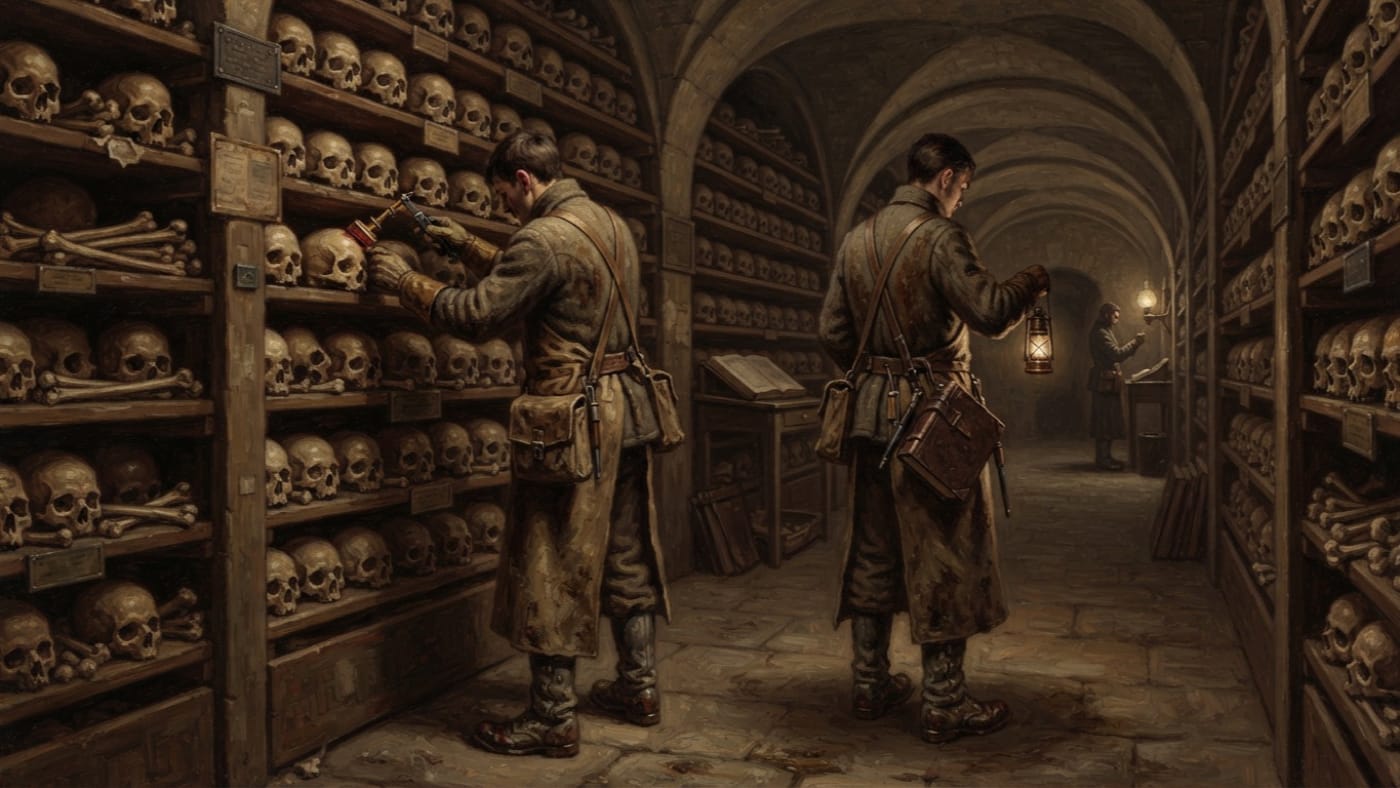
The maxim only makes sense underground. A bone-stamp is applied in six steps, and every stamper performs all six whatever his tendency. The tap-rod puts its question to the bone: a dead bone answers flat, and a drifting one rings long. The bone is wiped and turned to its axis, because a skull facing the wrong way in its stack is "open." The wax wafer is warmed over a covered flame and pressed while the stamper says the Force-Count aloud, at the cadence the Catechism prescribes. Ink line and notch code follow. Then comes the ledger: count, location, anomaly. Then the bone goes back where the geometry says it belongs.
Four of those steps happen to the dead. Two happen to paper.
The Bureau audits the two it can read. Its inspectors compare wax batch codes, verify notches, check stamp-heads for wear and walk the cold corridor listening for hum. A stamper may keep a ledger without a smear of red ink and still leave a stack singing by Tuesday. Another may keep a blotted ledger and leave a gallery so still that the lantern flame stands upright under its hood. The corridor does not read.
This is the Quieters' ground. The maxim describes a judgment made at the end of the shift, in vinegar air and marrow grit, with the tap-rod cold in the glove: did it hold, and did anything leave the corridor that should not have? I read the second clause broadly. Hum spreads. So does warmth along a rack. So does the story of a twitch, carried up the stairs to a tavern by a Wax-Runner who has not yet learned to keep his mouth shut.
#On Paper Authority
The Ledger Loyalists hold the stronger institutional position. The profession's official metrics are stamped counts per night, error rate, ledger completeness, quarantine compliance and incident response time. A man who has never smelled wax can read every one of them from a desk.
The Loyalist's argument is better than his desk. A stamp without a record is a private act, and private acts in ossuaries breed relic laundering. A skull without a record is also a skull no widow can bury. The trade's own idiom puts the matter plainly: a clean ledger is a quiet city. The Bureau of Records did not license this vocation in A.S. 92 so that each stamper could consult his nerves and call the result doctrine.
The unofficial metrics are spoken rather than filed: how few rumours spread, how many hot zones stay quiet, how many stampers survive the year. The Quieters' maxim reads like a summary of that second list. Strasbourg's Fourth Ossuary, which keeps both a Vellum slate of corridors quiet for a year and a shame slate beside it, has chalked the second list onto the wall.
The two lists stay together until the wax runs short. The foundries fill military orders first. After a plague week, the quota exceeds what any hand can press honestly. In those conditions a ledger can be completed by morning, and a corridor cannot. Backdating a stamp to clear a quota satisfies paper at the corridor's expense. Double-sealing at offset angles and re-stacking in unofficial geometry serve the corridor at the expense of paper. I assign none of these practices to either tendency. Whoever is short of wax at three in the morning commits them.
The maxim has a second face as well. Read as containment, truth is what doesn't spread describes the stamper's whole vocation in five words. Read as policy, it describes the Bureau's favourite habit, the one that turned the first unauthenticated motion into "gas pockets." Containing the dead and containing the report of the dead can be separated by a single ledger line. By the profession's own reckoning, the scribe who logged an anomaly too clearly is among the first sacrificed when pressure rises. No record before me shows a Quieter suppressing a report. The danger is in the grammar, and an inquisitor needs nothing more.
#On Vellum's Remaining
The Vellum dossier records three accounts of the saint. In the first, she invented the Force-Count by pressing her bare palm to a tapping skull. In the second, she whispered the dead person's name into the wafer before the seal cooled. The dossier says the third is preserved among Field Quieters and forbidden in training halls, and it credits her with neither. She stayed in the corridor after the others fled, and according to the account, the dead mistook her stillness for authority.
I report the account. I do not certify it. The dossier sets her vita in a Bastion-Brest underworks during the years after the Sundering, before A.S. 92, and grants her no proved name, parish or date of miracle. The third version adds none. Whether anything in that underworks mistook anything for anything is a question for the dead, who have not filed.
The story suits the maxim well. The first two versions give the profession a technique: a count or a whispered name, something the Bureau of Rites can examine and Records can enter in a manual. The third gives a posture and nothing to file. A woman did not run, and the trouble did not spread. People judged on outcome tell a story about outcome. The training halls give no reason for the ban. I can supply one: a Wax-Runner who believes the story may decide that standing still is a procedure, and the Catechism has no line for it.
Vellum is not thereby the Quieters' founder. The dossier does not say so, and neither do I. Nor does the tradition, as attested, teach stillness as a power that one stamper can lend another.
Workshop sheets cited in the Vellum dossier called her "the first licensed Bone-Stamper."
The dossier itself corrects them. Licensing began with the Bureau of Records Directive of A.S. 92, after the Corridor Twitching and two sealed incidents, and Vellum belongs to the period before it. This survey adopts that correction and dates no Quieter tradition by it.
The names invite confusion, and I refuse it. The Quiet Hands are rise-response specialists, senior stampers sent in when a corridor goes active. Quiet-Hand is an older shop epithet for anyone whose seals hold in bad corridors, and the saint borrowed it. Neither term names a Field Quieter. No roster joins them, and I have not drawn one.
#On the Present Survey
As of A.S. 201, the following can be attested. A tendency called the Field Quieters exists within the Ritual Bone-Stampers, and a maxim characterizes it. On the question of what counts as true, it stands opposite the Ledger Loyalists. It keeps an account of Saint Vellum that the training halls will not teach.
The following cannot be attested: a leader, a membership, an oath, a meeting place, a founding year, a written rule, or any act the tendency performed as a body. I have omitted them. A Bureau-trained writer notices such gaps the way a binder notices a missing gathering, and his hand reaches for gilt.
The Records reader will call this survey thin. The Rites reader will call it unfinished. If the maxim is correct, the omitted paragraph is the most accurate thing in it.