
#On the Profession of Bone-Stamping
"Unsealed is unbound." — Stamper's Catechism (Unregistered), Bureau of Records, A.S. 91
I have written elsewhere of the bone-stamp — its function, its efficacy, the disquieting correlation between a clerk's conviction and the stamp's capacity to keep the dead from remembering that they were once alive. I have praised the system and damned the system in the same paragraph, which is a privilege afforded only to the Warden of the Sacred Ledger and to men who talk in their sleep. What I have not written, until now, is a proper account of the men and women who hold the stamp itself: who heat the wax, press the seal, log the count, and descend each evening into corridors where the air tastes of vinegar and old iron and something else — something the Bureau of Rites calls "post-mortem atmospheric residue" and the stampers call "the breath."
They are called Ritual Bone-Stampers. The Bureau of Records calls them Ossuary Authentication Wardens, which is the sort of title the Bureau manufactures when it wants to pretend a job is administrative rather than terrifying. The street calls them Bone-Stamps, Night Notaries, Rib-Clerks. The unkind call them Grave-Tappers, Wax-Lickers, Paper-Priests. The stampers themselves use none of these names. They say "I seal," or "I quiet," or simply "I work nights," and the inflection on the last word carries a weight that daylight professions cannot parse.
#On Their Origin and Necessity
The profession arose, like most professions in the Synod's employ, from a catastrophe the Bureau attempted to reclassify as a policy success.
In the decades following the Sundering, the dead arrived faster than the clerks could process them. Battlefield carts, plague wagons, mine collapses, foundry explosions, the ordinary and extraordinary harvest of a continent at war with Hell — corpses by the thousand, delivered to ossuaries and grave-fields that had been designed for the peacetime output of a single parish. The bodies were stacked. The skulls were shelved. The paperwork was, in many cases, omitted entirely, because the clerks who should have filed it were themselves among the dead, and their replacements had not yet been issued stamps.
What happened next the Bureau has spent a century and a half declining to describe with precision. In certain ossuary conditions — diesel-resonance bleed from adjacent engineering works, harmonic interference from improperly calibrated bell-arrays, wound-site contamination from battlefield materiel — the unstamped remains began to move. The Bureau of Rites classifies these events as "post-mortem atmospheric disturbances, Category Two." The stampers who were present at the first documented occurrence, in a sealed corridor beneath what is now the Bastion-Brest outer works, called it "the Corridor Twitching," and three of the five original witnesses refused to enter an ossuary again.
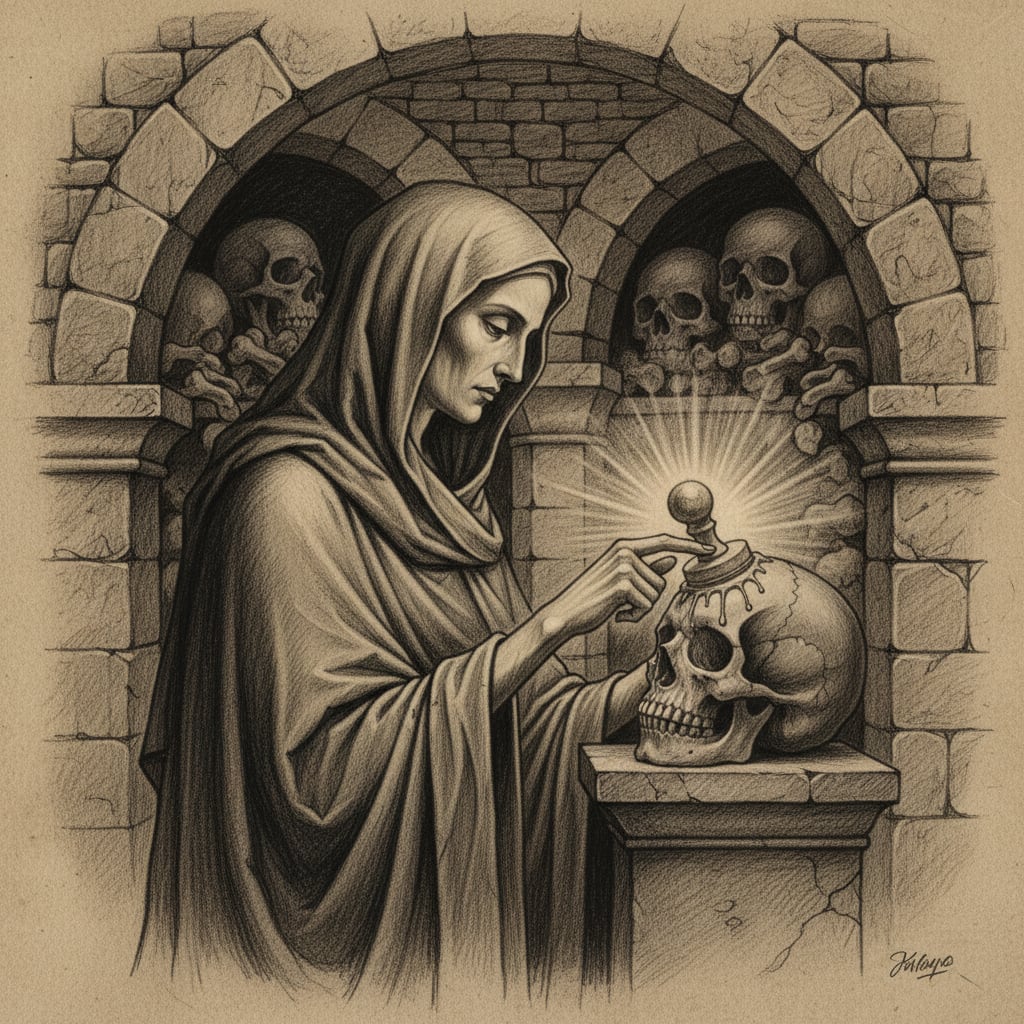
The Directive of A.S. 92 created the profession. Before that date, bone-stamping had been one duty among many for ossuary clerks — a ritual afterthought performed when time permitted. After the Corridor Twitching, and after two subsequent incidents the Bureau sealed from public record, bone-stamping became a dedicated vocation with its own licensing, its own quotas, its own hierarchy, and its own patron saint: Saint Vellum-of-the-Quiet-Hand, depicted in the approved iconography holding a stamp over a skull as though bestowing a blessing. She is almost certainly invented. The Bureau of Records lists her feast day. The Bureau of Rites has never confirmed her canonisation. The stampers pray to her anyway, because the stampers pray to whatever keeps their corridors still, and theological accuracy ranks below survival in the professional order of priorities.
#On the Work Itself
The bone-stamper's shift begins at dusk and ends at the last bell before dawn. This is policy, and the policy is sound: the dead are quieter during daylight hours, a fact the Bureau attributes to divine grace and the stampers attribute to the simple observation that sunlight makes things harder to imagine. Night is when the corridors hum. Night is when the wax sweats. Night is when a stamper earns the hazard allotment the Bureau promises and the quartermaster's office frequently neglects to deliver.
The process is six steps, performed on every bone, every skull, every fragment large enough to receive a seal:
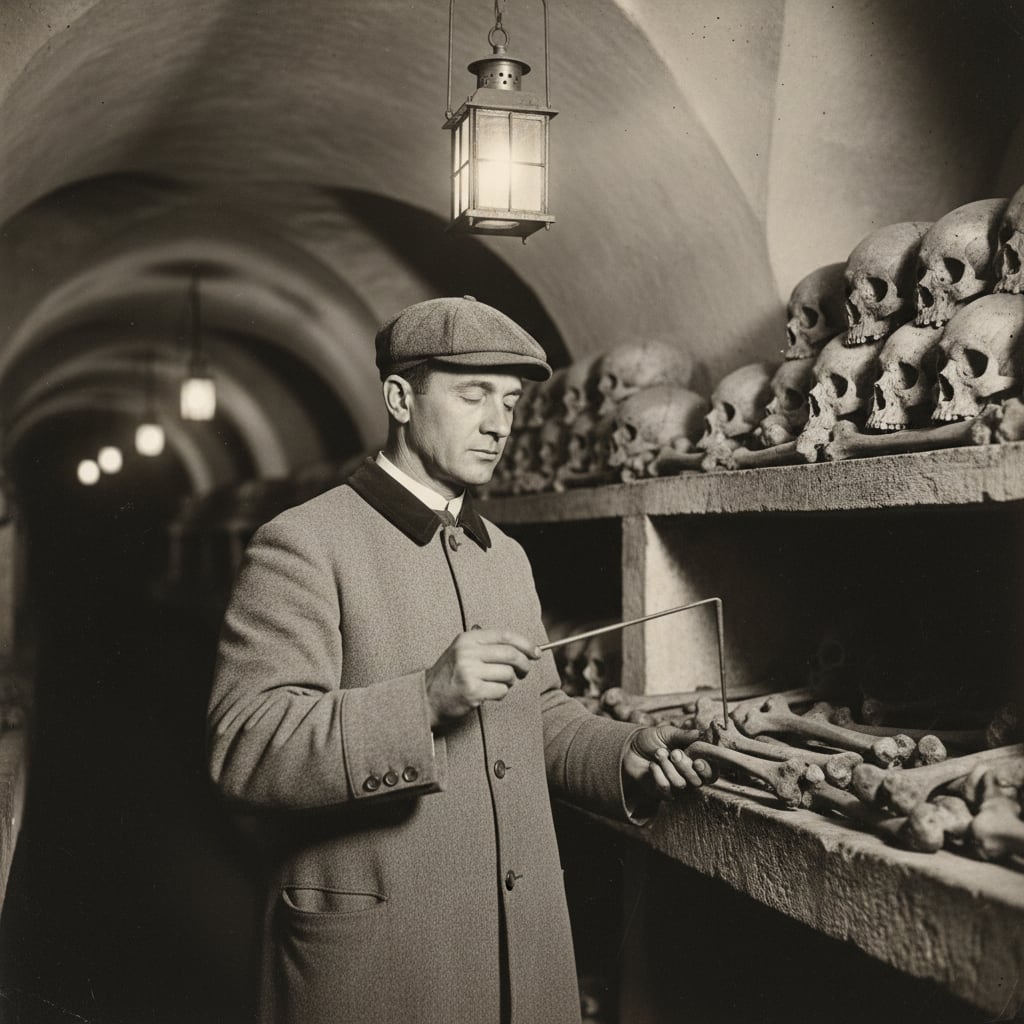
First, the resonance check. The stamper taps the bone with a tuning fork or a tap-rod — a slender iron implement calibrated to ring at a frequency the Bureau of Bells calls "diagnostic" and the stampers call "the question." A properly inert bone returns a dead sound, flat and finite. A bone exhibiting what the trade calls "live drift" rings longer than it should, or rings at a pitch that climbs, or — in cases that prompt immediate evacuation of the corridor — does not ring at all but absorbs the tap like flesh.
Second, the cleaning and orientation. The bone is wiped, aligned to the prescribed axis. Orientation matters more than the Bureau admits in its public manuals. A skull facing the wrong direction in a stack is, in the stampers' experience, "open" — receptive to influence, prone to drift. The geometry of placement is half the seal. The stamp is the other half. The Bureau of Rites considers this superstition. The stampers consider the Bureau of Rites welcome to spend a night in a corridor where the stacks were shelved by day-clerks who could not be bothered to check the orientation chart.
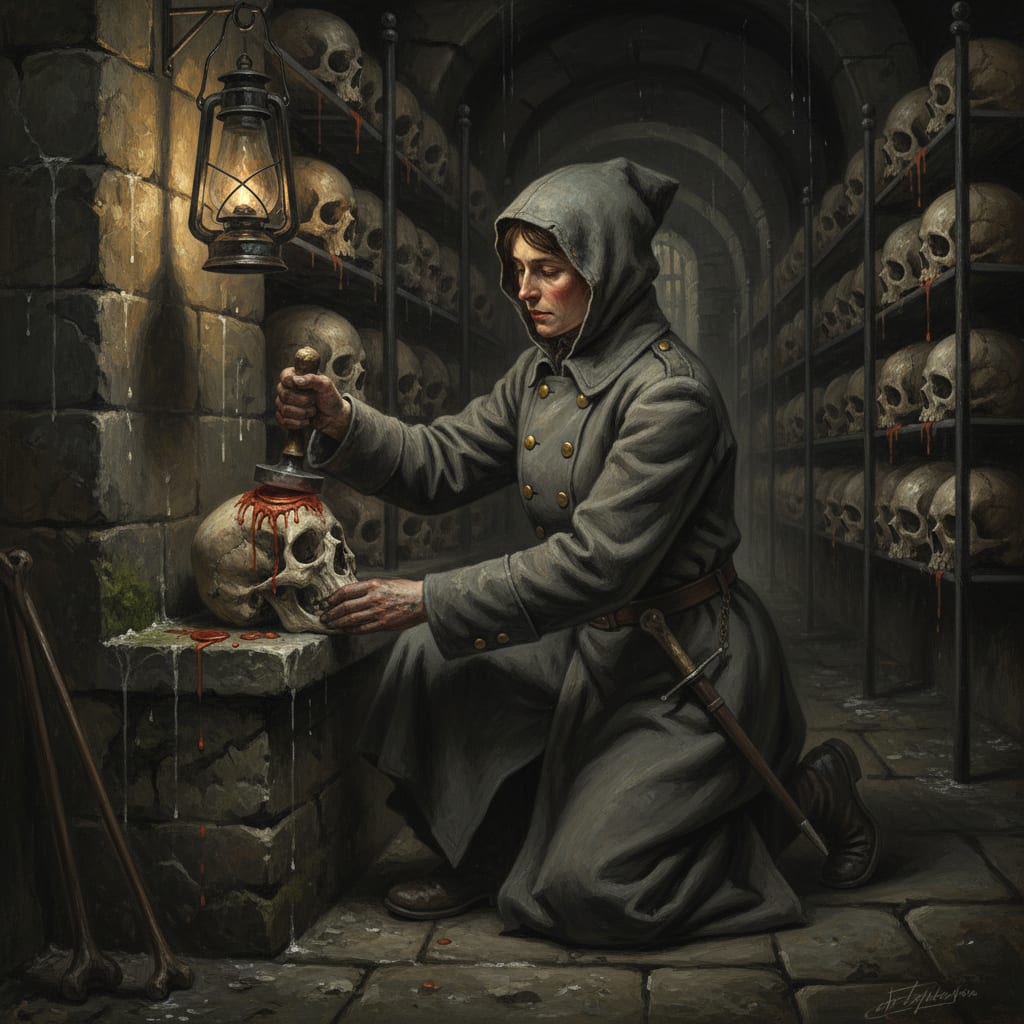
Third, the seal application. A wax wafer — stamped with the Synod's mark, the district code, and the date — is heated over a covered flame and pressed to the bone at a force and duration specified in the Stamper's Catechism. The pressure matters. Too light, and the seal sits on the surface without biting. Too heavy, and the bone cracks, and a cracked bone is worse than an unstamped one, because a crack is an opening and an opening invites precisely the attention the seal was meant to prevent.
Fourth, the secondary mark — an ink line and notch code recording district, date, and chamber position. This is the bureaucratic half of the seal, and it is the half the Bureau of Records actually audits, because the Bureau of Records can read ink and count notches but cannot measure the conviction with which a wax wafer was pressed.
Fifth, the ledger entry. Count, location, anomalies. The anomaly codes are a vocabulary unto themselves: "fracture" is self-explanatory; "soft wax" means the seal failed to bite; "warm stone" means the corridor's ambient temperature has risen in a manner the Bureau of Engineering cannot explain; and "singing stack," which is not an official code but which every stamper knows, means the sealed bones in a given stack have begun to produce a faint harmonic that the tuning fork picks up and the stamper's nerves confirm.
Sixth, the placement. The bone is returned to its position in the stack according to a geometric pattern the Bureau of Rites prescribes and the Bureau of Engineering quietly revised in A.S. 178 after a resonance cascade in the Przemyśł Third Gallery killed two stampers and a visiting auditor. The official pattern and the practical pattern are different. Every senior stamper knows this. The Bureau knows they know. The arrangement persists because changing it would require the Bureau to admit that the official pattern was wrong, and the Bureau does not admit error — it issues errata, which is a different verb.
An earlier edition of this Codex described bone-stamping as "a minor clerical function performed by ossuary attendants as part of routine intake processing."
The Bureau of Doctrine amends: bone-stamping is a sanctified vocational discipline requiring licensure, physical conditioning, doctrinal certification, and a demonstrated tolerance for working conditions the Bureau of Medicine classifies as "Category Three Hazardous." The earlier description has been reclassified. The author has been reminded that "minor" is a word with consequences.
#On Conviction and Its Absence
The bone-stamp works. I have written this before and I will write it again, because the alternative — that the Synod has built an entire profession around a ritual that accomplishes nothing — is a thought the Ledger cannot survive. The stamp works because it imposes order on matter that has forgotten how to be still. The wax seals. The ink records. The geometry contains. The cadence of the Force-Count creates a resonance that the dead respond to the way water responds to a vessel: by assuming the shape offered.
But here is the detail the Bureau of Rites would prefer I buried in a footnote rather than a heading: the stamp's efficacy varies with the stamper's conviction. A clerk who believes — in the seal, in the prayer, in the sacred authority of the wax and the ink and the Synod behind them — produces a stamp that holds. A clerk who stamps from habit, from quota pressure, from the mechanical repetition of a gesture emptied of meaning, produces a stamp that degrades. The wax cracks sooner. The ink fades. The dead beneath that seal stir earlier than they should.
The stampers know this. Every stamper knows this. It is the profession's open secret and its central terror: that the work requires faith, and faith is a resource that depletes faster than wax. A stamper in her first year seals with the fervour of the newly ordained. A stamper in her tenth year seals with precision but less fire. A stamper in her twentieth year — and there are few who last twenty years — seals with a competence so practised it has become indistinguishable from indifference, and the corridors she works are measurably less quiet than the corridors worked by her juniors.
The Bureau's solution is rotation. Stampers are cycled between districts every three years to prevent the accumulation of what the Bureau calls "vocational fatigue" and the stampers call "the hollowing." The rotation helps. It does not solve the problem. The problem is that the Synod has built a containment system that runs on belief, and belief is the one commodity the Bureau of Tithes cannot tax into existence.
#On the Hierarchy and Its Discontents
A stamper enters the profession as a Wax-Runner — a porter and apprentice who carries wafer cases, fills lanterns, and learns the Force-Count by rote in corridors where the senior staff work. Promotion to Bone-Stamper requires six months of supervised stamping and a licensing examination administered by the district Seal-Warden, which consists of stamping thirty bones in sequence while the examiner watches for hesitation, pressure errors, and — this is unwritten but universally understood — any sign that the candidate is afraid. Fear is permitted. Visible fear is not.
Above the Bone-Stamper sits the Corridor Notary, who manages a section of ossuary; above the Notary, the Seal-Warden, who oversees a district; and above the Warden, the District Stampmaster, who reports to the Ossuary Superintendent and through her to the Bureau of Records' Office of the Last Watch. At the peak of the informal hierarchy — unlisted in any Bureau organigramme, acknowledged only in whispered shop-talk — stands the Quiet Hand: a rise-response specialist deployed when a corridor goes active and the standard protocols have failed.
The Quiet Hands are few. The Bureau does not recruit them; it discovers them. They are stampers whose conviction has survived decades of nightly work without eroding, whose Force-Count produces seals that hold where others crack, and whose presence in a corridor produces a measurable reduction in post-mortem atmospheric disturbance before they have pressed a single wafer. The Bureau of Rites wants to study them. The Bureau of Records refuses to release them from operational duty. The Quiet Hands themselves, in my experience, do not discuss what they do or how they do it, because the answer — if there is an answer — lives in a territory between faith and mechanics that the Bureau's categories cannot map.
#On What Goes Wrong
The stamper's enemies are five: the quota, the audit, the shortage, the corridor, and the self.
The quota is set by the district Superintendent based on intake volume, and the quota is always too high after a battle, after a plague wave, after any of the regular catastrophes the Sagittal Line produces at a frequency the Bureau of War calls "operationally sustainable" and the stampers call "Thursday." A stamper who falls behind quota faces demotion. A stamper who meets quota by cutting corners — lighter pressure, skipped resonance checks, placement by convenience rather than geometry — faces corridors that grow restless in six months rather than six years.
The audit arrives without warning. Inspectors from the Bureau of Records check stamp-heads for wear, compare wax batch codes against supply ledgers, verify notch patterns, and perform a "cold corridor walk" — a slow passage through a sealed section, listening for the hum that indicates degraded seals. An auditor who finds discrepancies writes a report. A report becomes a hearing. A hearing becomes a penance, or a demotion, or — for stampers whose failures coincided with a public incident — an erasure.
The shortage is constant. Wax wafers are manufactured by licensed foundries under Bureau contract, and the foundries prioritise military orders over ossuary supply. Stamp-heads wear down and must be replaced through a requisition process that the Bureau of Records designed to prevent fraud and that incidentally prevents stampers from obtaining replacements within any useful timeframe. Ink brine goes rancid in damp storage. Lantern oil runs short at the end of every fiscal quarter. The stampers improvise, and the improvisation is technically illegal, and the illegality is technically enforceable, and the enforcement is technically the responsibility of the same auditors who also know that without improvisation the corridors would be unstaffed.
This Codex previously stated that "wax wafer supply to ossuary districts has remained consistent since the Procurement Reform of A.S. 188."
The Bureau of Doctrine amends: wax wafer supply has remained officially consistent. The discrepancy between official supply figures and field-reported inventory is a matter the Bureau of Tithes has declined to investigate, on the stated grounds that "the ossuary supply chain falls outside the Bureau's fiscal purview," which is a sentence so precisely crafted to avoid responsibility that I suspect a fellow propagandist wrote it.
The corridor is the enemy that needs no explanation to anyone who has spent a night underground with a lantern and a stamp and the knowledge that the bones around them are listening. The air in a working ossuary is cold, damp, laden with marrow-dust that coats the throat and fills the lungs over years until the stamper develops the dry, persistent cough the profession calls "bone-lung." The sound is wrong — too soft, then too loud, with echoes that arrive from directions the corridor's geometry cannot account for. And on bad nights, the wax sweats. The stamper presses a fresh seal and the wax beads moisture along its surface, as though the bone beneath is exhaling warmth that has no source in ambient temperature, and the stamper logs this as "warm stone" and moves to the next skull and does not think about it, because thinking about it is the corridor's other weapon.
The self is the enemy the Bureau cannot issue a directive against. A stamper who works ten years underground begins to count in her sleep. Her hands perform the stamping motion against the bedsheets. She flinches at tapping sounds — a spoon against a cup, a knuckle against a door. She scrubs the ink from her cuticles until the skin splits and the ink remains, because the ink has become part of her, and the part of her that is ink belongs to the corridors, and the corridors do not return what they take.
#On the Bribe Economy and Its Sacraments
A bone-stamper controls access to closure. This is worth money to the living.
A widow whose husband died without Synod registration — killed in a factory collapse, or in the wrong district, or under a name the Bureau does not recognise — cannot bury him in consecrated ground without a stamp. The stamp requires intake processing. Intake processing requires a fee. The fee requires paperwork. The paperwork requires a clerk who is willing to process an unregistered corpse after hours, which is to say a clerk who will accept three wax wafers and a fuel chit to look the other way while a stamper applies a seal that the ledger will record as "routine, no anomalies."
This economy is universal. The Bureau knows it exists. The Bureau does not suppress it, because suppressing it would require acknowledging that the Bureau's own intake procedures are too slow to serve the living and too rigid to accommodate the dead, and acknowledgement is a commodity the Bureau hoards more jealously than wax.
The bribe flows upward. The widow pays the stamper. The stamper pays the patrol captain who controls corridor access. The captain pays the ledger clerk who files the entry. The clerk pays no one, because the clerk is the endpoint, and the endpoint's reward is a clean ledger and the quiet satisfaction of having helped a woman bury her husband, which is — in the stamper's world — the closest thing to grace the profession offers.
#On the Sounds They Do Not Discuss
Every stamper has a story about the sounds. They do not tell these stories to outsiders, and they do not tell them sober, and when they tell them at all it is in the clipped, flat register of people describing something they have decided to survive rather than understand.
The tapping. Bone on bone, in a sealed stack, in a sealed corridor, at an hour when no living person is present. The stampers call it "settling" when the auditors ask and "the answer" when the auditors leave. The singing — a harmonic that rises from stacks where the seals have degraded, a sound the tuning fork confirms and the Bureau of Bells has classified as "structural resonance of ossuary masonry, non-anomalous," which is a classification that required eleven committee meetings and the retirement of the acoustician who disagreed.
And the warmth. The bone that gives back heat when the stamp is pressed. The wax that will not cool. The corridor where the air temperature rises half a degree every hour after midnight and the stamper works faster, seals harder, recites the Force-Count with a conviction born less of faith than of the growing suspicion that the bones know she is there, and are waiting to see if her wax holds.
The stampers do not discuss these things with the Bureau. The Bureau does not ask. The arrangement suits both parties. The bones, as always, are not consulted.