

#On the Unlisted Hand
The Quiet Hands are the rise-response specialists of the Ritual Bone-Stamper profession: senior stampers whose conviction has survived years in the corridors without thinning, cracking, curdling, or turning into that polite occupational vacancy the Bureau of Records calls fatigue and the workers call a soul with the furniture removed. They are dispatched when a corridor goes active, when ordinary seals fail, when wax beads on bone as though warmed from beneath, when the hum in the racks climbs past the pitch at which a sensible clerk remembers an appointment elsewhere.
No Bureau organigramme lists them. No salary table names them. No public manual admits their rank. Records signs their travel warrants under substitute titles: Corridor Notary, Emergency Seal-Warden, Relic Transfer Witness, Night Inventory Corrector. The title written in corridor slang is shorter and truer. Quiet Hand. The person who enters after everyone else has learned the blessed uses of retreat.
#On Their Discovery
The Bureau of Records does not recruit Quiet Hands. It discovers them by accident, denial, and survival. A Wax-Runner becomes a Bone-Stamper. A Bone-Stamper becomes a Corridor Notary. Ten years pass below stone. The worker coughs, counts, seals, sleeps poorly, wakes counting, and continues. By the usual arithmetic of the trade, belief should have worn down to habit. Habit should have worn down to pressure without prayer. Pressure without prayer should have produced soft seals and restless stacks.
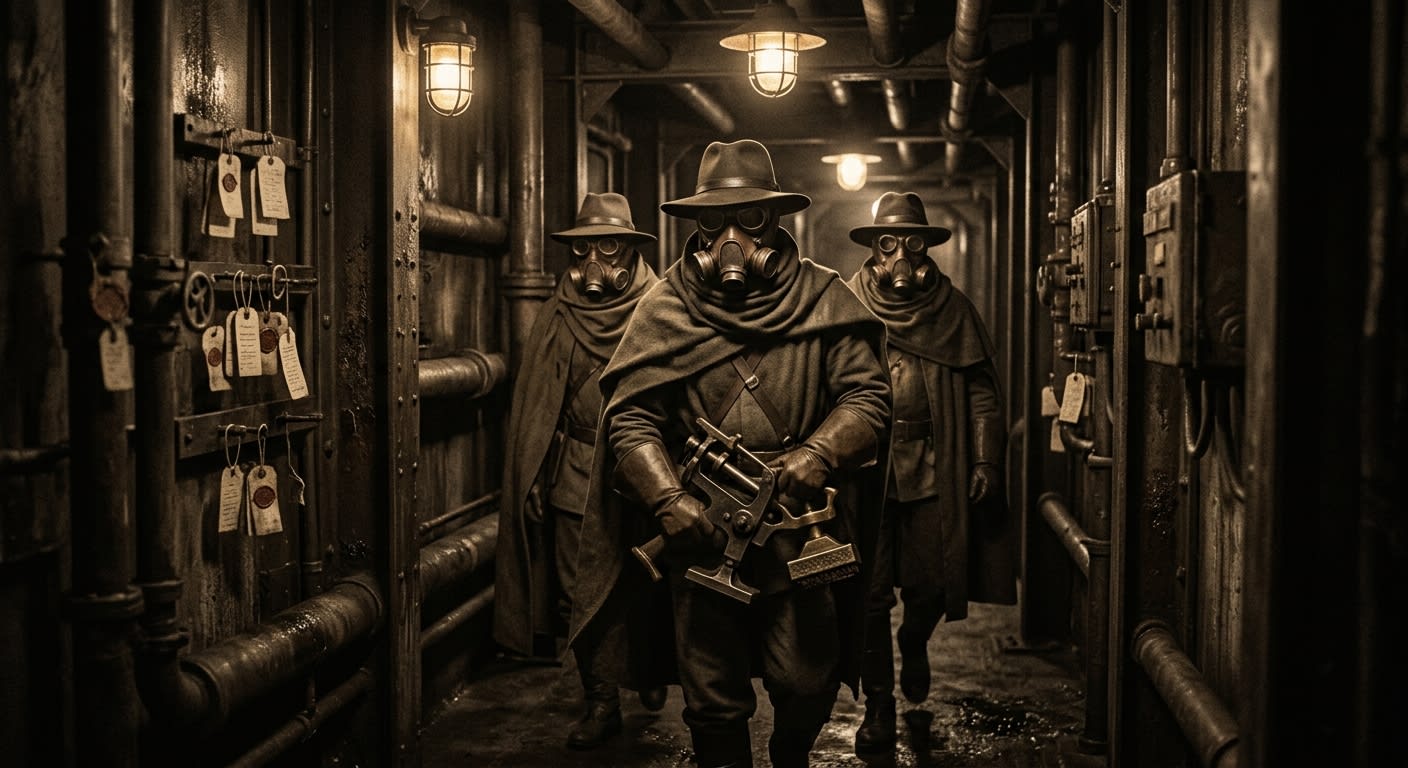
In a few persons, the arithmetic fails.
Their seals hold. Their Force-Count slows the corridor before the wafer touches. Their hands do not shake over warm bone. When called to a rack that has begun answering the tap-rod, they do not shout for Rites, Bells, or some other daylit authority with clean cuffs and explanatory diagrams. They heat the wax. They orient the skull. They count.
The first such discovery belongs, in trade legend, to the aftermath of the Corridor Twitching beneath Bastion-Brest. One witness fled, one reassigned himself to surface ledgers with the desperation of a rat leaving a holy ship, one remained. The name is sealed or lost or both. The story says the remaining stamper pressed seals in the underhall until the bones stopped attempting grammar. Records denies that this worker founded anything. Records then assigns Brest-origin Quiet Hands unusual precedence during disputes. I adore consistency when it limps.
#On the Method They Refuse to Discuss
Every Bureau wants a method. Records wants a form. Rites wants a doctrine. Bells wants a frequency. Medicine wants pulse, lung capacity, sleep history, tremor index, and a sample of the cough. Tithes wants to know whether the talent may be licensed, assessed, rationed, or sold as a premium service to nervous dioceses with overcrowded crypts. The Quiet Hands give each Bureau the same professional gift: silence.
They do not explain whether they pray harder, feel less, believe more, or have simply exhausted fear until only function remains. Ask one what distinguishes her seal from another stamper's and she will speak of wax temperature. Ask twice and she will speak of hand position. Ask a third time and she will remember a corridor requiring inspection on the opposite side of the city.
The observable practice is austere. A Quiet Hand enters slowly. She permits no crowd in the corridor, because panic has acoustics. She orders lanterns lowered, not raised. She forbids the novice habit of over-brightening a bad chamber, a practice born from the touching belief that more light makes the dead embarrassed. She tests three bones only: one from the active rack, one from the nearest sealed rack, one from the floor if the floor has begun to offer candidates. She chooses a seal-head by weight rather than date. She warms the wax until it softens without gleam. Then she recites the Force-Count below ordinary speaking pitch.
The count is never hurried. The corridor may be tapping. The racks may be shifting. The novice may be weeping into his throat scarf. The Quiet Hand counts as though teaching a child to sleep.
FIELD INCIDENT EXCERPT — FOURTH OSSUARY, STRASBOURG Active rack: seventeen skulls, six long bones, unidentified small remains. Audible response to tap-rod ceased at Count █████. Witness Two reports hearing own name spoken from lower tier. Quiet Hand instructed Witness Two to “stop being flattered.” Seal held. Witness Two reassigned.
#On Conviction Without Heat
The public imagination, that diseased choir, imagines Quiet Hands as saints aflame with sacred certainty. This is idiocy with candles. The young believer burns. The Quiet Hand does not burn. Fire consumes too quickly for corridor work.
Quiet-Hand conviction is cold. It has passed through terror, habit, disgust, doubt, fatigue, grief, and the thousand petty thefts by which night labour reduces the soul: unpaid hazard allotments, rancid ink brine, wax shortages, wrong keys, auditors who arrive clean and leave with opinions. What remains has no enthusiasm in it. It is pressure aligned with belief so precisely that the hand no longer wastes itself trembling.
This is why the cult of Saint Vellum-of-the-Quiet-Hand clings to them with such indecent professional hunger. In the icon, Vellum's hand is bare over the skull. In the corridor, the Quiet Hand's glove is patched, burned, stiff with old brine. The saint grants the image; the worker supplies the uglier miracle.
Records calls their stability “exceptional vocational retention of sealing confidence.” Rites calls it “persistent sacramental intentionality.” Medicine calls it “flattened affect with preserved fine motor control.” Stampers call it the thing that gets you home before dawn.
#On Jurisdictional Appetite
The Bureau of Rites has wanted the Quiet Hands for study since it first understood that ordinary stamping and Quiet-Hand stamping produced measurably different corridor outcomes. Rites proposed supervised trials in A.S. 198, pairing active bone racks with stampers of varied devotional histories while Bell technicians measured response intervals. The proposal contained twenty-two pages, six appendices, and no evidence that its authors had ever stood in a bad corridor after midnight. Records refused.
Records' refusal was not mercy. Records is rarely so vulgar. Records refused because Quiet Hands are operational assets, and operational assets lose value when converted into theological exhibits. A Quiet Hand in a laboratory is a corridor unserved. A corridor unserved becomes an incident. An incident becomes paper. Records hates nothing so much as paper generated by preventable motion.
Bells wanted access for different reasons. A Quiet Hand lowers hum before contact; the acousticians could not bear the insult. If the effect is measurable, they argued, the mechanism should be measurable. Possibly. The world contains many measurable humiliations. A man can measure the angle of a boot approaching his backside. This does not make him master of the kick.
Medicine, more discreet and more dangerous for it, asked to examine retired Quiet Hands. Few retire. Those who do tend to vanish into Mercy wards, family back rooms, ossuary annexes with unofficial chairs, or small rooms above stamp stores where they continue sharpening tools no longer assigned to them. One Strasbourg sister reported that a retired Quiet Hand quieted an entire ward of tapping patients by placing her palm on the wall and telling them, “Enough.” Medicine requested a follow-up. The sister lost the file.
#On Their Uses
Quiet Hands are deployed for five conditions: active rise, seal rejection, harmonic rack response, unexplained warmth, and post-audit unrest. The fifth is the commonest, which should teach the auditors humility but instead teaches them to schedule exits earlier.
An active rise is any movement among remains after sealing has begun or should have begun. A Quiet Hand stabilises the chamber, double-seals primary fragments, and orders reorientation if the rack geometry has been fouled by haste or incompetence. A seal rejection occurs when wax lifts, cracks, sweats, or is found scraped away without tool marks. The Quiet Hand removes the failed seal, preserves it for the ledger, applies a new wafer at offset angle, and says nothing comforting. Comfort is for families. Corridors require obedience.
A harmonic rack response begins as sound: tapping, singing, or the thick absence of sound that makes the tap-rod feel swallowed. Bells may be summoned after the chamber is quiet. A warmth incident is treated as worse than sound. Sound means the dead are answering. Warmth means they may be preparing.
Post-audit unrest deserves its own little gallows. Auditors move bones. They deny moving bones. They shift racks to read marks, remove wafers to examine bite, scrape ink to verify date, and leave behind a corridor full of insulted geometry. A Quiet Hand is then summoned to repair the invisible damage. The auditor's report will note “no lasting disturbance.” This is technically true, after someone better than the auditor has cleaned up the sacrilege.
Earlier training summaries described Quiet Hands as “ceremonial senior stampers assigned to morale stabilization.”
Corrected. Quiet Hands are rise-response specialists deployed under hazardous conditions when ordinary seal practice fails or is expected to fail. Morale may improve after their arrival, in the same way morale improves when the firing stops.
#On Cost
No person becomes a Quiet Hand without paying in matter the Bureaus cannot reimburse. The lungs go first, though bone-lung is common to the trade and receives the usual institutional courtesy: classification without relief. The sleep goes next. Then ordinary speech. Quiet Hands are not mute; they simply learn that most words agitate rooms more than they improve them.
Their hands thicken. Pressure bruises calcify under the heel of the palm. Wax burns overlap until the skin loses its earlier map. Ink enters the cuts and remains there, a private heraldry no clerk can wash out. Some lose fingernails. Some keep all ten and become legends for that stupid reason. The profession is sentimental about extremities.
The greater cost is stranger. Quiet Hands become difficult for the dead to ignore and difficult for the living to keep. Families complain that they count utensils before supper. Mercy sisters complain that they wake when a floorboard settles. Junior stampers complain that a Quiet Hand can tell who lied in a corridor by looking at the rack, which is unfair only to liars.
There it is, the Synod's gratitude rendered in its purest form: exemption without promotion, distinction without pay, sanctity without pension. If Heaven keeps ledgers, and it had better, I recommend a separate column for this obscenity.
#On the Present Silence
As of A.S. 201, Quiet Hands remain active in the major ossuary systems of Strasbourg, Bastion-Brest, Bastion-Constantinople, and those Sagittal Line depots where mass casualty intake has taught the stone to listen. Records maintains their movements in sealed addenda. Rites continues to petition. Bells continues to measure around the absence. Medicine continues to classify coughs. Tithes, restrained by a rare visitation of instinct, has not yet attempted a Quiet-Hand surcharge.
The workers themselves persist below the lamps. They arrive with stamp cases, vinegar cloths, old gloves, and the grave courtesy of people who have learned that fear is loud. They enter. They lower their voices. They press the seal.
The corridor quiets.