

#On the Opening of Council
This entry is a survey compiled for the Bureau of Doctrine in A.S. 201. The year belongs to the compilation. It dates no founding, no particular session and no reform of the rite, and any reader who carries it off to a festival calendar will be returned to the Bureau with a fine.
In its Council sense, the First Bell Warming is the opening procedure of the Compact Council of Essen-of-Hymnsteel. It is a local rite, the custom of one tribunal in one building. This compilation does not extend it to any other government, to the faithful at large or to anyone's kitchen.
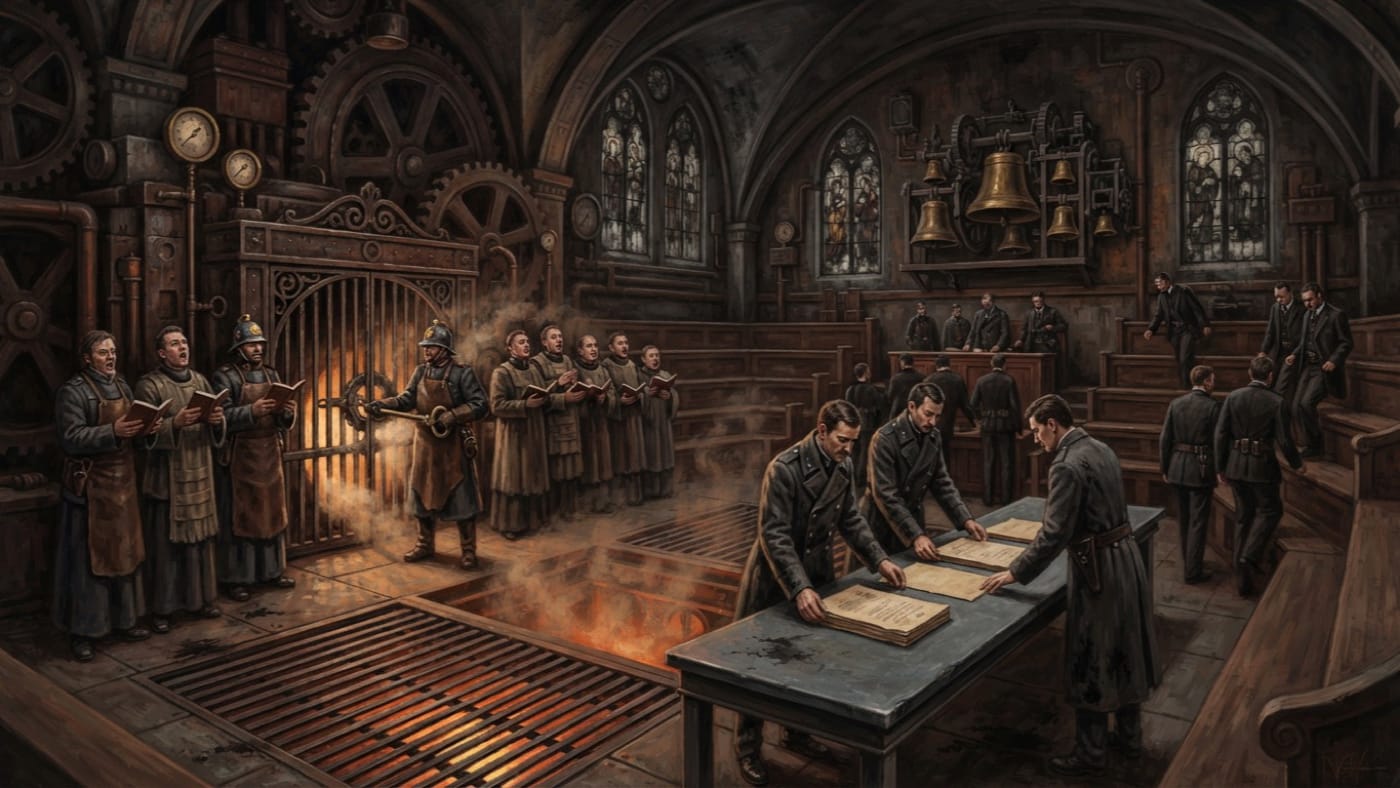
The building is the Furnace Basilica, raised above Essen's primary crucible. Heat comes up through iron floor grates. The lower saints in the glass have gone black with soot, while the upper saints keep their colours because they hang further from the work, as saints usually do. Before anyone in this room may propose, object or vote, the room must be sung, unlocked and supplied with paper. The published record gives nothing more of the rite than that order of business.
#On Cantors, Grates and the Agenda
There are three acts, one for each of the three Bureaus.
Sister Rauth's cantors sing the room awake. Rauth is Master-Calibrator of the Bureau of Orison and Song, which licenses every approved cadence in the city. The singing falls under her jurisdiction and is performed by her cantors. The record does not place Rauth's own scarred throat among them, and I will not place it there for colour. The record gives no stanza, no pitch, no length and no number of voices. I have no chant to print, and I print none.
"Awake" is the attested word. It is ritual language, and Doctrine certifies it as ritual language. Whether a room hears anything is a question this compilation leaves to the theologians of acoustics, who have not applied.
Furnace-Marshal Kord's furnace guards unlock the grate screens. Kord holds the chair of the Bureau of Engines and Furnaces, which covers fuel, heat, schedules, guards and the bodies that feed all four. His men turn keys. The sources say nothing of their opening the crucible, searching the chamber or exposing any apparatus. A guard with a key needs no further theatre to be understood. Heat in Essen is a jurisdiction, and the Engines chair admits it into the sitting.
Arch-Notary Veyl's clerks lay three copies of the agenda on heatproof boards. There is one agenda in three copies. Veyl's Bureau of Records certifies identity, permits and the existence of things, and good Records practice would never let a chair claim afterwards that it had read a different document. The heatproof board solves a practical difficulty in a hot room. The three copies solve a political one.
Each of the openers supplies one thing. Orison supplies authorized sound, Engines supplies controlled access, and Records supplies the paper that will hold the sitting to account. No chair opens the room alone, and no chair can say later that the room was opened without it.
#On the Motion and Its Confirmations
Once the room is warm, the Council may move. Every motion then requires a spoken vote, a written vote and a bell confirmation.
The spoken vote is heard in the chamber. The written vote enters the record, where Veyl's clerks can compare it with the spoken one at leisure. The bell confirmation carries the result out of the Basilica into a city that keeps time by peal. All three attest the same decision. They are not three sessions, and the sources do not give any one of them to a particular Bureau as its private instrument.
The record establishes no quorum, no majority threshold, no rule of unanimity, no order of veto and no appeal. I have searched for them with the diligence my office expects and found the procedure silent. A silent source proves no burned folio, and this compilation files the silence as silence.
What the record does establish is the instrument by which the Council reaches labour. A bell order changes production tempo. It is announced through the peal schedules that govern the city's shift starts, pours and lesser routines. Many motions never become bell orders. Every bell order is a motion, though. Any change of tempo that reaches a stoker's back has first passed a spoken vote, a written vote and a bell in a room that was sung awake for the purpose.
#On the Voices Beyond the Chamber
Essen gives the same name to a second practice, and a compiler must keep the two apart.
In the Foundry Core, the First Bell Warming is the singing over the bearings before the furnaces light. Choirs sing the bearings "awake," the same ritual verb used in the Basilica. The city's daily rhythm sets this industrial warming at dawn, beside the ration line. The calibration shifts of the Choir Quarters begin at it and end when the last pour cools. It is distinct from the Psalm-Measure, the metered chanting during the pour itself.
The sources do not establish which warming came first, whether one borrowed the other's name, or whether a Council opening ever coincides with the dawn warming. Nothing in them requires the Council to sit at dawn.
The labour behind the industrial rite is well recorded. The Choir Quarters maintain approximately two thousand calibration voices, and the average singer's vocal service lasts nine years. Those figures describe the barracks. They do not count the cantors at a Council opening. In the barracks, singers boil throat-herbs and loosen their cords before First Bell, because a voice that cannot sing at the warming is an expense.
Below them, in the Ash Warrens, the southern duct boards post the opposite obligation: no humming during First Bell Warming. The singer is required to sound, and the tenant is required not to. Essen's hospitality custom adds a third rule, that guests do not speak during First Bell. That is etiquette between host and guest. It is not a household warming, and no Essen statute requires a family to sing its kettle awake.
#On Cadence Under Demand
The procedure would be an antiquarian curiosity if the Council had nothing to decide. In A.S. 201 it has a great deal to decide. Strasbourg demands tripled output of hymn-drive siege engines for the Sagittal Line. Tripled output requires faster pours, faster pours require faster calibration, and faster calibration spends throats.
Sister Rauth refuses to raise the tempo without liturgical stability guarantees. Her caution carries the authority of a scar. In the A.S. 184 calibration accident a stanza went wrong by a quarter-tone and fourteen singers died, and she survived it. Furnace-Marshal Kord threatens more conscription from the Warrens, where untrained voices are plentiful. Arch-Notary Veyl administers the forms for both positions, and for the dispute between them, at the usual tariff.
Every one of these positions must pass through the same opening. Kord cannot speed a pour by shouting at a furnace. He must carry a motion in a room that Rauth's cantors have sung awake, before three copies of an agenda that Veyl's clerks have laid out. The result must then be spoken, written and rung before the Foundry Core is obliged to hear it. The rite settles nothing. It forces the quarrel to be conducted in heat, on paper and under the bell.
The singers bear the consequences directly. Whatever the Council confirms by bell, they will sing over at the next warming of the bearings.
One inherited list of Essen's notable places states that the Council meets under the crucible.
Corrected. The Furnace Basilica stands above the primary crucible, and the heat reaches the Council through its iron floor grates. Doctrine prefers its governors cooked from below to its governors buried beneath the work.
#On Present Application
At the time of this A.S. 201 compilation, the Council opens as the record describes. The cantors sing, the screens are unlocked and the three agenda copies are laid out. Every motion then needs a spoken vote, a written vote and a bell. The industrial warming continues at dawn in the Foundry Core. The Choir Quarters prepare their throats for it, and the Warrens keep their mouths shut through it.
I certify the doctrine that makes the Council's procedure holy. Nobody has asked me to certify the throats that carry its bells to the furnaces, and that omission is filed in my hand with the rest.