

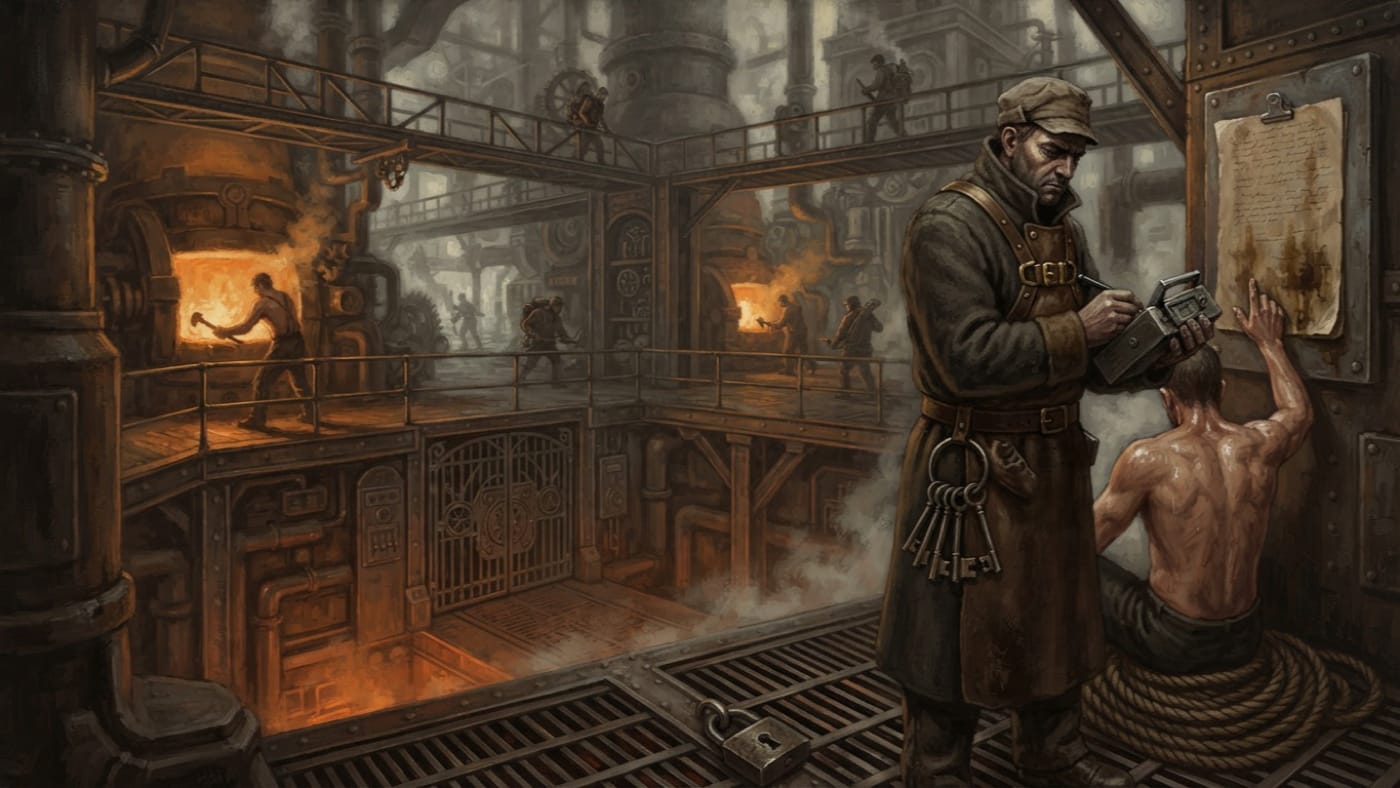
#On the Station of the Furnace Guard
This entry is a documentary survey compiled for the Bureau of Doctrine in A.S. 201 / 1911 CE. That is the year of compilation and nothing more. It does not date a founding, a recruitment, a charter or an inspection, and the compiler has found none of those things in the record.
The furnace guards of Essen-of-Hymnsteel are the armed hands of heat. They serve the industrial order of the Tri-Bureau Compact. Under the Compact the Bureau of Engines and Furnaces, the Bureau of Records and the Bureau of Orison and Song share one city and resent the arrangement. The Compact Council governs that city by decree, audit and bell order, and the guards appear wherever those instruments touch iron, keys and bodies.
They answer to the Engine chair. The published record speaks of Kord's furnace guards and of Kord's procurement guards. Furnace-Marshal Kord also holds the slag fuel, the furnace schedules, the overtime and the requisition of labour. Essen's own list of its enforcers sets furnace-guards beside tribunal clerks, Orison provosts and inquisitorial auditors. That list is a census of who may lay hands on a citizen. It is no table of organisation.
Readers raised on Strasbourg pamphlets will ask for the regiment, the colours, the ranks, the founding year and the name of the first captain. The archive supplies none of them, and I decline to build a regiment so that a reader may feel tidier. The guards exist as a function of the Bureau of Engines and Furnaces. A function needs no birthday.
They must also be kept apart from their neighbours. Records clerks certify, Orison wardens listen, and the furnace guard counts, locks and enforces. An account that lets a guard stamp a work permit or judge a quarter-tone has folded three Bureaus into one. The Compact was built to prevent exactly that.
#On the Grate Screens
The Furnace Basilica stands above the primary crucible. Heat rises through its iron grates into the nave, blackens the lower saints in the glass, and has worked through boot leather before the second motion is read. Each Council sitting opens with the First Bell Warming, and in it three things happen. Rauth's cantors sing the room awake. Veyl's clerks lay three copies of the agenda on heatproof boards. Kord's furnace guards unlock the grate screens.
That is the whole of the guards' ceremonial office as attested: a key turned in a lock in a hot room. The sources give them no part in opening the crucible, no search of the chamber and no admission of anyone beneath the floor. They unlock the screens, and the heat comes into the sitting. In a city where heat is a jurisdiction, letting it in is an act of government.
The Council's warming should not be confused with the dawn singing over the bearings in the Foundry Core, which carries the same name. Nothing in the record requires the Council to sit at dawn, and nothing places guards among the bearing choirs.
An inherited list of Essen's notable places states that the Council "meets under the crucible."
Corrected. The Basilica is built above the primary crucible, and heat rises to the Council through iron grates. Anyone meeting under a crucible would be in no condition to vote.
#On the Audit of Gloves and Fingers
The audit is where the guard earns his wages, or at least collects them.
The published account of the Compact's audit divides the work cleanly. Records clerks walk the Foundry Core with black ledgers, checking work permits, injury receipts, ration cards, hymn sheets and tool allotments. Orison wardens test vocal cadence at the checkpoints. Furnace guards count missing gloves and missing fingers with equal severity.
I have read that last sentence more often than any other line in the Essen file, and I commend it to every seminarian who thinks the Church has no gift for brevity. A glove is drawn from the Bureau's stores. A finger was issued by the Creator. The guard holds both to the same tally, so a stoker who comes back from a pour with nine fingers and two gloves has, by this arithmetic, achieved partial compliance.
What the guard does with the count is not written. The record sets no tariff for a lost glove, no quota of fingers, no compensation and no form on which the two are reconciled. It establishes only the equal severity. Severity in Essen has enough instruments without my inventing more. Records enforces debt by throttling identity: permits are turned "pending," and draft eligibility falls on anyone whose paperwork ripens at the wrong moment. The injury itself belongs to Records' side of the ledger. A notary-surgeon notarises it and it is filed as an injury receipt, which the clerk then checks. So the guard counts, the clerk certifies, and the warden listens to the survivor's breathing for wrong intervals.
Three Bureaus inspect one man, and none of them asks about his hand.
#On Safety Sold by the Hour
Essen's environmental killers are furnace flash, falls from gantries, lung rot, chemical burns from the river and the slow theft of hearing. The guard's office is advertised as protection against these. Safety waivers appear on the city's list of things always for sale, which tells the reader how the office is run.
The published account of the Council puts it plainly: the Furnace Guard sells protection from inspections it schedules itself. The inspector and the insurer are the same man, and the premium falls due before the inspection is announced.
The Essen file names one local militia that practises this art, the Saint-Helm Company. Its public face is safety enforcement and its recorded aim is profit through protection permits. Its methods are listed as raids, confiscations and staged inspections. Its resources are weapons, writs and access to the locks, and its ground is the perimeter of the Foundry Core. It is recorded as an ally of procurement and an enemy of the unions. All of these particulars describe the Saint-Helm Company and no one else. The file does not say that every furnace guard in Essen belongs to it, that it commands the others, or that the city has a single unified guard. A reader who extends the Company to every key-bearer in the Core does so under his own seal.
The enmity with the unions needs no invention to explain it. The Throat Line disguises its slowdowns as liturgical caution. A company that sells safety has every reason to find the barracks unsafe.
#On Discord, Output and the Raid
A.S. 201 finds the Compact under procurement pressure. Strasbourg demands tripled output for hymn-drive siege engines. Kord threatens forced conscription from the Ash Warrens, whose refugees are drafted first by custom. Sister Rauth refuses to speed up the tempo without guarantees of liturgical stability. Veyl profits either way. The published account of Kord observes that the Marshal has grown louder in his guard orders and quieter in the Council minutes. The guards are the loudest thing he owns. When his certainty leaves the chamber, it goes to them.
Over all of this hangs the Wrong Choir. Tools hum on tables, teeth ache, and candles tremble where there is no draught. As it escalates, rivets shear and bell-cannon throats crack. Afterwards a district can fall into a silence that lasts for days. The city's official vocabulary calls the event a Resonance Bloom and, in kinder moods, holy alignment.
The Compact's public summary attributes recent Bloom events to Mirror Choir sabotage. The published Council account records that Kord favours this theory because it justifies guard raids. A raid needs a suspect, a suspect needs a cause, and a circular has supplied the cause. A guard can break a door in the Warrens, confiscate a hymnal with altered measures and record a chalk mark under a lectern. None of that shows who or what sheared the rivets. I find the raids orderly and the attribution unproven, and I sign both findings.
The physical danger is not in dispute. A guard on a gantry during a Bloom faces the shearing rivets in the same body as the stoker he audits. In the Core, discipline is kept by men standing on the same failing iron.
Every quota ends at the Sagittal Line. A bell-cannon throat that cracks in Essen is a loss in the ledger. One that cracks after shipping is a loss under fire. That is why Strasbourg pays the guards' prices.
#Present Disposition
This survey, compiled in A.S. 201 / 1911 CE, finds the furnace guards of Essen serving as the Engine chair's enforcement at the grates, at the audit and on the perimeter of the Foundry Core. It certifies no founding, no rank system, no unified regiment and no list of officers, because the record holds none. It certifies the key, the count and the price.