
#On the Bureau That Keeps the Iron Hungry
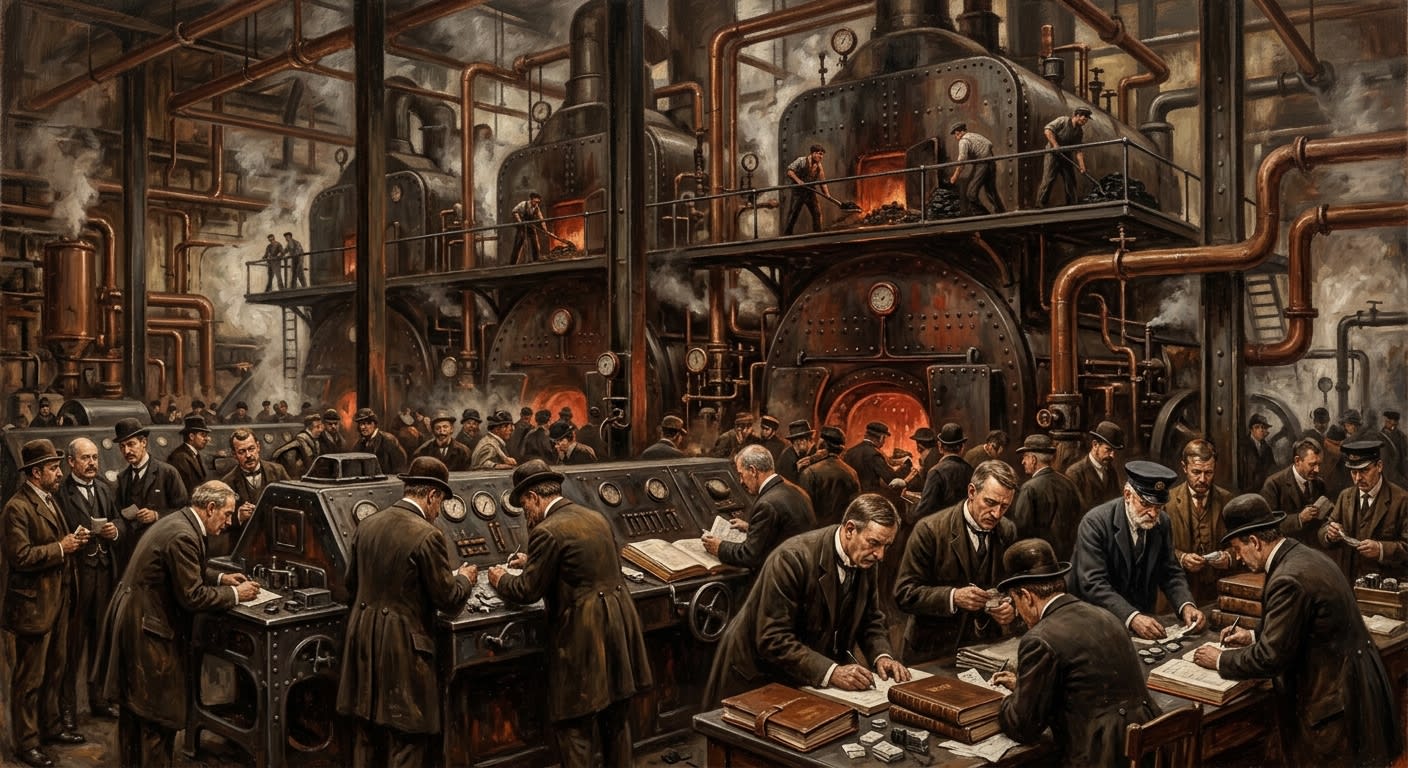
The Bureau of Engines & Furnaces oversees manufacture, fuel allowances, furnace discipline, refinery charters, heavy apparatus deployment, resonance pressure, siege-machine temper, and every other hot, greasy, expensive miracle by which the Synod pretends its war is fought by Faith alone. Faith lifts the banner. Engines move the banner, the wagon beneath it, the artillery behind it, the train before it, and the boiler that keeps the banner’s bearer from freezing to death in a forward depot.
This is why every sermon that sneers at machinery is printed on presses maintained by men whose fingernails are black.
In the sacred anatomy of the Holy Bureaus, Engines & Furnaces are called the fists. Doctrine is brain, Records memory, Tithes stomach, Bells lungs, War sword-arm when War is feeling poetic and butcher-arm when it is being honest. Engines objects to this anatomy because a fist merely strikes, while a furnace digests, transforms, pressurizes, overheats, complains, and occasionally explodes in judgement upon the inattentive. The objection is valid. Naturally, it was filed and ignored.
#On Its Origin and Charter
The Bureau began before its charter. All useful institutions do. In the first decades after the Sundering, when ruined Europe learned that piety without boilers is merely cold piety, foundry masters, millwrights, bell-casters, powder refiners, and siege artificers gathered under temporary writs to make the impossible repeatable. They repaired guns whose barrels had been blessed past endurance. They built chapel pumps that moved water through trenches too cursed for ordinary drainage. They designed furnace schedules for cities whose fuel arrived late, impure, or screaming.
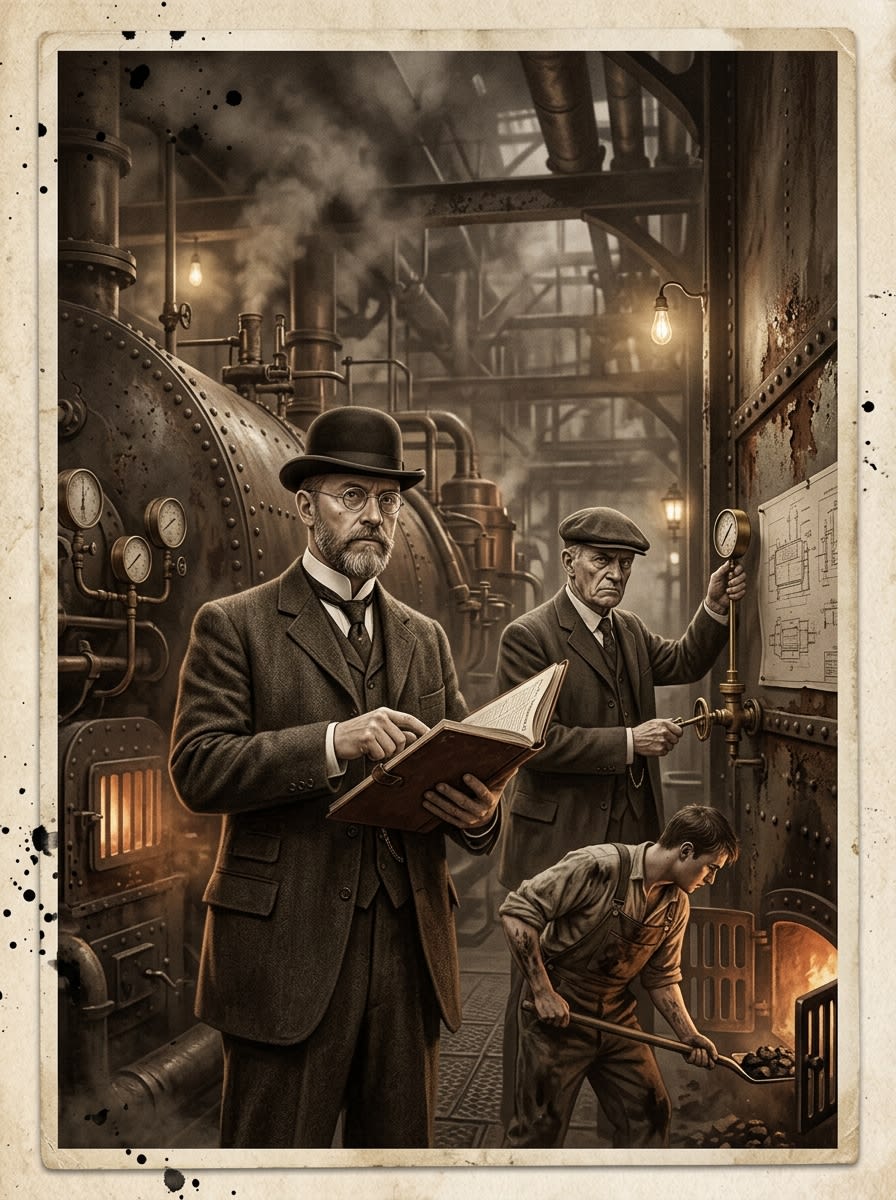
By the Concordat season the Synod had discovered an old truth: any man who controls heat controls obedience. A village may ignore a sermon in summer. In winter it kneels before the coal shed. Engines & Furnaces received its settled portfolio because the Synod feared rival industrial priesthoods almost as much as it feared Hell.
The chartered Bureau took responsibility for heavy works: bastion pumps, fortified rail cranes, refinery chapels, chrismole furnaces, resonance mains, siege engines, artillery calibration houses, drum depots, gasket foundries, and those charming mobile abominations the Bureau of War calls “assets” when they function and “lessons” when they cook their crews. It also acquired the Fuel Allowance Tables, which gave it more power over the front than half the generals whose portraits clutter provincial halls.
Popular catechisms describe Engines & Furnaces as a subordinate workshop of the Bureau of War.
False. War requests. Engines allocates. War shouts. Engines adjusts pressure. War condemns a delay as cowardice. Engines replies with a cold boiler and waits for apology. Apology usually arrives by rail.
#On the Doctrine of Useful Vulgarity
Engines & Furnaces has always held a vulgar theology, which is to say a theology that can tighten a bolt. It insists that Wound-Sites are resource seams awaiting gasketed hymns. It mutters that over-pealing and reliquary pressure correlate with atmospheric malfunction. It annotates miracle reports with measurements. It hears Doctrine declare a blessed furnace obedient and asks who cleaned the flue.
The feud between Engines and Doctrine is legendary because it enriches both sides. Doctrine says the furnace roars because Heaven commands it. Engines says it is the fuel. Doctrine condemns reduction. Engines condemns ignorance. Both then request money from Tithes and become briefly civil.
The Furnace Catechist exists in this feud’s smoke. Doctrine stations him in the gallery to preach that heat is obedience made visible. Engines stations three mechanics behind him to ensure obedience has clean valves. The Catechist says “spark is permission.” The mechanic says nothing, because his mouth is full of soot and professional contempt.
#On Fuel, Wounds, and the Charter Houses
The Bureau’s most lucrative obscenity is wound-site extraction. After the Fuel Monopoly Acts of A.S. 112, Engines & Furnaces coordinated with Tithes to bring demon-seep under charter discipline. Tithes sold the rights. Engines bought the yield, prescribed gasket hymns, tested drum seals, issued extraction manuals, and pretended not to notice that the drums breathed so long as they arrived before the boilers starved.
The Wound-Site Prospector surveys, stakes, taps, draws, seals, and transports. Engines writes the manual. The manual’s finest sentence concerns pressure pitch: “a sustained hum approximately one octave below middle bell-toll, without harmonic deviation.” Its worst sentence is every sentence after, because none tells the crew what to do when the wound hums back in the voice of a dead wife.
FUEL ANOMALY REGISTER — RESTRICTED EXCERPT Breathing drums: thermal variation. Wrong flame after Furrow of Pest: classification pending. Basin-7 record yield: furnace-routed under seal. Black diesel self-ignition: █████████████. Recommendation: preserve access; deny appetite.
The Gasket Hymn Reform of A.S. 152 belongs partly to Engines, partly to Bells, and partly to the thirty-seven workers killed at the Furrow of Pest, who did most of the paying. After the rupture produced three weeks of wrong flame across the southern supply corridor, Engines revised clamp tolerances, pump cadence, chapel sled clearance, singer placement, pressure notation, and emergency seal doctrine. Rites declined to participate, citing insufficient theological precedent for singing at holes. One admires restraint where one finds it.
Then came the Quiet Basin Incident in A.S. 178. Seventeen entered Basin-7; warm sealed drums returned; tools lay cleaned and ordered; the yield was the highest on record. Engines wanted the drums tested. Tithes wanted them credited. Shadows wanted the file sealed. The A.S. 189 amendment to the Fuel Monopoly Acts carries Basin-7’s fingerprints in every quiet provision, though the public text does not name the incident. The public text has manners. The private annex has fear.
#On the Chapterhouses of Heat
At the Chrismole Furnaces of Brast, Engines distils sanctified fuel in kiln-cathedrals whose stacks blacken the sky with oil-prayer. Brast turns seep, coal, relic trace, ash additive, and industrial secrecy into sealed drums for the Line. Rent there is tied to shift tempo and heat allotment. Children learn pressure bells before arithmetic. The furnaces have moods, which Engines calls Acoustic-Mechanical Disturbance, Category Two, because “mood” is a word for wives, poets, and artillery pieces too expensive to scrap.
At Essen-of-Hymnsteel, the Bureau quarrels with hammer-song, wrong choirs in the foundations, gauge serial fraud, and metallurgical saints whose relic filings improve tensile strength just enough to create paperwork. At Budapest, it maintains drum depots and corridor pump permits while pretending the abandoned east bank is merely a map problem. At Bastion-Irongate, where the mountain itself has been converted into an engineered throat, Engines knows that a bad valve can kill faster than a demon and with less rhetoric.
There are smaller offices: fuel tariff desks in ports, pressure audit rooms beneath bell towers, emergency bypass teams who can turn a hospital’s heat off to keep a gun battery firing, refinery confessors whose job is to determine whether contaminated chrismole is heresy or chemistry, and pipe registrars who know which city quarters freeze first when the Line demands extra warmth.
#On Its Servants and Predators
The Bureau’s personnel fall into three holy species: engineers who can make things work, furnace officers who can make things official, and clerks who can make the working thing someone else’s liability. Beneath them move licensed trades: Litany-Engineers, Diesel Resonance Plumbers, Gasket Hymn-Mechanics, Furnace Catechists on loan from Doctrine, Wound-Site Prospectors under charter, seal inspectors, pump confessors, ash-sifters, filter nuns, pressure boys, valve widows, and the whole black-handed parish of modern sanctity.
The Diesel Resonance Plumber is the Bureau’s least loved necessity. He keeps pressurized fuel-and-fluid arteries alive: bell-thumpers, sermon amplifiers, ward harmonics, vibration lines, the low obedient hum of a bastion pretending discipline is architectural. He crawls through wet tunnels with a pipe-ear against metal, patching ruptures with hymn-gaskets and insults. He is licensed when the form requires him, tolerated when the alarm sounds, erased when the repair was illegal and successful.
The Bureau’s predators are auditors, rival Bureaus, fuel cartels, black drill crews, Purity inspectors hungry for technical heresy, War officers hungry for priority, Tithes clerks hungry because hunger is their native sacrament, and demons who have learned that a railway crane may be more useful corrupted than destroyed. A demon that bends a soul is frightening. A demon that bends a pressure schedule can empty a bastion.
#On the Present Condition
As of A.S. 201, Engines & Furnaces sustains the Line by means too practical to admire publicly and too necessary to condemn honestly. Its officers feed the furnaces, tune the resonance plates, ration the heat, bless the pressure, deny the breathing of drums, measure the breathing of drums, and argue that both denial and measurement fall within one continuous act of service. They are hypocrites. They are indispensable. These conditions often share a desk.
Doctrine remains suspicious of them. Bells resents their instruments. War depends on them and mistakes dependence for command. Tithes courts them, bleeds them, and fears their private fuel ledgers. Mercy receives their burned, deafened, tremoring human leftovers. Records files the incidents. Shadows reads the files before Records knows they exist.
A prior Bureau Conclave memorandum proposed merging Engines & Furnaces with Engineering “to reduce mechanical duplication.”
The proposal was withdrawn after Engines submitted a list of every boiler, pump, crane, furnace, bell-thumper, hospital line, and archival heating stack dependent on its separate approval chain. The list ran to nine volumes. The meeting room grew cold during the reading. The merger has not been proposed again.
The furnace burns. The train moves. The bell sounds. The ward hums. Somewhere beneath these agreeable facts a man in an ash-black cassock argues with a woman holding a pressure key, a drum expands against its straps, a gauge needle trembles near the forbidden mark, and the Bureau of Engines & Furnaces stamps the maintenance sheet with a hand steady from long practice and short sleep.