
#On the Quarters
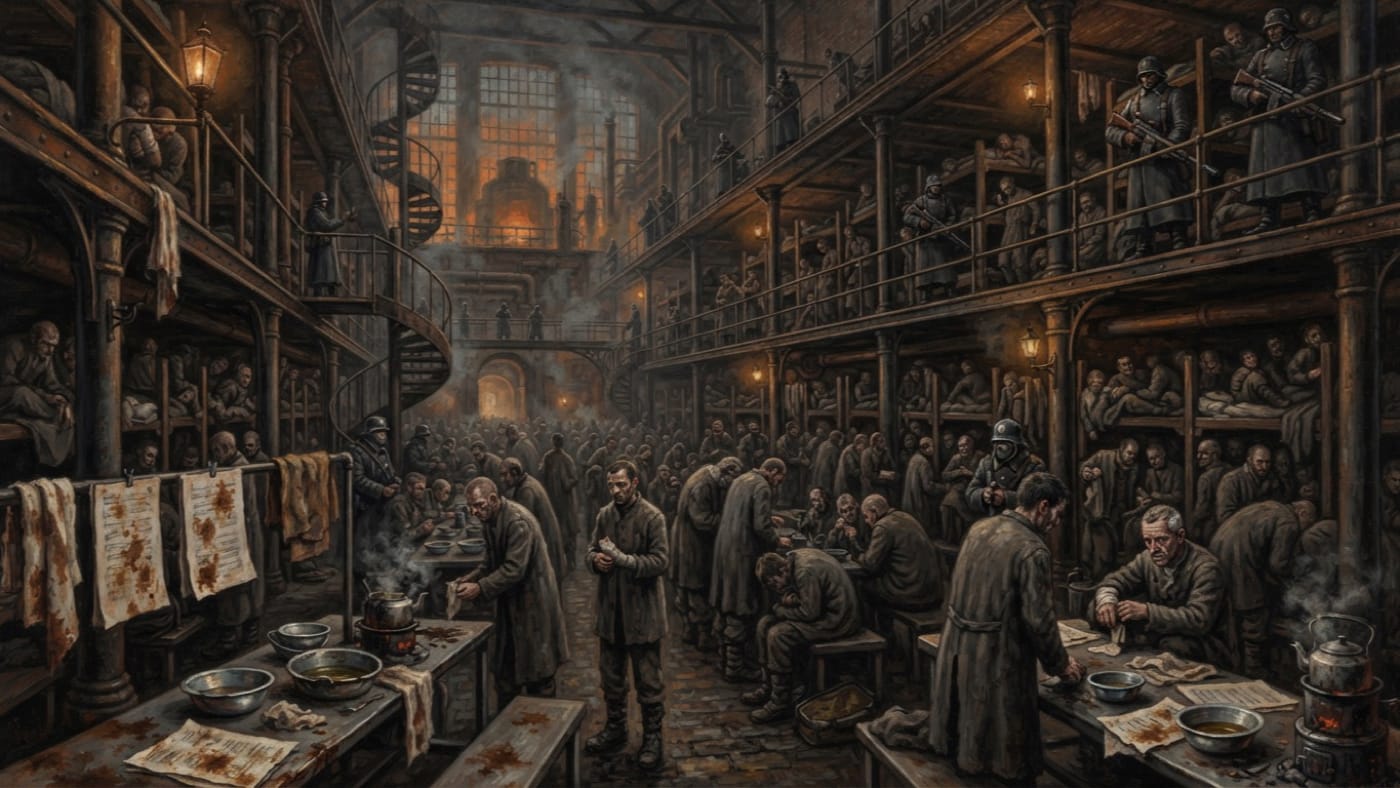
The Choir Quarters is a district of Essen-of-Hymnsteel, set among the terraces that ring the Foundry Core. It exists for a purpose the Compact states without blushing: to keep usable voices within marching distance of the pour. The Bureau of Orison and Song lists its barracks as dormitories. The residents call them the Throat Dorms. The organization those residents built inside them calls itself the Choir Barracks Union, and it also answers to a shorter name, the Throat Line. That is the name the furnace-guards spit.
So there are three names, for a district, a barracks and a grievance. Strasbourg files all three under "calibration complement" and has never smelled any of them.
The smell is boiled herbs and throat-blood. Kettles of steeped root and leaf stand on the mess-stoves, because a singer who cannot loosen the cords before First Bell Warming does not sing, and a singer who does not sing is an expense. Rags stained a particular rust-brown hang to dry near the hymn sheets. Soot settles on both without distinction. Barracks feud with barracks over messes, bunks and precedence, and the brawls are loud. They are the only loudness in the district that no Bureau licensed.
Approximately two thousand voices are maintained here at any given time. The verb belongs to the Bureau, and it is exact. One maintains a boiler.
#On the Service of the Voice
The Compact holds calibration to be a sacrament and singing to be licensed work, and has arranged its law so that the two descriptions never meet in the same court. In the Hall of Measures, paired choirs face each other across the crucible and sing the prescribed stanzas while the hymnsteel cools. The Bureau of Orison's technical account holds that the vibration of the voice aligns the grain of the metal. I repeat the account as given. I am a theologian. I certify the sacrament and leave the grain to men with burnt hands.
What leaves the Hall is beyond dispute. Bell-cannon throats, hymn-drive housings and reliquary fasteners go out by barge and rail to the Sagittal Line, and every one of them was sung over by somebody who slept in the Choir Quarters. The shift begins at First Bell Warming and ends when the last pour cools. The pour does not consult the throat about its schedule.
Service arrives by several doors at once. Certain classes owe the voice tithe, which the singers call the throat tax. Others come through debt, through quota penalties, or through a household that cannot meet its labour-hours. A temporary exemption can be purchased. I have found a permanent one in no schedule. The Bureau of Records holds the work permit, the ration chit and the certified identity of every singer in the district. A voice that falters on the stage in the morning may find by evening that its owner has also faltered on paper.
Injuries are notarized. Essen's rivet confessors stamp injury reports as though stamping absolution, and the confession receipt goes into the same ledger as the tonnage.
The average career lasts nine years. It is only an average, and the singers know better than any clerk how cruelly an average treats the people at either end of it. When the pitch drifts, the singer is reassigned to the slag hills, the lock-gates or the Ash Warrens. Orison calls this completion of service.
#On the Throat Line
The Throat Line is half union and half monastery. From both parents it has learned the art of saying one thing in public. Its public face protects singers. Its purpose, which it does not trouble to hide from anyone who can count, is to win permanent ration privileges for its members and to end the bleed shifts. The Union has never defined that term for the Codex. It has never needed to.
Its method is the slowdown, performed as liturgical caution. A stanza is taken a breath slower because the breath marks on the sheet look doubtful. A pour waits while a cantor confirms the pitch, and a second confirmation follows the first, for piety's sake. Every delay can be defended on doctrine. Every delay also costs the Bureau of Engines and Furnaces tonnage it has already promised to Strasbourg. The Throat Line owns nothing but its members' voices and their capacity to withhold them a quarter-beat at a time. In Essen this is a considerable fortune.
Furnace-Marshal Kord regards the Union as a fuel shortage with lungs, and Engines is its declared enemy. Its alliance with Orison is uneasy and mutual. Sister Rauth's resistance to faster calibration serves the singers, since the scar across her throat testifies to what a hurried pour does to a choir platform. It serves just as well the safety of the steel and the authority of the Bureau that alone decides which stanzas are approved. Rauth is no labour saint. She is a Master-Calibrator who has found the Union useful. The Union returns the courtesy exactly as long as her caution and its own coincide.
Two names recur in the Records files on the Throat Line. Mara Nine-Notes is recognized by missing teeth. Brother Pell keeps time by scars. Neither holds an office the Compact acknowledges. The files give neither one a charter, a title or an election, because the Union has given Records none of those things to file. The barracks are said to keep strike hymns that never appear on an approved sheet. The hymns are rumoured. The slowdowns are measured.
#On Discipline and Silence
Rest in the Choir Quarters is kept under guard. Night practice goes on under watch, and the Compact cites the danger of "sleep-sabotage." No tribunal has described the shape of that crime, and its suspects are, conveniently, everyone asleep.
Silence costs money. Ordinary hearing protection requires authorization. Sound-dampening material must bear a Hushwright Guild seal, and anything unsealed is contraband. Up the slope, the Quiet Gradient sells licensed silence by the room to those who can pay a year of a lockhand's wages, and the Hushwright Guild keeps its monopoly on felted ash and sealed timber. The singers work with the ear as much as the throat. They may not stop a single ear with wax until an office has stamped the wax.
Licensed quiet must never be confused with the Silent Zones that follow a Resonance Bloom. The first is a commodity. The second is a wound in the city's hearing, and the Hushwrights would sell their grandmothers to reproduce it.
Discipline beyond the barracks walls is administrative. A singer who sings flat may lose a permit. A singer who argues may find a name misspelled in Ledger Row and a ration chit "under review." The tribunals keep the deafening sentence in reserve: forced labour in unshielded resonant halls, where the ear is surrendered to the noise it was trained to serve. Records has never needed to sentence a whole barracks. The possibility does the work.
#On the Choir Beneath
The Wrong Choir reaches the Choir Quarters through the jaw. Tools hum on the mess tables. Teeth ache in sequence. Candles tremble without a draught. The singers read these signs before any foreman can, since their trade is detecting a wrong note, and they know what follows: sheared fasteners, cracked metal, bleeding ears. The Bureau of Medicine issues jaw splints. The Choir Quarters enforce off-duty silence after second bell, which spares a city already arguing with its foundations one more barracks of voices.
For a singer, the greater danger is the explanation. For years the Compact found its answer close to hand, and that answer lodged in the barracks.
Compact Report 447-E (A.S. 198) attributed all Resonance Bloom events to Mirror Choir sabotage.
Corrected under sealed Bureau of Rites review. Resonance Bloom activity predates the earliest documented operations of the Mirror Choir by approximately forty years. The calibration singers of the Choir Quarters lived beside the hazard long before the Compact had a heresy to blame for it.
The Mirror Choir exists. It alters hymn sheets, a breath mark here and a quarter-tone there, and it exploits acoustic failure when failure arrives. The Bureau of Purity has hunted it since A.S. 187. Residence in the Choir Quarters proves nothing about heresy, however, and a Throat Line slowdown proves nothing about a Mirror Choir stanza, whatever the shift reports insinuate. If the Bloom is sabotage, Purity arrests singers. If it is resonance, Engines rebuilds foundations. The first course is cheaper, and Essen keeps its accounts.
Every approved stanza descends from the Master Hymnal Plates, which were altered by Synod authority decades ago. The singers sing the altered lines every shift. What the original lines released, and what the foundations say when the alteration slips, lies outside this entry and well outside a singer's pay.
#On the Present Condition
As of A.S. 201, Strasbourg demands tripled output for hymn-drive siege engines. Tripled output requires faster pours. Faster pours require faster calibration. Faster calibration spends voices at a rate the nine-year average was never asked to survive. Sister Rauth refuses to raise the tempo without liturgical stability guarantees. Furnace-Marshal Kord threatens conscription from the Ash Warrens, where voices are untrained and plentiful. Arch-Notary Veyl has already printed the forms that will profit from either result.
Three Blooms have come in eighteen months. Cracked hymnsteel parts have been returned from the Line, fractured along the grain-lines the choirs sang into place. Each return occasions an audit, and each audit begins in the Choir Quarters.
The Throat Line's caution is now indistinguishable from the Master-Calibrator's refusal. This is the best protection the Union has ever enjoyed, and also the most dangerous. Strasbourg's patience is a procurement schedule, and schedules expire. Should Rauth yield, or be replaced, the Union will be left holding a slowdown with no approved stanza to hide behind.