
#On the Surviving Account
“The wall eats.” — grave-field saying
This entry is a survey, made in A.S. 201, of what remains of the account called the First Grave-Field Winter. The winter has no date. No reliable register gives its year, its first frost or how long it lasted, and the Bureau of Doctrine will not invent one simply because a codex page has room for it. What survives is a sequence. Tents froze upright outside three bastion walls. Refugee families went inside, into chambers sanctified for the dead. Four offices objected. The objections became a committee, the committee became a clerk, and the allocation of ossuary space stopped being a local improvisation and became a central charge.
The Ossuary Housing Allocator traces the birth of the profession to that sequence. The profession may keep its genealogy, but it is not entitled to a calendar, and neither am I.
The account names none of the three bastions. Later chroniclers have put forward candidates on the strength of local pride, which means on no strength at all. They remain three walls.
#On the Shelter Beside the Dead
The winter falls somewhere in the long period after the Sundering, while the retreat was hardening into what became the Sagittal Line. Nothing narrower can honestly be said. In that period the forward cities had two surpluses and one shortage. They had the dead, in numbers the ossuary architects had never imagined. They had the living, arriving on foot, by cart and by rumour from every district the war had emptied. What they lacked was roofs.
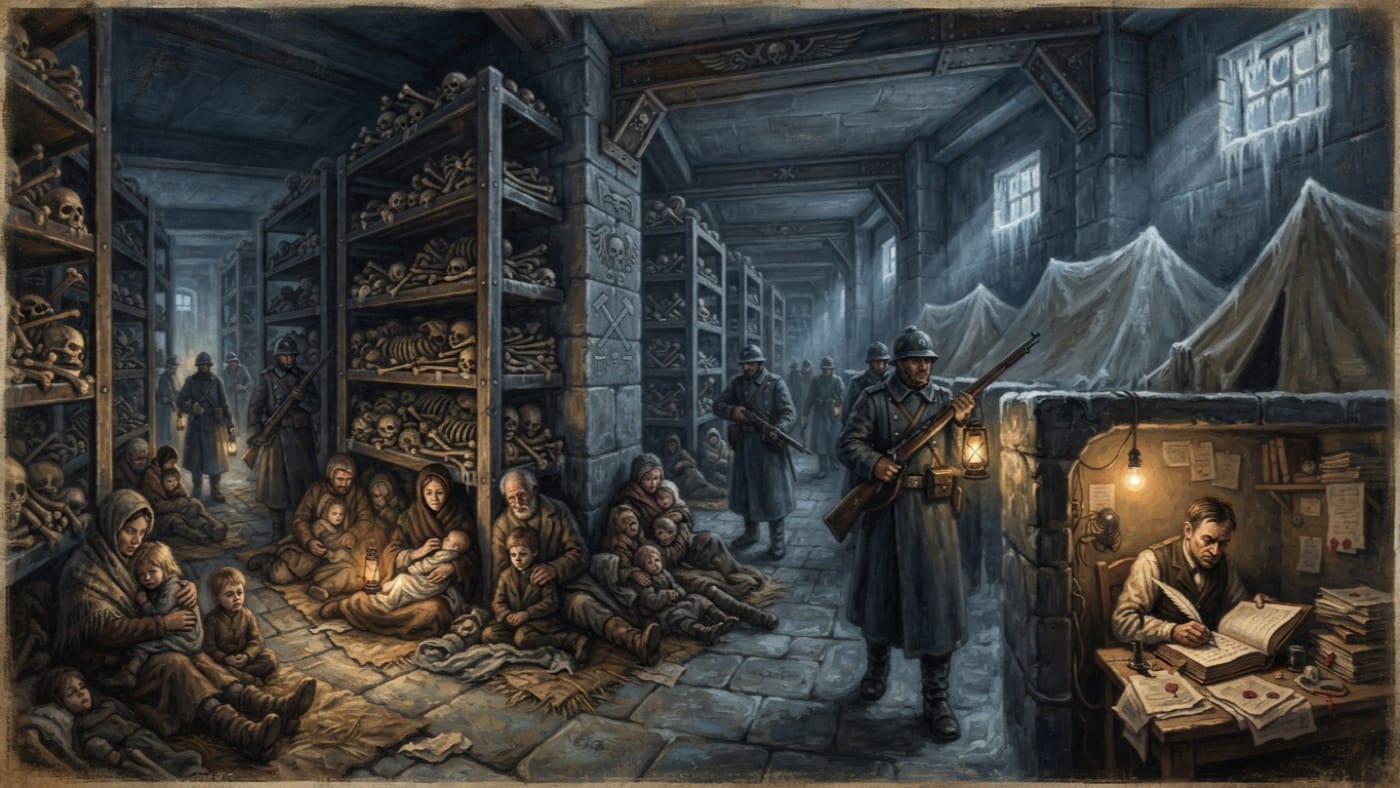
Ossuaries were built for storage. Remains came in faster than rites could close them, and chambers built for order filled with backlog. Along the outer walls the refugees pitched their tents as close to the stone as patrols would allow, because that was where the protection was.
The reasoning of the poor should be set down plainly, since the offices of the time never bothered. Stone stops wind. A grave-field beside a bastion wall lies inside the bell perimeter, which means a watch, a warning, and a night that is officially somebody's responsibility. Ossuary works drew patrols because the dead were stock worth guarding, and anyone sleeping beside that stock got a share of the guard for nothing. None of this made a chamber dry, lawful, or safe from whatever the dead are said to do after the lamps go out. It only made it better than canvas.
Then the canvas froze. The account gives no measurements, and I will not supply any. It says the tents froze upright, stiff on their poles in the shape of shelter, firm enough to stand empty. The families in them made the judgement any competent quartermaster would have made. They went through the doors.
Patrols afterwards found them asleep beneath racks of femurs, wrapped in shrouds taken from storage. Damp stone, bone dust, a lamp if someone had oil. The dead had been there first, but the dead did not complain. Others did.
#On the Four Objections
The same floor was claimed four ways at once, and every claim was correct.
Records recorded unauthorised occupation. That was its whole contribution, and it was the one that lasted. A family under a femur rack is a misfortune. Write that family into a ledger and it becomes a violation, and a violation demands a response.
Rites objected to the living and the dead mingling in sanctified space. The objection was theological, and practical too: a chamber consecrated to remains carries duties of order, seal and the decent separation of categories, and a sleeping child keeps none of them.
Mercy objected to corpses in the corridors. Mark which way that objection ran. Mercy, whose wider charge was shelter, did not complain that the living had come into the ossuary. It complained that the dead, pushed out of their racks or never racked at all, now lay where the living had to step. Storage and shelter had become the same square yard, and one of them would have to move.
War objected to blocked evacuation routes. An ossuary passage beside a bastion wall is the way out for men, carts and wounded when the wall is under pressure. With a family asleep across it, the passage is a dormitory. The account records no failed evacuation that winter, and I will not invent one for effect. The objection needed no disaster. It only needed a commander to picture the bells ringing at night and his men climbing over children by lamplight.
The office titles used above are the ones in the surviving account, which uses the Bureau names of the present. Whether each office already carried that name in the winter, the account does not say. I keep the titles and file the question.
#On Allocation Becoming Office
Four objections produce one committee. I put that in the parent entry as a joke, and a joke it remains. The account gives neither the committee's size nor its name. What it does preserve is the order of events. The objections could not be settled one office at a time, because each office's remedy broke another office's rule. Clear the corridors for War and the families go back to the frozen tents, which Mercy cannot accept. Return the shrouds and restore the racks for Rites, and the dead take back the floor the living need. Records would accept any outcome, provided it was written down.
A committee cannot sit in a corridor at night holding a lamp, so it produces a clerk. On the turning point, the private lore and the public account agree: allocation became centralised. Before the winter, who slept against which wall was settled by custom, by the patrol captain, by whoever held the key and whoever had the nerve. Afterwards, space beside the dead was handed out from one desk.
At its narrowest, as far as the account will support, the desk decided who could shelter inside the ossuary and who could not, which chambers stayed with the dead, and which passages had to stay open. The rest of the profession's equipment grew from that desk later: permits, corridor maps, chalk boundaries, coloured tags, cold iron keys, wax seals and inspections. The account does not show them all arriving that winter, and I will not issue them backdated.
The committee built no walls. After the winter there were exactly as many walls as before, and exactly as many refugees. The clerk's achievement was to make the shortage readable: a crowd sleeping wherever it could became a list of persons sleeping where they were permitted, plus a remainder.
#On the Separate Precedents
Careless lecturers routinely fold two later catastrophes into this one. They are distinct, and anyone who wants to know why the present system looks as it does must keep them apart.
The Bone-Corridor Fire was about overcrowding. The winter had settled who allocated space. The Fire showed what happened when allocation let too many bodies into a passage with too few ways out, and occupancy controls were tightened as a result. Its details belong to its own entry and are not repeated here.
Early public notices described the Bone-Corridor Fire as a consequence of unlawful occupation.
Corrected, per the parent account: the residents of the burned corridor held authorised exceptions. The Fire was a failure of permitted occupancy. It may not be filed as a relapse into the winter's squatting, however convenient that filing would be for the offices that signed the permits.
The Quarantine Reforms came by a third road. They brought in clean tags, forced relocation and sealed zones. Worries about disease were present among the winter's objections from the start, since corpses in corridors and families in burial chambers alarm anyone with a nose. But the winter account names no outbreak and no contagion, and the Reforms' machinery was built for later fears. First the winter gave one office the power to allocate. Then the Fire put a ceiling on how many it could place. Then the Reforms sorted the people inside. The Allocator carries all three on a single belt.
#On the Continuing Administration
The parent entry records the A.S. 201 grave-fields: crowded, temporary in name and permanent in fact. Plots chalked for one season now hold families of several generations. Permits decide who may shelter against which stone. Corridor clearance is disputed every night, and War's old question from the winter, whether a passage is a route or a bed, gets a different answer each night depending on the cold, the patrons and the inspector. The Bellwardens keep the perimeter. The Allocator decides who sleeps inside it. The refugees once reached the bells by walking towards the wall. Now they petition for them, and the petitions are deferred.
Not every present abuse descends from that winter. Bribery came in through its own gate, and so did the tent bosses and the shanty brokers who rent out the mud. What descends from the winter is the desk itself: the principle that shelter beside the dead is no longer taken but given, by one hand, from one ledger, under one seal.
The families in the frozen tents judged well. They went through the nearest door and slept beneath the femurs in borrowed shrouds. The Church answered them with an office, and the office is still answering.