
#On the Last Real Estate
“You do not live here. You are permitted.” — corridor notice, Third Ossuary Ring, south wall copy
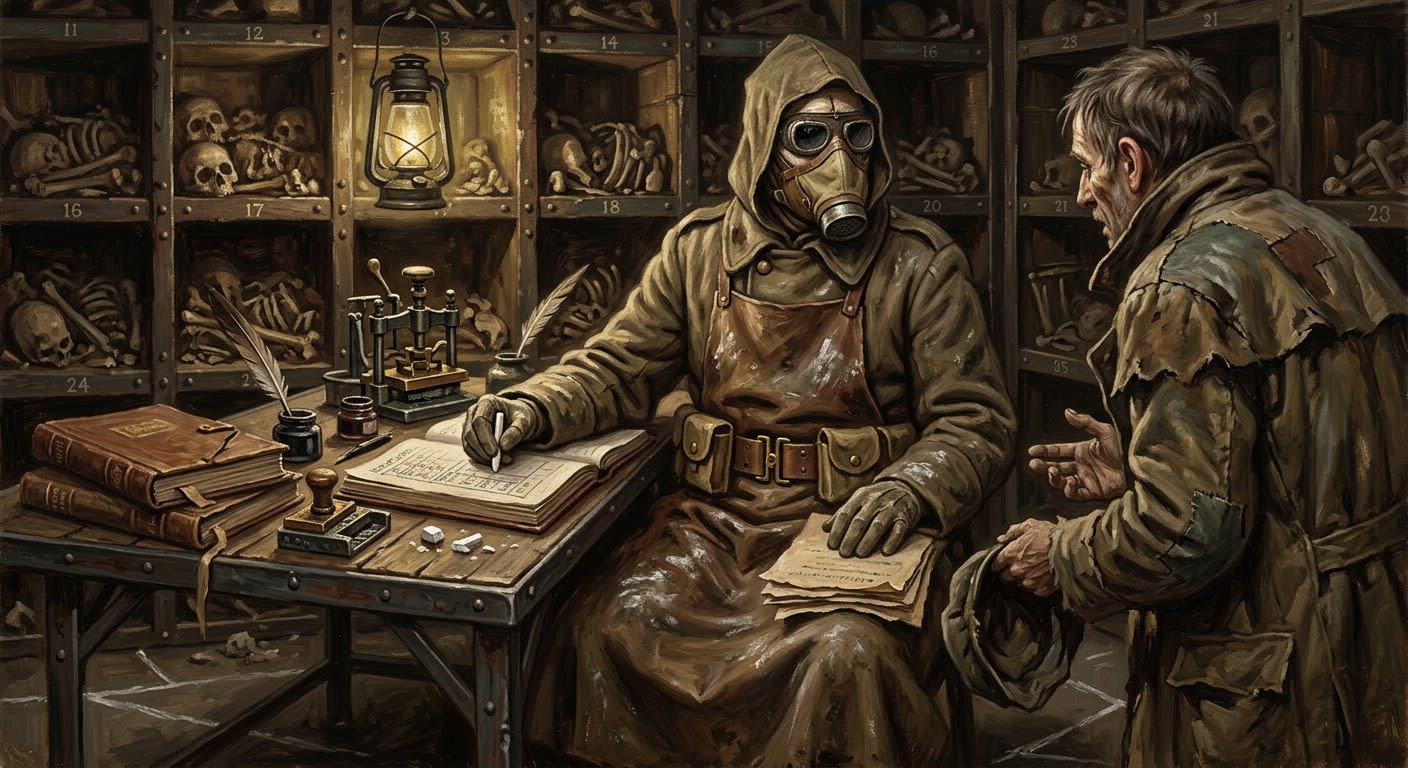
The Ossuary Housing Allocator governs the final and most honest property market in the Synod: space near the dead. Wall niches, stacked catacomb bunks, corridor alcoves, grave-field plots, drainage strips behind bastion underworks, tent rows chalked between bone pits and fever ditches — these are his inventory. He sells dryness, bell-coverage, distance from sealed doors, proximity to patrols, and the exquisite civic luxury of sleeping where the stone does not breathe against one’s cheek.
The Bureau calls this sanctity management. The refugees call it rent. The widows call it whatever the man with the key tells them to call it.
The Allocator’s office sits where mercy loses its softness. A soot-lamp burns above a counter. Behind the counter hang corridor maps rolled in cracked leather, tag rolls by colour, seal stamps in vinegar cloth, key rings heavy enough to deform a belt, and the measuring rod: twelve inches of sanctioned cruelty, brass-tipped, used to determine whether a family fits into the space a clerk has decided their grief can afford.
Every major city has its Allocators. Every bastion has more. Königsberg slots the frozen into ice-dry corridors beneath the lakeward chapels. Brest hangs bunk rows inside bridge piers where brass ribs sweat in winter. Przemyśl stacks sleepers against ammunition galleries and insists this is temporary, as all permanent abuses are. Constantinople has entire neighbourhoods that exist because the Ossuary Rings cast enough shadow to make tents defensible.
The living crowd beside the dead because cities at war do not merely fill. They pile up. The dead enter the wall, the living cling to the wall, and the Allocator, standing between them with a ledger and a scarf full of bone dust, decides which category gets the drier stone.
#On the First Grave-Field Winter
The profession was born from frost, stench, and administrative embarrassment. After the Sundering and the two decades of retreat that hardened into the Sagittal Line, every forward city discovered that casualty storage, refugee shelter, burial law, plague control, military logistics, and the stubborn human desire not to freeze had become the same problem wearing different hats.
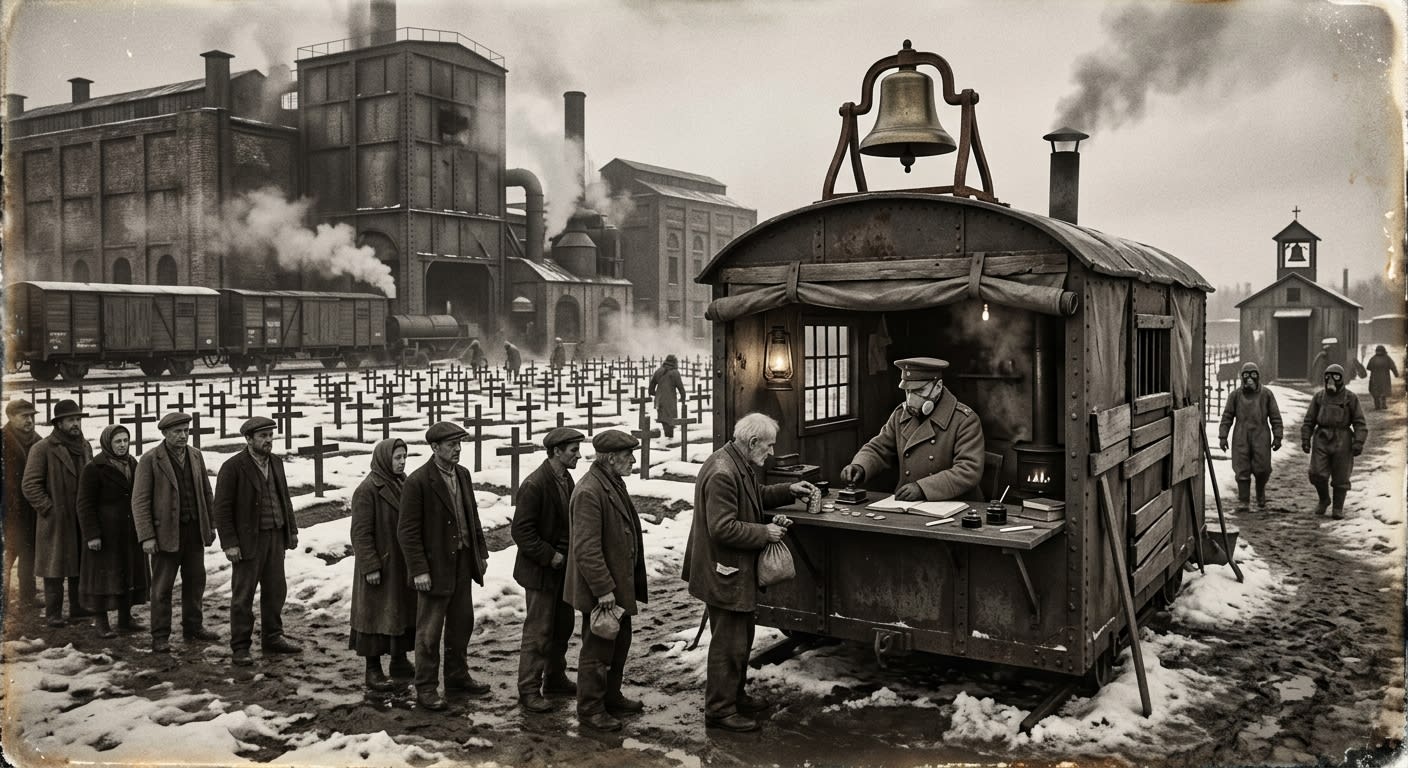
Ossuaries were built for remains. The remains arrived in arithmetic the architects had not imagined. Refugees arrived beside them, because stone chambers keep wind out and even a damp grave-field remains within the bell perimeter. A mother with three children will choose a wall of skulls over demon weather nine times in ten. The tenth time she is already dead.
The First Grave-Field Winter converted improvisation into office. Tents froze upright outside three bastion walls. Unauthorized squats filled sanctified dead chambers. Patrols found families sleeping beneath racks of femurs, wrapped in shrouds stolen from storage, warmer than the citizens outside and therefore resented by all proper society. The Bureau of Records recorded the violation. The Bureau of Rites objected to the mingling. The Bureau of Mercy objected to the corpses in corridors. The Bureau of War objected to blocked evacuation routes. Four objections produce one committee. One committee produces a clerk. Thus civilization advances.
The Bone-Corridor Fire (Unregistered) gave the clerk teeth. A lamp overturned in an overcrowded underwork where six hundred people had been slotted into a space certified for one hundred and forty, not counting the dead, whose occupancy had already been entered under structural load. Smoke moved along the ceiling vault, trapped against sealed niches, and cooked families in their bunks before the outer gate could be opened. The official death count was revised downward because some victims had already been technically resident in a burial chamber and therefore could not be counted as having died there for the first time.
Early public notices described the Bone-Corridor Fire as “a tragic consequence of unlawful occupation by disorderly migrants.”
Corrected: the corridor was occupied under temporary exception slips issued by three licensed Allocation Clerks, two patron letters, and one emergency Mercy dispensation. The migrants were lawful until flame made legality expensive.
After the fire came quotas, chalk boundaries, clean tags, relocation notices, seal-mason inspections, quarantine gates, and the magnificent little fraud by which every grave-field expansion is still called temporary. Nothing lasts longer than a temporary measure in the Synod. It arrives apologising. It remains with guards.
#On Tags, Chalk, and Dryness
Morning begins with the corridor walk. Seals checked. Chalk refreshed. Unauthorized marks scraped from stone. Sleepers counted by lantern. Cough clusters noted. A cold patch near a sealed door receives a cross in the margin and, if the Allocator is wise, no spoken comment.
The queue is already waiting when the office opens: refugees with travel papers damp enough to lose their names; widows holding wedding rings in closed fists; foremen demanding labour bunks; body carts seeking niche clearance; shrine agents with sealed letters; tent bosses offering lamp oil; children sent forward because children look colder than adults and occasionally this works.
The intake categories are simple because cruelty prefers tidy drawers. Citizen. Indentured. Pilgrim. Refugee. Convoy attached. Unsealed. Clean tag. Dirty tag. Fever watch. Bell-starved. Patron hold. No-paper. Each category yields a space, a ration link, a curfew rule, and a future insult. Wall niche if the family has death-rights or money. Catacomb bunk if labour value is proven. Corridor alcove for the useful poor. Grave-field plot for the rest. Quarantine, if cough or politics require it.
The chalk is doctrine made visible. White lines mark permitted sleep. Red marks quarantine. Blue marks shrine claim. Black marks sealed dead chamber. Yellow marks emergency corridor and must never be slotted, unless the night is cold enough, the patron letter heavy enough, or the inspecting officer suitably drunk. People learn the colours before they learn the catechism of the district. A child in the grave-fields can tell by chalk whether her family will be moved, fined, fed, sealed, or forgotten.
Clean tags hang from cords at the throat. Dirty tags stain the wearer without saying why. Tag laundering occurs in lamplight: green exchanged for white, red faded with vinegar, black filed at the edge until a patrol captain agrees it was only soot. The public believes tags record status. Allocators know tags create it.
The measuring rod decides what the sermon refuses to say. A niche too short for a father becomes adequate for two children. A bunk row narrowed by three inches yields six extra permits. A family moved “one corridor worse” loses bell coverage, dryness, patrol pass, and hope in that order. Space is sanctity. Space is ration. Space is government in its purest form: a line no one may cross without a stamp.
#On the Living Beside the Dead
The Synod has always maintained that the dead must be ordered. This is correct. The dead, left untended, mutter, chill rooms, enter ledgers at improper intervals, and generally prove themselves poor citizens unless processed with stamps, bells, geometry, and enough conviction to make the procedure hold.
The difficulty is that ordered dead occupy excellent shelter.
Ossuary walls are thick. Catacomb corridors remain cool in summer and above freezing in winter. Bell resonance travels well through bone-mortared stone. Patrols visit them because the dead are valuable and the living, by nesting there, acquire incidental protection. The poor are not stupid. They will live where the system accidentally defends them. The Allocator exists to convert that accident into revenue and policy.
Officially, no living quarters are assigned inside sanctified dead chambers without authorization. Officially, clean and unclean occupancy do not mix. Officially, no child is ever moved into quarantine for space. Officially, no shrine agent sees the exception ledger. Officially, the wall keeps if the wall is kept.
In practice, the categories bleed. A dead chamber may be declared “structural overflow.” A corridor of bone niches may become “night shelter under watch.” A grave-field tent row may, after twenty-seven years, remain temporary with grandsons born beneath its tarred cloth. The living cook against ossuary vents. The dead listen. Some nights the stones click as they cool. Some nights the clicking answers conversation.
The Allocators develop rules that do not appear in manuals. Do not slot newly bereaved families against fresh niches; they will pray all night and wake the corridor. Do not place fever wards near skull stacks stamped in bulk after bombardment; the cough rhythm carries. Do not permit singers in catacomb bunks unless the Bureau of Orison and Song has cleared the repertoire. Never use dead-niche chalk on living bunks. The story attached to that last rule is old, contradictory, and universally believed: sleepers marked with dead chalk stopped waking, though their ration tags continued to be renewed for three weeks.
#On Exceptions, Bribes, and the Market for Bell-Coverage
Bribery enters the ossuary through the same gate as grief, wearing better gloves. Lamp oil. Extra wax. Medicine. Dry cloth. A silver pin. A patron’s smile. A widow’s wedding ring warmed in her palm until the metal seems alive. The Allocator may refuse. The Allocator may also look at the grave-field after midnight, hear the wind worry the tents like teeth, and decide virtue is a luxury issued to men with roofs.
The bribe has names. “Map correction” moves a family one corridor closer. “Extra wax” renews a clean tag without inspection. “Lamp oil” buys a blind count. “Private housing” means a sanctified dead chamber opened with a key that does not exist. “Bell-cover supplement” purchases sleep inside the reach of the fourth peal. The words are ugly only if one lacks imagination. With sufficient theology, every transaction can be laundered into mercy.
Underworld tent bosses squat along the grave-field edges and govern by rope, cudgel, and favour. Shrine wardens claim corridors for pilgrims who pay in advance. Foremen demand bunk rows for workers and threaten delays in fuel delivery. Ration clerks tie soup to occupancy tags and thereby become kings of the stomach. Patrol captains enforce chalk boundaries unless paid to misread them. The Allocator sits in the middle of this sacred marketplace, despised by every party and necessary to all of them.
SEALED CHAMBER INCIDENT — BASTION-████, A.S. 198: Inspection party opened Chamber 4-Black under authority of Quarantine Review. Interior contained forty-six living occupants, eleven registered remains, nineteen unregistered skulls, three cooking lamps, and one public corridor map not matching any office copy. Airflow reversed upon entry. Occupants stated they had paid “the Bone-Landlord.” No licensed Allocator by that title exists. Follow-up interviews suppressed under Seal █████.
The finest Allocators are Stability Clerks, though the Purity Clerks pretend otherwise. A Purity Clerk will evict an unclean row into sleet because the tag demands it, then write a proud report while the grave-field sharpens knives. A Stability Clerk bends rules just enough to keep riots from acquiring hymns. He sells a clean tag to a mother with children. He moves a cougher near ventilation rather than into mass quarantine. He falsifies a map to keep an emergency lane open while the public believes it full. He is corrupt in the manner of a beam that bends instead of breaking. Naturally, auditors hate him.
The corrupt ones are easier to understand and therefore less interesting. They sell the same niche twice. They issue ghost permits to draw rations for residents who never existed or died usefully out of sight. They seal rivals into quarantine, upgrade patrons, downgrade enemies, and learn which widows will pay twice if the first promise is vague. When caught, they are condemned as aberrations. The system then replaces them with men given identical incentives and cleaner cuffs.
#On Audits and Being Bricked In
Audit begins with wax. Inspectors sniff for fresh seals, examine tag rolls under clean lamps, compare corridor counts to ledger counts, and ask why a red-marked family appears in a white corridor on the public map but not on the private copy. They start with exceptions. The Synod always starts where mercy occurred without permission.
The Allocator fears four persons. The quarantine inspector, because plague makes every compromise look murderous. The ossuary superintendent, because key custody is a theology of its own. The inquisitor, because “mixed chamber” can become heresy in the mouth of a man who enjoys vowels. The judge, because paper crimes are easiest to prove and hardest to dramatize, making them ideal for exemplary punishment.
Punishments fit the architecture. Demotion to grave-field perimeter, where the wind makes theology brief. Public shame, with the condemned clerk wearing doubled dirty tags around the neck. Reassignment to plague wards. Erasure for records fraud. Immurement for sanctity violation: the clerk sealed inside a bricked alcove with a lamp, a prayer sheet, and enough air to appreciate procedure.
Older disciplinary manuals describe immurement of Allocators as “symbolic confinement following conviction.”
Clarification: the confinement is symbolic in purpose and physical in execution. The distinction has been retained for pastoral reasons.
Sealing mistakes are never joked about. Allocators joke about square feet of salvation, about widows who bargain harder than bishops, about skulls with better housing than clerks. They do not joke about the scrape of brick behind a living voice. Every office has a story: a sealed corridor opened after three days to find fingernails in mortar; a perimeter warden “lost” during count walk and heard beneath the floor by morning; a clerk who sold a chamber key and received it back in his soup.
These stories improve compliance more efficiently than circulars.
#On the Present Grave-Fields
A.S. 201 finds the grave-fields fat and restless. War surges from the Line, plague rumours from the wards, ration squeezes from the markets, and bad weather from Heaven’s less generous departments have driven more living bodies toward ossuary walls than the official maps admit. Public boundaries remain neat. Private maps are amended nightly. Chalk drifts outward. Tents creep toward sealed doors. The wall eats.
The sharpest pressure lies near the bastions and the great medical ports. Marrowgate processes casualties until its wagon quays smell of wet bandage and lime. Shipka slots sleepers beneath marsh-cold stone while Syrion's fog paws at the outer works. Irongate keeps emergency lanes clear by law and fills them by necessity before dawn. Constantinople, swollen beyond honest mapping, has grave-field families who have lived three generations beneath ossuary shadow and still renew “temporary” permits every month.
The Bureau of Rites demands purity. The Bureau of Mercy demands shelter. The Bureau of War demands clear routes. The Bureau of Records demands maps that match counts. The Bureau of Tithes demands payment from anyone enjoying roof, wall, bell, or the rumour of any of these. The Allocator listens, nods, stamps, and returns to the queue where a mother is asking whether her fevered son can sleep one corridor closer to the bells.
At shift’s end, the Allocator burns misprinted tags, locks the key ring, smears ash on his thumb to hide his prints from the dead, and pretends he will sleep. Outside, the tents bow under wind. Inside, the walls hold their stacked citizens. Between them, the chalk line waits for morning.