
#On the Nature of the Profession
"A plot is a promise." — Street proverb attributed to Mother Vell of the Crooked Stones, whose name appears in no Bureau register and whose grave, fittingly, has been sold fourteen times.
Where the Synod builds, it builds upon the dead. Where the Synod cannot build — where the dead already own the ground by right of burial, by weight of headstone, by the sheer administrative inertia of a corpse that has been filed, stamped, tithed, and declared sanctified — there, in the narrow legal silence between cemetery and city, the Grave-Field Shanty Broker makes his living.
The profession has no charter. The Bureau of Settlement does not acknowledge it. The Bureau of Records files its practitioners under "Caretaker, Interment — Auxiliary," a classification that covers everything from the man who sweeps mausoleum floors to the woman who controls six lanes of shanty housing between the grave-rings of Bastion-Przemyśl and charges rent in ration chits she prints herself. The breadth of the classification is the point. A category wide enough to hold anything holds nothing accountable.
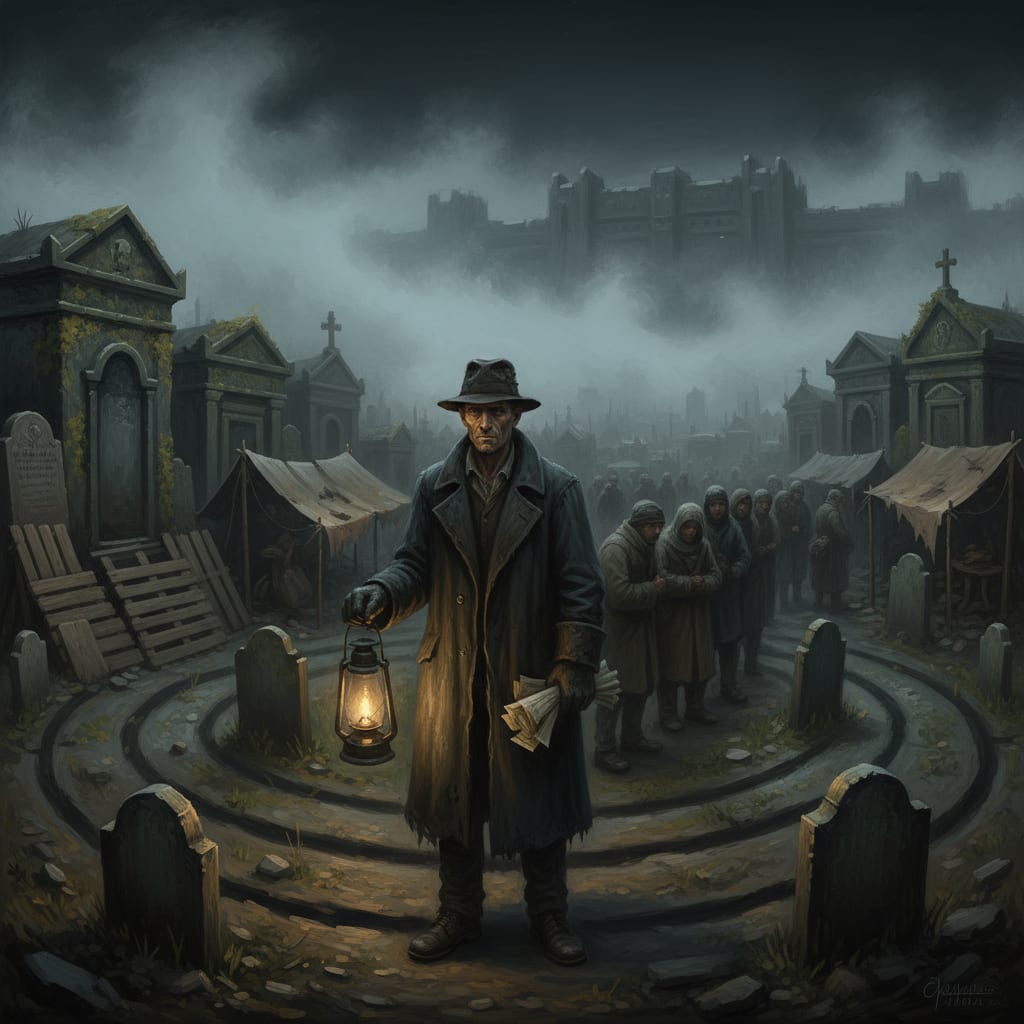
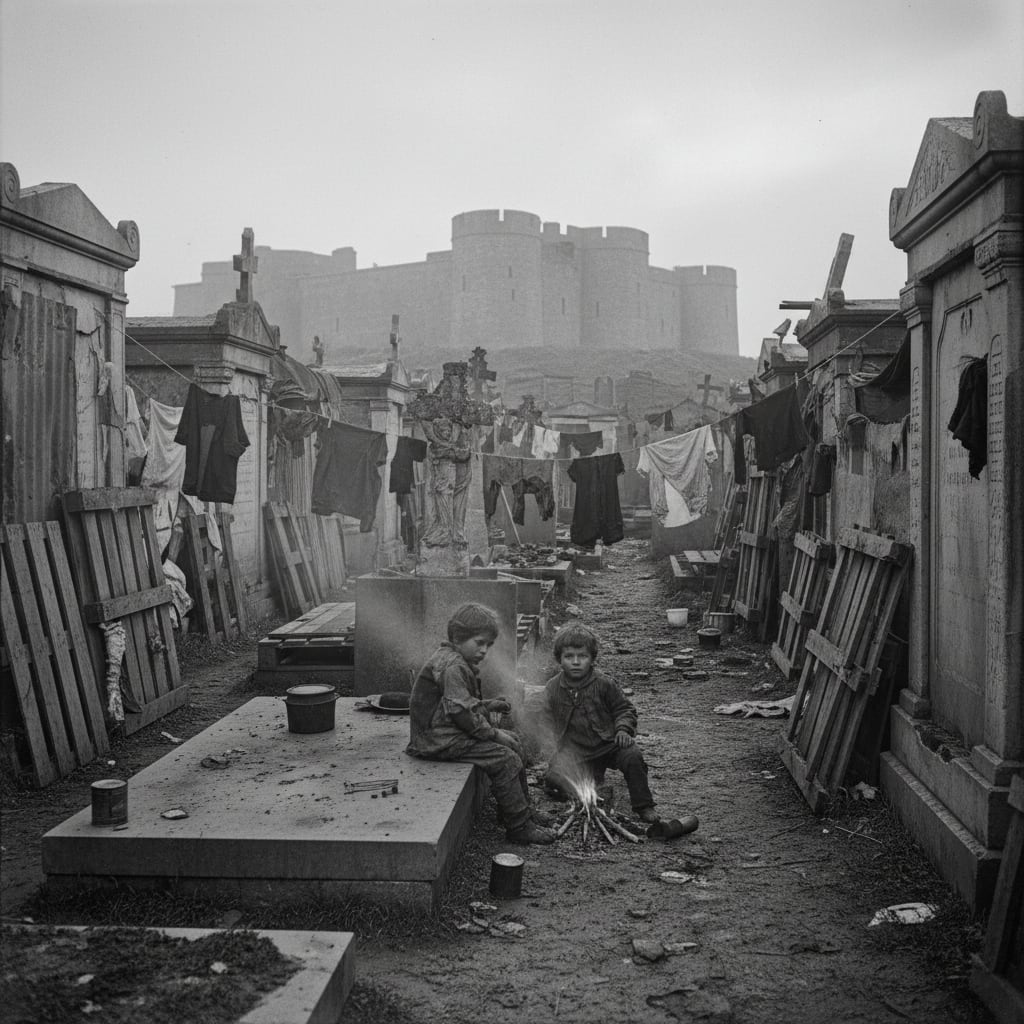
The Broker exists because the Synod's housing calculus does not balance. The Sagittal Line generates refugees at a rate that exceeds the capacity of every Settlement programme, every conscription intake, every ossuary tenement block. The surplus must go somewhere. It goes to the grave-fields — those rings of headstones and mausolea that surround every bastion like the layers of an onion whose innermost skin is iron and whose outermost is calcium. There, among the markers and the crypts, families build shelters from scavenged pallet-wood and tarpaulin and the occasional stolen coffin-lid, and the Broker is the man who tells them which plot is safe, which lane the patrol will skip, which headstone belongs to someone important enough that building against it would invite a visit from a Custodian rather than a simple fine.
#On the Mechanism
The legal fiction is elegant in its absurdity. Burial plots, once consecrated, fall under the joint jurisdiction of the Bureau of Rites (which sanctified them), the Bureau of Records (which catalogued them), and the Bureau of Tithes (which taxes them). Settlement has no standing on consecrated ground. Neither does the Bureau of Purity, unless heresy can be demonstrated — and sleeping between headstones, while undignified, is not heretical. The Broker operates in this jurisdictional void the way a tongue finds the gap in a row of teeth.
The practical method is this. A Broker acquires interment rights — legally, through purchase of expired plots whose families have died or been conscripted into oblivion; or illegally, through forged parish stamps and bribed ossuary clerks. He "anchors" a lane with legitimate burials: three or four genuine graves whose headstones and death certificates will survive any audit. Between and behind these anchors, he builds. Shelters go up overnight — lean-tos braced against mausoleum walls, shacks roofed with grave-slabs prised from the older sections where no one visits. He leases these as "caretaker housing," the fiction being that each resident is a relative of the interred maintaining a family plot. The paperwork is thin. The paperwork has always been thin. The miracle is that thin paperwork, in a bureaucracy that runs on thick paperwork, is itself a form of camouflage — the Bureau's own auditors, confronted with a file too slim to be worth reading, move on to the next one.
Rent is collected in rations, in fuel scrip, in favours owed to patrol sergeants. The Broker pays a cut to the ossuary clerk who maintains the burial register and another to the parish warden who stamps the "caretaker" permits. What remains feeds his family and funds expansion into the next lane. The economy is circular in the way all parasite economies are circular: it feeds on the host's inefficiency and produces, as its only output, the host's continued tolerance.
#On the Grave-Fields Themselves
The grave-fields are the Synod's shadow suburbs. Every bastion has them — rings of consecrated earth that spread outward from the walls like the growth-rings of a tree whose medium is calcium and grief. At Marrowgate, the cemetery terraces and ossuary ridges extend for miles. At Constantinople, the Hintermark is "orchards and foundry-towns and levy-villages and grave-fields," a landscape that has been supplying the city for a hundred and thirty years and shows it. At Przemyśl, the grave-rings are so dense that the Bureau of Engineering has complained — formally, in triplicate — that the dead are obstructing planned trench-spur expansions, and the dead, characteristically, have not responded to the complaint.
The Synod teaches that "every headstone sanctifies its plot." Rites agrees. The faithful kiss the markers. Children use them as goalposts for games whose rules change with the season and whose alphabet, carved into the stones, must spell Bureau hymns rather than nursery rhymes. Doctrine insists their amusements remain "patriotic." Rumours persist that children etch games into the stones that later reappear carved into soldiers' bodies in the trenches — wounds forming into letters and circles no blade could cut. Mothers smudge their children's inscriptions in fear, but some games etch themselves back by dawn.
Refugees and the dispossessed crowd these grave-rings, camping among the tombs and begging for entrance into the ossuary housing within the bastions. The Bureau rarely admits them. Only the most tithed families are granted wall-space — an apartment built from the bones of their own ancestors, where rent is paid in marrow-shavings deposited into neighbourhood ossuaries. The rest remain outside, in the permanent shantytowns of the half-dead, the living huddled between rows of the silent, sharing meals by candlelight on gravestones. Entire generations grow up without roofs but with epitaphs above their heads. The line between village and cemetery, between survival and death, has ceased to exist — and the Broker is the man who sells passage across a border that is no longer there.
#On the Incidents
The grave-fields breed their own horrors, and the horrors breed paperwork, and the paperwork feeds the Bureau, and so the cycle turns.
STAMPED ERRATUM — Bureau of Records, Ref. 14-R/7 (A.S. 136): The "Epitaph Plague of Novi Sad" (previously classified as "Anomalous Calligraphic Deterioration, Category Two") is hereby reclassified as "Demonic Interference, Passive, Category Four." The distinction is that Category Two implies the tombstones rewrote themselves through natural weathering. Category Four acknowledges that the tombstones rewrote themselves on purpose. The Bureau regrets the fourteen-year delay in reclassification and notes that all villagers whose names appeared on the rewritten epitaphs have since perished, rendering the question academic.
At Novi Sad, disease swept a grave-ring and left epitaphs rewritten overnight. Each tomb bore the name of a living villager. The villagers perished within days. The Bureau sent auditors. The auditors sent reports. The reports were filed under "Calligraphy — Anomalous" for fourteen years before anyone thought to cross-reference them with the death register. By then the grave-ring had been resettled twice, and the new residents reported that the stones were blank — which was, the Bureau noted, "an improvement."
At Târgu, children played with grave-lamps until their own skulls glowed from within. They were marched into the trenches to serve as living beacons until extinguished by Wrath's slag. The Broker who had leased their families the lane was arrested, tried, and released when it emerged that the grave-lamps had been supplied by the Bureau of Engineering as "surplus ecclesiastical illumination." The Bureau declined to comment on the children. The Broker returned to his lane. The lamps, I am told, are still in use.
The gravest risk — and the Brokers will tell you this, late at night, in mausoleum offices lit by contraband diesel lamps — is not disease, not patrol sweeps, not even the occasional sinkhole that opens to reveal stacked bodies with mismatched tags. It is what happens when the ground notices. The official documentation's Contradictory Sidebar puts it cleanly: grave-fields are holy while tithed, damnable when neglected. The tithe is the price of the dead's quiescence. When a lane falls behind on its offerings — when a Broker skips the candle at the newest grave, when a family forgets to whisper the names mortared into their walls — the ground begins to answer. Mausolea groan. Headstones shift. Families report water seeping through floors that is warm and smells of iron. The Bureau calls these "structural adjustments." The Brokers call them evictions.
#On the Hierarchy and Its Factions
The profession's internal ladder is short and steep. A Stake Runner marks boundaries with chalk and chain, delivers rent notices, and learns to read ground sag — the subtle subsidence that warns a lane is about to become a grave itself. A Lane Broker controls a single row of shanties and maintains relationships with the ossuary clerk and the parish warden. A Field Broker — the senior rank — controls multiple lanes across a grave-ring and answers to no one except the Warden or Ledger Prefect who has decided that "solving" housing informally is preferable to declaring a crisis formally.
Three factions divide the trade. The Caretaker Saints — the Brokers who entered the profession to shelter refugees and have retained enough conscience to lose sleep over it — minimise harm, feed people, and maintain their lanes with a tenderness that the Bureau would find suspicious if it noticed. They keep the candles lit. They whisper the names. They charge rent that is close enough to fair that a family might, with discipline and luck, survive a winter without selling a child's ration card.
The Stone Sharks are profit-maximisers who treat the grave-fields as real estate and the dead as leverage. They charge what the market will bear, evict families who fall behind, and maintain relationships with patrol sergeants that are less bribery than subscription. A Stone Shark's lane is clean, well-patrolled, and expensive. The families who live there are safe in the way that a man locked in a cell is safe — nothing can reach him, but he cannot leave.
The Ossuary Allies are embedded with the corpse-handlers, the Dead-Goods Tariffers, and the bone-lime crews who process the dead into building material. They operate at the junction where the grave-field economy meets the ossuary economy, converting burial rights into housing rights and housing rights back into burial rights as the market demands. When a family can no longer pay rent, the Ossuary Ally offers a final transaction: surrender the interment rights to your lane's anchor graves, and we will relocate you to an ossuary tenement within the walls. The family gets a roof. The Ally gets the graves. The graves get new headstones. The cycle begins again.
#On the Present Condition
The grave-fields grow. The war does not end. The bastions swell with each conscription levy and each refugee column, and the surplus spills outward into the rings of the dead, and the Brokers are there to meet them with a lantern, a forged caretaker's permit, and a promise that the ground is safe — this season.
The Bureau of Settlement's most recent operational assessment (A.S. 200) estimates forty thousand souls living in "informal interment-adjacent habitation structures" across Zones 2 through 5. The estimate is, by the Bureau's own admission, "provisional and likely conservative," which in Bureau terminology means "we stopped counting when the number became embarrassing." The Brokers themselves estimate higher. The dead, as always, decline to comment.
The profession will endure as long as the war endures, which is to say forever. The Synod needs its grave-fields holy and its refugees housed and its paperwork thin enough to deny. The Brokers provide all three. They are tolerated because tolerance is cheaper than solution, and taxed because taxation is cheaper than acknowledgment, and despised because despising them is cheaper than thanking them. They sell quiet. The Bureau buys it. The dead, who have no opinion on the transaction, continue to guard the harvest.