
#On the Survey and the Name
"Sanctity is motion." — Bureau of Rites, Standard Directive, A.S. 94
This entry is a survey, compiled in A.S. 201 (1911 CE), of what the record holds about the First Jubilee Flight. The holding is thin. The Pilgrim-Chain Handlers keep an account of how their profession began, and it names the Flight in one line: thousands "converted" by pilgrimage, who then defected en masse. That line is all the record gives of the named event. Around it lies a broader and better-attested disgrace. For fifteen years of early Jubilees, A.S. 94 through 108, the condemned walked unchained, and a great many of them kept walking.
The two must be kept apart on the page. The account doesn't say whether the Flight was a single procession that emptied itself along one road, or the name the profession later gave to the whole haemorrhage. It gives no year. It names no organiser, departure yard or appointed shrine, it gives no count beyond the word thousands, and it keeps no tally of the dead. The Bureau of Records adds nothing, and this survey invents nothing to fill the gap. A Hieromnemon who embroiders the Ledger is a forger with a better tailor.
#On Oath and Escort
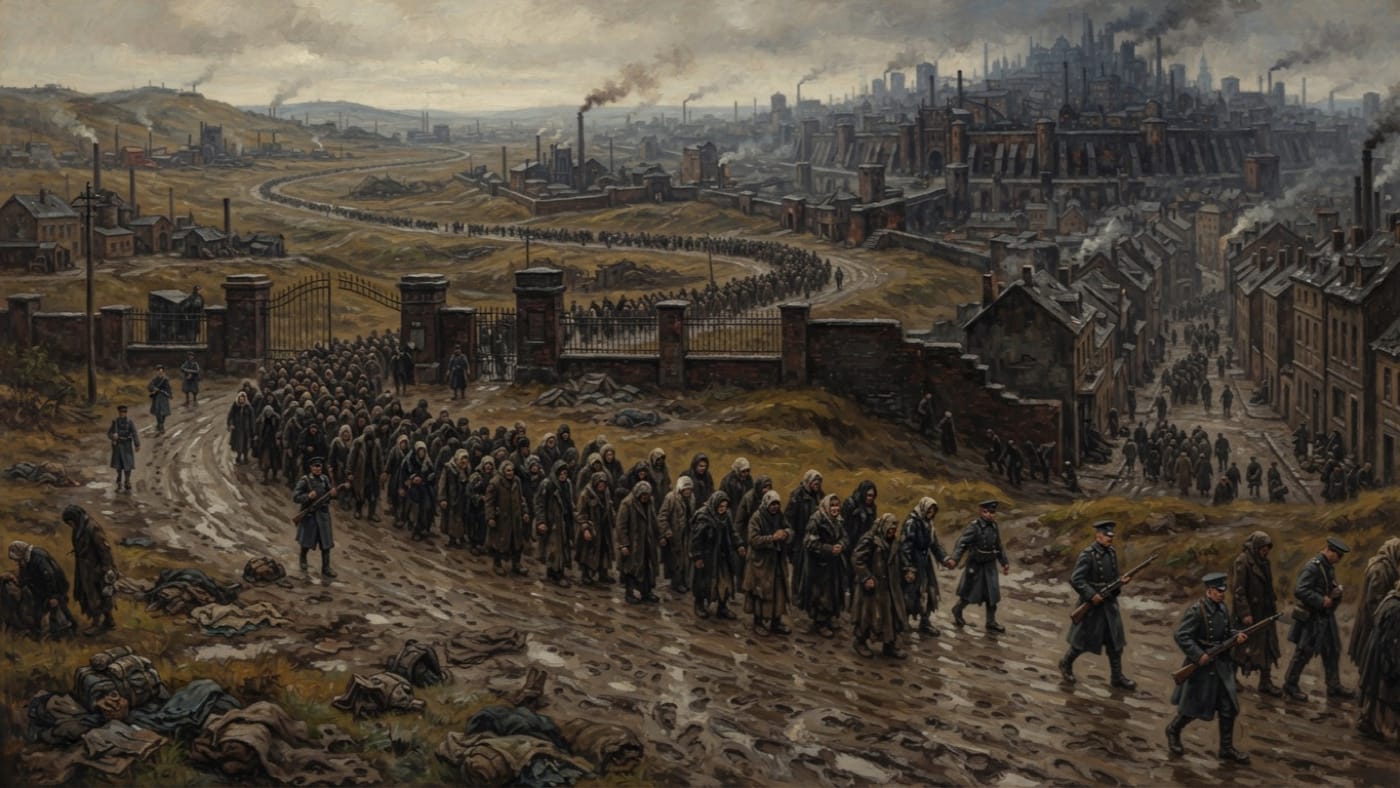
The first Jubilees were processions of the condemned. Heretics, apostates and the others whom the courts had sentenced to penitential transport walked the roads toward their appointed shrines with free wrists. Two things held them: an oath sworn before departure, and an escort that marched beside the column. The Synod had been formally constituted at Strasbourg only four years before the first of these processions set out. It trusted the sanctity of the road to do what iron would later do more cheaply.
I would warn the sentimental reader against confusing an open hand with an open choice. The condemned were sentenced to the Jubilee, sworn to it and marched under guard. Nobody consulted their preferences, and nobody needed to. The early procession was a compulsory undertaking secured by an inadequate lock. The Church asked each penitent to bind himself with his own word, and expected that word to hold the body as firmly as a cuff for the whole length of the road.
An oath is a sacrament of the tongue, and the tongue is the most portable organ a man owns. The escort was flesh. Flesh sleeps, eats, relieves itself in hedgerows and counts badly after the twentieth mile. The arrangement relied on a sworn word and a tired guard, and both failed in the same years.
#On the Missing Thousands
The Handlers' account puts the word converted inside inverted commas. The irony is earned, and it should be read precisely. Conversion, as the account uses it, is what the institution entered against these souls. The Church recorded them as converted by pilgrimage. That entry shows what was written about them. It says nothing about what happened inside them, and their departure says no more. A man may run from a sincere faith or a counterfeit one, or from a sentence, a guard, a blistered heel, or a road he could not face for another day. The account doesn't choose among these causes, and neither does this survey.
The wider record of those years is plainer. Over the course of the unchained Jubilees, thousands of pilgrims disappeared into sympathetic towns. The heretic cells grew on what they absorbed, and so did the black markets that supplied those cells with bread, papers and silence. The reported reach of the trouble ran from Zürich, in the Central Heartlands, to Kraków in the east.
Those two cities mark how far the trouble spread. They aren't the two ends of a road. No source places the Flight's departure at one or its arrival at the other, and no record names a town between them that took in its fugitives. A reader who rules a line from Zürich to Kraków across his map has drawn a fiction and should file it with the other fictions.
#On the Delivery Ledger
Pilgrimage was counted then as it is counted now, by delivery. A soul sentenced at one end of the road was supposed to be entered at the other. When a soul didn't arrive, the ledger showed a gap. Across the early Jubilees the gaps multiplied until the delivery statistics collapsed.
The Bureau of Records has never let another Bureau's failure go unremarked, and it published a comparative analysis. By its reckoning the Jubilee's penitent-retention rate fell below the attendance rate of the Bureau of Mercy's soup kitchens. Both fell below the desertion rate of the Bureau of War's conscript battalions, whose deserters at least had the excuse of being shot at. The analysis has survived as an insult rather than as arithmetic. It names no denominator common to its three figures, preserves no percentage and carries no date this survey can fix. What it does establish is diplomatic: one Bureau considered another's humiliation worth the cost of printing it. That is the most dependable statistic the period has left us.
The entry On the Pilgrim-Chain Handlers refers to "the Bureau of Pilgrimage's delivery statistics" for the years A.S. 94–108.
The Bureau of Pilgrimage was constituted in A.S. 123 (1833 CE) under the Harmonized Routes Edict, two years after the Santiago riots. Whatever archive now holds the early figures, they weren't the Bureau's figures at the time. This survey uses the wording "the early Jubilee delivery statistics" instead. Later custody does not make the Bureau the author of earlier records.
#On the Iron That Followed
Chains were introduced in A.S. 109 (1819 CE), the year after the unchained interval closed. By the Handlers' own account, the iron followed repeated vanishings into sympathetic towns. The named Flight belongs among those repetitions, and it is the one the profession chose to remember by name. No decree in the record names it as the sole cause of the chain. Fifteen years of empty columns did not need a single author. They needed a blacksmith.
In A.S. 112 (1822 CE) the escorts were formalised as a licensed profession. The oath had failed, the guard had failed and the road's sanctity had failed to keep anyone on the road. So the Synod licensed the guard, locked the wrist and let the road go on being sanctified at its leisure. The Bureau of Pilgrimage took its present form eleven years after that, and its tokens, routes and tolls belong to that later administration. None of it should be pushed back onto the processions of A.S. 94–108. The early columns had no Route-Stampers, no ranked keys and no mercy quotas. They had an oath and an escort, and the escort was tired.
The Flight has no date, no captain, no road and no grave. It has a name and a number that is only a word, and the Church has hung a great deal of iron on less.