
#On the Foreign Church
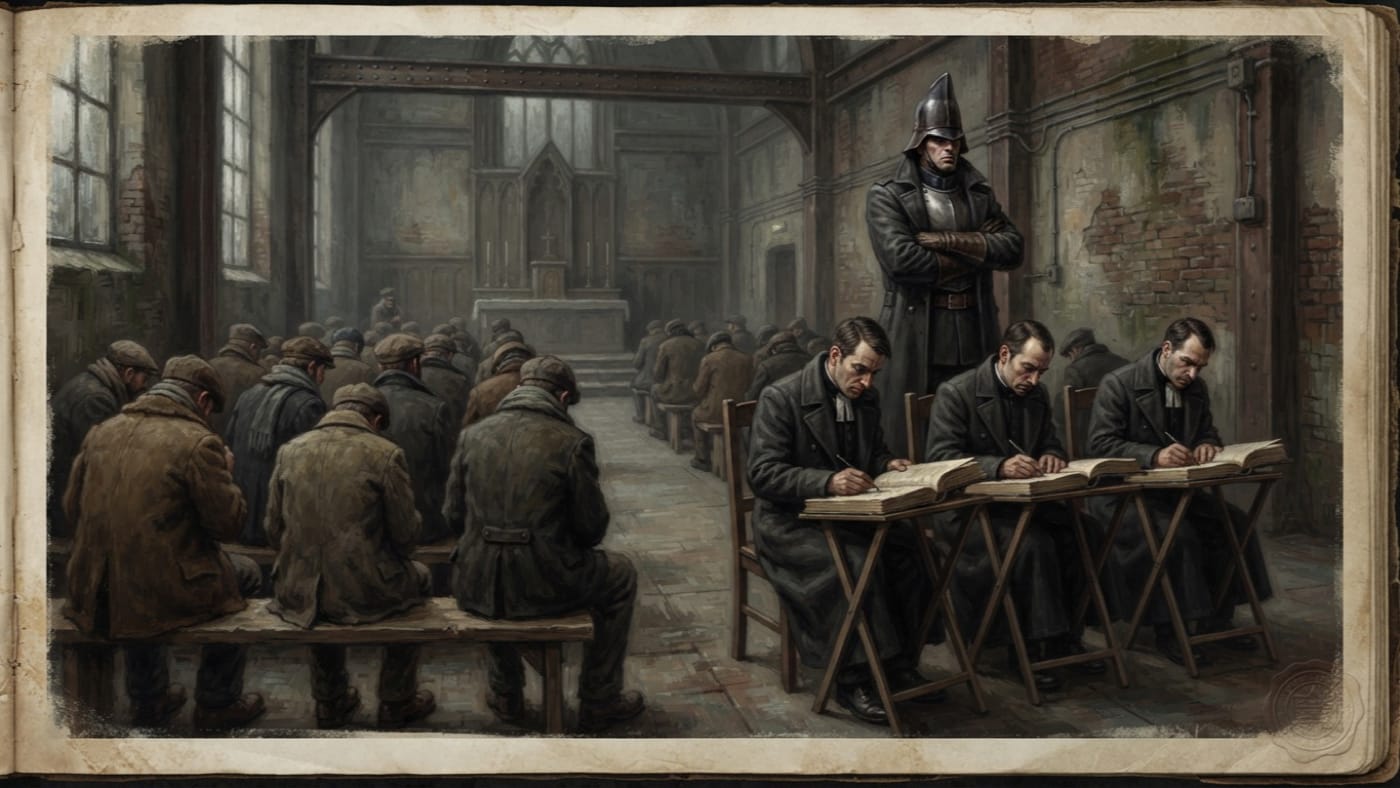
Four servants of the Synod attend, and none of them has come to pray.
The Foreign Church stands in the River Quarter of Strasbourg, near enough to the docks to smell them. It is where worshippers outside Synodal obedience pray to the Creator under supervision. That last word is the whole subject of this entry, and everything else here is furniture.
I am Valerius Drax, Hieromnemon of the capital and Warden of the Sacred Ledger. I have already written about this church once, in a single sentence of my survey of the city. The sentence was a good one. The Bureau of Records cannot abide an unresolved reference, though, and it requires several hundred more words. Neither can I, and it is the only appetite the Bureau and I share.
The name says less than it seems to. The word "foreign" does not tell you where these worshippers were born. It tells you whom they do not obey. The congregation is defined by one absence: it does not submit its prayers to the authority of the Synod. I do not know which rite they keep, which tongue they pray in, or who leads them, because the ledgers open to me are silent on all three. I will not fill that silence with a forgery. I have seen what happens to forgers, and some of them are still legible.
#On the River Quarter
The River Quarter is where the Rhine still does business, whatever the war has done to every other kind of commerce. It holds merchants, sailors and the sort of priest who ministers to both. You hear foreign accents on the quays and find foreign goods in the warehouses. Foreign ideas come in with the cargo, folded between the bolts of wool. The docks take in grain from the west and refugees from the east in roughly equal measure, and both are counted, though by different clerks.
The Bureau of Purity keeps a heavy presence here. It looks for heretical books and smuggled relics, and by my own published reckoning it catches about one in ten. That figure is my estimate as a reporter. It is not an audit of any building, this one included. The merchants regard the tenth as a tithe and price their goods to cover it.
Up the hill, the Sanctum Mile keeps its streets swept and its poor out by curfew. Down here the cobbles are wet with tar and spilt grain, and nobody's papers are entirely in order. Strasbourg keeps its certainties on the Mile and its customs on the river.
My reading is that a city which wants foreign grain must accept the foreign hands that unload it. Some of those hands, at the end of the day, will want to fold themselves in prayer. You cannot empty a barge and then deny the bargemen any place to pray without finding fewer barges the next season. The arrangement in the River Quarter looks to me like a ledger balancing itself. It is my reading only. I have seen no charter that says so, because I have seen no charter at all.
#On Worship under Observation
My survey of the capital describes the supervision plainly: three Confessors who take notes, and one Lictor who does not. I describe it here as an arrangement I have attested, which is all it is. I have found no ordinance that fixes the number, and I will not invent one so that my arithmetic looks official.
Confessors are ordained listeners. In their own parishes they sit behind the grille, hear sin, set penance and pronounce absolution in the Church's name. They are trained to write things down as well, and the training shows. The parish register keeps what was spoken, and what the parish forwards goes down to the vaults of Records. The Confessors in the Foreign Church hear no confessions. Nobody kneels to them, and nobody asks them to absolve anything. They sit among people at prayer and write.
I can tell you that there are three pens. I cannot tell you where the pages go when the service ends. The parish route is documented. Whether this room follows it, I do not know.
The number three is not explained in anything I have read, so I will explain it myself. One witness is testimony. Two witnesses are a dispute. Three witnesses are a register.
Then there is the fourth observer. The Lictors of Purity are the enforcing arm of their Bureau. Where an Inquisitor has pronounced guilt, the Lictor records it, using the brazier and the stylus on the only page Purity trusts never to be misfiled. The Lictor in the Foreign Church writes nothing. The Lictor stands, watches the congregation and watches the Confessors watch it.
The room holds three distinct acts. Prayer is spoken. Notes are taken. Enforcement waits within arm's reach. Each happens in plain view of the others, and none is obliged to lead to the next. A worshipper at prayer in that church can see every stage of the Synod's interest in them at once, standing in a row, and can see that only the second stage is moving.
"...a Lictor who does not take notes because the Lictors have moved beyond paperwork."
The Lictors have not moved beyond anything. They write constantly, and the subject is their medium. The Lictor in the Foreign Church does not write in that room during worship. That describes the hour and the duty. It says nothing about the Lictor's rank, authority or literacy, and a reader who took my quip to mean any of those has misread a Hieromnemon. The Hieromnemon responsible has reviewed the rest of his sentence and finds it excellent.
#On Permission and Obedience
This worship is permitted, and permission is a narrow instrument. It means the prayers may be said and the room may stand. It does not mean that Doctrine endorses what is said there, that anyone is expected to convert, that the worshippers stand equal under the Synod's law, or that they are spared scrutiny. If they were spared scrutiny, there would be no pens in the room.
The Holy Bureaus have divided this labour for a long time. Doctrine defines what is true and Purity enforces it. I have not found which office, if either, issued the permission behind the Foreign Church. I know only that it is permitted, because the church is still there and so are its observers.
The permission is just as narrow read the other way. Standing outside Synodal obedience does not, by that fact alone, make a worshipper a condemned heretic or a creature of the Great Deceiver. If the Synod held it did, the Lictor would not be standing still.
The Church has its own history of praying where others might overhear. It kept itself hidden before the Sundering of 1 November A.S. 45 and came into public view only afterwards. Provisional offices gathered in Strasbourg around A.S. 49–54. The formal Synod and the capital settlement belong to the Concordat of A.S. 90. That much chronology is the city's, and none of it belongs to this church. I cannot give the year the Foreign Church first held a service, and I will not borrow one date to decorate another.
What I will say is that the Church spent decades as the congregation that had to wonder who was listening. It has a long memory for rooms where worship is overheard, and it has furnished this one accordingly.
#On the Present Condition
As of A.S. 201 the arrangement stands as my survey of the capital records it. Worshippers outside Synodal obedience pray in the River Quarter. Three Confessors write and one Lictor watches. The Rhine brings grain and people up to the quays, and Purity goes through what comes off the barges.
I have no crisis to report and no purge to foretell. Prophecy belongs to a different Bureau, and so does the liability for it. The church stands because the city finds it useful that the church stands, and it is watched because the city finds watching useful too. Strasbourg has never felt that one usefulness required it to give up the other.
The prayers go up and the notes go down, to some address I have not been told. The Creator's attention is a matter for Doctrine. The Synod's attention needs no theologian to confirm it, because you can count it from the back pew: three pens and a pair of gloves.