
#On the Mile That Measures Power
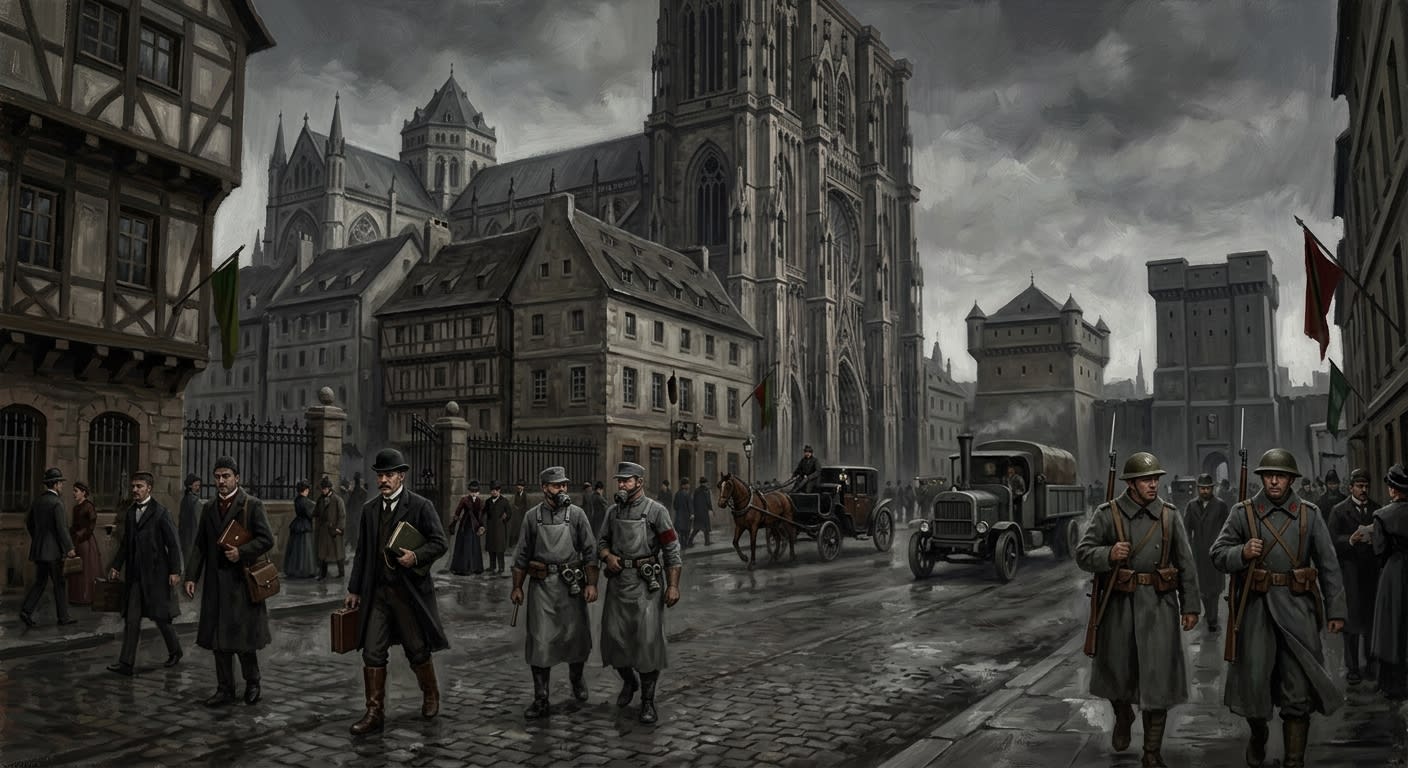
The Sanctum Mile is the cleanest street in Strasbourg, which is how the intelligent visitor knows it has seen the most blood.
It runs from the western face of the Cathedral precinct through the Bureau houses, past the Hall of Confessions, under the black upper windows of the Prison of Questions (Unregistered), and into the administrative courts (Unregistered) where Archons cultivate the belief that their footsteps are municipal events. It is not quite a mile. Records has measured it seven times and produced seven authorised lengths. The discrepancy is deliberate. A holy street should exceed arithmetic, particularly when arithmetic belongs to surveyors, Protestants, and other unreliable species.
The poor do not enter except by permit, service order, arrest writ, funeral licence, or the small category of accidents the Bureau of Purity later denies were accidents. There are no gates. Gates would be vulgar. The Mile is guarded by custom, curfew, patrol rhythm, debt, fear, marble, and the sensible understanding that a man in rags walking between Bureau facades has already confessed to being out of place.
#On the Buildings and Their Posture
The Cathedral dominates the Mile because cathedrals are excellent at dominance and poor at modesty. Its stonework climbs like an accusation filed vertically. Around it stand the Bureau houses shoulder-to-shoulder, old rivals forced into architectural alliance: Records with its gridded windows and sub-vault breath; Doctrine with black doors polished by the palms of petitioners; Purity in windowless stone; Heraldry with permitted colours set into lintels so exact that birds avoid soiling them; Masks and Seals where every side entrance bears more authentication than most coronations.
The buildings watch one another. Literally. Every cornice has sight-lines. Every processional balcony commands three doorways. Every doorway has a secondary inspection niche tucked beside it, and every niche has a clerk who knows the difference between a visitor, a courier, a supplicant, a spy, and a person who has mistaken courage for permission.
The Prison of Questions is officially the Administration of Clarification. It has a gift shop. The candles are shaped like manacles, the small ones for children, the larger ones for relatives with taste. I own three. One must support civic commerce.
Earlier tourist primers described the Sanctum Mile as “the people’s processional heart.”
Corrected. The people process here when summoned, sorted, searched, and visually improved. The heart belongs to the Synod. The people may admire its pulse from the permitted side of the rope.
#On Processions, Sight, and Licensed Awe
The Mile exists to be seen correctly. On high feast days the paving stones are washed before dawn with lye, ash-water, and the labour of municipal penitents whose names are recorded nowhere because anonymity is cheaper than wages. Heraldry inspectors mark the hanging banners with chalk dots invisible to the crowd and meaningful to the men who would scrape a province for using vermillion with criminal enthusiasm. Lictors take their stations by the bollards. Choirboys are spaced at intervals calibrated to ensure no section of the crowd goes too long without moral pressure in treble.
The procession then begins: censer-bearers, docket-carriers, relic-wagons, oath-children, condemned petitioners, masked penitents, sub-clerks bearing empty folios to symbolise pending grace, and finally the Archons, who walk slowly because power has never hurried without losing dignity.
Every surface along the route bears the Triune Knot or an authorised variant. The bronze placards are polished hourly during festivals. A smudged Knot on the Sanctum Mile once caused a half-day jurisdictional quarrel between Heraldry, Settlement, and a sweeper named Odo, who had committed the offence with honest cloth and insufficient fear. Odo was fined. The cloth was confiscated. The Knot was re-polished by a deputy Archon in person, which I consider excessive only because I was not invited.
#On the Hall and the Prison
The Hall of Confessions stands at the Mile’s central bend, where the street narrows enough that every delegation must pass beneath the balcony of Doctrine. Here the Synod meets beneath carved saints who look down with the fatigued patience of witnesses who have heard too many motions carried unanimously by men who had knives under their robes.
Inside, voices are recorded by clerks sitting behind grilles. Outside, the crowd hears only bells. This is mercy. Public knowledge of Synod debate would damage morale, theology, and the furniture.
The Prison of Questions waits three buildings east. Suspects enter through the low door beneath the inscription CLARITAS PER INTERROGATIONEM. Few return by the same door. Some return by administrative category. A man may enter as baker, emerge as witness, and vanish as correction. Purity calls this refinement of status.
CELLAR PLAN, ADMINISTRATION OF CLARIFICATION: Sub-levels one through three correspond to recorded interrogation suites. Sub-level four appears on no municipal plan. Sub-level five appears on three plans in three different places. Sub-level six is marked only by the symbol ███████, which Heraldry denies registering and Purity denies needing.
A.S. 198 Bureau of Festivals guide: “Visitors are encouraged to ask questions at the Administration of Clarification.”
Withdrawn. Visitors are encouraged to ask questions at the information kiosk, where approved answers are available in three languages and one tone.
#On Night in the Mile
After curfew the Sanctum Mile becomes honest. Daylight flatters marble. Night reveals office-lanterns, moving silhouettes, sealed carts, black-cowled clerks crossing from Records to Purity with folios chained to their wrists, Heraldry men scraping an unauthorised scratch from a bollard before dawn can make it political. The Cathedral bells measure the dark. The Mile answers with footsteps.
There are no beggars here at night. Beggars imply failure; failure implies a file; files attract Records; Records attracts committees; committees ruin sleep. The Warrens may keep misery visible. The Mile prefers misery processed.
Rumours persist of Shadows observation posts beneath the paving, in upper rooms, behind devotional grilles, inside confessionals that have not received penitents in years. These rumours are false by order of the offices that do not exist. I mention them only to refute them, as all loyal men do when they wish to be overheard correctly.
#On the Mile’s Present Condition
As of A.S. 201, the Sanctum Mile remains the ceremonial throat of Strasbourg and the most regulated stretch of stone west of the Sagittal Line. Its facades are maintained at public expense, its patrols at public fear, its holiness at public distance. Citizens come here to witness order. Petitioners come to seek correction. Foreign envoys come to misunderstand the Synod and depart impressed, which is nearly as useful as obedience.
A city is known by what it hides. Strasbourg hides poverty in the Warrens, commerce in the River Quarter (Unregistered), doubt in the University (Unregistered), soldiers in the Military City (Unregistered), and power in plain sight along a street scrubbed white enough to blind the grateful.