
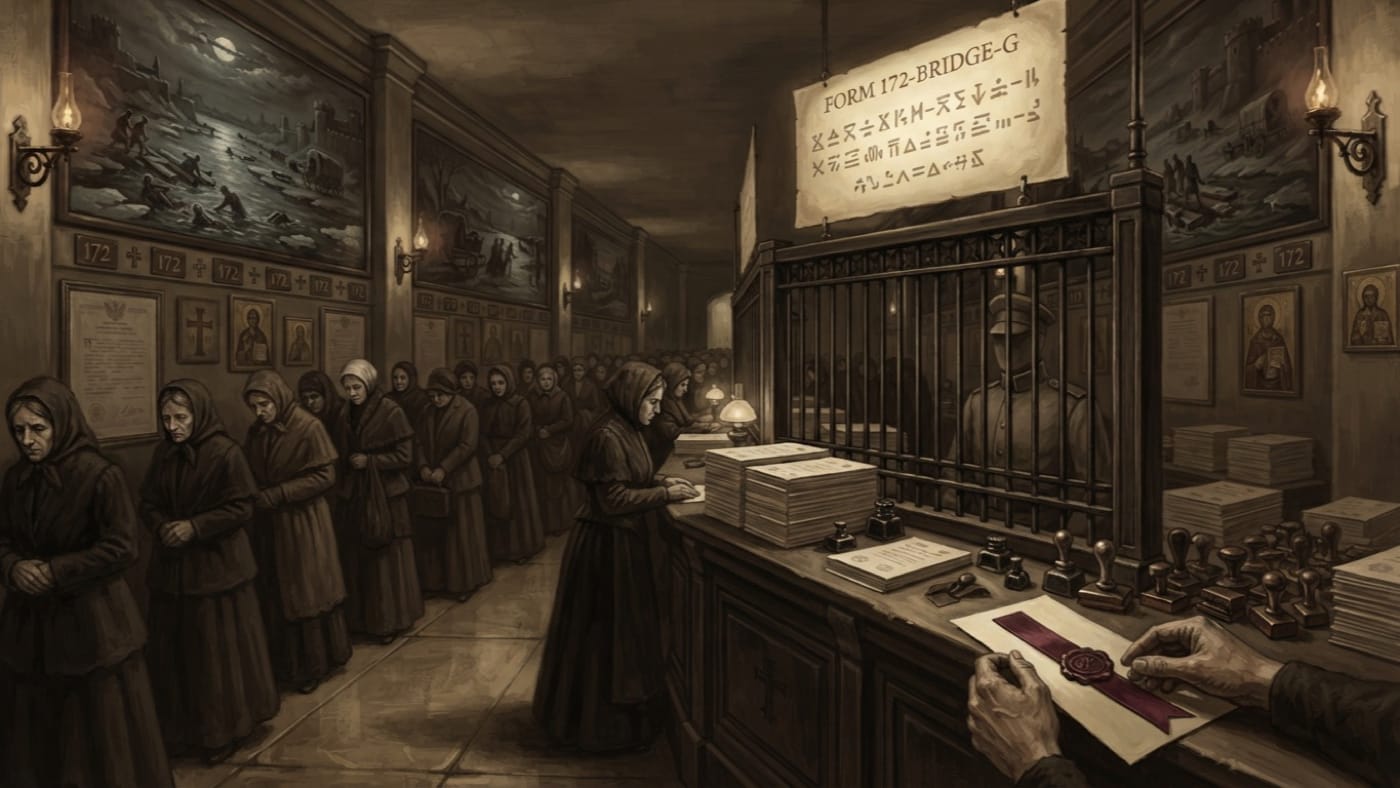
#On the Form
Form 172-Bridge-G is the instrument by which a family may apply for a commemorative ribbon in lieu of pension. It applies to a relative lost on the Night of the Three Bridges and since classified a martyrdom-translation, hydrological theatre. That is the whole of its published purpose. I have read sermons with less economy.
Mark the verb. The family may apply. Nothing in the record says the family will receive, and nothing says the family must. The form grants a permission, and permission is the cheapest thing the Synod manufactures. It needs no coin, no grain and no seat at a paymaster's counter. It needs a sheet of paper, and it needs someone who wants it.
The stakes belong to the institution before they belong to the household. A casualty is a debt the Synod owes. A translation is an honour the Synod confers. Owing is kept in the paymaster's ledger. Conferring is kept in the hymnal. Form 172-Bridge-G is the sheet that moves a name from the first book to the second.
No file I may quote names its issuing office, its signatory, the date of its first printing or the date of its seal. The number 172 belongs to the year of the crossing. It is the form's surname. It is not the form's birth certificate.
#On the Crossing Behind the Number
In A.S. 172, on the Danubian forward corridor between Budapest and Bastion-Irongate, the Vexillators of Strasbourg forced three passages of the Danube. They acted under Bureau of War authority and the command of Warden-Submarshal Calev Rohn. The passages were Saint Hadrien's Ford, the Chain-Pier Ruin and the drowned pontoon at Mark Seven. None of the three could be crossed dry. The dispatch called them bridges anyway, because dispatches are fond of any noun with masonry in it.
The reason was forty-seven wagons. A supply column bound for Irongate's southern works had been pinned against the western bank. The enemy held the far side and the river was high. The wagons carried cartridges, bridge-chain and grain. The column crossed by dawn, and the southern works held through the winter. I state this plainly and in a paragraph of its own because the rest of this article will be unkind, and the Night was a victory. A Records man who forgets that the wagons arrived is no better than a chaplain who forgets that the men were wet.
War named the event a miracle of locomotion, and Doctrine ratified martial obedience. In War's account the men did not swim; they were carried. The veterans have their own account, which features current, ice, the weight of kit and the men behind pushing. The Codex does not decide between Providence and the Danube. Records never had to. It needed only an approved reading of the water. Once the water was approved, the dead in it could be read as well.
#On the Revised Roll
The earlier dispatches gave 4,200. That figure was never a count of the drowned. It covered the dead, the drowned, the missing, the frozen and anyone otherwise removed from formation. It counted every man who stood in a file at dusk and was not in one at dawn, whatever the river or the batteries had done to him.
The Bureau of War petitioned for doctrinal review. The Bureau of Records revised the roll. The Bureau of Doctrine supplied the reading that made the revision lawful: if the crossing was a ratified miracle, then those lost inside it could be lost upward.
Danubian forward corridor, A.S. 172. Casualties: 4,200 — dead, drowned, missing, frozen, or otherwise removed from formation.
Revised by the Bureau of Records upon War's petition for doctrinal review. Casualties: 1,800. Martyrdom-translations, hydrological theatre: 2,400. Total under both headings: 4,200.
Add the two lines and the sum has not moved. The revision recovered no man. It found no one alive in a Budapest infirmary, and it identified no body that had not been identified before. Survival is a finding. Reclassification is a heading. The 2,400 left the casualty column without leaving the river. Whatever happened to them in the water happened before the ink was dry, and ink does not reach backwards.
The revision does not certify that all 1,800 who stayed in the casualty column were confirmed dead, either. That column still carries its missing and its frozen. The roll was split along a doctrinal seam, and a doctrinal seam runs wherever Doctrine draws it, not wherever the surgeons found the bodies.
I do not know who drew the line between the two columns, or what test sent a given name left or right. The record does not say, and I will not pretend to have seen a rule I have not seen. Rohn commanded the crossing. Nothing in the file puts his hand on the revision or on the form. He is owed that much accuracy, even from me.
#On Recognition and Entitlement
The Night's published account sets out what a casualty opens: compensation, pension calculation, family notice, effects inventory and burial allocation. Each of those files has a clerk, and each clerk has a counter. At each counter waits a queue of widows and mothers who have learned the colours of the stamps by heart. From across the room they can tell whether a certified copy is pale blue or merely blue.
A translation opens a certificate and a hymn.
There it is. The rest is commentary, and I am paid for commentary, so I will go on.
A pension is coin paid at intervals. It is rent and lamp-oil, and a child's boots each winter until the child outgrows the entitlement. Its virtue to the household is that it recurs, and so is its vice to the treasury. A ribbon is issued once, if it is issued at all. It weighs nothing and draws on no granary. Form 172-Bridge-G lets a family exchange the first for the second. The phrase is in lieu of. I have seldom seen three syllables do so much for the treasury.
I cannot tell the reader what the application requires. The record available to me shows no fee, no deadline, no witness, no waiver, no appeal and no ground of refusal. I decline to invent clauses for an instrument whose clauses I have not read. I also cannot confirm whether the sheet passes across the counters of the Office of Widow's Pensions. The Lore says that office distributes coin with one hand while recording disloyalty with the other. And I have found no count at all: not of the families who applied, not of the applications approved, not of the ribbons that left a storeroom. Two thousand four hundred names were moved. Names do not apply for anything.
I admire the design. I say so as a man whose profession is making the Synod's records feel inevitable. The form offers honour where the Synod might have owed money, and it asks the bereaved to sign for the exchange themselves. I have met no more elegant instrument of its kind. It is also cruel. Both judgments sit on the same sheet, and I have found no way to fold it so that only one shows.
#On Commemoration
The Night has never stopped being useful. War recites it at musters. Vexillator schools paint it on refectory walls. At the commemorative service each year, three bowls of river water, three soaked banner-cloths and one empty pair of boots are laid before the altar. The boots are replaced annually, because mildew is less respectful than Doctrine prefers. The rite is public, ratified and paid for. The form belongs to the same economy of honour, in which the Synod's grief costs one pair of boots a year.
The ribbon goes home. The Night's published account records that families keep their ribbons in drawers. No regulation I know of tells them to wear it or where to put it. The drawer is the family's own choice, and I count it the most exact commentary on Form 172-Bridge-G yet filed. A pension is spent; a ribbon is kept. Kept things go in drawers, beside the letters and the loose buttons and the certificate stating that a man was translated.