
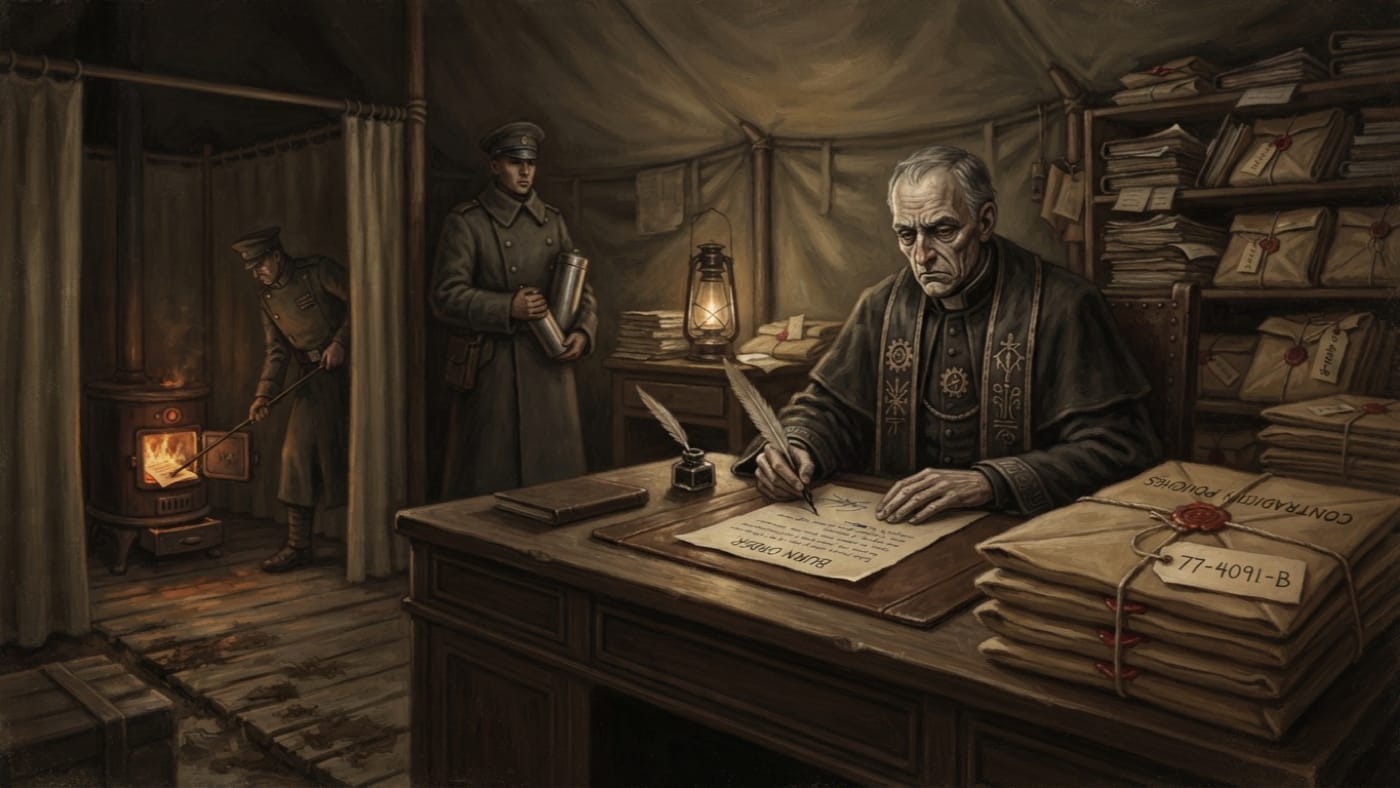
#On the Station
The Front Prelate is the name at the foot of a burn order. That is the whole of the office's public description and most of its private one.
The Bureau of Records sets out the trench-court hierarchy in a single breath. Tag runners sort the tags. Clerks record. Supervisors reconcile the counts. Contradiction Custodians manage the burn cycle. Above them stand the Desertion Hearing Specialists, the Cadence Examiners, and the Front Prelate, who signs the orders and sleeps in a tent that does not share a wall with the dugout courts.
That tent is the office's one documented piece of architecture. The clerk works under a lantern, close enough to the dying man to catch whatever he manages to say. The Prelate works under canvas, close enough to ink. A courier walks between the two, carrying a sealed thing and a number. No paper I have seen says how far the tent is from the dugouts. It does not need to say. A wall that is not shared is a distance, and the clerks measure it in their own way.
#On the Mandate
The office belongs to the machinery the Synod built after the Uncounted Winter. The Bureau still dates that winter to anywhere between A.S. 87 and A.S. 91, and I will not settle the dispute here, since disputes about catastrophes are generally kept alive by someone who profits from them. What is not disputed is the arithmetic: fifty thousand dead without attestation, widows who could not remarry, children who could not inherit, and tithe-collectors writing to corpses.
In A.S. 91 the Trench Courts were constituted under the joint field mandate of the Bureau of Records and the Bureau of War, and the Contradiction Doctrine was codified with them. The courts would make death legally legible: attestation, burial clearance, final bequest, and a category for every confession. The Doctrine would decide what happened to testimony the living could not be trusted to hear.
That is the framework in which the Front Prelate appears. It is not the office's birth certificate. The Bureau has given me no first incumbent, no letters of appointment, and no foundation seal, and I decline to forge them. My restraint here exceeds the Bureau's own in the matter of Saint Vell's complete transcripts.
#On the Countersignature
Burn Directive 7-C has a fine sense of grammar. "Cauterize on Receipt" is an imperative without a subject, and the Front Prelate's office supplies one.
The order is a single sheet. It lists bundle numbers and a date and carries a signature. Nothing on it summarises the contents or explains the decision. A sheet like that asks nothing of the person who signs it except a hand. There is nothing on the page to read, so the signatory is never required to know what the bundles held.
The sequence that brings the sheet into existence starts far below the tent. A clerk at the plank table hears something that contradicts the narrative the war requires. The clerk marks the confession with sector code and severity and seals it in the contradiction pouch. One cord on that pouch belongs to the clerk and the other to the supervisor. The bundle number goes into the register without a word about what is inside. A courier carries the sealed object away. Then comes the countersignature, from the Front Prelate or the War Registrar. The furnace receives the pouch, a squat iron box with a hinged mouth and an ash drawer. The contradiction number is copied into the furnace log, and the ash is swept up and classified as administrative waste.
Count the hands. The clerk hears, the supervisor ties, the courier carries, and an attendant feeds the iron. The Prelate does none of these things. The Prelate authorises them, from the far side of canvas, on the strength of numbers.
I have seen one burn order with both names on it, the Front Prelate's and the War Registrar's. The Doctrine asks for one or the other. Whether that sheet showed extra caution, a disputed bundle, or two officials who liked company in their signatures, the sheet did not say. Burn orders never say. I will not turn one sheet into a rule requiring two signatures, and I will not invent a law to explain it. One sheet is evidence that one sheet existed.
#On the Hands Below
The division of labour is the office's real theology, so it should be set down accurately.
The clerk transcribes and classifies: faithful, drift, contrition, contagious doubt. The supervisor reconciles tags against bodies and attestations against casualty returns. The Contradiction Custodian keeps the pouch counts, the burn cycles and the furnace records, and decides which bundles go back to rear Records review and which go forward to the iron. Under the fifth category, cadence anomaly, a confession calls for specialist assessment by the Cadence Examiners. No document I have read gives that diagnosis to the Front Prelate, and I would not want it given.
The War Registrar stands as the Prelate's alternative at the foot of the order. One name belongs to the Church and the other to War, and either will make the furnace lawful.
That is the full extent of what the papers establish. The Bureau's own lists group the Front Prelate with the Synod War Registrar and the Judge-Delegate as political patrons of the profession. A list of patrons is a different thing from an organ chart. Nothing I have examined gives the office a verdict to pronounce, an appeal to hear, or a sentence to carry out. Those belong to the courts' judges, who hear the living. The Prelate's documented business is with the dead, in bundles.
#On the Cost of a Clean Record
A category code decides whether a family receives a pension, a reduced pension with an annotation, or a standard notification of death with nothing behind it. It decides how the man is buried and how his name is entered. The pouch decides whether anyone will ever be able to argue the point.
Consider the ordinary case, which is the worst. A dying private names a captain who ordered a retreat and then called the dead cowards. That is contradiction, and it goes into the pouch. The captain lives. The private's family receives the standard notification. Some weeks later a sheet arrives at the tent bearing a bundle number, which is all the accusation has become. The signature that follows is perfectly regular, and the regularity is what makes it monstrous. I have spent decades admiring regular signatures and I still admire this one.
The cord has a market, too. At Bastion-Przemyśl a cleaner death costs three months' lamp oil. At Bastion-Constantinople it costs a morphine vial and a promise. Officers pay to push accusations into the pouch, and families pay to keep doubt out of it. All of this trading happens below the canvas, among clerks, couriers and captains, and none of the papers I have seen puts a Prelate's hand on the money. None needs to. Whatever has been bought and sold by the time a pouch is numbered, the countersignature turns the result into procedure.
The schism among the clerks ends at the same line. Record-True Clerks delay burn orders by pleading damp, shelling, wax shortage, a missing courier, or the Creator's known preference for legible handwriting. Rubric Clerks hurry them through for the sake of morale and pensions. Both factions wait on the same signature. The office has declared for neither, at least in any record I can cite. It has no need to, since every argument between them ends at its desk.
An instructional pamphlet of A.S. 104 described the procedure ending in countersignature as "the humane preservation of morale-sensitive testimony."
Corrected. Custody under the Doctrine is temporary and lasts only until a burn order is signed. Preservation ends at the Front Prelate's or War Registrar's signature. The ash is filed.
#On the Present Application
As of A.S. 201, every licensed trench court on the Sagittal Line, from Königsberg down to Constantinople, keeps its contradiction pouches separate from its ordinary ledgers. Inspectors count the pouches first. Auditors ask how many there were, where they were routed, under whose signature, in which ash log, and with what delay. Of those questions the signature is the easiest to answer, because the name at the foot of the sheet is legible and the bundles it disposed of are not.
The Bureau of Purity tolerates the irregularities found below the tent and records them politely. Rear registries and Records scribes inherit the outcomes as pensions, writs and corrections, and never see the reasons, because the reasons were never written down. The office does what it was built to do. It signs, from a tent with no shared wall, and the furnace takes it at its word.