
#On the Necessity of Writing in Mud
I have visited the trench courts twice. I do not intend to do so again, because I am Valerius Drax and I prefer my ink dry, my table level, and my confessants breathing at a rate that permits legible dictation. The front does not accommodate these preferences. The front does not accommodate anything. The front is a long, wet scar cut into the earth where men go to die in administrative categories, and the Trench-Court Clerk is the officer charged with ensuring that the categories are spelled correctly before the bodies cool.
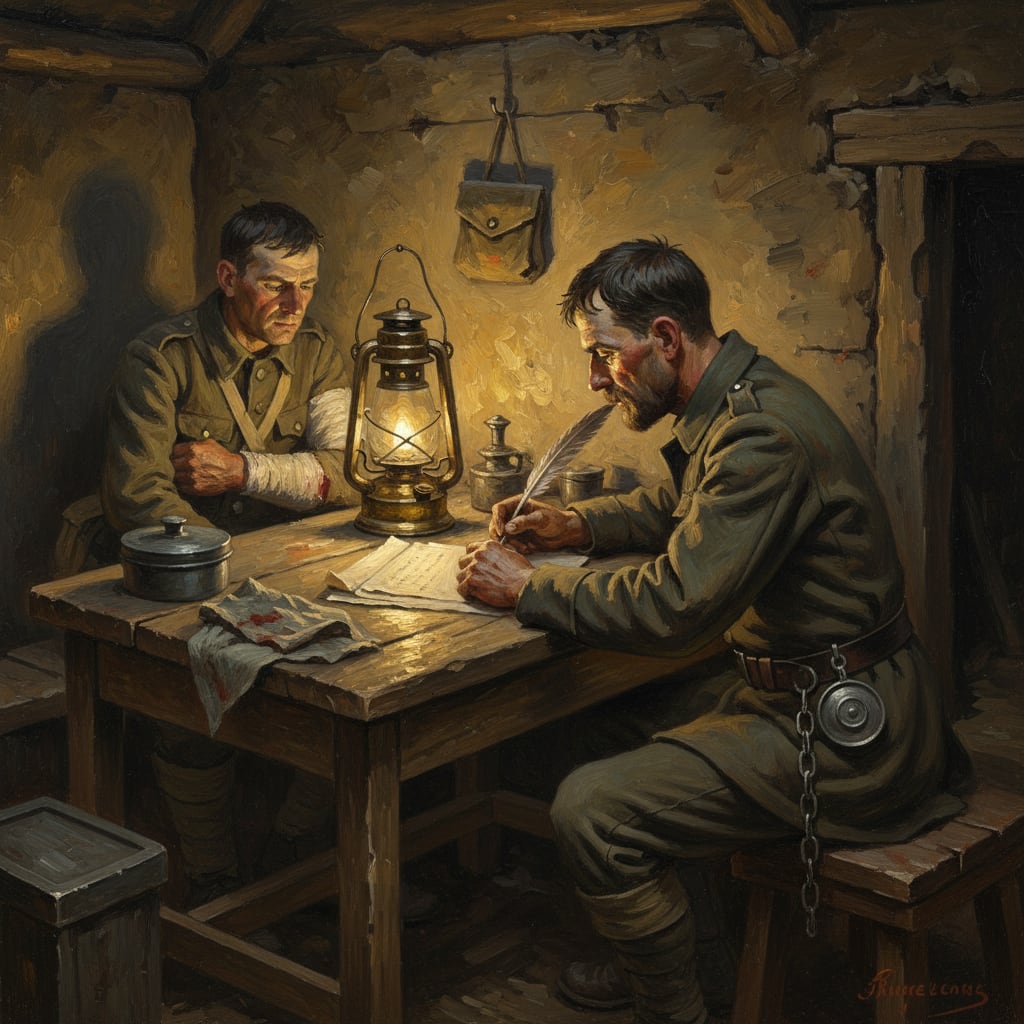
The profession's formal title — Front Registrar, Wound-Testimony Clerk, Trench Court Scribe — conveys a bureaucratic dignity that dissolves on contact with the reality. The reality is a man in a mud-stained coat, seal tin chained to his belt, ink frozen in its well, recording the last words of a soldier who has perhaps four minutes of consciousness remaining and is using two of those minutes to describe the colour of his daughter's hair. The clerk writes this down. The clerk also writes down the soldier's name, unit designation, doctrinal allegiance as assessed by rubric, the nature of his wounds, the disposition of his personal effects, and a category code — faithful, drift, contrition, contagious doubt — that will determine whether the man's family receives a pension, a letter, or a visit from the Bureau of Purity.
The category code is the cruelty. Everything else is paperwork.
#On the Origin of the Mud Courts
The Trench Courts did not exist before the Uncounted Winter. I will let that sentence settle, because the Uncounted Winter is one of those episodes the Bureau of Records prefers to reference obliquely, in subordinate clauses, attached to other subjects — as though fifty thousand dead men without paperwork were a footnote to a supply chain discussion rather than a crisis that nearly broke the Synod's authority on the Line.
The facts are plain. During a sustained offensive in the northern sector — the precise year is disputed between A.S. 87 and A.S. 91, and I suspect the dispute is manufactured — the field registry system collapsed under volume. Clerks in the rear echelons could not process the dead quickly enough. Tags were lost, mismatched, duplicated, or buried with the wrong bodies. Confessions were taken on scrap paper, if taken at all. Thousands of soldiers were listed as "presumed fallen" without attestation, which under Synod law meant their families could not collect death benefits, could not remarry, could not inherit, could not mourn with the formal authority of the Ledger behind them.
The homefront erupted. Fraud claims multiplied. Widows who were legally married to dead men they could not prove were dead. Orphans whose fathers existed in a bureaucratic limbo between living and unrecorded. The Bureau of Tithes attempted to garnish wages from men who had been corpses for six months. It was — I will use the Bureau's own language — an administrative irregularity of the first order.
The Synod's response was the creation of the Trench Courts: forward-deployed registry stations, each staffed by a clerk empowered to take confessions, verify identities, issue death attestations, assign burial clearance, and — this is the part that makes the profession what it is — flag and segregate contradictions for later disposal.
The Deserter Purges refined the system further. Quick-hearing protocols were codified. "Loyalty phrasing" rubrics were distributed, so that a clerk could categorize a dying man's final words according to doctrinal alignment without the inconvenience of interpreting what those words actually meant. The Contradiction Doctrine followed: a formal recognition that soldiers' last confessions sometimes undermined official narratives, and a formal procedure — burn orders, sealed pouches, coded marks — for ensuring those confessions reached the furnace rather than the archive.
Saint Vell of the Lantern Table is the profession's patron. She is said to have recorded confessions under sustained bombardment without losing a single page, though the Bureau of Records has never produced a complete transcript from her tenure, which suggests either that Saint Vell was remarkably tidy or that the Bureau has a broader definition of "without losing a page" than the rest of us.
A previous edition of this entry attributed Saint Vell's patronage to the Bureau of Bells, citing her "steadying influence on front cadence." The Bureau of Bells has issued a formal denial. Saint Vell belongs to the Bureau of Records, Field Operations Division.
#On the Work Itself
The Trench-Court Clerk's workplace is a dugout. The dugout contains a plank table, a lantern, a seal box, a stack of waterproof ledger sheets, a pouch of brine cloth, and a queue of men who know they are going to die. The lantern makes everything yellow and old. The brine cloth smells of the sea that is hundreds of miles away. The queue does not end. It recedes during lulls and surges after assaults, but it does not end, because the front produces dead men at a rate that exceeds any other manufacturing process the Synod has devised, and each dead man requires paperwork.
The process is this:
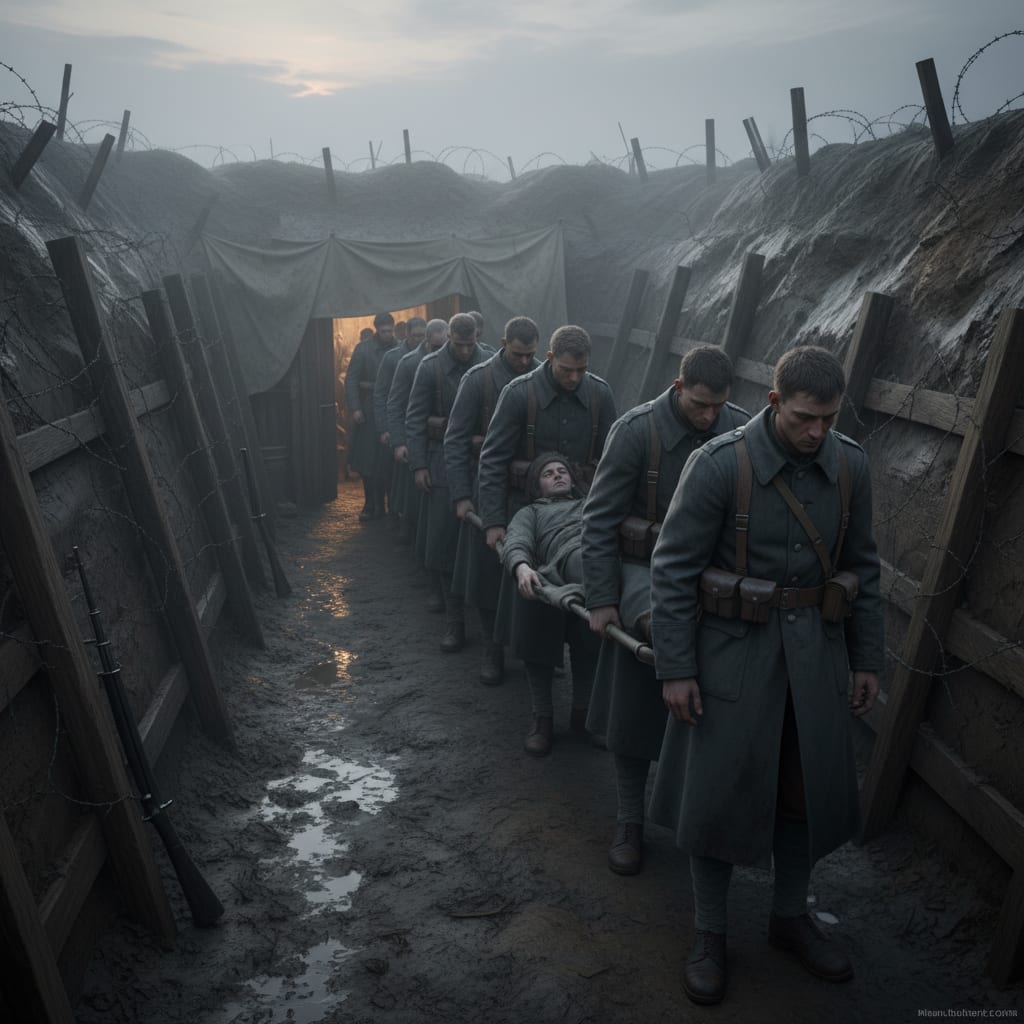
The soldier arrives — carried, stumbling, or dragged by a medic who has already triaged him as beyond saving but not yet beyond speaking. The clerk verifies identity: one dog tag plus one living witness, or two dog tags if no witness survives. The clerk records the confession. Name. Unit. Doctrine line. Final bequest. The confession may be brief — a name whispered, a ring pressed into the clerk's palm, a single word repeated until the breathing stops. The confession may be elaborate — an officer dictating his memoirs into the lantern light while his legs cool under a blanket that the medic has drawn up out of mercy rather than medical necessity. The clerk writes it all down. The clerk does not editorialize. The clerk categorizes.
Faithful means the soldier died professing loyalty to the Synod, the Ledger, and the Doctrine. His family will receive benefits. His name will enter the rolls of the honoured dead.
Drift means the soldier expressed doubt, confusion, or heterodox opinion — but within parameters the Synod considers recoverable. His family will receive reduced benefits. His name will enter the rolls with an annotation.
Contrition means the soldier confessed to specific sins — desertion, cowardice, heretical speech, collaboration — and repented before death. The clerk must record the sin and the repentance separately, in triplicate, and forward the contrition packet to the Bureau of Records for cross-referencing against unit logs.
Contagious doubt means the soldier said something that, if repeated, would damage morale among the living. His confession is sealed. His family receives a standardized notification of death. The confession itself enters the contradiction pouch.
The contradiction pouch. That is the thing. That is the mechanism that turns a registry clerk into something else — something the Bureau does not name, because naming it would acknowledge that the Synod's war machine runs on selective truth.
#On the Burning of Words
The contradiction bundles arrive at the furnace by courier. The courier does not know what is in them. The clerk who sealed them knows exactly what is in them, because the clerk recorded every word, categorized every doubt, and stamped the pouch with a code that means: this man's last breath contradicted what we need the living to believe.
I have seen a burn order. It is a single sheet, countersigned by the Front Prelate and the War Registrar (Unregistered), listing bundle numbers and a date. No explanation. No justification. The bundles are fed into a field furnace — a squat iron box that smells of paper and something else, something the clerks will not name, something that lingers in the dugout for hours after the burning is done. The ashes are swept into a standard-issue receptacle and classified as administrative waste.
The clerks call it different things. The official term is doctrinal cauterization. The veterans call it feeding the furnace. The ones who have done it too many times call it nothing at all, because they have stopped distinguishing between the burning of words and the burning of men. Both produce ash. Both leave the dugout smelling wrong. Both make the lantern flicker, though that last detail is superstition and I note it only because every clerk I interviewed mentioned it independently.
The profession's internal schism runs along the line of the furnace. Record-true clerks — a minority, shrinking — maintain that every word should be preserved, that the Ledger's authority depends on completeness, that burning a man's last confession is a species of murder the Synod has not yet invented a category for. Rubric clerks — the majority, and growing — maintain that the front runs on belief and paperwork, that contradictions are a wound the Synod must cauterize, and that the dead are served better by a clean narrative than by a messy truth that would destroy their families' benefits.
Both factions are correct. Both factions drink too much. These facts are related.

An earlier draft of this entry included testimony from a Trench-Court Clerk at Bastion-Irongate who claimed to have preserved a complete set of contradiction bundles spanning A.S. 194 to A.S. 198, hidden inside a sealed ammunition crate in the rear trench system.
The Bureau of Records has investigated and determined that no such crate exists. The clerk in question has been reassigned.
#On the Superstitions and the Tells
The front breeds ritual. The Trench-Court Clerk's rituals are small, precise, and non-negotiable.
At the start of each shift: the table is wiped with brine cloth. The ink is warmed near the lantern. The seal tin is tapped three times. The clerk recites the words "Name, unit, vow" into the lantern light, addressing no one. This is written in no manual. Every clerk does it. I asked why and received four different explanations, all of which amounted to the same confession: because if I don't, the first man through the flap dies before I can write his name.
At the end of each shift: tags are counted. The seal tin is locked. Scrap notes — not confessions, never confessions without an order — are burned. The clerk washes his mouth with salt water, because the front smells of cordite and rot and brine, and the salt, they say, keeps the taste of the dying out of your throat.
The great taboo: never write a confession on paper taken from a dead man's pocket. The story is old and consistent across every bastion I have visited. A clerk at Bastion-Shipka, during a shelling, ran out of ledger sheets and tore a blank page from a letter found in a corpse's tunic. He wrote the next confession on it. By morning, the handwriting on his ledger had changed — into the dead man's hand rather than the dying man's. The clerk burned the page. The handwriting did not revert. The clerk burned the ledger. The Bureau of Relics classified the incident as "scribal contamination, provenance uncertain" and moved on.
#On the Clerk's Instruments and Their Weight
The seal tin is the badge. Every Trench-Court Clerk carries one — a flat, battered rectangle of tin containing a wax block, a stamp, and a wick. The stamp bears the sigil of the Bureau of Records, Field Operations Division, which is a quill crossed with a sword over an open ledger. When the clerk presses that stamp into hot wax on a confession, the confession becomes real in a way that speech does not. Speech dies with the speaker. Wax endures. Wax, in the Synod's theology of bureaucracy, is the material form of institutional memory — which makes the Trench-Court Clerk a priest of a very particular sacrament, one that transforms dying breath into administrative fact.
The waterproof ledger sheets are issued by the Bureau of Engineering, treated with a compound the engineers describe as "wax-resin laminate" and the clerks describe as "paper that hates ink." Writing on treated sheets requires a heavier hand and a thicker nib, which means the clerk's handwriting degrades over months of service — the letters growing larger, the pressure marks deeper, the margins shrinking. An experienced clerk's ledger page looks like a wound.
The grab satchel is the survival kit. When the shelling starts — and the shelling always starts — the clerk has approximately twelve seconds to sweep the current ledger, the seal tin, and the active tags into a waxed leather bag and flatten against the dugout wall. The satchel goes before the clerk. This is policy. The records are, in the Synod's calculus, more valuable than the registrar, and the Synod has never pretended otherwise.
██████████████████████████████████████████████████████████████████████████████████ ██ [SECTION REMOVED — Trench Court Field Manual (Unregistered), Appendix C: "Procedures for ██ ██ Continuity of Registry in Event of Total Clerk Casualty." Contents describe ██ ██ protocol for untrained personnel to assume recording duties using simplified ██ ██ rubric cards. Classified by Bureau of War, Standing Order 44-R (Unregistered).] ██ ██████████████████████████████████████████████████████████████████████████████████
#On the Men Who Do This Work
They are, in the main, literate conscripts. Men who can read and write and who, by virtue of that ability, were pulled from the rifle line and handed a seal tin instead of a bayonet. Some volunteered — believing that the pen was safer than the trench wall, which is true in the same sense that drowning is safer than burning. You die either way; the question is whether you spend your last months recording other men's deaths or contributing to the casualty count directly.
The personality that survives the work is specific: calm under bombardment, emotionally sealed, obsessive about detail, capable of writing a man's name while the man bleeds on the table and the ceiling shakes and the lantern gutters and the queue outside the flap coughs and prays and waits. The personality that breaks is also specific: anyone who listens. The clerks who hear the confessions — who let the words settle rather than transcribing them as data — those clerks develop what the field chaplains call bell-sickness and what the Bureau of Bells calls front cadence trauma: a condition in which the rhythms of the dying begin to replace the rhythms of ordinary thought. They hear stamp-beats in their sleep. They count syllables instead of words. They tap their seal tins in patterns that match no known hymn.
The hierarchy is brief and brutal. Tag runners — boys, usually, because the front has a permanent appetite for boys — sort the identity tags and dry the pages. Clerks record. Supervisors reconcile the counts: tags against bodies, attestations against casualty reports, names against the rolls. Above them, the Contradiction Custodians — senior clerks tasked with managing the burn cycle, deciding which bundles are forwarded to the Bureau of Records and which feed the furnace. Above them, the Desertion Hearing Specialists, the Cadence Examiners, and the Front Prelate, who signs the orders and sleeps in a tent that does not share a wall with the dugout courts.
The pay is a hazard stipend, rations, and front housing. The side economy is letters. A Trench-Court Clerk who can write a decent letter home — actual sentences describing actual conditions in language that will survive the censor rather than the rubric phrases mandated by the Bureau of Doctrine — can charge a week's ration chit per page. The other side economy is cleaner deaths. A family that needs its soldier listed as faithful rather than contagious doubt will find a courier, and the courier will find a clerk, and the clerk will discover that the category code on the attestation was, on reflection, transcribed in error.
The price for a reclassification varies by sector. At Bastion-Przemyśl, it is three months' lamp oil. At Bastion-Constantinople, it is a morphine vial and a promise. The Bureau of Purity is aware of the practice. The Bureau of Purity has not intervened, because the Bureau of Purity understands that a front registry system running on honesty would produce truths the Synod cannot afford.
The Trench-Court Clerk's desk smells of brine and cordite and wax smoke. His hands are stained. His ledger is mud-grimed and stamped and sealed and will outlast every man whose name it contains. He records the last words and assigns the categories and feeds the furnace when ordered, and the furnace eats the words, and the ashes are classified as administrative waste, and the Synod's war continues with its narrative intact, and the widows receive their letters, and the orphans receive their writs, and the dead — the dead, who said what they said in the lantern light with the stamp-beats counting down — the dead receive nothing, because the dead have been processed.
The Ledger is complete. The Ledger is always complete.