
#On the Winter Without Names
An unrecorded death is not a mercy. It is a debt with teeth. — Records teaching slate, later withdrawn for excessive honesty
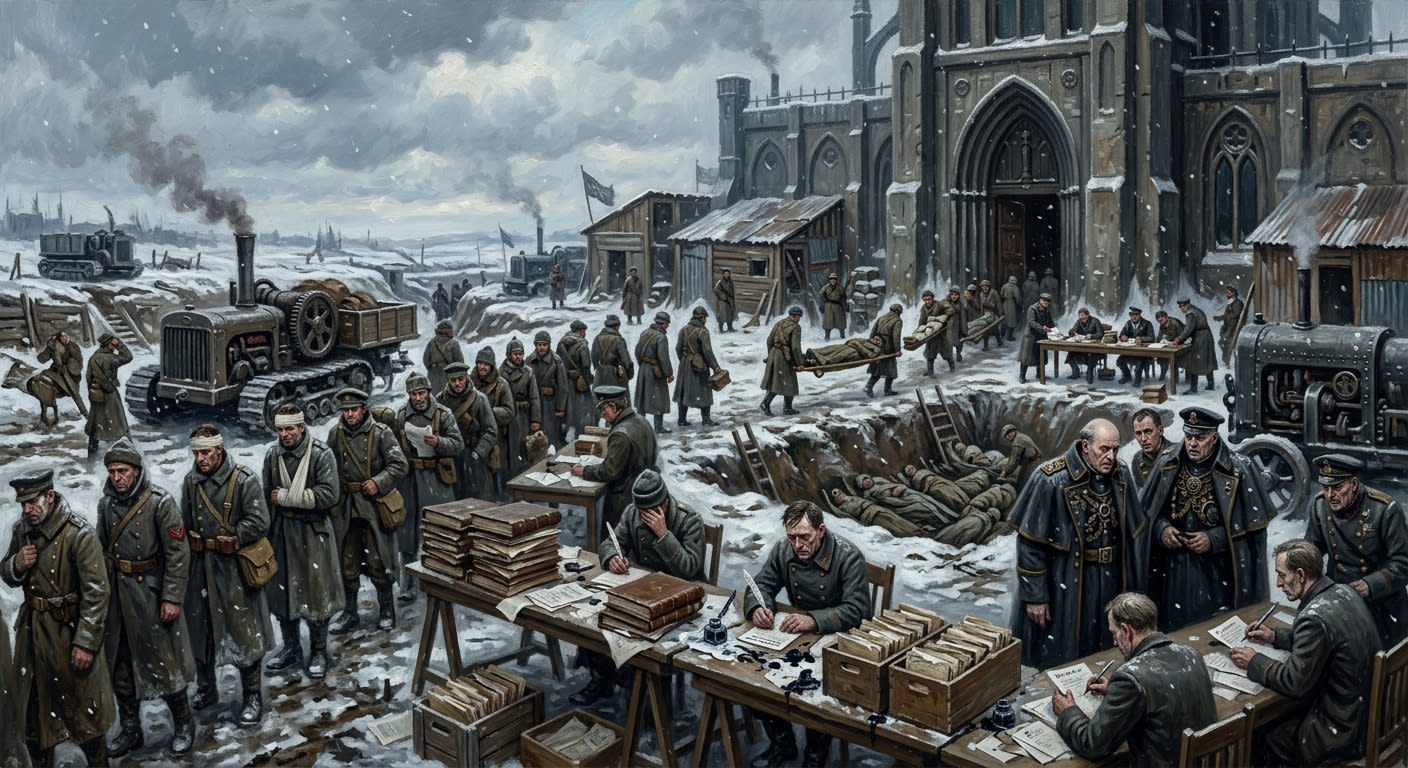
The Uncounted Winter was the northern offensive, dated A.S. 87–91 by honest confusion and dishonest convenience, during which the Synod’s field registry collapsed beneath the simple theological problem of too many dead men and too few correct pages. Fifty thousand soldiers died without attestation. That number is official, which means it is rounded, negotiated, frightened, and probably low.
The offensive itself receives less ink than its paperwork, a fact that would offend soldiers if soldiers retained voting authority after burial. The fighting occurred in the northern sector of the Sagittal Line, across frozen trenchworks, broken causeways, timber revetments, and casualty pits dug into ground so hard that picks rang like bells. The enemy pressed. The Line held. The dead accumulated faster than tags, faster than carts, faster than clerks, faster than widows could begin becoming widows in the proper legal manner.
#On the Date Dispute
The date dispute is the first corpse. Some files place the beginning in A.S. 87, the year of the Council of Worms, when bishops knelt in a roofless cathedral and signed unity into the rain. Some place the worst losses in A.S. 89, in the frozen months before the Concordat of Strasbourg made power respectable. Some put the end in A.S. 91, when the Trench Courts were constituted and the Bureau could pretend the answer had existed in time to solve the question.
I suspect the dispute is manufactured. A.S. 87 attaches the failure to the old wartime church, still forming, still ragged, still able to plead immaturity. A.S. 91 attaches the remedy to the newly formalised Synod, already wise, already procedural, already stamping the wound it had inherited from its less organised self. Between those dates lies the useful fog in which blame changes coats.
Several patriotic lectures describe the Uncounted Winter as “the first registry trial of the mature Synod.”
Corrected. The Synod was not mature. It was armed, sanctimonious, hungry for authority, and learning how to make disaster productive. Maturity came later, when the forms improved and the bodies remained much the same.
#On the Collapse of the Field Registry
Before the Winter, death at the front travelled by chain: tag, witness, field note, rear copy, parish notification, pension entry, burial clearance. A soldier’s name passed from mud to ledger by many hands, any one of which could freeze, bleed, desert, misread, misfile, or be removed from the world by shellfire before supper. The system worked tolerably during ordinary slaughter. Ordinary slaughter is the phrase by which civilisations prove they have lost the right to complain about demons.
During the Winter, the chain broke at every link. Tags were torn away with coats. Tags were collected from corpses and dropped into sacks without unit order. Living men wore dead men’s tags for ration access. Dead men were buried under wrong tags because a medic guessed, a corporal lied, or frost made faces into one grey family. Confessions were taken on ration wrappers, torn prayer cards, cartridge labels, and a corporal’s sleeve, which was later laundered by an idiot with commendable hygiene and no sense of history.
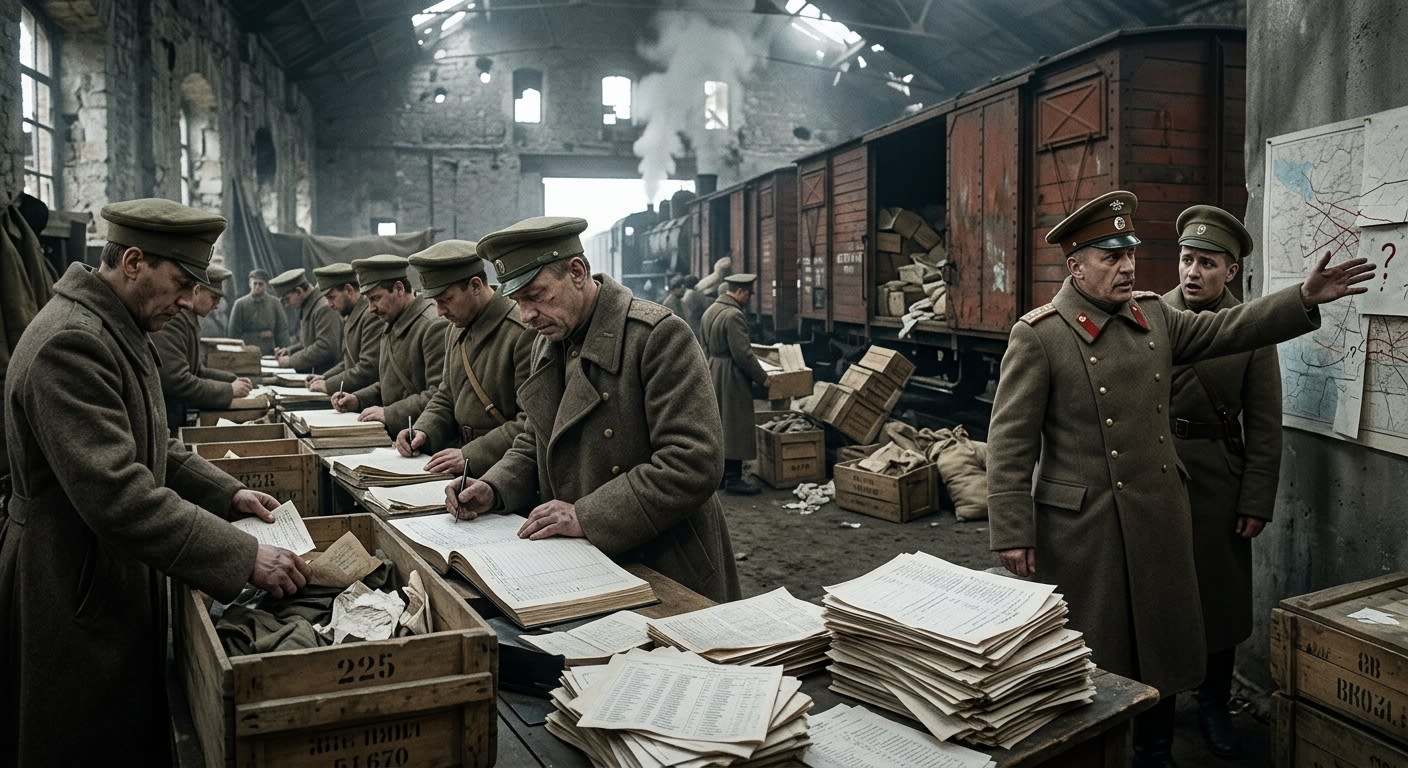
Rear clerks received sacks of tags with no bodies, bodies with no tags, lists with names spelled three ways, casualty slips dated by saints’ feasts, witness statements from men killed before signing, and officer reports written in the clear, cowardly hand of men who had retreated early enough to preserve penmanship. The registry rooms filled. The corridors filled. Then the courtyards filled. Tags were strung on wire like devotional beads. No one prayed to them. They rattled in the wind anyway.
#On the Homefront Eruption
A man without attestation is a legal obscenity. He is dead to his comrades, alive to his creditors, absent to his children, present to the Bureau of Tithes, and spiritually unresolved to any priest with a burial register. His widow cannot remarry, cannot claim pension, cannot inherit, cannot sell certain household goods, cannot enter mourning with the black cord authorised by parish law, and cannot stop being married to a man whose boots have already been issued to someone else.
Multiply this by fifty thousand and the homefront did more than grieve. It litigated, screamed, forged, rioted, bribed, and learned the shape of the state by striking its face against the counter.
Pension offices were besieged by wives carrying letters, buttons, thumb bones, hearsay, dreams, and infants conceived during last leave who could not be registered as fatherless because the fathers had not been proved dead. Parish courts filled with women seeking provisional mourning. Tithes offices attempted collection from households whose wage-earners existed only as unresolved entries. The widows’ relief tables learned in that season that proof of death could be more valuable than bread, because bread feeds the day and proof feeds the law.
Fraud followed grief like a clerk after a fee. False widows appeared. False survivors appeared. Men declared dead returned and found their stipends assigned. Men alive on paper had been buried under other names. One bastard in Cologne, whose name I preserve only because I have standards and he has descendants, sold the same forged death attestation to eleven women in four districts. Records hanged him for fraud. The women received no pensions, because the forms were forged. The rope was authentic.
#On What the Soldiers Said Before No One Wrote It
The greater loss was not monetary, though money is the language by which the Bureau admits pain without blushing. The greater loss was speech. Men died without confession, without bequest, without last correction of name, without accusation, without repentance, without that miserable little privilege of telling a stranger what should be carried home. Their words vanished into frozen cloth and shell smoke.
The Synod speaks often of souls. It speaks less readily of the administrative uses of last words. A dying man may confirm an officer’s courage, expose a deserter, name a hidden child, retract a heresy, confess one, assign a ring, clear a debt, accuse a quartermaster, or describe an enemy movement. His mouth is a registry station with blood in it. During the Winter, thousands of such stations closed unattended.
FIELD NOTE FRAGMENT — NORTHERN SECTOR, DATE UNRESOLVED “Bodies stacked by revetment six. No tags visible. Some still speaking under canvas. Chaplain gone. Clerk gone. Private H— attempting names from memory. Shelling resumed. █████████████████████████████████. We will mark them faithful if anyone asks.”
This is why the Winter terrified Records more than War. War can survive dead soldiers. War is built for that disgusting arithmetic. Records cannot survive unclassified dead, because an unclassified dead man leaks uncertainty into every office he touched: parish, ration hall, marriage desk, inheritance court, levy roll, burial ground, shrine ledger, debt book, orphan allocation, and the Great Ledger itself. One missing attestation becomes ten disputed entries. Ten become a district quarrel. A district quarrel becomes doctrine if allowed to sing.
#On the Remedy That Became a Profession
In A.S. 91, by joint mandate of the Bureau of Records and the Bureau of War, the Trench Courts were constituted. The remedy was brutal, elegant, and beloved: put the registry beside the wound. Do not wait for death to travel rearward by cart, sack, rumour, and thaw. Station a licensed clerk in the dugout. Give him waterproof ledger sheets, a lantern, a seal box, short-codex rubric cards, identity tags, brine cloth, burn pouch, and authority to turn dying breath into administrative fact before the breath stops steaming.
The Trench-Court Clerk was born there, though the profession later dressed itself in older prayers and installed Saint Vell of the Lantern Table above the desk. The clerk recorded confessions, assigned doctrinal categories, issued death attestations, cleared burial, received bequests, flagged contradictions, and kept the front legible enough for the homefront to remain governable. Each station became a small court, chapel, morgue, censor, pension office, and furnace-mouth. Efficiency is always most admired by those standing farthest from its smell.
The Winter also birthed the first hardened form of the Contradiction Doctrine. The army discovered that last words were useful until they were true in the wrong direction. Soldiers blamed commanders. Soldiers doubted saints. Soldiers reported impossible voices from wound-sites. Soldiers confessed to seeing dead comrades walking before the assault. Such testimony could no longer be lost; loss had caused the crisis. It had to be recorded, marked, segregated, and burned under order. The state had learned from failure. It would never again misplace dangerous truth by accident when it could destroy it by procedure.
Early Records commemoratives praised the Trench Courts as “the end of uncounted death.”
Corrected. The Trench Courts ended unprocessed death in designated stations during staffed periods when ledgers, lanterns, clerks, and roofs survived. Records has approved the shorter phrase for morale use.
#On the Deserter Purges
The Deserter Purges followed the Winter like a bailiff follows a late payment. Once death attestations were centralised, absence became more visible. Men who had vanished during the registry collapse could no longer hide in the fog between dead, missing, transferred, buried, and miscopied. Some were deserters. Some were casualties without tags. Some were prisoners. Some were alive under other names. The Bureau, finding uncertainty offensive and categories cheaper than investigation, refined the quick-hearing protocols.
Loyalty phrasing rubrics entered service. A dying man’s final words were weighed for alignment. “Tell my mother I tried” scored differently from “Tell my mother command lied.” “I am afraid” remained human. “We were abandoned” became actionable. The phrasebook did not make clerks cruel. It made cruelty reproducible. That is civilisation in miniature.
#On the Memorials
There is no grand monument to the Uncounted Winter in Strasbourg. Grand monuments require clean names, and clean names are precisely what the Winter withheld. Instead there are annexes, cabinets, tag wires, provisional widow ledgers, pension correction shelves, and a narrow Records hall where fifty thousand blank slips sit in grey boxes. Each slip bears a number, a sector if known, and the phrase Attestation Deficient. Families sometimes petition to see the boxes. Permission is rarely granted. Denial preserves hope more cheaply than inspection.
In the northern parishes, older widows still keep double cords: black for death, grey for unresolved proof. Their grandchildren call it superstition. Their grandmothers call it filing.
A.S. 201 finds the Winter still unresolved in the only sense that matters. The Trench Courts function. The clerks write in mud. Saint Vell holds the table in cheap icons. The pension offices have better counters. The Bureau has learned to count the dead close to the place where death occurs, and when counting fails, it has learned to name the failure narrowly enough that doctrine survives.
The dead were counted after they had ceased being countable. Records calls this victory. Records has always enjoyed arriving late with a clean stamp.