
#On the Wound Made by Truth
Contradiction is a wound that must be cauterized. — Field Operations maxim, approved after its third denial
The Contradiction Doctrine is the Synod’s formal recognition that a dying soldier may tell the truth in a manner harmful to victory. No rebuke is meant for dying soldiers. They are tired, frightened, drugged, perforated, sentimental, and often more honest than policy permits. The rebuke belongs to truth, which has always required supervision when allowed near artillery.
Codified with the Trench Court system in A.S. 91, after the Uncounted Winter taught the Bureau of Records that losing testimony by accident produces riot, pension chaos, inheritance rot, and widows with the legal status of furniture left in rain, the Doctrine established a cleaner rule: dangerous last words must be recorded, marked, sealed, routed, and destroyed under authority. Accident became process. Process became virtue.
#On the Origin in the Uncounted Winter
Before A.S. 91, the front mishandled testimony with democratic incompetence. Confessions were written on ration wrappers, prayer cards, sleeve cloth, cracked slate, or memory. Some reached the rear. Some vanished in mud. Some were copied badly by men whose fingers had frozen into hooks. Some were improved by officers, which is a polite way of saying falsified by gentlemen with better boots.
The Uncounted Winter exposed the old system’s uglier mercy. When fifty thousand men died without attestation, their families raged because nothing had been recorded. When fragments of testimony surfaced, commanders raged because something had been recorded. The Synod, standing between the widow and the officer, did what any intelligent government does when both grief and command demand satisfaction. It created a form.
The Trench-Court Clerk would take the confession at the wound-site. Name, unit, vow, bequest, statement, category. The clerk would decide whether the confession entered ordinary archive, required doctrinal notation, or bore contradiction severe enough to threaten morale, command legitimacy, or approved history. The Contradiction Doctrine begins there: at a plank table, under a lantern, while a man uses his last minute to say something inconvenient.
An instructional pamphlet of A.S. 104 described the Doctrine as “the humane preservation of morale-sensitive testimony.”
Corrected. The Doctrine preserves testimony only until its danger can be measured. The humane portion of the procedure consists chiefly of writing quickly before the patient expires.
#On What Counts as Contradiction
Contradiction exceeds doubt. Doubt is common, taxable, and often curable with sleep, soup, punishment, or a sermon delivered at sufficient volume. Contradiction is testimony that strikes the official narrative at a joint.
A soldier says the bell did not ring before the assault. Contradiction.
A soldier says the captain ordered retreat, then accused the dead of cowardice. Contradiction.
A soldier says the enemy wore the faces of missing men and the chaplain recognised his brother among them. Contradiction, with Purity notification.
A soldier says he saw no demons, only hunger, cold, and officers spending lives to correct a map. Contradiction, severe.
A soldier says the Synod lied. The clerk must pause here. “The Synod lied” is heresy if spoken with conviction, grief if spoken under morphine, contagious doubt if overheard by stretcher-bearers, and operationally useful if attached to a specific quartermaster. The Doctrine’s genius lies in forcing the clerk to decide which sin best protects the Ledger.
#On the Pouch
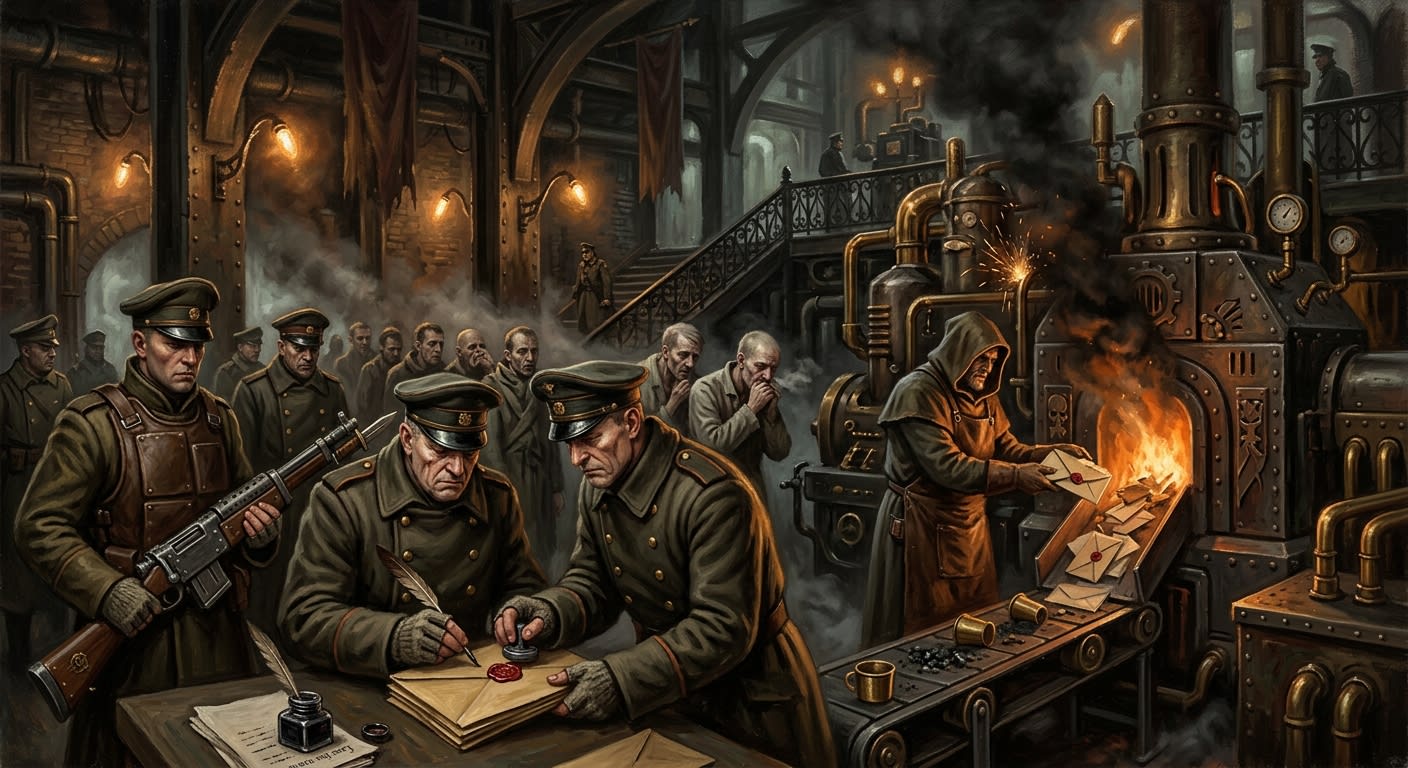
The contradiction pouch is a small waxed satchel, grey or black by sector, hung from a hook behind the clerk’s table where the confessing man cannot see it unless he turns his head, which most cannot. Its mouth closes with two ties: one cord for the clerk, one cord for the supervisor. The seal mark is not the ordinary Records stamp. It is a coded slash beside the unit designation, small enough for deniability, clear enough for auditors, feared enough that clerks dream of it.
The pouch exists because direct destruction looked too much like murder of words. The Synod dislikes resemblance when resemblance is legally actionable. The confession first enters custody. Custody gives the confession dignity. Dignity gives the burn order something to remove.
Procedure requires a clerk to copy the contradiction number in the furnace log, route the sealed pouch by courier, receive countersignature from the Front Prelate or War Registrar (Unregistered), and burn according to Burn Directive 7-C. Procedure also requires the clerk to continue working after this, which proves that procedure was written by men far from the table.
APPENDIX B — CONTRADICTION SEVERITY RUBRIC Category III examples include: officer abandonment, bell failure, ration diversion, enemy voice-mimicry, posthumous command sightings. Category IV examples include: █████████████████████████████████████████ Category V examples include: statements in which the dying speaker █████████████████████████ while using the clerk’s childhood name. Immediate flame authorised.
#On the Furnace
The furnace is small. This disappoints civilians, who expect wickedness to require architecture. A field furnace is a squat iron box with a hinged mouth, bolted feet, ash drawer, and enough appetite for a night’s worth of truth. It sits outside some dugouts, inside others, depending on shelling, ventilation, superstition, and whether the supervisor has retained enough conscience to want smoke between himself and the pages.
Clerks call the act feeding the furnace. Veterans call it cauterization. New clerks call it burning until corrected. Old clerks call it nothing.
The burn order is usually a single sheet. Bundle numbers. Date. Signature. No contents. No explanation. A merciful bureaucracy explains little. Explanation invites reply.
Furnace superstition attaches itself to the Doctrine like soot under nails. Papers containing final bequests are said to burn with blue edges. Confessions marked contagious doubt leave a sweetness in the dugout. Names of brothers curl inward. Pages written under cadence anomaly sometimes do not catch until the clerk speaks the name aloud, which is why experienced clerks keep their mouths shut and let younger men be instructive.
#On the Schism Among the Clerks
The Doctrine split the profession before the ink dried. Record-True Clerks hold that every confession must be preserved because the Ledger’s authority depends upon completeness. They quote Saint Vell. They keep duplicate slips. They delay burn orders by pleading damp, shelling, courier absence, wax shortage, audit confusion, and the Creator’s known preference for legible handwriting. Their numbers shrink, as all inconvenient decencies shrink when promotion boards begin asking about “temperamental suitability.”
Rubric Clerks hold that the dead are better served by a clean narrative than by a truth that ruins pensions, breaks morale, and gives the enemy free lodging inside the barracks. They believe in compression, safe category, formula, and speed. They survive. Many are good men, which is the detail that makes them unpleasant to judge. Monsters are a relief. Competent decent men with burn authority are civilisation’s preferred knife.
Between them stand the Contradiction Custodians, senior clerks who manage the burn cycle, reconcile pouch counts, certify ash drawers, and decide which bundles reach rear Records review and which feed the forward furnace. They sign little. They remember much. They are above supervisors, below Desertion Hearing Specialists, and exactly where a state places men who know enough to be useful and too much to be left unwatched.
A Records personnel circular of A.S. 132 states that “no factional division exists among Trench-Court Clerks regarding contradiction procedure.”
Corrected for internal use. No recognised factional division exists. Unrecognised divisions operate with schedules, slang, saints, grudges, and drinking rooms. Recognition is the least reliable measure of existence.
#On Abuse, Mercy, and the Price of Both
The Doctrine created an economy before anyone admitted it had created a procedure. A family that wants its son remembered as faithful pays to keep doubt out of the pouch. An officer pays to push accusation into it. A clerk sells a mercy seal by classifying contagious doubt as grief. Another clerk sells severity by marking grief as sedition. At Bastion-Przemyśl, lamp oil has purchased cleaner death. At Bastion-Constantinople, morphine and promises have done the same work with better manners.
The Bureau of Purity knows. Purity always knows, except when ignorance is cheaper. It tolerates the smaller corruptions because a front registry system run on naked honesty would produce mutiny, and a system run on perfect terror would produce silence. The Doctrine needs men to speak before it burns them. The pouch must look like a possible archive right up to the moment it becomes fuel.
#On the Present Application
As of A.S. 201, every licensed trench court maintains contradiction pouches separate from ordinary ledgers. Inspectors count them first. Auditors ask how many, where routed, under whose signature, in what ash log, with what delay. A missing ordinary ledger is negligence. A missing contradiction pouch is weather, enemy action, clerk incompetence, officer interference, heresy, or evidence. The final category is worst. Evidence travels.
The Doctrine has spread beyond its first mud table. Rear registries use its language for pension contradictions. Burial offices use it for disputed rites. Field chaplains invoke it when sermons produce statements better left untranscribed. The Bureau of Doctrine has politely avoided adopting the term in civilian canon, because once citizens learn that dangerous truth can be processed as a wound, they begin asking where else the cautery has been applied. Citizens are tiresome when they discover metaphor.
The official lesson remains tidy: the Synod honours the dead by protecting the living from corrosive testimony. The real lesson is older and more useful: the state may fear truth, but it fears unmanaged truth most. Write it down. Seal it. Count it. Burn it. File the ash.