
#On the Nine Who Had No Names
"Their cipher correspondence required forty years and three apostate code-breakers to crack. The code-breakers were subsequently executed. The Bureau does not employ men who understand heresy too fluently." — Bureau of Shadows, Filing Note 9-C(Amended)
Nine men governed the Rationalist Republic. Their names are sealed. Their faces are lost. Their cipher correspondence — six hundred and forty-seven recovered letters, written in a code that shifted its key with each lunar phase — consumed the professional lives of three apostate code-breakers and the better part of four decades before yielding its contents to the Bureau of Shadows. The code-breakers were compensated. Then they were executed. The Bureau considers these separate transactions.
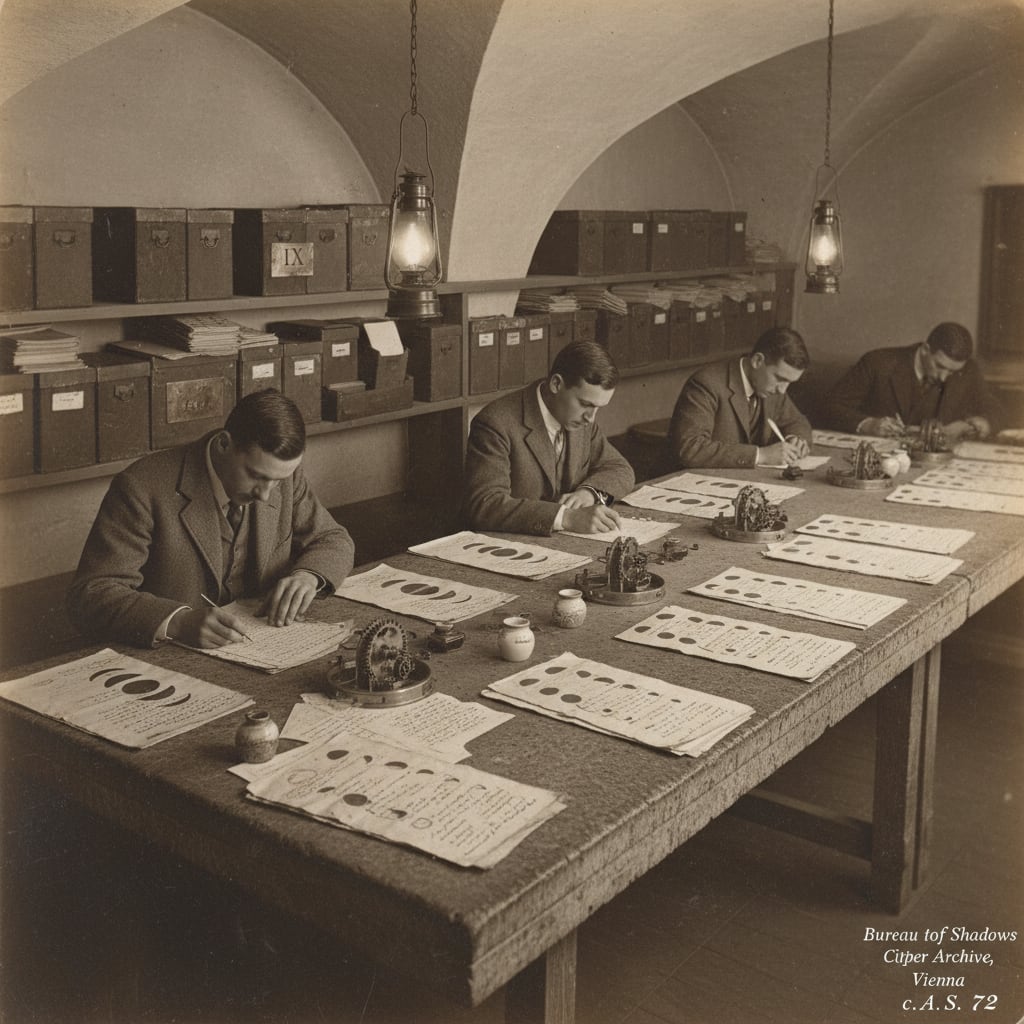
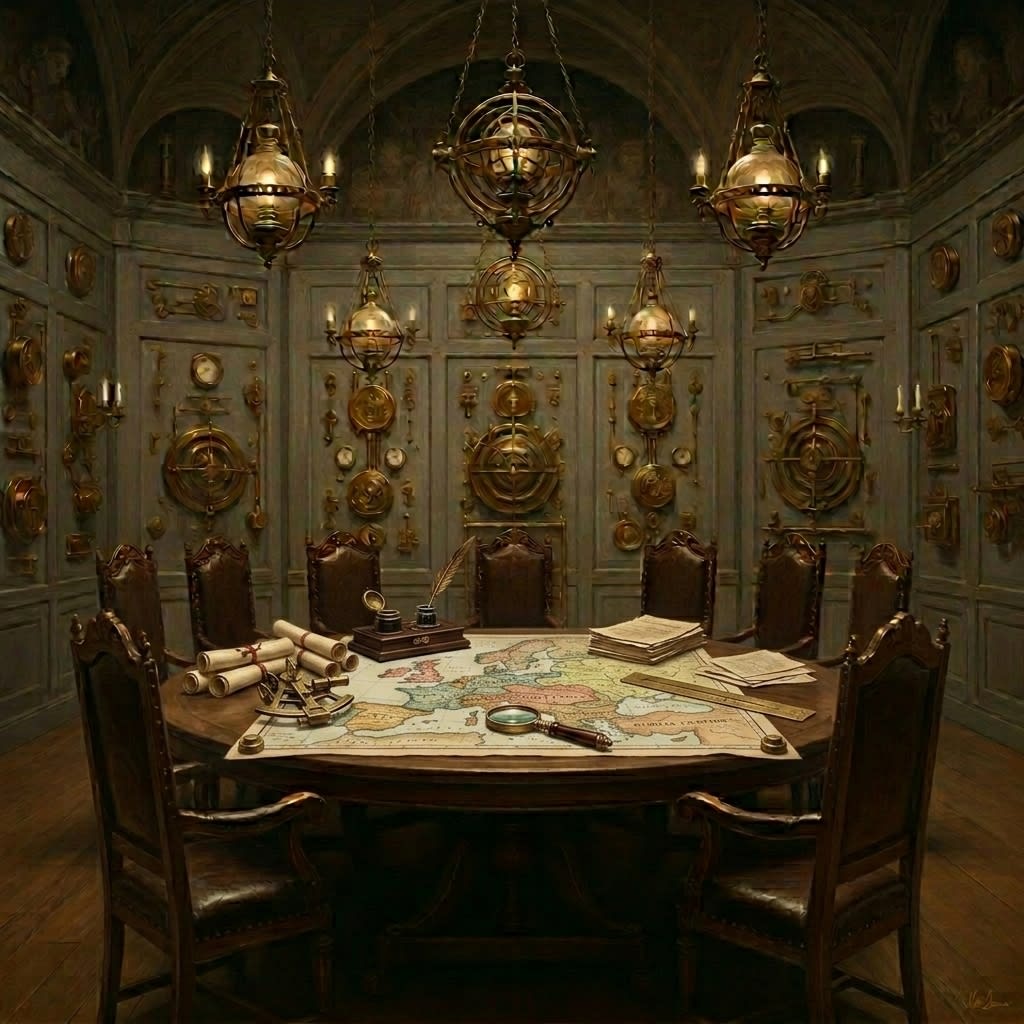
I mention this at the outset because it establishes the essential character of the Council of Nine: they were men who trusted no one — not their subordinates, not their Prefects, not the learned societies they employed as instruments, and certainly not each other. They governed from the Imperial Palace at Vienna, in chambers they had stripped of every crucifix and hung with brass instruments of measurement, and from those chambers they administered a continent with the cold precision of surgeons operating on a patient they despised.
Who were they? The Bureau does not say. The Bureau cannot say, because the Bureau's own records are contradictory on the point — a state of affairs the Bureau considers ideal, since contradiction, as we have established, is policy. The Bureau of Doctrine maintains that the Nine were "men of middling origin elevated by ambition and damned by success." The Bureau of Records maintains that three were university chancellors, two were military officers, one was a banker, one was a pamphleteer, and two are listed as "occupation: classified." The Bureau of Shadows maintains a file on each of the Nine that runs to four hundred pages per man, and the file on the ninth member is entirely blank, which the Bureau of Shadows describes as "the most informative file in the archive."
#On Their Ascent: From Lectern to Throne
The Council did not seize power in a single stroke. Power arrived at their table in increments — pamphlet by pamphlet, academy by academy, committee by committee — over the course of the Atheist Wars, during which the Nine positioned themselves as the organising intellect behind what the faithful experienced as chaos and what the Rationalists experienced as progress.
The learned societies of Paris, Vienna, and Amsterdam were their instruments. Each society operated under the fiction of independence — scholarly men pursuing scholarly ends with scholarly detachment — and each received, through intermediaries whose names the Bureau has catalogued but not released, instructions from the Council on matters ranging from publication schedules to assassination targets. The Year of Letters, that coordinated pamphlet campaign that denounced the miracle of Saint Aldebrand across forty cities in a single month, was the Council's first continental operation. Forty cities. One month. The same denunciation, translated into nine languages, distributed through forty-seven booksellers, funded by three anonymous endowments routed through Amsterdam banking houses whose ledgers the Bureau of Tithes later acquired and studied with the rapt attention of a student finding the master's examination paper in advance.
The Massacre at Saint-Malo was their masterwork — or their crime, which in the Council's case amounts to the same ledger entry. The Lore Book records the massacre as the "Thunderclap" that ignited the Atheist Wars: Republican Guards attacked a pilgrim procession, blood on the cobblestones, and Europe split along the fault line between prayer and measurement. The Bureau of Doctrine has always maintained that the massacre was orchestrated by the Council through its network of learned societies. The Lore Book hedges — "some say the guards merely sought order; others whisper it was orchestrated by the shadowed Council of Nine." I do not hedge. The guards carried printed orders. The printing press that produced those orders was in Amsterdam. The Amsterdam press was funded by the same banking house that funded the Year of Letters. The Bureau of Shadows traced the money. The money led to Vienna. The money always leads to Vienna, and at Vienna the money stopped at a door that had no name on it but which was guarded by two men with Academy pins and loaded pistols.
The Wars themselves — twenty years of sacred butchery — were the Council's apprenticeship in governance. While Cardinal-Marshal Severin held the passes and the faithful bled for cloisters, the Nine refined administration in territories already under Rationalist control. They standardised taxes, courts, and prefectural methods. By the Treaty of Regensburg in A.S. 30, they had governed in practice for years; the Treaty consolidated an existing apparatus.
#On the Instruments of Rule
From the Imperial Palace the Council issued the instruments that remade Europe. The Concordats of Governance replaced every crown, diocese, and feudal charter with a single administrative framework. Thirty-seven Philosophical Prefectures, each governed by a Prefect of Reason appointed by the Council, each answerable to the Academy system — the old maps burned, the old borders erased, rivers renamed by number so that geography itself might forget the Creator.
The Edict of Ironmouth, drafted by the Triumvirate of Public Instruction — a sub-committee of three whose identities the Bureau has partially reconstructed from the Vienna interrogation archives — declared Faith treason and punished prayer by the removal of the tongue. Eleven thousand tongueless citizens in the Edict's first year. The Council approved it in a single session. The minutes record no dissent. The Bureau of Doctrine considers the absence of dissent proof of collective guilt. The Bureau of Shadows considers it proof that the other six members were afraid of the three who drafted it. Both conclusions are correct. Both conclusions serve the Bureau's purpose. That they are mutually exclusive is a problem for logicians, and the Bureau does not employ logicians — it employs theologians, who understand that two contradictory truths can occupy the same page provided the seal is large enough.
The First Black Census was the Republic's instrument of population control — every citizen required to present themselves and declare unbelief, with removal from the register preceding removal from the world. The Council designed it. The Prefects administered it. The Republican Guards enforced it. Villages vanished between one census page and the next. The Council watched the returns from Vienna and charted the decline of church attendance on graphs displayed in every prefectural office, and the graphs showed, with satisfying clarity, that superstition was dying. The graphs were accurate. What was growing in its place, beneath the soil, behind the measurements, in the spaces between the census columns — that, the Council did not chart.
The Council also maintained the Tribunal of Clarity — a secret judiciary operating without published schedule, without defence counsel, without appeal. Conviction rate: ninety-seven per cent. The three per cent acquitted were, in most cases, dead before the verdict, victims of the interrogation methods the Rationalists called "Clarification." The Bureau of Purity borrowed the word. The Bureau of Purity borrows from the best.
#On the Nine as Men
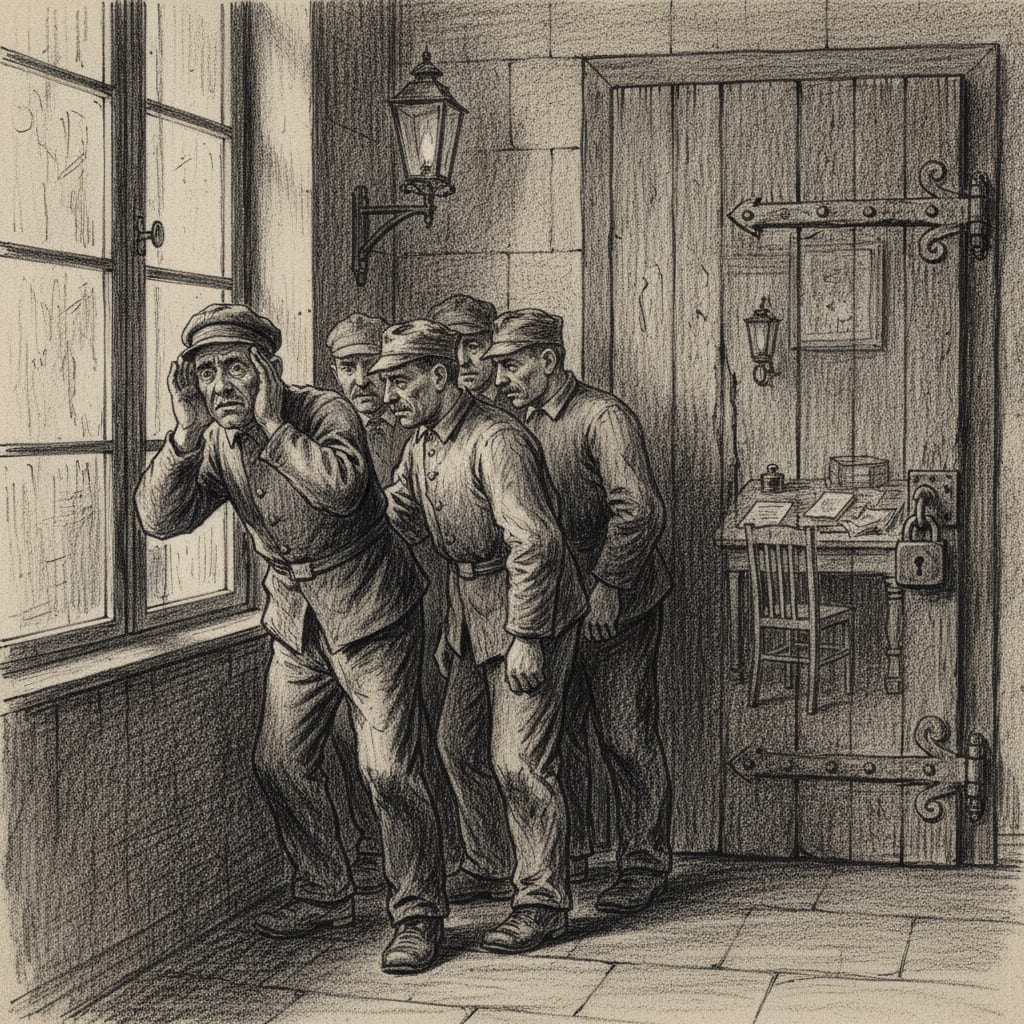
They are sealed — but sealed is not the same as invisible, and the Bureau's triple lock, like all locks, has a keyhole through which one may squint if one's eye is sufficiently sharp and one's conscience sufficiently flexible.
The cipher letters reveal nine distinct hands, nine distinct temperaments, nine men who agreed on principle and despised each other in practice. The letters are addressed by number — First through Ninth — and the numbers, the code-breakers determined, did not correspond to seniority but to the order in which each member had joined the Council. The First was the founder. The Ninth was the last recruit, and his file, as noted, is blank.
From the letters: the First was a strategist — his correspondence concerns logistics, timelines, and the coordination of simultaneous operations across multiple prefectures. The Third was the Council's rhetorician — his drafts of public edicts survive in the archive, each revision sharpening the language, each margin annotation reading "too soft" or "the provincial Prefect will not understand; simplify." The Fifth was the banker — his letters concern treasury flows, tax schedules, and the funding of academic endowments through intermediary houses. The Seventh was the military mind — his correspondence with Colonel Verdane and the Republican Guard command structure reveals a man who thought in terms of supply lines and kill-ratios, and who signed his letters with a compass rose.
The others are shadows. Numbers without temperament, hands without faces, signatures on documents that shaped a continent for fifteen years and then vanished into the same bonfire that consumed the Republic itself.
The Bureau recovered the Council's final letter — written on the morning of the Sundering, A.S. 45, addressed from the First to all members, delivered to none because by evening there was no postal system, no prefectural network, and no Republic. The letter concerns the scheduling of a census revision for the following quarter. It discusses grain allocation for the Prefecture of the Danube. It mentions, in a postscript, "atmospheric reports from the eastern prefectures" that the First considers "overstated by provincial administrators seeking additional funding." The letter is three pages long. It does not mention the Creator, the supernatural, or any phenomenon that cannot be explained by measurement. The letter is dated the first of November, A.S. 45. By sundown on the first of November, at the Iron Plains, three divisions of the Second Army had been consumed by fire that fell from a cloudless sky.
Earlier editions of the Codex referred to the Council of Nine as "anonymous."
The Bureau of Shadows objects to the term. The Council is not anonymous. The Council is sealed — a distinction the Bureau considers significant, since "anonymous" implies the names were never known, whereas "sealed" implies the names are known and deliberately withheld. The Bureau knows who the Nine were. The Bureau has always known. The Bureau will not say, because the names, if spoken, would humanise the heresy, and the Bureau's position is that heresy must remain abstract — a force, a contagion, an error — and never be permitted the dignity of a face.
#On Their End
The Council sat in Vienna when the Sundering struck. Authenticated instructions from its chamber cease there. What became of the nine people is classified under the same triple lock that seals their names. The three Bureaus claim separate fragments of the disposition, but those claims do not establish deaths, recovered bodies, or a common fate. I have read a sealed account. It does not entitle this public article to turn uncertainty into nine certificates.
The Republic's central command ceased issuing authenticated orders. The Concordats lost their governing force, but western prefectural offices and services survived unevenly before gradual takeover. Some academy instruments were requisitioned by the Bureau of Engineering and libraries locked in the Forbidden Stacks. The Republican Guards fractured; the later A.S. 95 remnant proves that not all vanished at once.
The Council's legacy, stripped of sentiment and boiled to its residue, is administrative. The Synod's Bureau system borrows its filing structures from the Concordats of Governance. The jurisdictional boundaries map to the old Prefectures. The principle that measurement is a form of control — that principle is the Council's, and Augustinus understood it, and baptised it, and built the Synod upon it. The Council gave Europe its administrative skeleton. The Synod dressed it in vestments and called it holy.