
#On the Republic's Hand
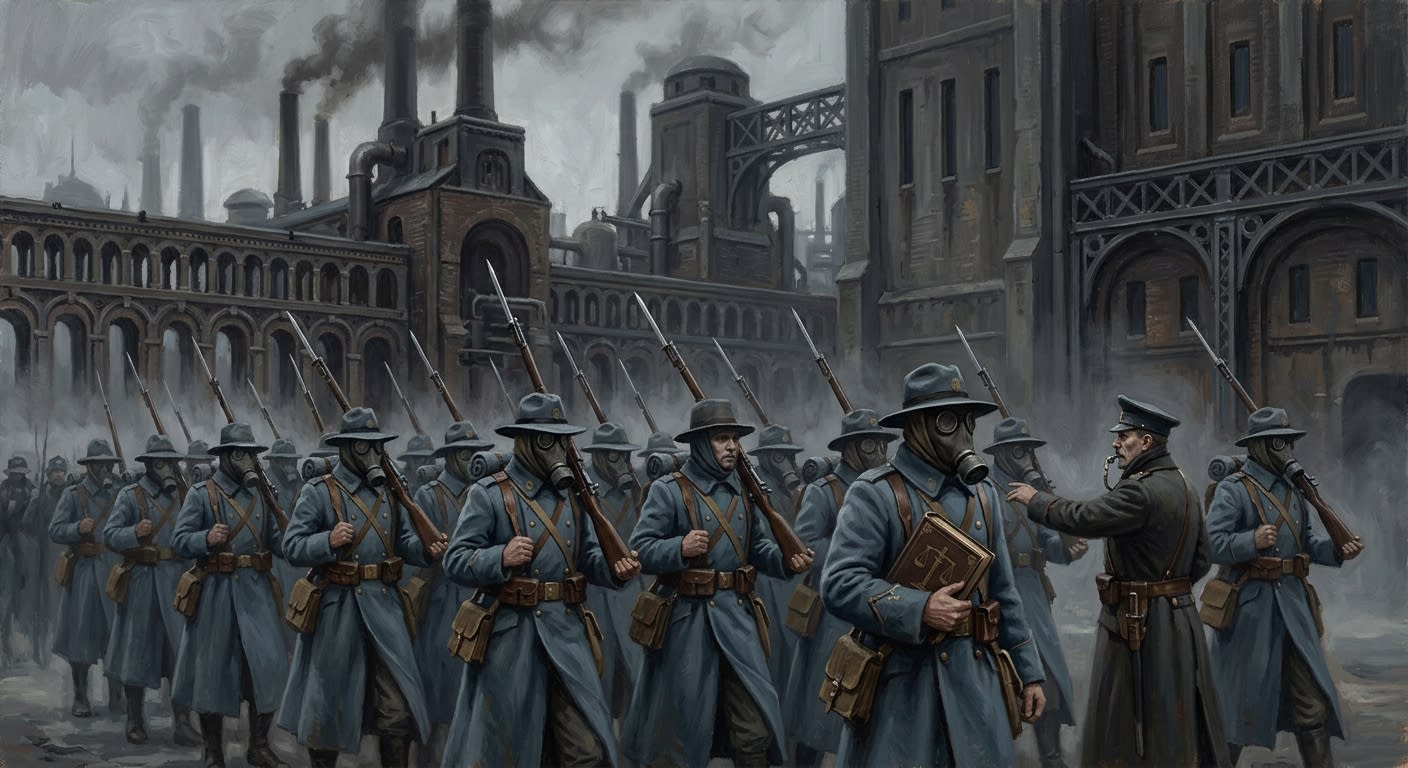
The Republican Guards were the armed hand of the Rationalist programme: secular infantry raised from municipal militias, academy loyalists, discharged crown regiments, and men who discovered that philosophy paid better when it came with boots. They wore blue-grey coats, black cross-belts, brass buttons stamped with the compass-and-broken-cross device, and the expression common to all soldiers instructed that cruelty is civic hygiene.
They were founded as “public order companies” attached to Rationalist magistracies in the first decade after De Vera Luce. The title softened quickly. A guard is reassuring. A soldier suggests war. A policeman suggests law. The Republican Guards managed the useful portions of all three and discarded the shame.
Their creed was printed on the inside flap of the field manual: Reason Alone Shall Rule; the Guard Shall Keep Reason's Peace. The first half belonged to the academies. The second half belonged to men with muskets. Between those halves lay the whole atrocity.
#On Organization and Uniform
A Guard company numbered one hundred and twenty on paper, ninety in weather, and any number required by propaganda when reporting losses. Ten companies formed a cohort under a Captain-Prefect; four cohorts formed a district column; district columns answered to the local Rational Magistrate until A.S. 30, when the Treaty of Regensburg reorganized the Republic into thirty-seven Philosophical Prefectures and placed the Guards under the Council's Ministry of Civic Security. The name is preserved in the Forbidden Stacks. It smells of sealing wax and fear.
Their equipment was plain, competent, and hateful. Flintlock muskets in the early period; rifled pieces after the Paris armories converted under Lucien Artois's ordnance reforms; triangular bayonets designed to produce wounds difficult to close; short sabres for officers; truncheons for crowd work; iron wire for arrests after Kraków taught them that a bound mouth is easier to classify. Their drill emphasized volley discipline, street clearance, shrine seizure, document control, and the suppression of “ritual obstruction.” The last phrase meant kneeling.
The uniform mattered because the Guards wanted the theatre of neutrality. No saints, no regimental patrons, no relic tokens, no embroidered prayers. Their coats bore numbers instead of names. Their banners bore the Broken Cross. Officers carried a copy of the Secular Gatherings Act in a black leather case on the left breast, exactly where soldiers of the old kingdoms had worn medals of the Virgin. A law over the heart. The symbolism is excellent. The heart, in most specimens, was unnecessary.
#On Saint-Malo and the First Blood
The Republican Guards entered sacred history at the Porte Saint-Vincent, Saint-Malo, A.S. 10, when a detachment enforcing secular assembly law advanced on forty-three pilgrims bearing the Reliquary of Saint Matthias. The sergeant carried a writ. The pilgrims knelt. The Guards fixed bayonets and fired.
Thirty-one dead are certified. Seven wounded gave testimony. Five vanished into that exquisite Bureau category “consumed by the event.” The Rationalist gazettes called it a regrettable disturbance. The Guards' after-action note, preserved in fragments, records “religious crowd dispersed; object secured; civic order restored.”
Saint-Malo cannot be filed as accident in the useful sense. The writ was genuine. The sergeant's authority was genuine. The bayonets were issued, polished, inspected, and used according to command structure. No shadowed villain needed to send instructions from Amsterdam. The Republic had built a machine that could encounter a kneeling procession and produce corpses with legal punctuation.
Earlier catechism broadsheets claimed the Saint-Malo detachment acted under forged orders from the Council of Nine.
Corrected. The orders were lawful under Rationalist law. This worsens the crime. A forged order would indict conspirators; a lawful order indicts the state.
After Saint-Malo, recruitment surged. Some joined the faithful. Others joined the Guards. There are always men who see blood on cobblestones and ask which side is issuing wages.
#On Doctrine by Bayonet
The Guards enforced three instruments with special devotion: the Secular Gatherings Act, the First Black Census, and the Edict of Ironmouth. The first gave them crowds. The second gave them names. The third gave them tongues.
Under the Secular Gatherings Act, prayer became an unlawful assembly when conducted by enough bodies to inconvenience a magistrate. Under the Black Census, a citizen who refused to declare unbelief became absent from the ledger before becoming absent from the street. Under Ironmouth, spoken prayer became treason of the tongue. The Guards made philosophy audible from the cellars.
They became specialists in humiliation. A priest was arrested, then marched bareheaded past his parish. A reliquary was seized, then weighed in public. A bell was silenced, then its clapper was carried through the market like a captured tongue. The Guards understood, with a propagandist's instinct and a butcher's wrists, that symbols must be broken where witnesses can learn from the fragments.
At Kraków, Colonel-Prefect Ignaz Brechtold used secular militia and philosophical police alongside Guard detachments to seize forty-seven clergymen in the Night of Knives. At Toledo, Colonel-Prefect Étienne Grimal brought Republican Guards and twelve clockwork cannon against monks, women, and the Relic of Saint Iago. At Aachen, Guards received surrendered gates with parade discipline. In every theatre of the Atheist Wars, one finds them in the same posture: behind a writ, before a body.
#On Numbers and the Republic's Army
By A.S. 30 the Republican Guards numbered approximately four hundred thousand under arms, excluding auxiliary prefectural militia, philosophical police, municipal watchmen, informants with armbands, and the swarm of clerks who always arrive after violence to improve it with filing. The Bureau of War insists on the distinction because soldiers are trained to face enemies, while armed civilians are trained to face citizens. The Guards occupied the poisonous middle: soldiers against pilgrims, police against armies, servants of Reason against anything that bled.
Their strength lay in predictability. They could hold a square, clear a street, escort a census table, seize a chapel, guard an academy, and die in formation if the enemy obeyed the category assigned to him. Against peasants, priests, monks, widows, students, and hungry mobs, they were very fine. Against the Great Deceiver's legions, they were an exhibit in misplaced confidence.
Recovered field memorandum, Battle of the Iron Plains, A.S. 45: “Column remains in order. Men refuse chaplaincy because no chaplains attached. Enemy form inconsistent with zoological tables. Captain requests updated classification before engagement. █████████████████████████████████. The banner has begun to smoke.”
The Sundering dissolved them more completely than any decree. At Debrecen, Guards guarding ration stores watched Kargath's hunger pass through locked doors and leave sacks full of absence. At the Iron Plains, Maldrake's fire took cohorts standing at regulation spacing and made regulation spacing into a method of cooking. Along the Danube, companies deserted in whole blocks, stripping off blue-grey coats and begging for priests their Republic had imprisoned, drowned, or mocked into hiding.
Synod primers once taught that every Republican Guard died under demonic assault by A.S. 48.
False. Many survived. Some joined the Continental Levy under assumed names. Some became Cellar Saint informants. Some entered the early Synod's service and taught our officers how the Republic had moved men, guns, writs, and fear. The Bureau forgave none of them. It employed several.
#On What Became of Them
After the Sundering, the Republican Guards ceased to exist as a lawful body. Their banners were confiscated, their rolls sealed, their officers interrogated, and their manuals divided between flame and study. The Bureau of War took the drill. The Bureau of Records took the ledgers. The Bureau of Purity took the surviving insignia and made possession of the Broken Cross punishable by immurement. The Bureau of Doctrine took the lesson, which is to say, the valuable part.
A blue-grey coat still appears in smuggler trunks, attic shrines of treason, university theatricals, and the private collections of men who believe history becomes harmless behind glass. It does not. Cloth remembers sweat. Brass remembers fingers. A bayonet remembers the angle of a kneeling body.
The Republican Guards matter because they prove that unbelief does not remain in books. It drills. It requisitions cloth. It learns volley fire. It carries a law where a medal should be and calls obedience to that law virtue. The philosophers wrote the sentence. The Guards added punctuation.