
#On the Uncounted
"No tag, no dawn." — Proverb of the Orchard
The Gleaners are a heretical mutual-aid cell working inside and beneath Bastion-Przemyśl. Counting north to south, it is the third principal bastion of the Sagittal Line, where the Line crosses the western Carpathian approaches. The Gleaners have no public face. They keep no office, hold no seal, pay no tithe and appear in no directory of approved confraternities. The bastion's working files record their public presence in a single word: none.
What the Gleaners answer is a condition the bastion manufactures every morning before the first bell. At Przemyśl a ration tag is the instrument of existence. It carries a name, a number, a lane, a food class and two dates. Between those dates the bearer may eat, sleep under a roof and pass through the Wire Orchard without being converted into a lesson. Once the second date passes, or the tag is confiscated, or no tag was ever issued, the bearer joins the Erased. The Erased go on breathing. They cough, steal bread, bear children and die in ditches like anyone else. The Ledger simply declines to notice. A person without a current instrument cannot draw a bowl, claim a bed, walk a lane or purchase a burial worth the wax.
The cell's origin is undocumented. No founder, charter or founding year survives in any file open to this office. The earliest dated notice is hostile: the bastion's account records that the Bureau of Purity has sought the cell's extermination since A.S. 183 (1893 CE). That proves the Gleaners were active by then. How long before, the Bureau has not said, and the Gleaners never filed.
#On the Cell Beneath the Wire
"To enter the Underwire you need a contact. To leave it you need luck." — Orchard saying
The bastion's working files give Gleaner territory as the ditch edge and the tunnel theatre. The ditch edge is the wet margin where the flood-ditch meets the outer groves. Patrols pass it and tend to look elsewhere, because the ditch is cold and the Orchard is more interesting. The tunnel theatre lies below, in the Underwire. It is a warren of culverts, root cellars of the old pre-Sundering orchard, half-collapsed trench galleries, drainage passages and smugglers' cuts, and all of it is officially classed as sanitation access. Officially, a great many things at Przemyśl are clean.
The cell keeps what are called safe pits. The Bureau does not know how many there are or where they lie, and it would very much like to correct this. A person goes into a safe pit when their tag fails. They come out when a better tag, a route or a family's money turns up.
Recruitment is attributed to the Underwire Theatre, an illegal playhouse in the galleries. People come down to watch forbidden plays. Some of them stay down to do forbidden work.
The Gleaners do not own the Underwire. They share it with the Runners, who sell routes, curfew gaps and Tower Nine's searchlight timings. They also share it with identity brokers, antibiotic traders and the culvert stalls that deal in brand paint and vinegar for lifting wax. These trades are distinct from the cell. The Gleaners also sell things, clean wire among them, so I will not call them saints of free gift. But what they deal in is survival, and they have been hunted for it since at least A.S. 183.
Their methods also include false hymns. The bastion's files name the practice and say nothing more about it, and this office will not supply lyrics, ciphers or miracles the record does not contain. It is enough to note that in a bastion where the wire is said to sing names, someone else has taken up singing, and the Bureau does not care for the harmony.
#On Grafting and the Private Harvest
"Dawn is a knife with paperwork." — Proverb of the Orchard
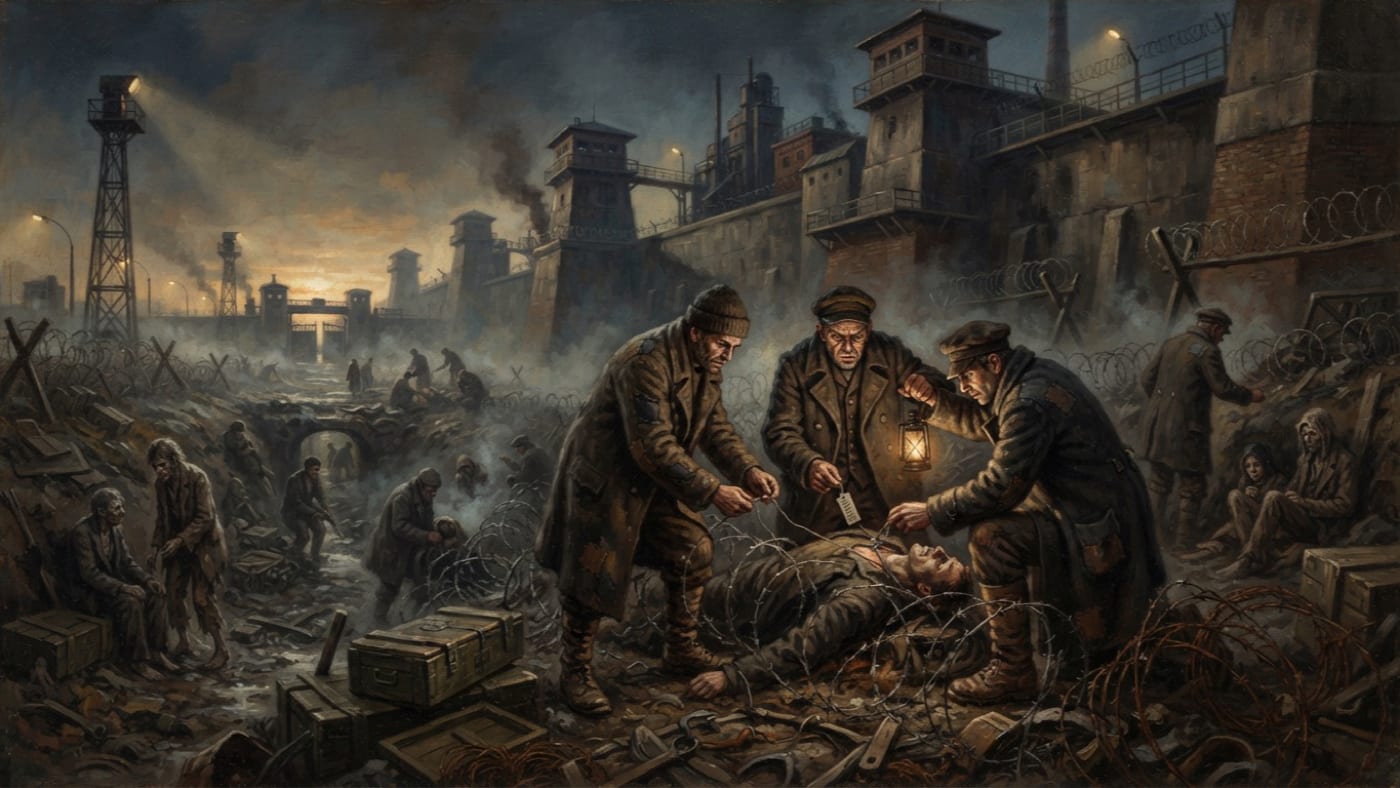
The Orchard has a word for attaching someone else's tag string to your own body: grafting. Every tag the Gleaners redistribute is a graft. The bastion account names the cell's central offence as swapping tags between the living and the recently dead. At three in the morning, a corpse in the wire holds a valid tag it no longer needs, and a living person in a safe pit needs one badly. Before the dawn patrol arrives, a Gleaner can move the one to the other.
The Orchard account adds a ledger of smaller crimes. The Gleaners return tags to widows, whose grief at Przemyśl is a matter for the auditors. They burn forged papers, for reasons the record does not give. They sell clean wire. They guide deserters under dead lanes, and the bastion account follows those routes through the Underwire into the marshes beyond the southern gate. Where the routes go after the marsh, and how many travellers reach the far side, this office does not know.
They also cut bodies down before the official harvest, when family payment can be raised. I set that condition in bold so that no sentimental clerk mistakes it for charity. The Gleaners work inside the same scarcity as everyone else at Przemyśl. Rope, lamp oil, tunnel labour and silence all cost something. A family that can pay gets its dead back with the name still attached and the body still fit for burial rites. A family that cannot pay gets the ditch-pits like everyone else. Mercy here comes with a price list. In this one respect the cell is fully orthodox.
The cell is also said to sabotage the harvest lists, the public boards in Taghouse Row where names appear and vanish overnight. Records already blames these changes on clerical optimisation, and the soldiers blame the Provost. A third set of hands in that ink would be hard to detect.
Earlier entries of this Codex gave the dawn harvest patrols the sole function of deserter recovery.
Corrected. The patrols recover deserters, refugees, smugglers, the tagless dead and the tags of the tagged dead, along with whatever the Gleaners failed to reach first. The deserter remains the harvest's official crop. It has never been the only one.
Grafting has been far more dangerous since A.S. 113. The Paper Plague taught the Synod that paper can lie. The Compulsory Marking Decree of the following year answered by writing on people. At forward checkpoints a body must now match its document, and inspectors check its marks against pigment charts and brand keys. A dead man's tag on a living woman's wrist is exactly the discrepancy they are trained to catch. When paper and flesh disagree, the wire settles the matter.
Tag-swapping continues all the same. The record does not say how the Gleaners get a particular grafted tag past a particular inspector, and this office will not invent a method. The culvert stalls teach one general rule: perfection draws Purity, so a good forgery limps. The cell evidently understands this as well as any broker.
#On Mercy Under Investigation
The Gleaners are heretics by any standard the Church cares to apply. Tag-swapping is identity fraud, identity fraud is sacrilege against the Great Ledger of Souls, and sacrilege against the Ledger is grounds for immurement. The bastion account states this plainly. The cell plainly knows it and goes on working anyway.
Arrested Gleaners are charged with theft of Synodal property. That property may be tags, wire, bodies or names. This list is the most honest document Przemyśl has ever produced. It puts the name and the corpse in the same column as the coil of barbed steel, and no one in the Tribunal sees reason to correct it. Sentences vary. The principle does not: whatever the wire catches belongs to the Synod, and anyone who takes it back is a thief.
The Gleaners' opponents work at both ends of the night. Provost-Marshal Vanna Rook commands the dawn harvest. Her patrols come back at first light with tags on strings, and the morning ledger must balance. The Chapel of Counting, under Archivist-Prelate Odran Kelle, works the other end with gentler tools. A tagless person may still confess and is encouraged to do so. A confession creates a trace, and a trace can be attached to labour, punishment, reassignment or a burial invoice. Once a tagless person has knelt at the grille, they are back in the index and the Synod's claim on them is restored.
The Chapel calls this recovery. The Gleaners call it capture-by-mercy. Both names describe the same hook from opposite ends of the line. The cell's whole practice works against that hook. It keeps people out of the index, puts them back under a name that is not theirs, or gets them into the marsh, where no index reaches.
Purges come at irregular intervals, usually after an audit finds too many bodies recovered privately and too few corpses left for the public to count. Between purges the bastion tolerates the cell as a man tolerates a rotten tooth: until it aches, and then with pliers. Nobody should mistake this for an agreement. Purity has been hostile since A.S. 183. Its enforcement has merely been uneven, and the Bureau declines to quantify the results.
No record available to this office links the cell to Atheron, whose Pride-host presses on Przemyśl from the eastern highlands. The Sin-General teaches men that they deserve a higher place. The Gleaners spend their nights in culverts helping people who have been told they do not count. Whatever their theology is, it does not appear to be his.
#On the Present Condition
As of A.S. 201 (1911 CE), the cell survives, and that is the only performance figure the record allows. The Bureau of Records does not know its membership, its losses or how many people it has carried through the ditch. The Gleaners are not volunteering a census.
Their constituency has grown. In A.S. 200 a stamp die was reported missing from Taghouse Row. Each emergency revalidation drive since has produced more expired persons than the previous count admitted was possible, and each failed tag sends one more person into the ditch-edge economy. The bastion's own modelling predicts tag inflation, ration riots and mass erasures if the die is not recovered.
The die's present holder is unknown, and nobody has charged the Gleaners with taking it. Plenty of officials would find that charge convenient, which is a poor reason to file it. If the cell could print valid lives, it would not need to strip tags from the dead. The bastion's files add one operational note: a posted mass hanging brings the Gleaners up out of the ground faster than any other notice in Przemyśl. The Provost may treat this as intelligence or as a warning.