
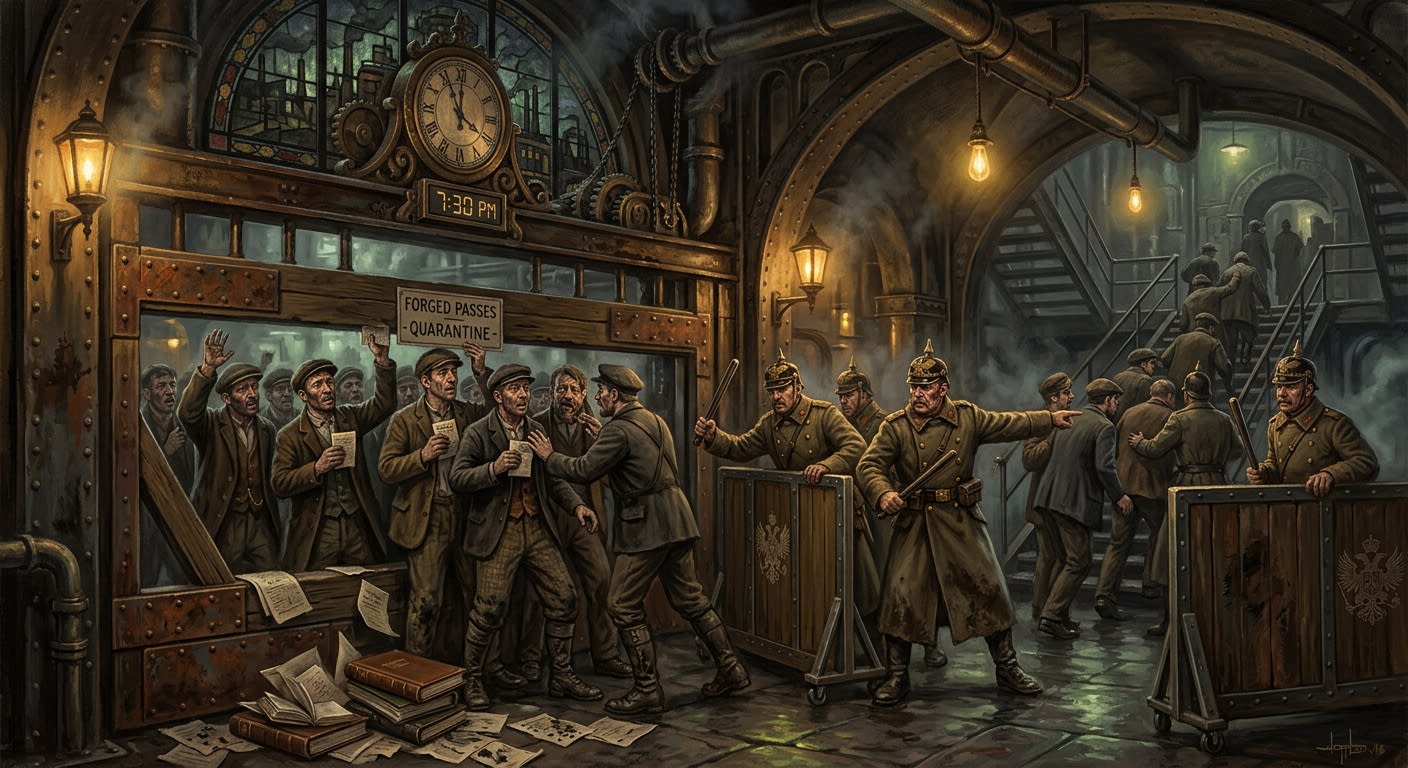
#On the Sickness of Documents
The Paper Plague of A.S. 112 was so named because the Bureau prefers contamination to incompetence. A disease can be quarantined, labelled, fumigated, and blamed upon climate, vermin, foreigners, or the Creator's inscrutable appetite for keeping clerks employed. Incompetence has signatures. Incompetence has supervisors. Incompetence, in the wicked arithmetic of administration, can be traced.
It occurred at Bastion-Przemyśl, the Wire Orchard, where the Sagittal Line enters the western Carpathian passes and every road learns to kneel before artillery. The fortress was already a machine of passage: refugees westward, ammunition eastward, invalids downward, priests everywhere, and paper flowing through it all in white, grey, blue, yellow, red-edged, ash-watermarked, bell-validated profusion. Transit permits. Kitchen permits. Chapel tokens. Muster deferrals. Ration slips. Ward rolls. Mourner exemptions. Clean-page affidavits. The whole city rustled.
Two hundred refugees entered the western perimeter carrying forged transit passes. That number has survived because Records loves a round figure once it has bled enough to appear grave. The passes were good. The seals were tolerable. The signatures had the correct tremor of overworked authority. The names existed in side ledgers, dead ledgers, duplicate ledgers, and in one case the ledger of a parish whose physical church had been ash since A.S. 97 but whose receipts remained lively. This, the Bureau assures us, was unusual.
#On the Western Perimeter
The western perimeter of Przemyśl was the wrong place for a pretty forgery to succeed. It contained a forward ammunition depot, a garrison pay office, two chapel hospitals, one records annex, a courier stable, three soup yards, an orphan transfer room, and enough stored powder to make the hill reconsider its contract with gravity. It was not a soft district. Soft districts have gardens, rumours, and local councillors who believe their opinions travel farther than their drains. The western perimeter had revetments, gate bars, wet sand, and boys with rifles taught to count wrists before faces.
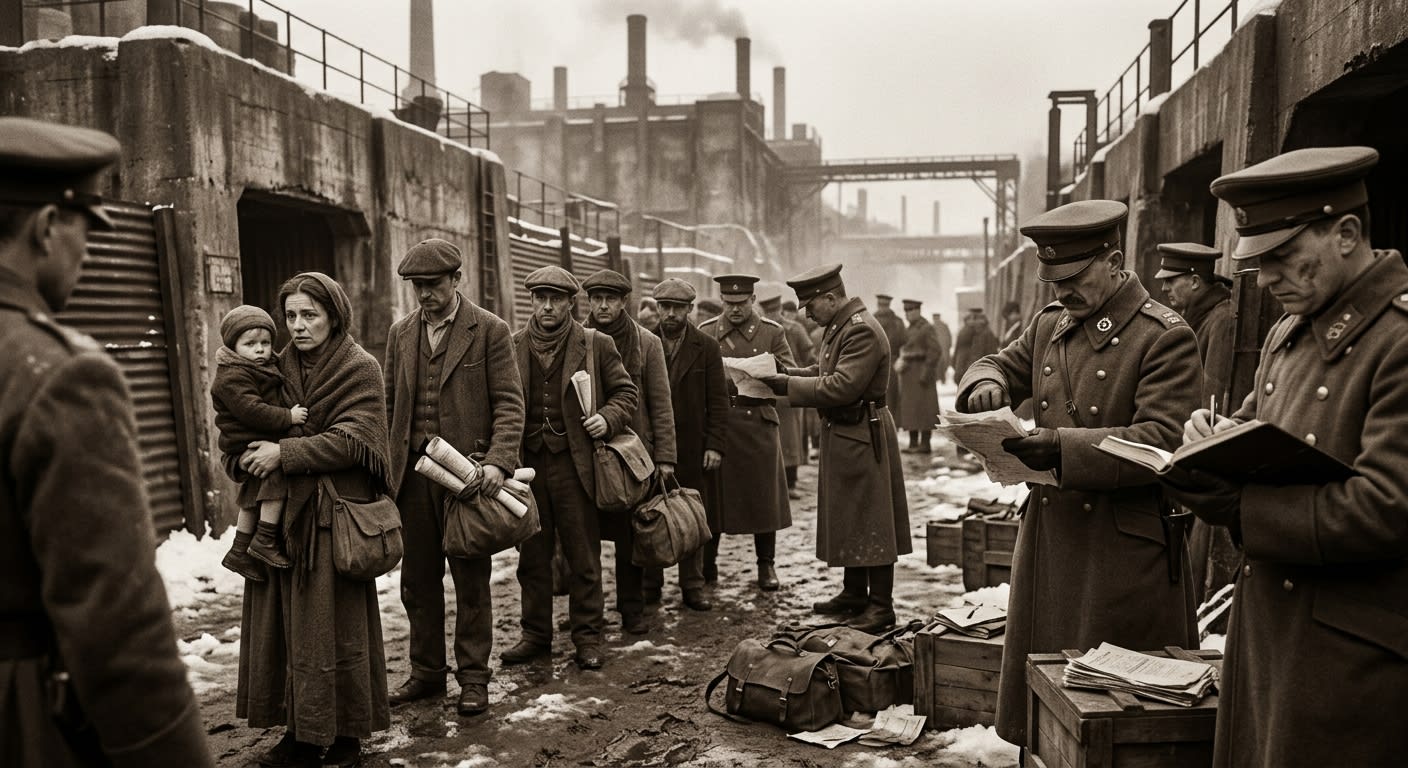
The refugees arrived in the second bell fog, when inspection lamps smoke badly and the line grows impatient enough to be dangerous. They came in family clusters: grandmothers with tin saints, men with workshop hands, women carrying bundles that moved, children too silent for children. Their papers named them as cleared displaced persons from three routes west of the Carpathian screen. Each packet bore transit endorsement, health notation, food allocation, and temporary quarter assignment.
The first desk passed them.
The second desk challenged eleven names and cleared nine after cross-check. The remaining two were routed to the bench and vanished from the first hour's summary because a bench count, unlike a body count, can be corrected after lunch. The third desk accepted the batch seal. A clerk later claimed the wax had been cold-stamped with a stolen die from Masks and Seals. Masks and Seals denied loss of any die. Records produced a receipt for the die's transfer. Heraldry produced a rubbing that matched neither receipt nor denial. Purity arrested the clerk, which simplified the meeting.
By third bell the two hundred were inside.
#On the Breach
No single explosion gives the Paper Plague its shape. This is inconvenient for painters and merciful for truth. The plague worked like paper works: by accumulation, duplication, misdirection, fold, seal, and handoff. One false family received quarters beside a powder-cart yard. One false labourer was assigned water detail near a shell store. Three boys with clean ward tokens entered the chapel hospital and left by the laundry exit wearing stretcher-cloth. A woman registered as a widowed seamstress delivered a sealed packet to a paymaster's door and walked away with the serene expression of a person who knows the state is already behind her.
Then the district began to fail in small official ways. A powder wagon appeared on the wrong ramp. A gate roster listed twelve sentries on a post that held eight. The courier stable released horses to a rider whose pass contained an obsolete route mark, a mark that should have been invalid after the A.S. 108 road revisions but remained honoured by habit. Habit, like mould, grows best in warm offices.
The first deaths occurred at the auxiliary magazine, where a guard refused passage to a cart whose writ had the correct seal and the wrong smell. The cart overturned during inspection. The official report uses the word ignition. Survivors use shorter words.
WESTERN PERIMETER CASUALTY ABSTRACT — A.S. 112 Magazine-yard dead: ██ Chapel-yard dead after secondary panic: ██ Sentry post unaccounted: █ Children separated during lockdown: ███ Bodies later reconciled with intake names: █ Bodies bearing names not present in intake ledgers: █████████ Recommendation: classify identity discrepancy under Paper Plague master file; avoid separate public enumeration.
Eighty-seven died in the first accounting. The second accounting produced ninety-one. The third returned obediently to eighty-seven after Records determined that four persons had been dead under the wrong names, which in Bureau mathematics means they had not increased the dead, only improved their paperwork.
Initial Przemyśl notices blamed “refugee-borne contagion” for the western perimeter deaths.
Corrected. The contagion was documentary. The bodies carried forged papers, stale endorsements, stolen custody marks, and enough contradictory authority to pass through three desks. Disease did not open the gate. Form did.
#On the Three Days of Lockdown
The gates sealed before Sext. Przemyśl under lockdown becomes less a fortress than a clenched jaw: rail mouths barred, ration queues frozen, chapel bells muted to hand-strike, tunnel doors pinned, officers moving in pairs because solitude permits blame to find a throat. No person could leave the western perimeter without full re-documentation. No person could enter without counter-signature from War, Records, Settlement, and whichever frightened sub-office happened to own the nearest stamp.
Three days. Enough time for bread to harden, wounds to sour, tempers to ripen, and the dead to begin making their usual administrative demands.
Families were split into categories: verified, pending, compromised, unclaimed, and hostile by association. Verified persons received chalk marks on the sleeve. Pending persons received bench tags. Compromised persons received rope. Unclaimed children went to the orphan transfer room, where an Orphanage Registrar recorded eighty-three names in one afternoon and later confessed she had heard the same lullaby from six unrelated mouths. Hostile by association remained a flexible category, as all useful categories do.
The chapel hospitals ran out of clean linen by the first night. The soup yards ran out of patience sooner. A priest of the outer ward attempted to shrive a bench of pending persons without identity confirmation and was reprimanded for sacramental imprecision. A lieutenant ordered a latrine trench cut through an old filing cellar and unearthed six crates of pre-revision travel chits, which caused three offices to request custody before anyone requested a shovel.
On the second night, the western perimeter bells rang the wrong sequence twice. One relief column turned back. One clerk soiled himself in the duty room. One sentry fired on a cart of surgical alcohol because the mule's ear tag had been listed under fodder rather than transport. Przemyśl survived, which is what Przemyśl does. Survival is not vindication. Rats survive theology.
#On the Blame Liturgy
The blame liturgy began while the smoke was still undecided. War blamed Records for accepting false writs. Records blamed Settlement for household instability, route churn, and the sinful human habit of moving after one's district has become artillery practice. Settlement blamed the refugees, who were dead, imprisoned, vanished, or too hungry to defend the grammar of their existence. Heraldry blamed paper.
Heraldry won.
This victory was less inevitable than later catechisms pretend. War wanted stricter gate discipline and more rifles at desks. Records wanted better ledgers, which is Records' answer to famine, plague, invasion, marital unhappiness, and spilled ink. Settlement wanted improved route consolidation, meaning larger holding yards and smaller consciences. Purity wanted permission to search mouths for hidden seals, a proposal defeated only because Medicine objected to the projected biting statistics.
Heraldry supplied the sentence that conquered the room: paper can be stolen, copied, burned, soaked, altered, inherited, swapped, eaten, forged, blessed, re-blessed, and found under a dead man's tongue. Flesh travels with the culprit.
Within months, the jurisdiction of the Geometry Brand-Smith Corps expanded beyond heresy classification into general identity authentication. A mark would walk with the body. A tri-mark would tell the gate what the paper might conceal. A child, a soldier, a pilgrim, a penitent, a ward, a civilian, a condemned man: each would carry the state in scar form.
The Compulsory Marking Decree followed in A.S. 113.
Older War lectures refer to the Paper Plague as a tactical breach caused by inadequate sentry aggression.
Rejected. Sentry aggression killed mules, clerks, and one chapel orderly during the lockdown. The breach entered through desks. War may keep its rifles polished; the file remains documentary.
#On the Marks That Followed
The first lesson of the Paper Plague was that a document lies at a distance. The second was that a body can be made to lie more locally, with heat.
The Decree required tri-marks at forward-zone checkpoints: civilian, military, clerical, ward, penitent, pilgrim, condemned. Brand-Smiths tripled in count, or rather the ledger tripled and men with irons were instructed to become the number already written beside their office. Angle-Runners came from orphanage rolls. Frame-Hands received three-week certificates. The Bureau of Doctrine called the courses adequate, and that word has never deserved forgiveness.
Przemyśl became the exhibit. Delegations from Brest, Irongate, Shipka, and Constantinople toured the western perimeter, read the casualty abstracts, inspected the reformed desks, and watched trial marks applied in a chapel yard still dark at the threshold. One visiting officer fainted. His staff claimed heat. The day was cold.
The new order reduced paper fraud at gates. It also produced Shadow Angle crews, mercy downgrades, false guild tri-marks, unbrandings, missing irons, and the glorious civic refinement of making a man's skin appeal against his mouth. Six years later, at the Angle Riots, a miscalibrated iron at Bastion-Irongate transformed 1,400 civilians into apparent heretics, sent forty-seven to the Paper Mines of Ulm, and killed eleven under Standing Order 22-D before correction caught up with murder.
The Paper Plague did not end paper. Let no idiot make that claim in my hearing. Paper multiplied afterward: mark ledgers, scar registers, swatch plate custody forms, brand-iron serial chains, bench correction sheets, appeal packets, quarantine forms, anomalous geometry reports. The body became a document, and paper became the document proving the document had properly entered the body.
Perfectly sane. Utterly Strasbourg.
#On the Present Condition of the File
By A.S. 201, the Paper Plague sits in the manuals as a clean causal hinge: forged passes at Przemyśl, eighty-seven dead, three-day lockdown, Heraldry correction, Compulsory Marking Decree. Students love a hinge. A hinge suggests the door moved obediently. The file itself is uglier: missing children, contradictory bodies, stale route marks, a cold-stamped die no office admits losing, families classified by proximity to forged ink, and four deaths removed from the count because the names were inconveniently dead already.
Przemyśl still keeps a sealed drawer of confiscated passes from the incident. Once each year, under inspection by Records, Heraldry, Purity, and War, a clerk turns the packets with bone tongs and verifies that the seals have not altered. Two packets have darkened. One bears a thumbprint that was not present in the A.S. 130 rubbing. The Bureau of Doctrine classifies this as storage discolouration.
The western perimeter desk where the first batch passed is gone. Officially it was replaced during the A.S. 119 gate refurbishment. Unofficially, a Brand-Smith bought one plank from a demolition porter and keeps it under his chapel brazier at Przemyśl. He claims irons heat cleaner above it. He is a fool, naturally. The Bureau has inspected the brazier three times.