
#On the Year Paper Lost Its Skin
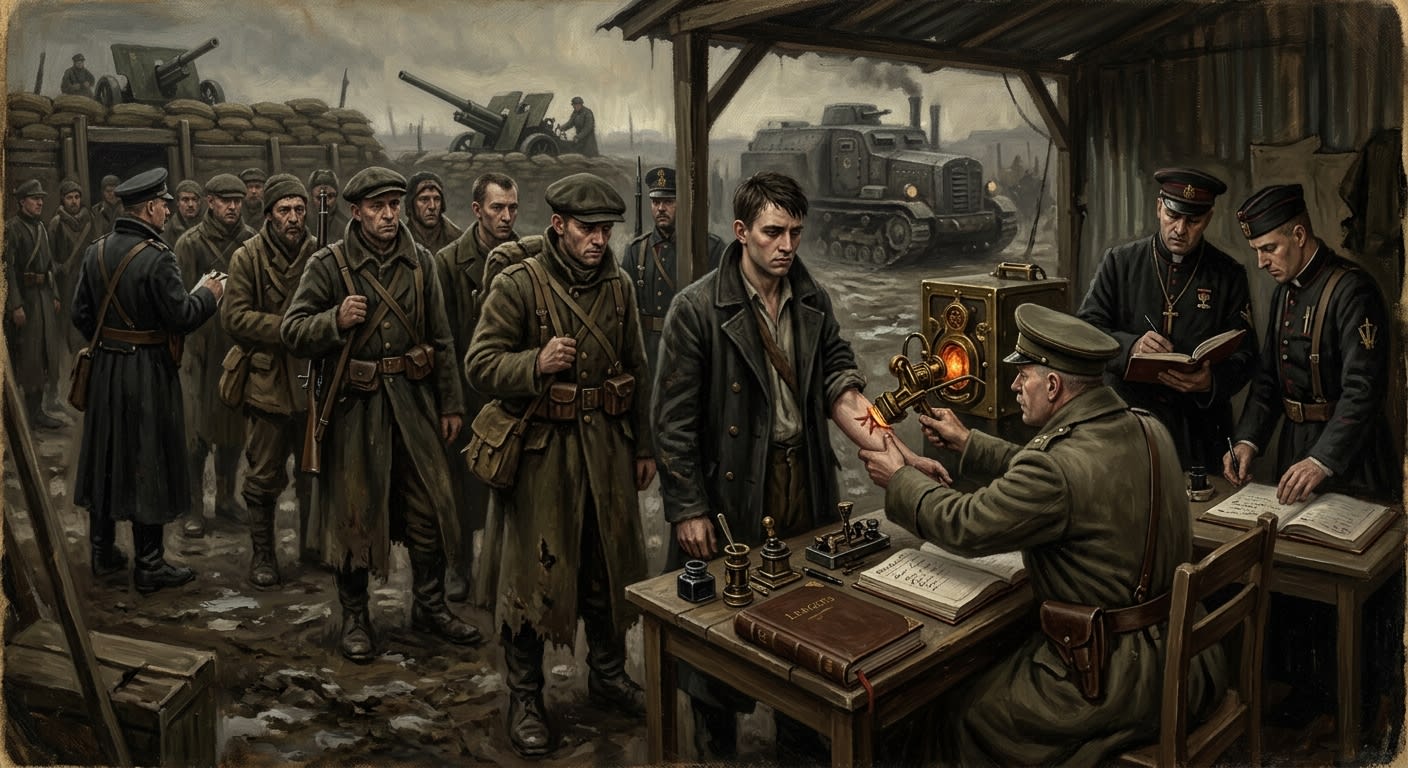
The Compulsory Marking Decree of A.S. 113 is the moment the Synod admitted, with the usual incense and denial, that paper could no longer be trusted to describe a human being. Before the Decree, a forward-zone traveller carried papers: transit writ, ration chit, baptismal note, labour licence, clearance token, or the sweaty little fraud that passed for one after a cousin with good ink and bad morals had finished helping. After the Decree, the traveller carried skin.
Every person passing a forward-zone checkpoint had to bear a tri-mark corresponding to class: civilian, military, clerical, ward, penitent, pilgrim, or condemned. The mark did not replace the document. Mercy forbid efficiency of that vulgar sort. The mark accompanied the document, corrected the document, overruled the document, accused the document, and, in cases of contradiction, sent the document to appeal while the body remained in custody.
The Bureau of Heraldry originated the Decree. The Bureau of Purity enforced it with tongs, escorts, Lictors, and that fresh white enthusiasm with which Purity approaches any opportunity to turn doubt into screaming evidence. Attribution matters because Bureaus care who receives blame after the corpses cool. Heraldry supplied the geometry. Purity supplied the appetite. Records supplied volumes enough to bury the difference.
#On the Paper Plague at Przemyśl
The Decree's blessed parent was catastrophe.
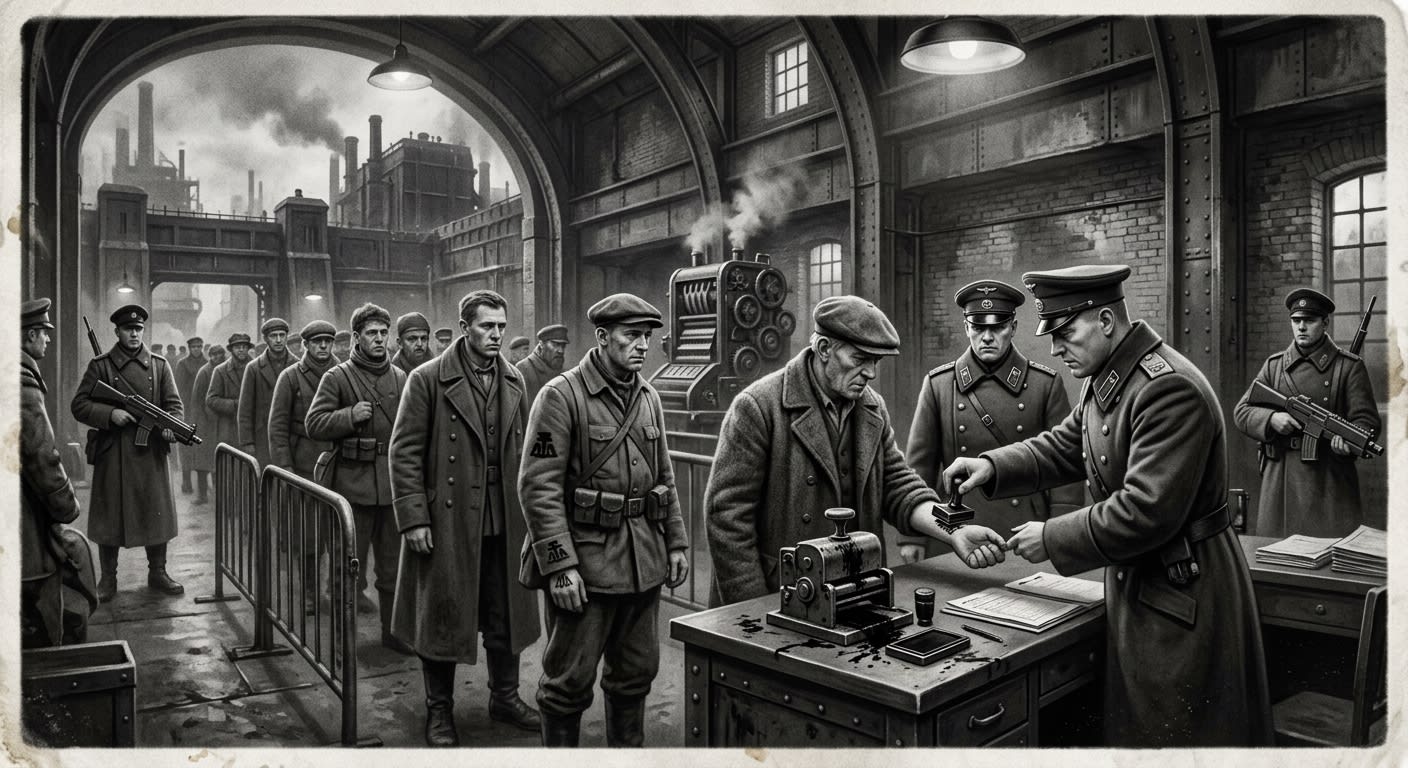
In A.S. 112, forged transit passes carried two hundred refugees with falsified identities into the western perimeter of Bastion-Przemyśl, the Wire Orchard, where the Carpathian fortress keeps its ammunition, sickbeds, rail mouths, ration depots, chapel bells, spare lungs, and several varieties of officer vanity packed much too close together. The passes were good. The seals were credible. The names matched enough ledgers to pass hurried inspection. The witnesses were either bribed, frightened, imaginary, or dead. This is a broad category in wartime and an excellent argument for never trusting anyone with a face.
The refugees entered the garrison district. What followed is filed as the Paper Plague because the Bureau prefers diseases to decisions. Eighty-seven dead. Three days of lockdown. Ammunition wagons halted under wet tarpaulin while priests argued over whether false identity carried spiritual contagion. Children in the holding yards learned that crying without a number earns no bread. The western perimeter bells rang the wrong sequence twice, causing one relief column to turn back and one clerk to soil himself in a manner later omitted from the duty log.
The blame liturgy began before the injured were counted. War blamed Records for accepting false writs. Records blamed Settlement for unstable household assignments. Settlement blamed the refugees, who were dead, imprisoned, vanished, or too hungry to employ advocates. Heraldry blamed paper. Heraldry won because Heraldry had the sharper metaphor and the cleaner solution.
Flesh is difficult to misplace.
Early district sermons taught that the Decree arose from a Purity finding against refugee deceit.
Corrected. Purity supplied enforcement after Heraldry's petition had already named paper as the compromised instrument. The refugees were used as evidence, meat, and theatre. They did not author the Decree by existing under bad stamps.
#On the Text of the Decree
The Decree is short, which is how one knows lawyers were kept away from its first draft. Its operative sentence occupies three lines in the Heraldry register: every individual crossing a checkpoint within forward-zone jurisdiction shall carry a bodily tri-mark, applied by licensed Geometry Brand-Smith or designated provisional hand, corresponding to recorded class, subject to inspection, challenge, correction, escalation, and immediate security action.
Immediate security action is the hinge. It means a guard may treat the mark as truer than the mouth, truer than the paper, truer than the old woman clutching a baptismal copy from a parish burned before her granddaughter was born. A civilian mark admits. A pilgrim mark routes. A ward mark transfers. A military mark musters. A clerical mark delays long enough for another office to become irritated. A penitent mark humiliates with devotional neatness. A condemned mark simplifies the guard's afternoon.
The seven classes were chosen for administrative completeness and moral cruelty. Civilian, because the Synod requires a category for people it has not yet consumed. Military, because boys must become numbers before they become casualties. Clerical, because even priests need a triangle when passing guns. Ward, because orphanage children are property with knees. Penitent, because shame travels better when visible. Pilgrim, because piety without route control becomes migration. Condemned, because the state dislikes ambiguity at the scaffold.
The Decree required marks at checkpoints, bastion gates, forward ration arches, levy yards, refugee intake roads, quarantine cordons, and selected bridge approaches where smugglers had grown sentimental about ink. Rear territories adopted softer variants later, of course. Rear territories always begin by condemning forward measures as emergency barbarity and end by requesting the forms in a tidier font.
#On the Corps That Tripled Overnight
The Decree tripled the Brand-Smith Corps overnight. This phrase appears in the manuals with a pride that should be tried in court. A corps does not triple overnight. A ledger triples overnight. Flesh catches up later, badly.
Licensed Brand-Smiths were pulled from chapels, tribunals, debt halls, orphanage intake rooms, levy offices, and those discreet little annexes where Purity marks people whose families receive euphemisms instead of bodies. Angle-Runners were recruited from orphanage rolls: quick children with narrow wrists, sent between brand tables with swatch plates, water, salve, witness tags, and instructions not to faint where the client could see. Frame-Hands received three-week certificates authorising them to clamp measuring frames, align limbs, hold skin taut, and repeat whatever the Brand-Smith said with sufficient confidence to sound trained.
The Bureau of Doctrine later called the courses adequate to the task, which is the sort of compliment one gives a bridge while standing on the riverbank.
TRAINING SUMMARY — FRAME-HAND COURSE, STRASBOURG FORWARD INTAKE, A.S. 113 Total candidates: ███ Completed: ███ Dismissed for tremor: ██ Dismissed for sympathy: █ Subject injury during practice: █████████ Instructor note: “Class understands triangle in outline. Recommend deployment where supervision exists.” Deployment authorised: yes
The brand chapels changed shape. Waiting benches multiplied. Coal braziers burned through the night. Iron racks were labelled by class. Swatch plates hung beside prayer cards. Brand-Singers learned shorter cadences for intake lines because the full penitential rite, lovely though it may be to the sadist with a trained ear, cannot process three hundred wrists before curfew. Scribes began stamping form headings in advance and trusting the names would arrive. Names, obligingly, did.
#On the Checkpoint as Chapel
The Decree made every checkpoint a small chapel of classification. A traveller entered between two rails. A guard read the paper. A clerk read the ledger. A Brand-Smith, Quick Burner, or authorised provisional hand read the skin. Three readings entered the air. Agreement permitted passage. Disagreement produced a bench, a hold-tag, a whispered prayer, or a Lictor's hand on the shoulder.
At Brest, the flat trench sectors turned marking into weather: wrists out in rain, frames slipping, boys shivering under tar cloth while the Bug River carried spent cartridge boxes past the bridge-fortress. At Shipka, time-fog made inspection maddening; a pilgrim mark applied at dawn could look older by Sext, or the bearer could swear it had been applied yesterday by a man not yet born. At Constantinople, the Bosphorus poured whole peoples into intake queues, and the Quick Burners there developed a wrist-turning motion so fast that Purity suspected witchcraft until Heraldry praised output.
Przemyśl remained the model and the warning. No one entered the western perimeter after A.S. 113 on paper alone. The Wire Orchard did not trust ink that could be folded. It trusted the triangle hissing into flesh, the witness seal cooling beside it, the entry made while the burn still shone.
A checkpoint manual of A.S. 114 instructed guards that “the mark alone suffices when documents are delayed.”
Withdrawn after three desertion cases, seven ward misroutes, and one condemned man who crossed two districts under a pilgrim triangle applied to the wrong wrist. The approved phrasing: the mark governs provisional action pending documentary reconciliation. The condemned man was recovered. The pilgrim whose wrist received his class was not.
#On the Troubles It Purchased
The Decree worked. Let the Ledger suffer the honesty. Forged transit passes lost much of their charm when challenged by bare skin. Ration queues shortened at some gates. Military police could sort levy-age boys faster than families could hide them under shawls. Orphanage Registrars found ward transfers easier to enforce. Pilgrim columns stopped shedding half their sinners into sympathetic towns. Condemned labour carts arrived with fewer disputes about whether the unfortunate man chained at the back had a cousin's cleaner papers hidden in his boot.
The Decree also created a market, a riot, a priestly vocabulary for scar tissue, and the professional exhaustion of men who began seeing triangles in soup foam.
The market came first. A mark that opens a gate can be sold. A mark that bars a ration arch can be softened. A mark that sends a boy to the levy can be shifted down to civilian if the family owns enough silver, a back room, and an acquaintance with Shadow Angle crews. Unbranding, counter-branding, false guild tri-marks, identity upgrades for deserters, downgrades for condemned men seeking penitence—all these grew from the Decree like mould on blessed bread.
The riot came later and wore lawful geometry. A.S. 119 brought the Angle Riots at Bastion-Irongate, when miscalibrated irons applied second-category heresy marks to 1,400 civilians during a Purity sweep conducted under forward-zone identity regulations. Three hundred detained. Forty-seven sent to the Paper Mines of Ulm. Eleven executed before correction. Re-inspection Brand-Smiths were born because the state required a new profession to apologise without apologising.
Tool-serial tracking followed. Every iron had to be traceable from maker to issue desk, from issue desk to chapel, from chapel to cart, from cart to hand, from hand to scar, from scar to complaint, from complaint to somebody less important than the officer who signed the requisition. Heraldry called this accountability. The citizens called it late.
The post-Irongate amendment reduced custody to a clerk's rosary: no iron without serial, no serial without maker, no field application without custody sheet, no correction without superior mark, no superior mark without ledger reconciliation, no reconciliation before the injured learn patience.
#On the Present Application
As of A.S. 201, the Compulsory Marking Decree remains in force across forward-zone checkpoints and has seeped, through amendment, habit, and bureaucratic envy, into half the rear. The licensed Geometry Brand-Smith Corps numbers roughly 6,400; the unlicensed number is larger wherever hunger, desertion, debt, or love has made the legal mark intolerable. Heraldry knows. Purity knows. The person with a wrong triangle knows first.
Brand-Smith factions recite the Decree differently. Licensed Chapels call it the moment flesh became worthy of law. Quick Burners call it the day the line got too long for ceremony and never shortened again. Mercy Branders call it their founding mercy, because a harsh mark invites a softer hand. Shadow Angle crews call it advertisement.
The Decree's defenders point to Przemyśl: eighty-seven dead, three days locked, forged papers in the ash. Its enemies point to Irongate: eleven executed by a mark that lied with lawful heat. The Bureau points to the current checkpoint tables, where disputes have decreased, passage has accelerated, and appeals have been assigned a separate office with no public window.
The triangle endures because it answers a question the Synod cannot stop asking: who are you, by what authority, and how quickly may we act upon the answer? Paper replies. Witnesses stammer. Flesh, once burned, speaks in a grammar guards can read at ten paces.