
#On the Signal That Moves the Street
This survey, filed in A.S. 201, describes graduated dominance as the Counter-Toll Corps practises it today. It covers nothing older. Nobody knows when the doctrine was first issued, or at least nobody the Bureau of Bells lets me ask. I will not borrow a date from the nearest convenient catastrophe to fill the gap.
Graduated dominance is the procedure by which a Counter-Toll Operator answers a hostile tone with sanctioned peal. The operator hears the tone and proves it hostile, obtains the right to drown it, drowns it at the smallest scale that will serve, watches what the drowning does to the street, and writes everything down. Those are six duties. The Bureau would prefer I called them one.
The consequences are physical. The Bellways tell a city when to stand to, when to march and when to bolt its doors. A counterfeit curfew empties a market at the wrong hour. A forged peal halts a convoy at the wrong gate. A crowd that hears two authorities at once runs toward neither of them, and then it runs over itself. Overwrite restores the lawful cadence, and the lawful cadence restores the routes people walk.
The Bureau's sermons claim more than that. They say the bell is obedience itself and that the drowned tone takes the sinner's will down with it. The Bureau is entitled to its homiletics. Read plainly, the protocol governs sound and the feet that follow it. What a man chooses inside a corrected street remains a matter between him and the Creator, and the Bureau of Bells keeps no ledger for it.
#On Listening and the Right to Answer
Everything begins at the ear. The operator must establish three things: the direction the hostile tone comes from, its cadence signature and its resonance footprint. Meters of stretched wire and brass plate help. The peal charts say what ought to be ringing where. A Bellwarden upstream may already have reported drift. The judgment is still a human one, made by a person in a brass-and-leather ear-mask with chalk cadence marks drying on the forearms. The present published account, given in the Clean Silence survey, requires two listeners to verify the source before any escalation. A peal rung on one man's hearing is a rumour with bronze behind it.
The operator then selects a sanctioned dominance pattern and pairs it with a harmonic mask. The pattern is the lawful sound that will be laid over the hostile one, and the mask is issued with it. The Corps does not print what either is made of in a Codex that any literate smuggler can buy. I follow the Corps in this, and gladly.
Authority comes next, in two forms and in a fixed order. First the operator presents the wax-seal authority slug, then speaks a confirmation into the console. The wax proves the order exists, and the voice proves who is giving it. For Hard Dominance and Full Wash, the present account also requires the living key, a phrase bound to the operator's own throat. That requirement was adopted after the Mimic Incident. The slug, the spoken phrase and the console's timing are meant to be read together, and auditors do read them together later.
The doctrine has no remedy for its own appetite. The instrument of verification is the operator's ear, and the instrument of authority is the operator's throat. Each shift in the vault, among the hot oil, the brass dust and a vibration that settles in the teeth, uses up some of both.
#On the Three Bands
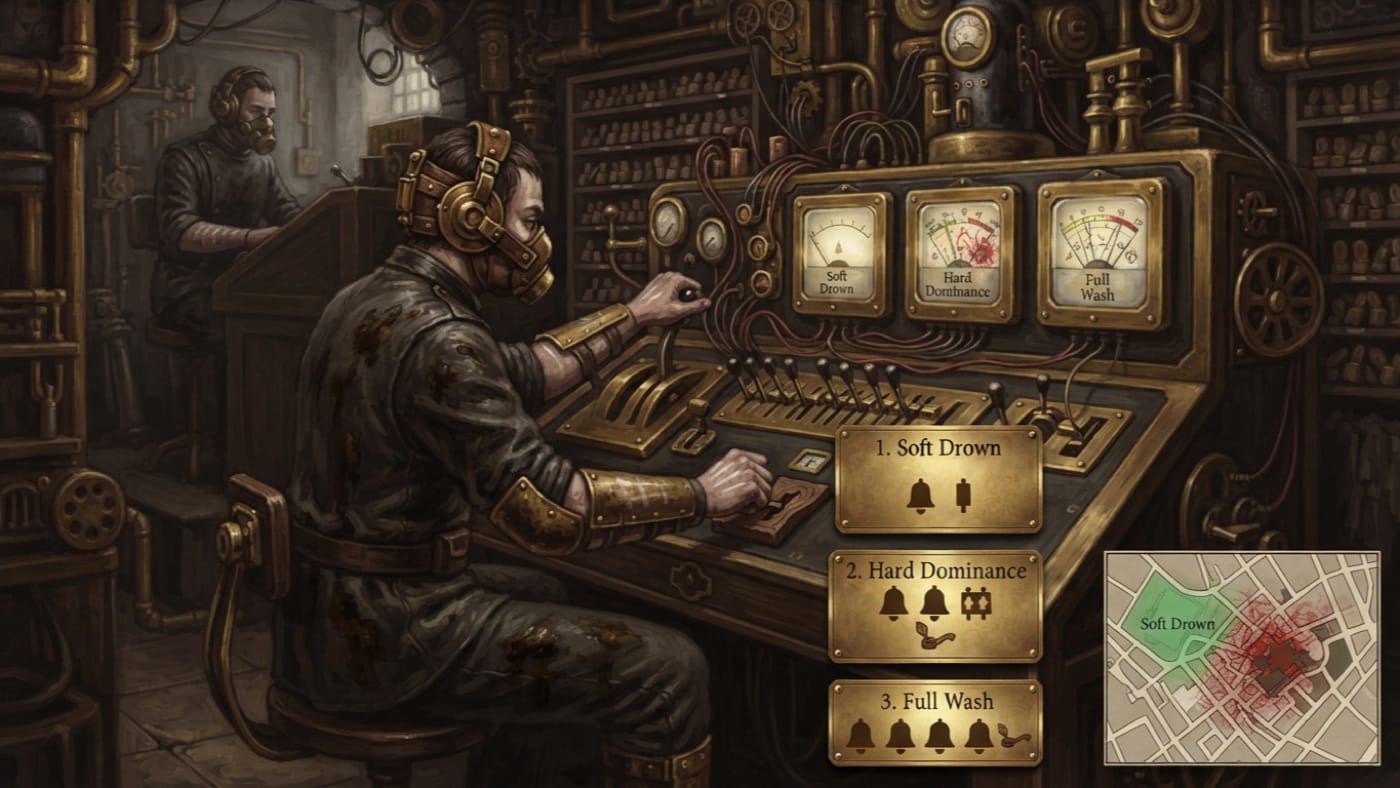
The bands are a ladder, and every rung has its own signatory. Soft Drown presses sanctioned peal over the hostile tone within one corridor on a Node Captain's word. If the tone persists, the operator may request Hard Dominance, which covers the district on a Dominance Marshal's authority. Hard Dominance rattles windows, sheds plaster and makes grown men clutch their jaws. If the tone survives even that, Full Wash takes the whole city, and only a Timing Prelate may order it.
Persistence justifies a request for the next band. It confers nothing else. A Node Captain whose Soft Drown has failed does not thereby acquire a district. He asks for one, and someone of higher rank answers.
Novices are misled every season by the gentle name of the first band. Soft Drown is still overwrite: lawful sound placed on top of hostile sound, done at limited scope. Hush, dampening and attenuation plates belong in another column of the Corps' ledgers. Clean Silence prefers that column. Graduated dominance does not include it.
Volume guarantees nothing. The things that ring foreign bells in the Church's cities are not always deterred by being out-rung. The operator escalates when the tone has not decayed and the authority has been granted. Frustration is not grounds for escalation.
"...the Operator may request a full district wash..." — Counter-Toll Operator entry, On the Method; the same entry assigns that order to a Dominance Marshal in On the Present Condition.
The Counter-Toll Operator entry's own classified block and the Clean Silence survey both state the governing rule: Full Wash is city-wide and requires a Timing Prelate. The narrative wording quoted above does not match that rule. It does not describe a fourth band, a Marshal's delegated power over a city, or a later amendment. It is a slip in the prose, and the table governs.
#On the Street After the Peal
The overwrite is running. The operator now watches two things at once: whether the hostile tone is decaying, and how the crowd is moving. The trade's process requires adjustment to prevent a stampede. Under the present account, a dominance that panics a street counts as a failure in every school's ledger. These are separate observations. A hostile tone can fall silent above a square that is crushing its own children. Routes can steady while the chapel glass lies in the gutter. All of it must be seen, and all of it must be written down.
The listening the protocol depends on is also the faculty the vault ruins. Bell-sickness, recognised throughout the profession, begins with phantom peals: bells heard ringing that are not ringing, and bells that rang three days ago. Compulsive cadence follows, with fingers tapping strike ratios into the console's oak rim. In the last stage the sufferer cannot bear silence at all. A second listener in that condition is a second voice in the operator's own head, and the protocol counts it as corroboration. An operator whose voice cracks halfway through a confirmation phrase has a failed authentication on file. The Corps keeps the schedule that spends these ears and throats, then relies on them to certify its work.
Then comes the record. It covers the event and the interference: the source, its strength, its decay and its recurrence. It also covers the damage and the status of the corridor. The corridor is either certified as clean dominance or flagged for quarantine, and the authority trail of wax, voice and band stays attached to the entry.
Auditors then compare the log against three things: wear on the arrays, the history of voice confirmations, and the records of crowd flow. The trade has a proverb for this, wear is confession. A certificate on its own proves only that someone owned a pen.
#On the Sound That Answers
Ring-back is the boundary of the doctrine.
Ordinarily a hostile tone under overwrite decays. In a ring-back it does not. It mirrors the overwrite and answers in its own cadence, giving the vault's argument back to the vault. Since A.S. 178 the Bureau of Bells has reported a series of these incidents. Three were in Strasbourg, where they are filed as calibration anomalies.
That is the whole procedure, and it is not a step on the escalation ladder. The operator does not request the next band. The operator does not try a louder pattern or a cleverer mask, and does not stay at the console to listen for whatever the answering tone wants. Hands come off the actuators, the vault is sealed and a Marshal is called. What the Marshal does after crossing the threshold is the Marshal's office. This survey does not record it.
The Mimic Incident explains why the living key exists. Published accounts leave the bastion unnamed and the year unstated, and I will not fill in either. They report a hostile tone that copied official patterns closely enough to redirect a garrison's movements for seventeen minutes before cadence was restored. That figure describes the breach. It is no measure of how long anyone may safely stand in such a sound. The Clean Silence survey adds that the tone met the first Soft Drown in perfect counter-shape.
Bells files the source as unknown. The doctrine of the Church attributes this borrowing of lawful voices to the habits of the Great Deceiver. That is the doctrine's reading, and I record it as a reading. The Bureau has also said that a voice cannot be forged. The incident that brought in the living key was a forgery of official sound. The requirement stands, and so does my scepticism about the assurance.
#On the Present Holding
The Corps has two schools of preference. Loud Mercy favours early, aggressive overwrite, drowning the hostile tone before the street notices that a second authority has entered it. Clean Silence favours dampening, local hush, attenuation plates and counter-cadence traps, so that fewer windows are lost for the same obedience. Both salute Canon Veyl's fork in its glass case, each in its own manner. They quarrel in memoranda that end under the same seal.
Neither school has its own chain of command. The ladder of Node Captain, Dominance Marshal and Timing Prelate binds both. So do the two listeners, the slug, the voice, the living key, the watch on decay and crowd, the log, and the cessation at ring-back. Neither school holds a licence for contraband dampeners. Neither has a ledger proving its method spares more citizens across every corridor of the Line and the cities behind it. The Bureau has ruled on neither. Under the Bell Codex the lawful hour still sounds the same, whichever school defends it.