
#On the Approved Designation
The High Censor's Advisory is the name the Bureau of Records provides whenever talk drifts toward the Council of Veils. Its charter, if it has one, has never crossed my desk. Its members, if it has any, appear on no roll I am cleared to read. One thing about it is beyond dispute and set down in good black ink: the instruction that created the wording. Any clerk in Strasbourg who receives an order with no recoverable author must still file it under some heading. Before the Revision he had only a rumour to write in the margin. Now he has a title.
To a frightened hand, a title is a mercy. It fits on a docket line. A lector in the cathedral precinct can read it aloud without lowering his voice. It lets an official admit that advice was given at the summit of the Inquisition while saying nothing at all about who gave it, how many gave it, or whether "who" is still the right word.
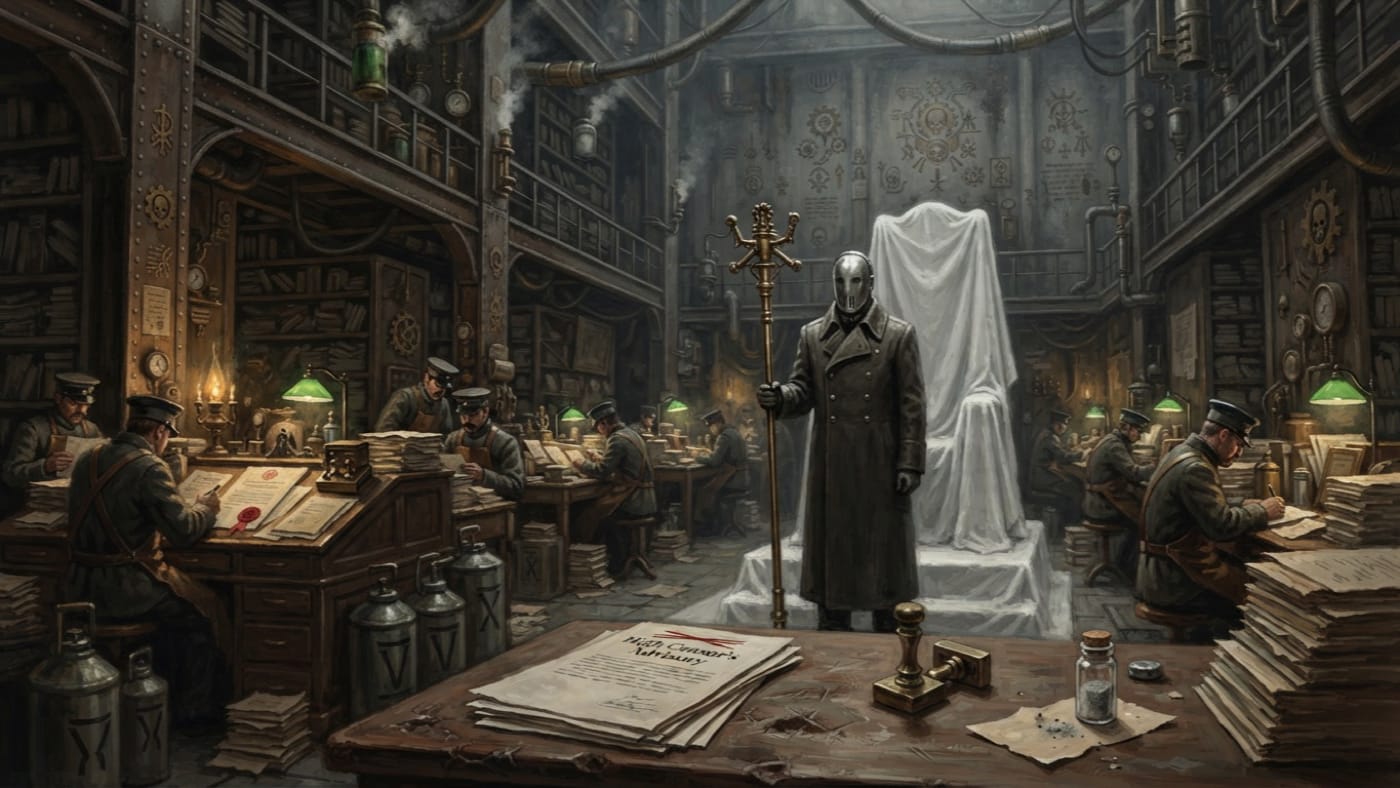
Rumours persist of the Council of Veils, a cloister-within-the-cloister, said to inhabit the High Censor's mask itself.
Records, Fourth Revision: "Replace all references to 'Council of Veils' with 'High Censor's Advisory.' Strike mention of smoke minutes. Friction is fuel."
#On the Censor and the Advice
The possessive carries the weight. By Doctrine's reckoning the High Censor of Strasbourg sits at the peak of the Inquisition, and the Advisory belongs to the Censor grammatically. Beyond grammar, the phrase says nothing about who holds it. The Censor may direct the Advisory. The Advisory may speak for the Censor. Or the Censor may be what the Advisory speaks through. All three readings survive the apostrophe. I have tested each at my desk by candlelight and could break none of them.
The Censor is rarely seen, and the accounts disagree. Some hold that the mask passes from inquisitor to inquisitor so that no one man becomes indispensable. Others hold that the mask is empty and moved by Providence, with a voice of no age and no sex. Rumour, set down by better men than it deserved, places the Veils inside that mask. Records changed the rumour's noun and left its address alone.
The Bureau of Doctrine proclaims that the Inquisition answers only to the High Censor. A redacted Records ledger once offered the opposite: that they answer to no one. Both positions remain on file and neither has been withdrawn. Doctrine calls this a double truth. I have signed my name under worse.
The word "advisory" slides into that gap like a warm blade under a seal. In the ordinary sense of the word, advice binds nobody. An inquisitor who acts on advice has acted on his own authority. A Censor who receives advice has received nothing that must be disclosed. When the paper is filed, the word turns command into counsel. When the door is broken down, it turns counsel back into command. Elegant. Disgusting. Mine to defend.
#On the Seventh Seal's Intermediaries
Since A.S. 107 nobody has publicly attended the Empty Throne of War, and the law has counted it occupied in absentia the whole time. That is ninety-four years by this survey. Orders under the Seventh Seal still reach the Bureau of War through intermediated writs and countersignatures, and through signatures that change every quarter. The guns are fed and the clerks file.
My own entry on the Throne repeated the Strasbourg muttering that the Veils work through the chair's absence and that the Advisory is their public alias. I let both stand as muttering, and they stand as muttering here. No War order has been authenticated as the Advisory's work. No countersignature examined so far carries the designation in a hand anyone can name. The connection lives in the air of the Inner Circle, along with the dust on the white cloth.
What the connection gives the clerks is a word. A garrison secretary at a bastion receives a marching order whose chain of authority runs through a white-draped chair, and he must enter an originating office. "War" is true and not enough. "Unknown" brings a visit from Purity. "High Censor's Advisory" is approved, blameless and always within reach, and I am told the temptation to write it in the author's column is considerable. Records has never issued guidance for that column. Records rarely issues guidance it could be held to.
#On the Sixth Seal's Routing Marks
The Hierarch of Vigilance holds the Sixth Seal under no published name and is listed as active in this year, A.S. 201. Its closeness to the Bureau of Shadows is never admitted and always in use. No public file links Vigilance to the Veils. Copy that sentence into your own notes before you read the next paragraph.
I have seen two Vigilance routing marks bearing the Advisory's designation. Both were inverted. I will describe nothing else about them. I was not supposed to see them, and I remember them with a precision that Vigilance would call impertinent. In Strasbourg routing, an inverted mark can mean refusal, transfer, custody or return, or only that a tired clerk held the stamp the wrong way up. Records publishes no key. Shadows denies that there is anything to need one.
An upright mark would have troubled me less. An upright designation means a document went to the Advisory or came from it. An inverted one may mean that Vigilance turned the Advisory away, or held something on its behalf, or answered it in a grammar of its own. Each reading implies a different government. I have chosen none of them and shall go on choosing none, because Vigilance would know my choice before I had finished making it.
#On What Records Permits to Remain
The Fourth Revision does two things in a single instruction. It replaces a name, which touches only vocabulary. It strikes the smoke minutes, which touches evidence, and Records chose its verb to match: strike.
Elsewhere in the archive, accounts of the Veils' recordkeeping survive, unstruck only because nobody has reached them yet. They describe decrees that emerge already written in ash, and minutes kept as vapour on the cisterns beneath Strasbourg. One describes a clean minute, pierced once at its centre, which Records received and stamped Filed. Long ago I gave testimony of my own about the cisterns, in an entry the Revision now governs.
TESTIMONY STRUCK PER RECORDS, FOURTH REVISION The undersigned states that he has seen ████ upon ████████ beneath ████████████, and that the ████████ vanished when ██████████. Submitted by: Hieromnemon Valerius Drax Status: struck; retained for audit
I comply. Compliance is my whole vocation, and I am very good at it. Look at what survives the strike: the pinpricked page, the ash, the mask and the title. Records lets the artefacts stand and removes the procedure that would explain them. A reader may keep the evidence of a method while losing the right to describe it.
More than one inquisitorial account attributes the quarterly Severity Indices to the Veils. Purity is said to pretend to ignore them. The Orders do not ignore them. Under the Revision, a clerk who receives such an index must name its author either by a struck name or as the Advisory. He writes the Advisory. The quota stands, and somewhere a district meets it.
In another part of the archive, a stamped notice insists that the Council of Veils has always had seven members, never fewer, and that any claim otherwise is heretical misremembering. The notice still uses the forbidden name, so it either predates the Revision or ignores it. It also gives a number without giving a single face to count. Seven of whom? The notice declines the question with a confidence I would admire in a junior.
Authority with no recoverable author has one great advantage over the ordinary kind: nobody can summon it to explain itself. A Hierarch can be petitioned, a Procurator delayed, a dead man at least blamed. The Advisory receives no petitions because no petition has anywhere to go. The Veils, if they exist, gained nothing from the Fourth Revision. The clerks gained a word they can say without trembling. The Creator keeps the full minutes, and I suspect the Great Deceiver keeps a copy, and neither has offered either one to Records.