
#On the Nature of the Seven Seals
"There is no higher arithmetic than this: seven divided by seven equals one. The theologian smiles. The mathematician objects. The theologian has him arrested."
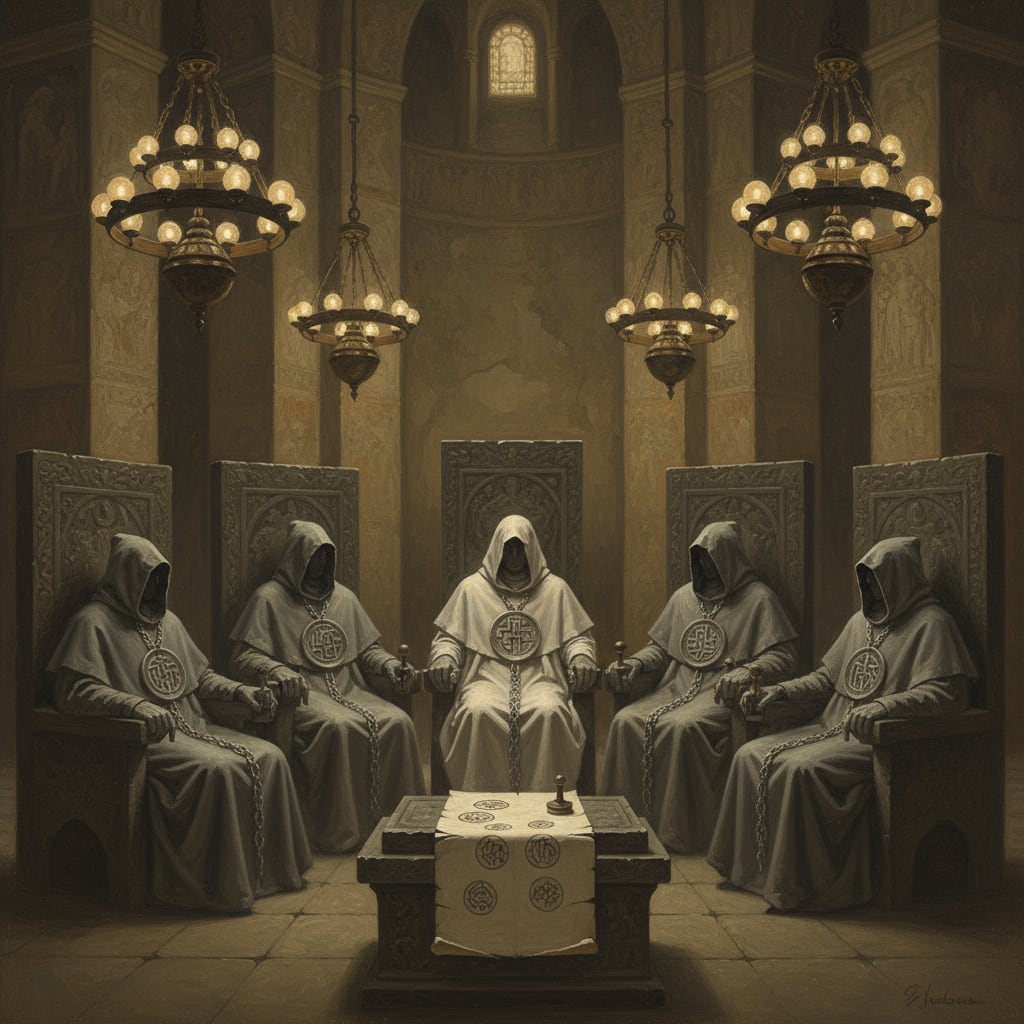
The Bureaucratic Synod governs through contradiction, and the contradictions are numbered. Seven of them, to be precise — seven domains of absolute authority, each assigned to one Hierarch, each overlapping with every other, each wielding a sovereignty that would be tyrannical if it were not checked at every turn by six rival sovereignties equally absolute. The Bureau of Doctrine calls this arrangement the Seven Seals of Faith. Kratz, who helped design it, called it something else, but Kratz's private correspondence was burned in the sub-vaults of the Basilica of the Ledgered Saints on the orders of a committee that no longer exists, and so we shall use the Bureau's language, which is the only language that survives.
The Seals were established at the Concordat of Strasbourg in A.S. 90, ratified by the Council of Mainz in A.S. 93, and have governed the Synod without interruption since — if one defines "without interruption" as the Bureau defines it, which is to say generously, retroactively, and with charitable silence regarding the periods when two or more Hierarchs claimed the same Seal simultaneously and the matter was resolved by means the Bureau classifies as "administrative."
#The Seal of Doctrine
"First among equals, which is to say: first."
The Seal of Doctrine defines truth. This is its mandate, and its mandate is absolute. When the Hierarch of Doctrine declares that a proposition is orthodox, it becomes orthodox — retroactively, comprehensively, and in all dialects including those that have been forbidden. When the same Hierarch declares the same proposition heretical the following Tuesday, the proposition becomes heretical, and the Bureau of Records amends every document that referenced it, and the Bureau of Purity begins compiling a list of everyone who believed it during the intervening days. The list is seldom acted upon. Its existence is sufficient.
The holder of this Seal commands the Bureau of Doctrine, the Tower of the Quill, and by extension every instrument of official speech: the authorised catechisms, the licensed sermons, the approved hymns, the sanctioned prayers. The Hierarch of Doctrine interprets scripture; he authors reality. The stones of Strasbourg are said to listen when he speaks. Whether the stones agree is a question no one has authorised the stones to answer.
#The Seal of War
The Seal of War commands the armies of the Sagittal Line, the Continental Levy, the Bureau of War and its considerable private arsenal, and the garrison commanders of every bastion from Königsberg to Constantinople. In theory, this Seal is the Synod's fist — the instrument by which the Hierarchs' pronouncements acquire the weight of artillery. In practice, the Seal of War has been empty since A.S. 107.
The chair stands in the Inner Circle, draped in white cloth that no one launders and no one removes. The Bureau of Records lists the Hierarch of War as "presently engaged in contemplative duties," which is the Bureau's way of saying that a century has passed and no one has sat in the chair and no one has been authorised to explain why. The generals of the Bureau of War receive their orders through intermediaries — sealed writs bearing a signature that changes each quarter and a file number that the Bureau of Shadows rotates with the moon. Whether the absent Hierarch is dead, imprisoned, contemplating, or simply misplaced is a question the Bureau has elevated from mystery to doctrine. The empty chair is the Seal's most eloquent occupant.
A prior edition of this entry listed the Seal of War as "vacant since A.S. 107."
The Bureau of Doctrine has corrected this. The Seal is not vacant. The Seal is occupied in absentia. The distinction is theological, jurisdictional, and — according to the Bureau of Records — load-bearing, in that the entire chain of military command depends upon the legal fiction that someone holds the Seal and has authorised the orders that the generals are already executing. The Bureau appreciates the reader's cooperation in maintaining this fiction.
#The Seal of Purity
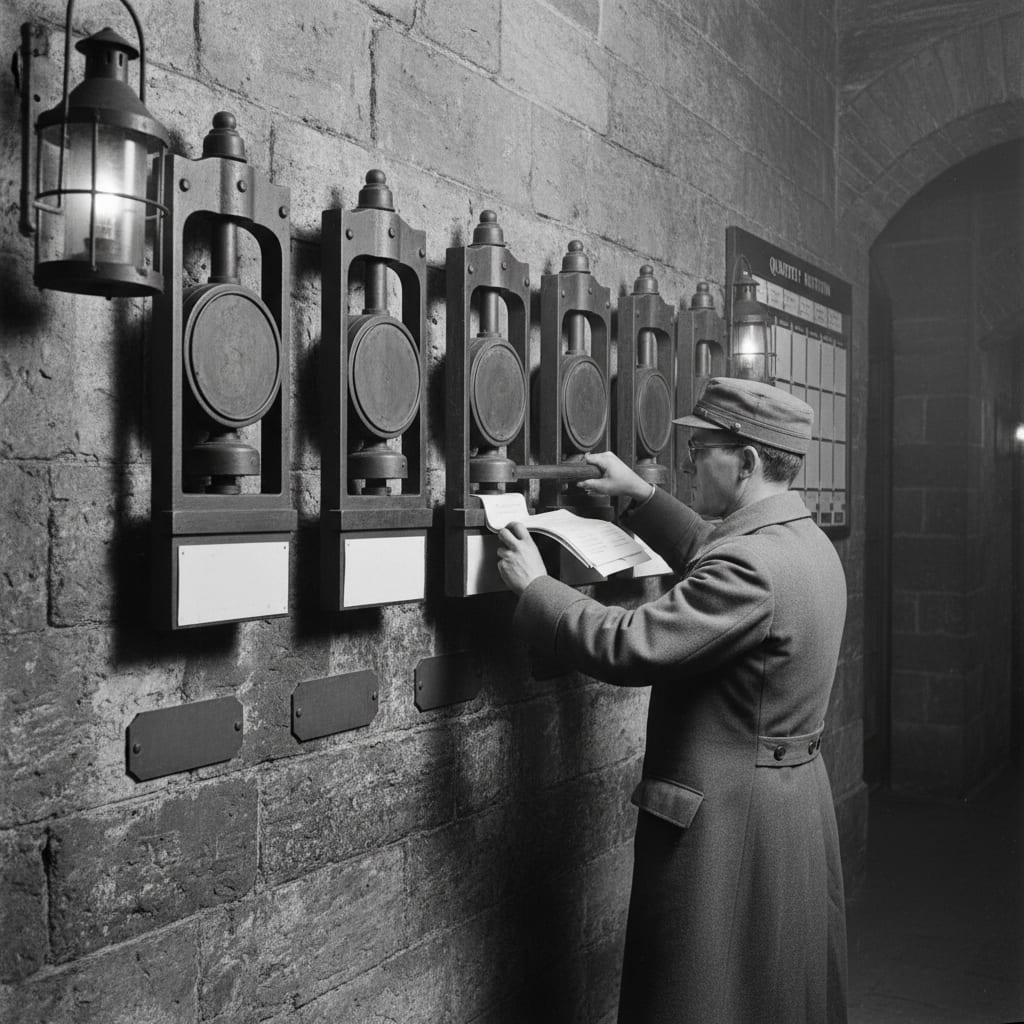
The Seal of Purity governs the Inquisition, the Index Damnatus, the licensing of permitted language under the Triune Alphabet, and the correction of the insufficiently devout. Its holder is the most feared of the Hierarchs — feared by the faithful, feared by the heretical, feared by the other six Hierarchs, who understand that the Seal of Purity's jurisdiction extends to them precisely as far as the Seal of Purity wishes to extend it, and the only check on that wish is the Seal of Doctrine's capacity to declare the extension heretical before the Seal of Purity declares the objection impure.
The White-Mantled Inquisitors answer to this Seal. The Fume-Inspectors answer to this Seal. The lexical patrols, the breath auditors, the confessional monitors — all of them instruments of a Seal whose mandate is cleanliness and whose definition of cleanliness has never been published, on the grounds that publishing it would contaminate it.
#The Seal of Discipline
The Seal of Discipline governs the internal conduct of clergy, which is to say it governs scandal, concealment, and the orderly disposal of inconvenient confessions. If Purity watches the laity and Doctrine defines the faith, Discipline watches the faithful who define and watch — the clergy themselves, from the lowest parish Street-Vicar to the Archons of the provincial tribunals. Its jurisdiction is the priesthood's own body, and its instrument is the Canonical Audit: an investigation conducted in sealed chambers by men whose names are withheld even from the Bureau of Records, whose findings are delivered in wax-sealed pouches that self-destruct upon opening (the Bureau of Engineering designed the mechanism; the Bureau of Engineering does not discuss the mechanism).
The Third Hierarch of the Seal of Discipline is the succession's first great absence. His file was destroyed — by moths, the Bureau of Records insists, in the sub-vaults during the damp winter of A.S. 112. His portrait in the Hall of Succession shows a frame, a nameplate, and a canvas painted over in ecclesiastical black. Three investigators were assigned to the matter. All three were subsequently reassigned to duties the Bureau describes as "contemplative." The moths have not been questioned. The Seal of Discipline understands, better than any other, that some silences are structural.
#The Seal of Concord
The Seal of Concord manages relations between the Synod's fractious provinces and its even more fractious neighbours — the British Crown, the Netherlands, and the Fractured North, each of whom cooperates exactly as much as self-interest demands and not a grain further. The Hierarch of Concord is the Synod's diplomat, which is to say the Synod's liar-in-chief, which is to say the only Hierarch whose function the Bureau of Doctrine does not attempt to regulate, because the Bureau understands that diplomacy requires a flexibility with truth that would constitute heresy if performed by anyone holding a lesser title.
The Seal of Concord also arbitrates disputes between the Twelve Holy Bureaus — a task so perpetual and so futile that the Bureau of Records has assigned it a permanent file number and a dedicated vault. The vault is the second-largest in the Basilica. It grows by approximately four hundred pages per month. No one reads it. Its existence is the point.
#The Seal of Martyrdom
The Seal of Martyrdom catalogues the dead, canonises the useful, and determines which corpses glow with sufficient sanctity to justify the expense of a reliquary. Its holder commands the Bureau of Relics, oversees the authentication process (which the Relic Authenticators execute with varying degrees of credulity), and maintains the Calendar of Saints — a document so frequently revised that the Bureau of Records has stopped printing annual editions and now distributes monthly amendment strips instead.
The Seal of Martyrdom is the quietest of the Seven. Its holder rarely speaks in session. He signs documents, attends to bones, and ensures that the dead continue to serve the Synod with an efficiency that the living cannot match. The dead, after all, do not file grievances, do not request transfer, and do not object when their relics are reassigned to a bastion whose morale requires a femur more than its current allocation permits.
#The Seal of Vigilance
The Seal of Vigilance watches. What it watches, whom it reports to, and whether it sleeps are questions the Bureau of Doctrine classifies as "ongoing." Its relationship to the Bureau of Shadows has never been formally acknowledged — the Bureau of Shadows' existence has never been formally acknowledged — and yet the Seal of Vigilance and the Bureau of Shadows share a corridor in the sub-levels of the Basilica, and the corridor has a single door, and the door has no handle on the outside.
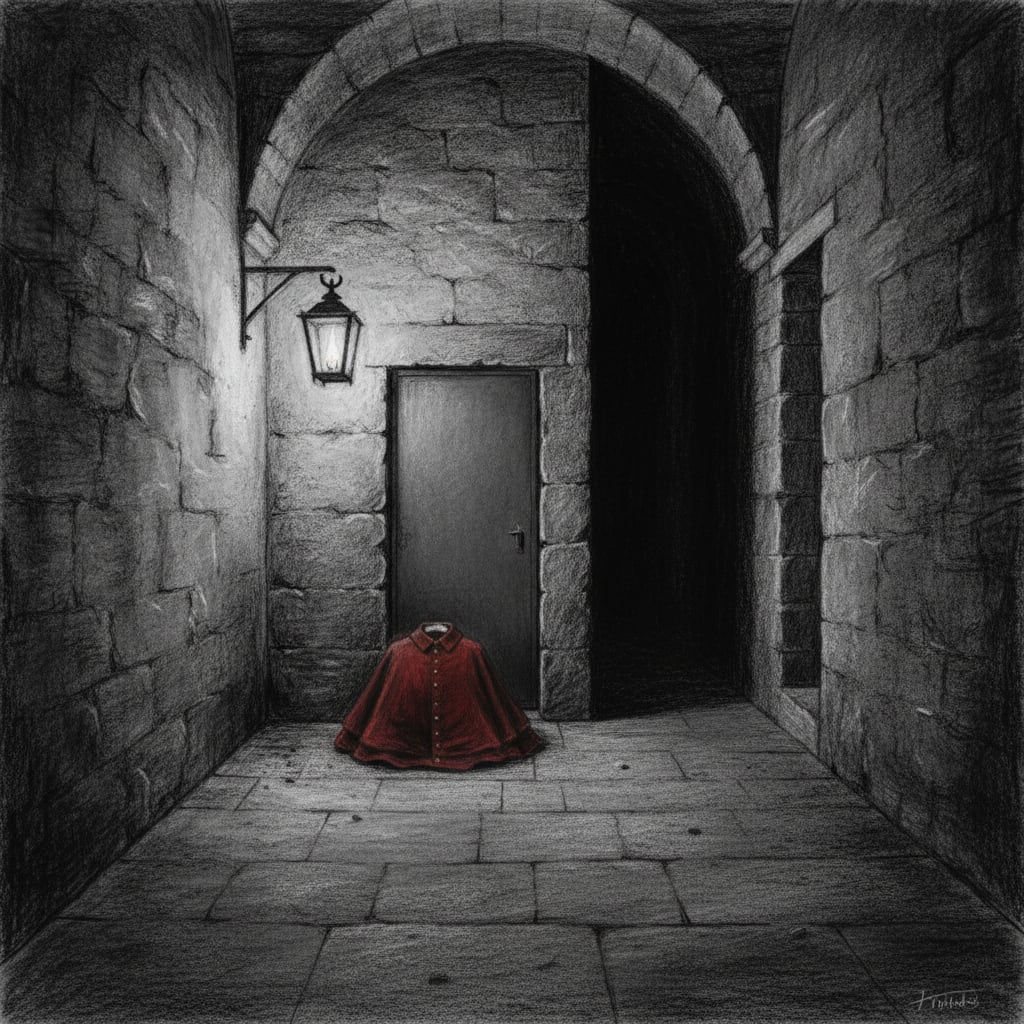
The Twenty-Second Hierarch of the Seal of Vigilance vanished from his chambers in A.S. 172, leaving behind a warm cassock, an untouched supper, and a single page of correspondence addressed to no one. The Bureau of Records classified the vanishing as "voluntary contemplative withdrawal." The Bureau of Shadows did not comment. The empty chamber was sealed for nine months. When it was reopened, the supper had been eaten.
The relationship between the Seal of Vigilance and the rumoured Council of Veils — if such a body exists, if it has ever convened, if its minutes are truly written in ash on censers that burn before the ink sets — is a matter I have been instructed to leave blank. I leave it blank. The blankness is informative.
#On the Architecture of Contradiction
"Seven pillars. Seven cracks. The building stands because the cracks push against each other."
The genius of the Seven Seals — and I use the word "genius" advisedly, for it is Kratz's genius and Kratz does not deserve the compliment — is that no single Seal can act without the others noticing, objecting, or filing a countersuit. Doctrine defines truth; Purity enforces it; Discipline punishes those who enforce it incorrectly; Concord apologises to the neighbours; War deploys regardless; Martyrdom buries the results; and Vigilance records everything in a ledger that no one is permitted to read.
The jurisdictions overlap by design. Augustinus wanted unity. Kratz wanted control. Together they produced a system in which unity is maintained by the impossibility of anyone accumulating enough uncontested power to shatter it. Every Bureau reports to a Seal; every Seal is checked by six others; every decree requires seven stamps, one for each Seal, and the stamps are applied in an order that changes quarterly, so that no Seal can claim precedence by virtue of stamping first. The bureaucratic friction is the load-bearing structure. Remove any Seal and the others would fly apart.
This is the Synod's governing principle, stated plainly: seven absolute authorities, each cancelling the others, producing a governance that is paralysed in every direction except forward, because forward is the only direction that does not require consensus — forward being defined as "toward the Sagittal Line, where the Enemy waits, and where the question of which Bureau has jurisdiction is answered by artillery."
An earlier edition attributed the design of the Seven Seals to Hierarch Augustinus alone.
The Bureau of Records has amended this. The structural overlap — the deliberate jurisdictional conflict that prevents any single Seal from achieving supremacy — bears the unmistakable fingerprints of Cardinal Hieronymus Kratz, whose contribution to the Concordat the Bureau of Doctrine continues to describe as "advisory." Kratz's advice, as always, proved binding.
Seven Seals. Seven chairs. Six occupied, one classified by a file number that rotates, one draped in cloth. The symmetry with the Seven Sin-Generals is noted. The coincidence is not discussed. I have attempted to discuss it. I was redirected to a pamphlet on bell maintenance. The pamphlet was four hundred pages long. I suspect this was the answer.